Quick Answer
The most common way to say 'nice to meet you' in Japanese is 'Hajimemashite' (はじめまして, hah-jee-meh-mah-shteh), meaning 'for the first time.' It is always followed by a self-introduction and 'Yoroshiku onegaishimasu' (よろしくお願いします), an untranslatable phrase that roughly means 'please treat me favorably.'
The Short Answer
The most common way to say "nice to meet you" in Japanese is Hajimemashite (はじめまして, hah-jee-meh-mah-shteh). But unlike English, where "nice to meet you" is a standalone phrase, Japanese wraps the entire first meeting into a ritualized self-introduction sequence that communicates humility, respect, and social awareness.
Japanese is spoken by approximately 125 million people, and according to the Japan Foundation's 2021 survey, over 3.8 million people are actively studying the language worldwide. Among all the phrases learners encounter, the first-meeting introduction may be the single most culturally loaded. Getting it right signals that you understand Japanese social norms. Getting it wrong (or skipping parts of it) can create an awkward impression that lingers. Whether you're looking up "nice to meet you in japanese" for travel, study, or conversation, this guide covers everything you need.
"In Japanese, the greeting upon first meeting is not simply a pleasantry. It is a performative act that establishes the social framework for the entire future relationship between speakers."
(Anna Wierzbicka, Cross-Cultural Pragmatics, Mouton de Gruyter, 2003)
This guide covers 15+ essential phrases for meeting someone new in Japanese, organized by formality level: the standard introduction ritual, casual alternatives, ultra-formal keigo variations, business-specific expressions, and proper bowing and business card etiquette.

Quick Reference: Japanese First-Meeting Phrases at a Glance
| English | Japanese | Pronunciation | Formality |
|---|---|---|---|
| Nice to meet you | はじめまして (Hajimemashite) | hah-jee-meh-mah-shteh | polite |
| Please treat me favorably | よろしくお願いします (Yoroshiku onegaishimasu) | yoh-roh-shee-koo oh-neh-gah-ee-shee-mahs | formal |
| Please treat me favorably (humble) | よろしくお願いいたします (Yoroshiku onegai itashimasu) | yoh-roh-shee-koo oh-neh-gah-ee ee-tah-shee-mahs | very formal |
| Nice to meet you (casual) | よろしく (Yoroshiku) | yoh-roh-shee-koo | casual |
| Nice to meet you too | こちらこそ (Kochira koso) | koh-chee-rah koh-soh | polite |
| I am [Name] | [名前]です ([Name] desu) | [name] dehs | polite |
| My name is [Name] (humble) | [名前]と申します ([Name] to moushimasu) | [name] toh moh-shee-mahs | very formal |
| I'm from [Company] | [会社]の[名前]です | [company] noh [name] dehs | formal |
| I've heard a lot about you | お噂はかねがね (O-uwasa wa kanegane) | oh-oo-wah-sah wah kah-neh-gah-neh | formal |
| Thank you for your time today | 本日はお時間をいただきありがとうございます | hohn-jee-tsoo wah oh-jee-kahn woh ee-tah-dah-kee ah-ree-gah-toh goh-zah-ee-mahs | very formal |
| Let's get along (casual) | よろしくね (Yoroshiku ne) | yoh-roh-shee-koo neh | casual |
| Here is my card | 名刺をどうぞ (Meishi wo douzo) | meh-shee woh doh-zoh | formal |
The Full Introduction Ritual
Japanese first-meeting introductions follow a specific formula. Skipping any step feels incomplete to a Japanese listener, much like a handshake that is pulled away too early. The Agency for Cultural Affairs' 2023 survey found that 91% of Japanese adults consider proper self-introduction etiquette important in both professional and social settings.
はじめまして
/hah-jee-meh-mah-shteh/
Literal meaning: For the first time / It is the beginning
“はじめまして。田中花子と申します。”
How do you do. My name is Hanako Tanaka.
Always the opening line when meeting someone new. Derived from 'hajimeru' (to begin), it acknowledges the newness and significance of the meeting itself.
Hajimemashite sets the entire tone. It comes from the verb hajimeru (始める, to begin), and it literally acknowledges that this meeting is happening "for the first time." This is more than a pleasantry; it is a formal declaration that you recognize the significance of meeting this person.
One critical rule: never use hajimemashite with someone you have already met. Even if you barely remember them, using it implies you have forgotten the previous encounter entirely, which is considered quite rude.
[名前]です
/[name] dehs/
Literal meaning: I am [Name]
“山田太郎です。東京から来ました。”
I am Taro Yamada. I'm from Tokyo.
The standard way to state your name. In Japanese, family name comes first: 'Yamada Taro,' not 'Taro Yamada.' In international settings, some Japanese speakers reverse the order for foreigners.
After hajimemashite, you state your name. In Japanese, the family name comes first: Yamada Taro, not Taro Yamada. The particle desu functions as a polite copula ("to be"). For extra formality, replace desu with to moushimasu (と申します), the humble form of "to be called."
💡 Self-Introduction Culture (自己紹介)
Japanese self-introductions (自己紹介, jikoshoukai) follow a cultural template: name, then affiliation (company, school, hometown), then one personal detail (hobby, skill, or interest). This structure applies everywhere from business meetings to university club orientations. Preparing a polished jikoshoukai is considered basic social competence in Japan.
よろしくお願いします
/yoh-roh-shee-koo oh-neh-gah-ee-shee-mahs/
Literal meaning: I humbly request your favorable regard
“はじめまして、佐藤です。よろしくお願いします。”
Nice to meet you, I'm Sato. Please treat me favorably.
The essential closing line of every Japanese introduction. It expresses humility and a request for goodwill. There is no English equivalent, translations like 'nice to meet you' or 'please take care of me' only capture a fraction of its meaning.
This is the phrase that has no English equivalent. Linguist Anna Wierzbicka has described it as one of the most culturally specific expressions in any language. Yoroshiku comes from yoroshii (good, favorable), and onegaishimasu means "I humbly request." Together, the phrase communicates: "I am placing myself in your care, and I trust you will treat me well."
The complete introduction ritual, spoken as one sequence, sounds like this: Hajimemashite. [Name] desu. Yoroshiku onegaishimasu. (How do you do. I am [Name]. Please treat me favorably.) Accompanied by a bow, this is the single most important social formula in Japanese.
Keigo Variations: Adjusting Formality
Japanese politeness operates on a spectrum. The Agency for Cultural Affairs classifies keigo (敬語, honorific language) into three levels: sonkeigo (respectful), kenjougo (humble), and teineigo (polite). First-meeting phrases shift accordingly.
よろしくお願いいたします
/yoh-roh-shee-koo oh-neh-gah-ee ee-tah-shee-mahs/
Literal meaning: I most humbly request your favorable regard
“はじめまして。山田と申します。どうぞよろしくお願いいたします。”
How do you do. My name is Yamada. I most humbly request your favorable regard.
The most formal version, using 'itashimasu' (humble form of 'shimasu'). Reserved for meeting executives, important clients, or in ceremonial situations. Common in business Japanese.
By replacing shimasu with its humble form itashimasu, you elevate the formality one level higher. This is the version you would use when meeting a company president, an important client, or anyone where maximum deference is appropriate. According to Sachiko Ide's research on Japanese politeness, choosing the correct formality level is not optional but "a matter of discernment," and speakers are expected to automatically select the right register.
[名前]と申します
/[name] toh moh-shee-mahs/
Literal meaning: I am called [Name] (humble)
“はじめまして。株式会社ソニーの田中と申します。”
How do you do. I am Tanaka from Sony Corporation.
The humble form of stating your name. 'Moushimasu' is the humble equivalent of 'iimasu' (to say). Use this in business introductions or any formal first meeting.
Moushimasu is the humble form of iimasu (to say/to be called). Using it lowers yourself relative to the listener, which is the core mechanism of kenjougo (humble speech). In business settings, this is the expected form, and using the plain desu form with a client could signal carelessness.
Casual Alternatives
Among friends, classmates, and peers of similar age, the full introduction ritual is often shortened dramatically.
よろしく
/yoh-roh-shee-koo/
Literal meaning: Favorably / Well
“おれ、健太。よろしく!”
I'm Kenta. Nice to meet you!
The stripped-down casual version. Drops 'onegaishimasu' entirely. Used among young people, at parties, in relaxed social settings. Would sound rude in any formal context.
Drop the onegaishimasu and you get the casual version that young Japanese speakers use when meeting peers. You might hear this at a university welcome party, a casual group gathering, or when being introduced through mutual friends. It keeps the spirit of the phrase while shedding the formality.
よろしくね
/yoh-roh-shee-koo neh/
Literal meaning: Favorably, okay?
“私、美咲。よろしくね!”
I'm Misaki. Nice to meet you!
Adding 'ne' (a softening particle) makes it warmer and slightly more feminine in tone. Common among women and younger speakers. The 'ne' invites agreement, turning the statement into a shared moment.
The particle ne adds warmth and a sense of shared feeling. It turns yoroshiku from a statement into something closer to "let's get along, okay?" This form is common among female speakers and in mixed casual groups.
どうぞよろしく
/doh-zoh yoh-roh-shee-koo/
Literal meaning: By all means, please treat me favorably
“はじめまして、鈴木です。どうぞよろしく。”
Nice to meet you, I'm Suzuki. Pleased to meet you.
A middle ground between casual 'yoroshiku' and formal 'yoroshiku onegaishimasu.' The 'douzo' (please, by all means) adds politeness without the full formal weight. Works well in semi-formal social settings.
Douzo means "please" or "by all means," and adding it creates a polite-but-not-stiff middle ground. This works well at dinner parties, community events, or when meeting a friend's parents, situations that call for manners but not full business keigo.
Business and Professional Phrases
Japanese business introductions layer additional phrases on top of the standard formula. The Japan Foundation identifies proper business introductions as one of the top five skills needed for working in Japan.
お噂はかねがね
/oh-oo-wah-sah wah kah-neh-gah-neh/
Literal meaning: Your reputation, for some time now
“お噂はかねがね伺っております。お会いできて光栄です。”
I've heard a lot about you. It's an honor to meet you.
A flattering phrase used when meeting someone whose reputation precedes them. Common in business and formal social situations. Always a compliment, it implies the person is well-regarded.
This phrase signals that you already know of the person by reputation. It is a powerful compliment in business contexts, implying that the person is well-known and respected. Pair it with oai dekite kouei desu (お会いできて光栄です, "It is an honor to meet you") for maximum impact.
名刺をどうぞ
/meh-shee woh doh-zoh/
Literal meaning: Please accept my business card
“はじめまして。名刺をどうぞ。株式会社トヨタの山本です。”
How do you do. Here is my card. I am Yamamoto from Toyota Corporation.
Business card (名刺/meishi) exchange is a sacred ritual in Japanese business culture. Present with both hands, text facing the recipient. Receive with both hands, read carefully, and never write on it or put it in your back pocket.
The business card exchange (meishi koukan, 名刺交換) is one of the most ritualized aspects of Japanese professional life. The card is treated as an extension of the person themselves.
🌍 Business Card Exchange Protocol
- Present your card with both hands, text facing the recipient so they can read it immediately.
- Receive their card with both hands, holding it by the edges.
- Read the card carefully. Glancing at it and putting it away is insulting.
- During the meeting, place received cards on the table in front of you, arranged by seating position.
- Never write on someone's card, fold it, or place it in your back pocket (sitting on someone's card is deeply disrespectful).
- After the meeting, store the card carefully in a card case, never loose in a bag.
Responding When Someone Introduces Themselves
Knowing how to respond is equally important. Japanese responses to introductions follow clear patterns.
こちらこそ
/koh-chee-rah koh-soh/
Literal meaning: It is I / This side, rather
“こちらこそ、よろしくお願いします。”
Likewise, please treat me favorably.
The standard response to 'Yoroshiku onegaishimasu.' It redirects the sentiment back: 'No, it is I who should be saying that.' Almost always paired with echoing 'Yoroshiku onegaishimasu' afterward.
Kochira koso is the reflexive "likewise" or "no, it is I who should say that." When someone finishes their introduction with yoroshiku onegaishimasu, the natural response is kochira koso, yoroshiku onegaishimasu, meaning "Likewise, please treat me favorably."
Response Patterns
| They Say | You Say | Notes |
|---|---|---|
| はじめまして (Hajimemashite) | はじめまして (Hajimemashite) + your introduction | Echo, then introduce yourself |
| よろしくお願いします | こちらこそ、よろしくお願いします | "Likewise" + echo |
| よろしく (casual) | こちらこそ / よろしく! | Echo casually |
| お噂はかねがね | ありがとうございます。恐縮です。 | "Thank you. I'm flattered." |
| 名刺をどうぞ | ちょうだいいたします (Choudai itashimasu) | "I humbly receive it" |
Bowing Etiquette for First Meetings
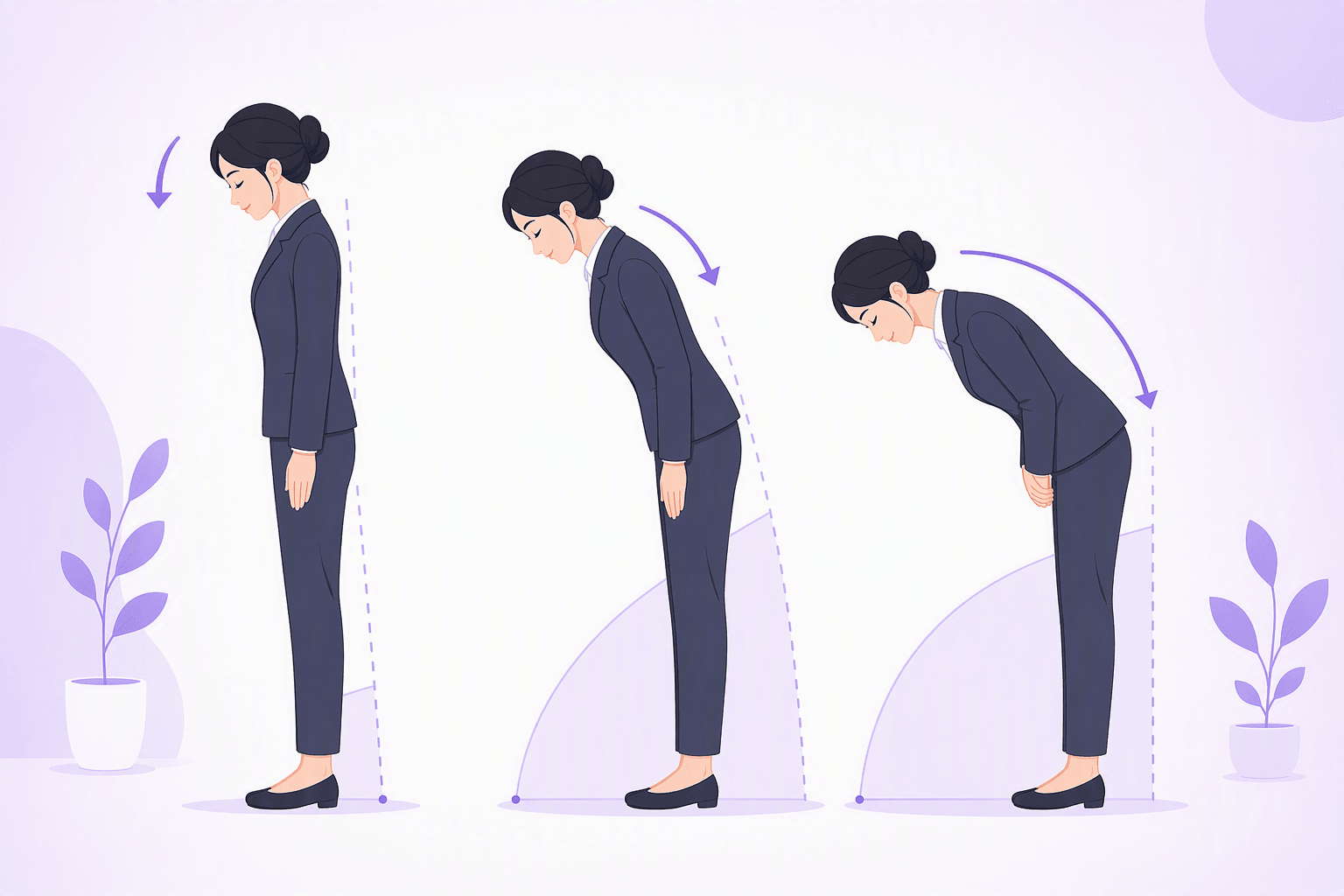
Bowing (ojigi, お辞儀) is inseparable from Japanese introductions. The depth and duration of your bow communicates respect, humility, and social awareness as clearly as your words.
| Bow Type | Angle | When to Use |
|---|---|---|
| 会釈 (Eshaku) | ~15° | Casual meetings, passing acquaintances |
| 敬礼 (Keirei) | ~30° | Standard business introductions |
| 最敬礼 (Saikeirei) | ~45° | Meeting executives, very formal occasions |
⚠️ Common Bowing Mistakes
Avoid the "bobbing bow," which means quickly nodding your head up and down multiple times. A proper bow is a single, smooth motion: bend forward, hold briefly (1-2 seconds for business, longer for formal), then rise smoothly. Keep your back straight and bend from the waist. Hands go to your sides (men) or clasped in front (women).
According to Ethnologue's 2024 data, Japanese remains one of the most context-dependent languages in the world, and physical gestures like bowing carry linguistic weight. In first meetings, your bow and your words should match in formality. A deep bow with casual yoroshiku or a head nod with yoroshiku onegai itashimasu would both feel incongruent.
Regional and Situational Variations
While the introduction ritual is remarkably consistent across Japan, some regional and situational differences exist.
おおきに、よろしゅう
/oh-kee-nee, yoh-roh-shoo/
Literal meaning: Thank you, please treat me well (Kansai dialect)
“おおきに、よろしゅうたのんます。”
Thank you, pleased to meet you. (Kansai)
The Kansai region (Osaka, Kyoto, Kobe) has its own dialect. 'Ookini' replaces 'arigatou' and 'yoroshuu' is the Kansai form of 'yoroshiku.' Hearing this marks the speaker as from western Japan.
The Kansai dialect (関西弁, Kansai-ben) spoken in Osaka, Kyoto, and surrounding areas transforms standard introductions. Ookini replaces the standard arigatou, and yoroshuu is the dialectal form of yoroshiku. While everyone in Kansai understands standard Japanese, locals often use dialect forms to express warmth and regional identity.
お見知りおきください
/oh-mee-shee-ree oh-kee koo-dah-sah-ee/
Literal meaning: Please remember me / Please take note of me
“はじめまして。今後ともお見知りおきくださいますよう、お願い申し上げます。”
How do you do. I humbly request that you remember me going forward.
An extremely formal phrase used in ceremonial introductions, formal speeches, or when meeting someone of very high status. Rarely used in daily conversation but important to recognize.
This phrase belongs to the highest register of keigo and is used in ceremonial contexts: formal speeches, introductions at award ceremonies, or when meeting someone of significantly higher social standing. You are unlikely to use it in daily life, but recognizing it marks you as having deep knowledge of Japanese formality.
Practice With Real Japanese Content
Reading about introduction phrases gives you the knowledge, but hearing them spoken in context, with the right intonation, timing, and accompanying body language, is what makes them natural. Japanese dramas and films are filled with introduction scenes that demonstrate every formality level, from casual university club meetings to tense boardroom introductions.
Wordy lets you watch Japanese movies and shows with interactive subtitles. Tap on hajimemashite or yoroshiku onegaishimasu in any scene to see the formality level, literal meaning, and cultural context explained in real time. Instead of memorizing phrases from a list, you absorb the full ritual from authentic conversations.
For more Japanese content, explore our blog for language guides including the best movies to learn Japanese. You can also visit our Japanese learning page to start practicing with real content today.
Frequently Asked Questions
What does 'Hajimemashite' literally mean?
What is the full Japanese self-introduction formula?
What does 'Yoroshiku onegaishimasu' actually mean?
How deep should I bow when meeting someone in Japan?
What are the rules for business card exchange in Japan?
Sources & References
- Agency for Cultural Affairs (文化庁), National Language Survey on Keigo Usage (2023)
- The Japan Foundation (国際交流基金), Survey of Japanese-Language Education Abroad (2021)
- Ethnologue: Languages of the World, Japanese language entry (2024)
- Wierzbicka, A. (2003). 'Cross-Cultural Pragmatics: The Semantics of Human Interaction.' Mouton de Gruyter.
- Ide, S. (1989). 'Formal forms and discernment: Two neglected aspects of universals of linguistic politeness.' Multilingua 8(2-3).
Start learning with Wordy
Watch real movie clips and build your vocabulary as you go. Free to download.


