Quick Answer
The most essential German slang word is 'Krass' (KRAHS), it works as 'crazy,' 'intense,' 'amazing,' or 'wow' depending on context. German slang draws heavily from English loanwords (Denglisch), regional dialects, and youth culture, with the Gesellschaft für deutsche Sprache voting on a 'Jugendwort des Jahres' (Youth Word of the Year) every year.
The Short Answer
The most essential German slang word is Krass (KRAHS). It functions as "crazy," "intense," "amazing," or "wow" depending on tone and context. If you learn only one German slang expression, make it this one. It covers virtually every emotional reaction.
German is spoken by approximately 132 million people worldwide across Germany, Austria, Switzerland, Liechtenstein, Luxembourg, and parts of Belgium and Italy, according to Ethnologue's 2024 data. With that reach comes a rich and rapidly evolving slang landscape shaped by regional dialects, English loanwords, and an annual national vote on the coolest new youth word.
"Slang operates as an in-group language marker. It signals social belonging, generational identity, and cultural awareness far more efficiently than formal vocabulary ever could."
(Connie Eble, Slang and Sociability, University of North Carolina Press)
This guide covers 20+ essential German slang words organized by category: everyday reactions, youth slang (Jugendsprache), Denglisch expressions, regional variations, and casual phrases. Each entry includes pronunciation, usage context, and cultural notes so you can actually use these naturally.
Quick Reference: German Slang at a Glance
| English | German | Pronunciation | Formality |
|---|---|---|---|
| Crazy / Intense / Wow | Krass | KRAHS | slang |
| Dude! (exclamation) | Alter! | AHL-tuh | slang |
| Bro / Dude | Digga | DIH-gah | slang |
| Cool / Great | Geil | GUYL | slang |
| To feel like (doing sth) | Bock haben | bohk HAH-ben | casual |
| No way! | Echt jetzt? | ehkht YETST | casual |
| Cringe | Cringe | KRINJ | slang |
| Suspicious / Shady | Sus | ZAHS | slang |
| Clueless / Lost | Lost | LOST | slang |
| To chill / Hang out | Chillen | TSHIL-en | slang |
| Nonsense / Rubbish | Quatsch | KVAHTSH | casual |
| Awesome (Berlin) | Knorke | KNOR-keh | slang |
| Great (Austrian) | Leiwand | LY-vahnd | slang |
| Dude (Austrian) | Oida | OY-dah | slang |
| Exactly / Innit | Ey voll! | ay FOHL | slang |
| Smash (hook up) | Smashen | SMEH-shen | slang |
| Vibe / Aura | Aura | OW-rah | slang |
| Cozy / Comfy | Gemütlich | geh-MÜÜT-likh | casual |
| Whatever / I don't care | Ist mir egal | ist meer eh-GAHL | casual |
| This sucks | Das nervt | dahs NEHRFT | casual |
Everyday Reactions
These slang expressions are the workhorses of casual German conversation. You will hear them dozens of times a day in any German-speaking city, from teenagers in Berlin to coworkers in Vienna.
Krass
/KRAHS/
Literal meaning: Crass / Stark (originally)
“Krass, hast du das gesehen? Der Typ ist vom Dach gesprungen!”
Wow, did you see that? The guy jumped off the roof!
The Swiss Army knife of German reactions. Works for positive surprise (Krass, wie schön!), negative shock (Krass, wie schlimm), and everything in between. Tone determines meaning.
Krass migrated from academic Latin (crassus = thick, coarse) into German student slang in the 1990s and has never left. According to the Duden dictionary, it now officially carries the informal meaning of "extraordinary" or "extreme." Its genius lies in its ambiguity: a single Krass! works whether your friend just got promoted or just crashed their car.
Alter!
/AHL-tuh/
Literal meaning: Old man / Old one
“Alter, das war so peinlich. Ich will da nie wieder hin.”
Dude, that was so embarrassing. I never want to go back there.
Germany's equivalent of 'dude!' Used as a standalone exclamation or to address friends. Originally meant 'old man' but completely lost that meaning in slang. Works for any gender despite the masculine form.
What happened to Alter is remarkable. A word meaning "old man" became Germany's most versatile exclamation, something between "dude," "man," and "oh my God." You can express disbelief (Alter, echt jetzt?), frustration (Alter, komm schon!), or excitement (Alter, geil!) all with the same word. In Austria, the equivalent is Oida (covered below), which has its own cult following.
Geil
/GUYL/
Literal meaning: Horny (original meaning)
“Das Konzert war so geil! Die Band hat drei Zugaben gespielt.”
The concert was so awesome! The band played three encores.
Originally meant 'horny/lustful' and still can in certain contexts. But in everyday slang, 'geil' simply means 'cool' or 'awesome.' Older Germans may still find it vulgar, but for anyone under 50, it is completely normalized.
The semantic journey of geil is one of the most fascinating in German slang. The Duden traces it from Middle High German geil (powerful, exuberant) to its sexual meaning, and then back to a general positive exclamation starting in the 1980s. The phrase geiles Essen (awesome food) would make your grandmother blush but is perfectly normal among younger speakers. The advertising slogan Geiz ist geil (Stinginess is awesome) by electronics chain Saturn cemented its mainstream acceptance.
⚠️ Context Matters with 'Geil'
Among people over 60, geil still primarily carries its sexual meaning. In formal settings or with older conversation partners, use toll (great) or super instead. Among peers and in casual conversation, geil is completely standard.
Quatsch
/KVAHTSH/
Literal meaning: Squish / Mush (onomatopoeia)
“Ach Quatsch, das stimmt doch gar nicht!”
Oh nonsense, that's not true at all!
Used across all ages and regions. Less vulgar than English 'bullshit', closer to 'nonsense' or 'rubbish.' Also works as a verb: 'quatschen' means to chat or gab.
Quatsch is one of those rare slang words that even your German teacher would use. It is onomatopoeic (the sound mimics something soft being squished) and it carries none of the vulgarity of its English equivalents. The verb form quatschen (to chat, to gab) is equally common: Wir haben stundenlang gequatscht (We chatted for hours).
Jugendsprache: Youth Slang
Every year, the Gesellschaft für deutsche Sprache (GfdS) and Langenscheidt publishers hold a public vote for the Jugendwort des Jahres (Youth Word of the Year). Recent winners reveal just how much English has infiltrated German youth culture. This section covers the words that define modern Jugendsprache.
Cringe
/KRINJ/
Literal meaning: Cringe (English loanword)
“Der hat auf TikTok ein Liebesgedicht vorgelesen. So cringe.”
He read a love poem on TikTok. So cringe.
Won 'Jugendwort des Jahres' in 2021. Used identically to the English word but fully integrated into German grammar: 'Das ist cringy,' 'Ich hab mich gecringed.' One of the most successful Denglisch imports.
When cringe won the 2021 Youth Word of the Year, some German language purists were dismayed. An entirely English word winning a German language award? But that is precisely the point. The GfdS noted that no existing German word (peinlich, fremdschämen) captured the exact social-media-era flavor of cringe. German speakers have since fully conjugated it: cringy (adjective), gecringed (past participle), cringen (infinitive).
Sus
/ZAHS/
Literal meaning: Suspicious (English abbreviation)
“Der Typ hat mich dreimal angeschrieben. Voll sus.”
That guy messaged me three times. Totally sus.
Entered German through the video game 'Among Us' (2020-2021). Pronounced with a German 'S' (closer to 'zuhs') rather than the English 'suss.' Used by teens and young adults, mostly online or in text messages.
Sus is a textbook case of how gaming culture shapes language across borders. The word jumped from Among Us chat rooms into German TikTok, then into everyday teenage conversation. The Institut für Deutsche Sprache (IDS) in Mannheim tracks such neologisms and notes that gaming-origin slang tends to have shorter lifespans than music- or film-origin slang.
Smashen
/SMEH-shen/
Literal meaning: To smash (English loanword)
“Die zwei haben auf der Party gesmasht.”
Those two hooked up at the party.
'Smash' was the Jugendwort des Jahres 2022. In German youth slang, it specifically means to hook up with someone. Used with the German verb ending '-en' and conjugated normally: 'smashen, smashte, gesmasht.'
The germanization of smash shows how loanwords adapt. English smash (to break) became German smashen (to hook up), a completely different meaning. It follows standard German verb conjugation (ich smashe, du smashst, er/sie smasht), demonstrating how seamlessly English roots integrate into German grammar.
Aura
/OW-rah/
Literal meaning: Aura / Vibe / Energy
“Er hat einfach so eine krasse Aura. Alle schauen ihn an.”
He just has such an intense aura. Everyone looks at him.
Named Jugendwort des Jahres 2024. In youth slang, 'Aura' refers to someone's overall vibe or charisma, often used in a humorous point-scoring way: 'Plus 100 Aura' (cool move) or 'Minus 50 Aura' (embarrassing moment).
The Aura trend swept German TikTok in 2024, where users assign "Aura points" to everyday situations. Tripping in public? Minus 200 Aura. Catching something mid-air without looking? Plus 500 Aura. The word existed in German before, but its slang usage as a quantifiable social currency is entirely new.
Denglisch: German-English Hybrids
Denglisch (Deutsch + Englisch) describes the growing trend of mixing English into German conversation. The Gesellschaft für deutsche Sprache estimates that roughly 8% of modern German vocabulary is English-derived. For language learners, these hybrid expressions are both the easiest to learn and the most revealing about how German is evolving.
Chillen
/TSHIL-en/
Literal meaning: To chill (English loanword)
“Lass mal am Wochenende chillen. Ich hab keinen Bock auf Stress.”
Let's just chill this weekend. I don't feel like dealing with stress.
Fully conjugated German verb from English 'to chill.' Used since the early 2000s and now in the Duden dictionary. Past tense: 'gechillt.' Also works as an adjective: 'Der ist voll gechillt' (He's really chill).
Chillen is so established that the Duden officially added it in 2004. It follows all German verb conjugation rules: ich chille, du chillst, er chillt, wir haben gechillt. The adjective gechillt (chill, relaxed) is equally common. This is peak Denglisch: an English root wearing a full German grammar suit.
Lost
/LOST/
Literal meaning: Lost (English)
“Ich war in der Matheklausur komplett lost.”
I was completely lost in the math exam.
Jugendwort des Jahres 2020. In German slang, 'lost' means clueless, confused, or helpless, not physically lost. It filled a gap because 'verloren' (the German translation) doesn't carry the same casual, mildly humorous tone.
Lost won the 2020 Youth Word of the Year during the pandemic, when students found themselves lost in online learning. Unlike the English word, German lost is almost exclusively about mental or emotional confusion, not physical location. You would never say Ich bin lost while looking at a map, but you would absolutely say it when overwhelmed by a tax form.
"The adoption of English words into German youth slang is not linguistic decay; it is linguistic creativity. Each borrowed word fills a precise semantic gap that standard German does not cover."
(Gesellschaft für deutsche Sprache, Annual Language Trends Report, 2023)
🌍 Denglisch in the Workplace
Denglisch is not limited to youth slang. German corporate culture is full of it: Meeting, Deadline, Feedback, Brainstorming, Homeoffice (home office), Handy (mobile phone, a German coinage that English speakers find hilarious). If you work in a German company, you will encounter Denglisch daily.
Casual Everyday Phrases
These expressions are not flashy youth slang but essential building blocks of casual German conversation. Mastering them will make you sound natural rather than textbook-perfect.
Bock haben
/bohk HAH-ben/
Literal meaning: To have a billy goat
“Hast du Bock, heute Abend ins Kino zu gehen?”
Do you feel like going to the movies tonight?
One of the most useful casual German phrases. 'Bock' literally means 'billy goat' but in slang means 'desire' or 'motivation.' The negative 'Keinen Bock' (no desire) is even more common: 'Ich hab keinen Bock auf Arbeit' (I don't feel like working).
The etymology of Bock haben is debated. Some linguists connect it to Romani bokh (hunger), which entered German through Rotwelsch (historical thieves' cant). Others trace it to the energetic nature of a billy goat. Whatever the origin, Bock haben and especially keinen Bock haben are phrases you will hear and need every single day in Germany. For more essential casual expressions, check out our German learning page.
Echt jetzt?
/ehkht YETST/
Literal meaning: Real now? / Really now?
“Echt jetzt? Du hast den Job bekommen? Herzlichen Glückwunsch!”
No way! You got the job? Congratulations!
Works for both positive and negative surprise. The shortened 'Echt?' alone is even more casual. Similar to English 'Seriously?' or 'For real?' Used across all ages, not just youth slang.
Echt jetzt? bridges the gap between slang and standard German. Even your boss might say it. The standalone Echt? is one of the first words German learners pick up naturally because they hear it so frequently.
Das nervt
/dahs NEHRFT/
Literal meaning: That gets on one's nerves
“Mein Internet ist schon wieder ausgefallen. Das nervt so!”
My internet went down again. That's so annoying!
Standard casual expression for frustration. Can be personalized: 'Du nervst' (you're annoying), 'Das nervt mich total' (that totally annoys me). Widely understood and used across all German-speaking countries.
Nerven entered German from Latin (nervus) but the slang verb nerven (to annoy, to get on someone's nerves) is distinctly colloquial. It is milder than most complaints, safe enough for a workplace coffee break but casual enough to signal genuine frustration.
Ist mir egal
/ist meer eh-GAHL/
Literal meaning: Is to me equal / same
“Pizza oder Burger? (Ist mir egal, du kannst entscheiden.”
Pizza or burger?) I don't care, you can decide.
The neutral 'whatever' or 'I don't mind.' Not rude in most contexts. For a ruder version, add 'scheißegal' (I really don't give a damn). The intensified 'Ist mir sowas von egal' means 'I could not care less.'
Egal on its own simply means "equal" or "same," but ist mir egal has become the default German expression for indifference. It scales from polite neutrality to aggressive disinterest depending on how you say it and what you add: Ist mir völlig egal (I really don't care), or the vulgar Ist mir scheißegal (I could not give a damn).
Regional Slang Variations
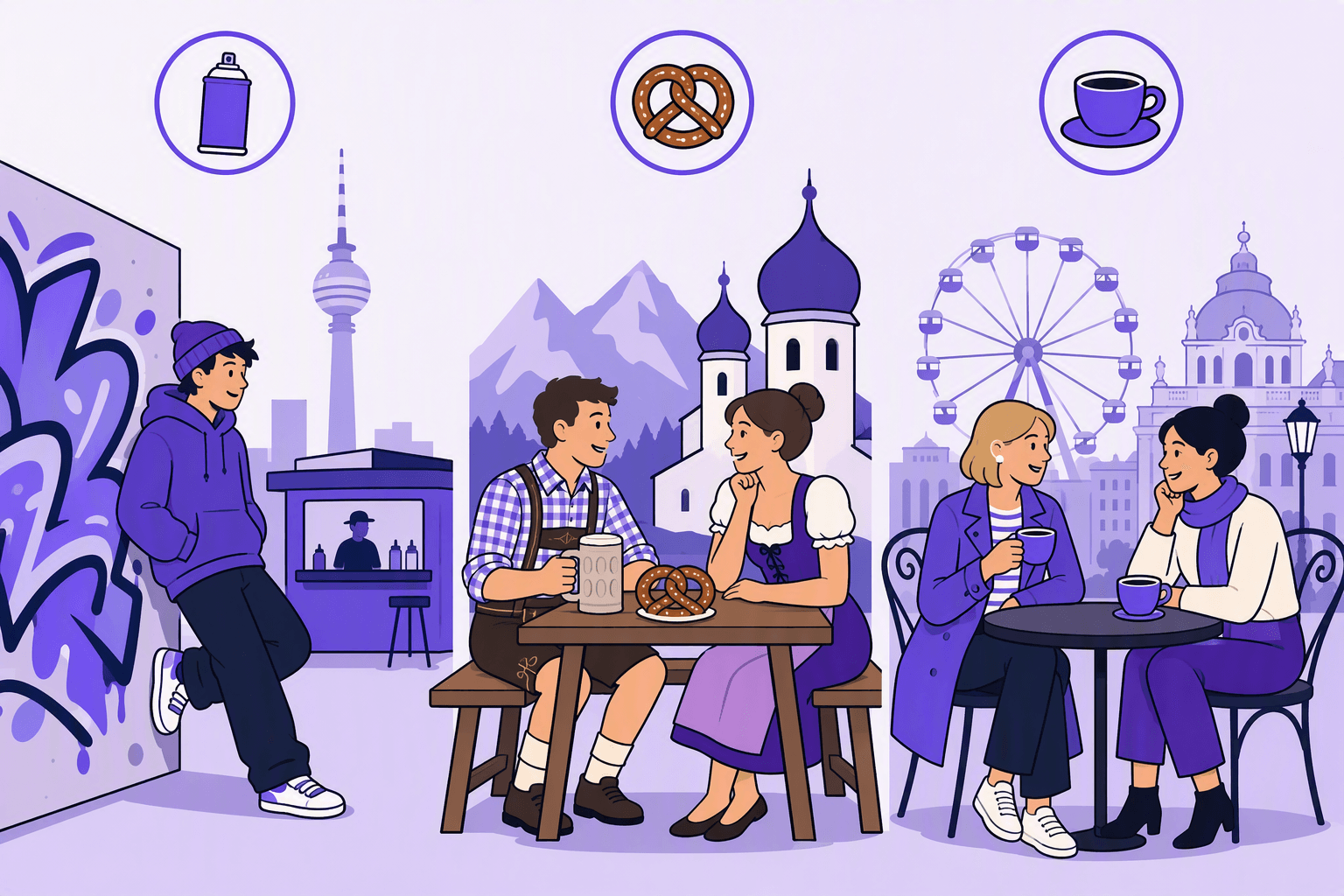
German slang is not monolithic. Berlin, Bavaria, Austria, and Switzerland each bring distinct flavors. Understanding these regional differences is essential because using the wrong regional slang marks you as an outsider, or earns you instant credibility if you get it right.
Knorke
/KNOR-keh/
Literal meaning: (Unknown origin, possibly Yiddish)
“Die Party gestern war echt knorke!”
The party yesterday was really awesome!
Classic Berlin slang (Berlinerisch). Has retro charm: older Berliners use it genuinely, younger ones use it with ironic nostalgia. Other Berlinerisms: 'Icke' (I/me), 'Kiez' (neighborhood), 'Schnauze' (mouth/attitude).
Knorke is quintessential Berlinerisch. It peaked in the mid-20th century, faded, and has made a comeback among younger Berliners who use it with a mix of irony and genuine affection for their city's linguistic heritage. If you visit Berlin, you might also hear Kiez (neighborhood), Icke (I/me), and the attitude-loaded Berliner Schnauze (Berlin snout, the city's famously blunt communication style).
Oida
/OY-dah/
Literal meaning: Old one (Austrian dialect)
“Oida, schau dir das an! Des is ja unglaublich!”
Dude, look at that! That's unbelievable!
Austria's answer to 'Alter.' A viral 2013 video of two Viennese men using 'Oida' in 30+ different emotional contexts became an internet classic. It proved that tone alone can give one word dozens of meanings.
The famous "Oida" video has over 10 million views and perfectly demonstrates how Austrian intonation transforms a single word into anger, joy, disbelief, greeting, farewell, and everything between. In Vienna especially, Oida is inescapable.
Leiwand
/LY-vahnd/
Literal meaning: Linen cloth (dialectal)
“Des Essen war echt leiwand! Können wir da nochmal hingehen?”
The food was really great! Can we go there again?
Austrian slang for 'great' or 'awesome.' Originally meant 'linen' (Leinwand) in Viennese dialect. Exclusively Austrian: using it in Germany will mark you as either Austrian or a very dedicated learner.
Leiwand is the ultimate Austrian shibboleth. Germans will instantly know you have been spending time in Austria if you drop it. Its evolution from Leinwand (canvas, linen) to "awesome" likely followed the path of "fine fabric" to "fine" to "great," a semantic shift that happened entirely within Austrian dialect.
| Region | "Cool/Great" | "Dude/Bro" | "Hello (casual)" |
|---|---|---|---|
| Northern Germany | Geil / Krass | Digga | Moin |
| Berlin | Knorke / Krass | Alter | Na? |
| Bavaria | Geil / Krass | Alter / Oida | Servus |
| Austria | Leiwand / Geil | Oida | Servus / Grüß dich |
| Switzerland | Cool / Krass | Alter | Grüezi / Sali |
💡 Spotting Regional Slang in German Films
German cinema is a goldmine for regional slang. Watch Good Bye, Lenin! for Berlin expressions, Die Fälscher for Viennese dialect, or Fack ju Göhte for pure Jugendsprache. Our guide to the best movies for learning German has more recommendations.
Digga & Bro Culture
These are the address terms, how young Germans refer to each other. They function like English "dude," "bro," or "man."
Digga
/DIH-gah/
Literal meaning: Thick one (from 'Dicker')
“Digga, ich schwöre, das ist wirklich passiert!”
Bro, I swear, that really happened!
Originated in Hamburg hip-hop culture from 'Dicker' (fat one) as an affectionate address. Spread nationwide through German rap music. Spelling varies: Digga, Digger, Diggah. Now used across Germany, especially in northern and western regions.
Digga is the success story of German hip-hop slang. It started in Hamburg's rap scene in the early 2000s, derived from Dicker (fat one) as a term of endearment similar to "big guy." German rappers like Sido, Capital Bra, and the 187 Strassenbande carried it into the mainstream. Today, it is arguably Germany's most popular address term among under-30s.
Ey voll!
/ay FOHL/
Literal meaning: Hey, fully!
“Der Film war ey voll gut! Den musst du sehen.”
The movie was like really good! You have to see it.
'Voll' (fully) works as an intensifier like 'totally' or 'really' in English. Combined with 'Ey' (hey) as a sentence starter, it is one of the most common youth speech patterns. 'Voll krass,' 'voll geil,' 'voll nervig': 'voll' amplifies everything.
Voll as an intensifier is one of the defining features of modern German casual speech. Where English speakers say "totally" or "really," German speakers say voll: voll schön (really beautiful), voll dumm (really stupid), voll der Hammer (absolutely amazing). Combined with ey as a conversation opener, it is the rhythmic backbone of Jugendsprache.
Gemütlichkeit and Cultural Slang
Some German slang words carry cultural weight that goes beyond translation. These are expressions that reveal how Germans think and socialize.
Gemütlich
/geh-MÜÜT-likh/
Literal meaning: Cozy / Comfortable / Convivial
“Lass uns ein gemütliches Café suchen und einfach quatschen.”
Let's find a cozy café and just chat.
One of Germany's most culturally loaded words. 'Gemütlichkeit' describes a state of warmth, friendliness, and belonging: a candlelit evening with friends, a cozy pub in winter, unhurried Sunday brunch. There is no perfect English equivalent.
Gemütlichkeit is not strictly slang, but it functions like cultural slang, a word that insiders use to describe a feeling that outsiders struggle to grasp. When a German says Das war gemütlich, they mean far more than "that was cozy." They mean the atmosphere was warm, the company was good, and nobody was in a rush. Understanding Gemütlichkeit is understanding a core piece of German social culture.
Practice With Real German Content
Reading about slang is a start, but hearing Krass!, Alter!, and Digga spoken naturally by native speakers is what makes them stick. German films, YouTube channels, and podcasts are the fastest way to absorb slang in context.
German rap (Deutschrap) is especially rich in current slang. Artists like Apache 207, Nina Chuba, and Cro use Jugendsprache constantly. German comedy shows like LOL: Last One Laughing (Amazon Prime) and films like Fack ju Göhte are packed with casual expressions.
Wordy lets you watch German movies and shows with interactive subtitles. Tap any slang expression to see its meaning, pronunciation, and register in real time. Instead of memorizing phrases from a list, you absorb them from real conversations with authentic intonation and context.
For more German content, explore our blog for guides including the best movies to learn German. You can also visit our German learning page to start practicing today.
Frequently Asked Questions
What is the most common German slang word?
What is 'Jugendwort des Jahres' and why does it matter?
What is Denglisch?
Is German slang the same in Germany, Austria, and Switzerland?
Can I use German slang in formal situations?
Sources & References
- Duden, Die deutsche Rechtschreibung, 28th edition (2024)
- Gesellschaft für deutsche Sprache (GfdS), Jugendwort des Jahres archives and language trend reports
- Eble, C., Slang and Sociability: In-Group Language Among College Students (University of North Carolina Press)
- Ethnologue: Languages of the World, 27th edition (2024), German language entry
- Institut für Deutsche Sprache (IDS), Mannheim, Neologismen-Wörterbuch
Start learning with Wordy
Watch real movie clips and build your vocabulary as you go. Free to download.


