Quick Answer
The most difficult English sounds are usually the ones your native language doesn’t use, especially TH (/θ/ and /ð/), R vs L, the short vowels (ship vs sheep), and consonant clusters (texts, sixth). You can fix them faster by training your mouth position, practicing minimal pairs, and copying real speech from movies and TV shows instead of isolated word lists.
English’s most difficult sounds are the ones that force your mouth to do something new, especially the two TH sounds, the English R, tricky short vowels (ship vs sheep), and consonant clusters like texts and sixth. The fastest path is to stop guessing and train three things together: mouth position, minimal pairs, and imitation from real speech, because English pronunciation is as much about rhythm and reduction as it is about individual letters.
English is also a high-stakes target: Ethnologue estimates about 1.5 billion English speakers worldwide (L1 plus L2), and English has official or de facto institutional roles across dozens of countries (Ethnologue, 27th edition, 2024). That means you will hear many accents, but the sound problems below show up again and again across learner backgrounds.
If you want listening practice that matches real speed, start with our picks for movies that help you learn English naturally, then come back here and target the exact sounds you keep missing.

How this guide works (and why “letters” are a trap)
English spelling is not a reliable pronunciation map. The same letter can represent multiple sounds, and the same sound can be spelled multiple ways.
That is why dictionaries use the IPA (International Phonetic Alphabet). Even if you never memorize the whole chart, learning a few symbols like /θ/ and /ð/ saves time because you stop mixing up “sound” and “spelling” (International Phonetic Association, accessed 2026).
A quick reality check: intelligibility vs accent
Many learners aim for “no accent,” but the practical goal is intelligibility: being understood easily. Jennifer Jenkins’ work on English as a Lingua Franca argues that not every native-like detail matters equally for international communication, and that some features (like clear consonants and vowel length contrasts) carry more weight than copying a specific regional accent.
So in this article, the priority is: sounds that cause misunderstandings, not sounds that only affect “native-likeness.”
The 12 most difficult English sounds (and how to fix each)
Each section gives you: what the sound is, why it’s hard, and a physical cue you can practice in front of a mirror.
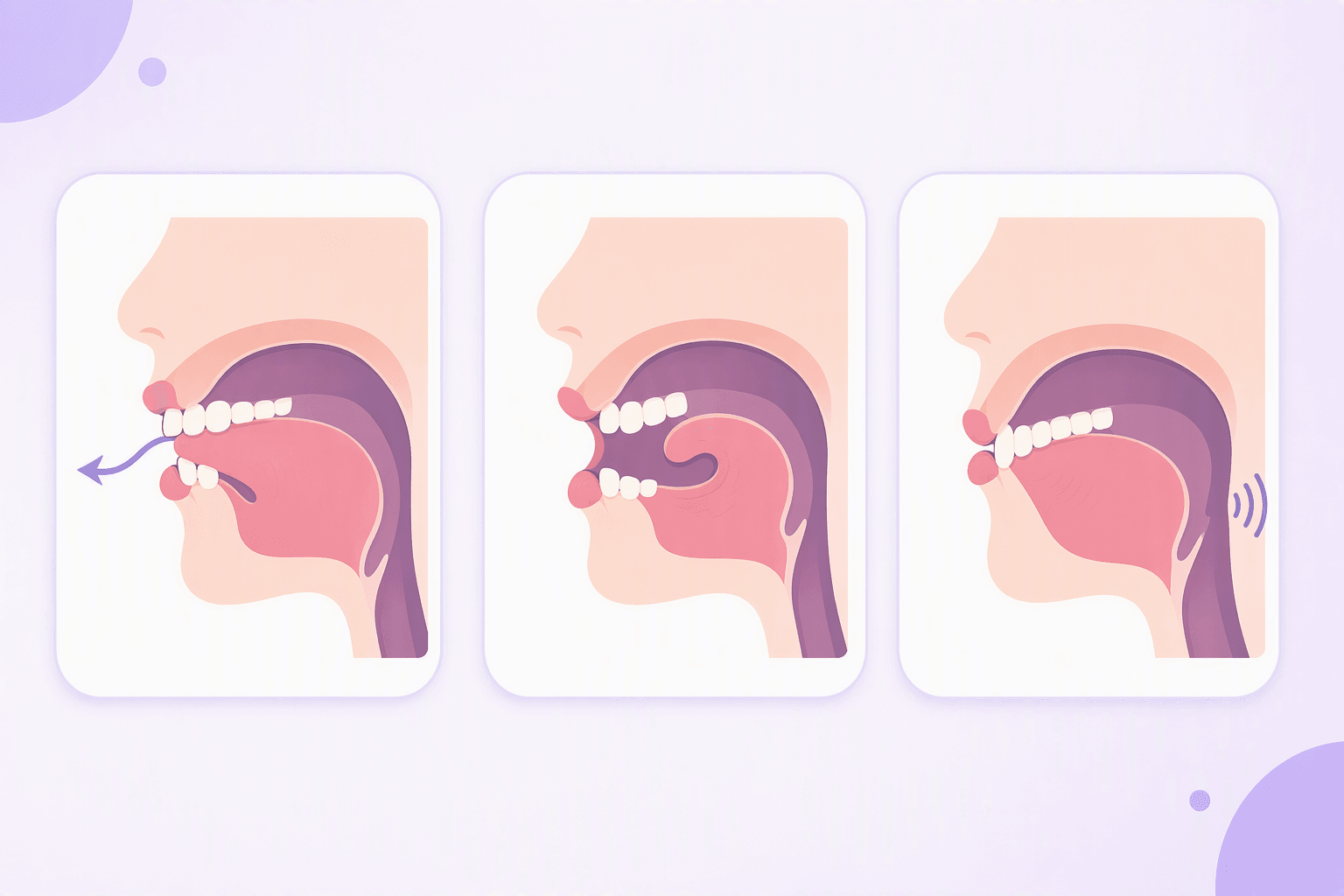
/θ/ (TH in “think”)
Pronunciation: thin = /θɪn/ (voiceless TH), “think” is /θɪŋk/ with air, no voice.
Why it’s hard: Many languages do not have dental fricatives, so learners substitute /t/, /s/, or /f/ (think becomes tink, sink, or fink). That can change meaning.
Fix cue: Put the tongue tip lightly between your teeth and blow air. Keep your jaw relaxed. If you feel a “stop” like /t/, you are pressing too hard.
Minimal pairs to drill:
- thin vs tin
- three vs tree
- thought vs taught
💡 Mirror test
If you cannot see the tongue at all, you are probably making /s/ or /t/. For /θ/, the tongue should be visible between the teeth, but only slightly.
/ð/ (TH in “this”)
Pronunciation: THIS = THIS (voiced TH), “the” is like thuh (with voice).
Why it’s hard: It uses the same tongue position as /θ/ but adds voicing, which many learners forget. That creates confusion between “then” and “den,” or “they” and “day.”
Fix cue: Keep the tongue position, then add vibration in your throat. A quick test is to touch your neck and feel buzzing.
Minimal pairs:
- this vs dis
- then vs den
- they vs day
/ɹ/ (English R)
Pronunciation: RED = RED (American-style R), “right” is RYTE.
Why it’s hard: English /ɹ/ is not the rolled or tapped R many learners know. It is also often “colored” by the following vowel, which makes it feel slippery in fast speech.
Fix cue: Pull the tongue tip back without touching the roof of the mouth. Lips can round slightly. The key is no contact, it is an approximant.
If you speak a non-rhotic variety (many UK accents), R may disappear before consonants (car sounds like kah). That is normal in those accents, but you should still learn to hear R clearly for listening.
/l/ (clear L vs dark L)
Pronunciation: LIGHT = LYTE, “full” ends with a darker, back-of-mouth L.
Why it’s hard: English has two common L qualities: a “clear” L before vowels (light) and a “dark” L at the end of syllables (full, people). Many learners use one L for everything, which can sound off and reduce clarity.
Fix cue: For clear L, tongue tip touches the ridge behind the teeth. For dark L, keep the tongue tip lighter and pull the back of the tongue slightly up, almost like you are starting a “uh” sound.
/ɪ/ vs /iː/ (ship vs sheep)
Pronunciation: SHIP = SHIP (short), SHEEP = SHEEP (longer, tenser).
Why it’s hard: Many languages do not use vowel length and tenseness the way English does, so both words collapse into one. This is a major intelligibility problem.
Fix cue: For /iː/, smile slightly and hold it longer. For /ɪ/, relax the mouth and keep it shorter. Record yourself and check whether the length difference is obvious.
Minimal pairs:
- ship vs sheep
- live vs leave
- bit vs beat
/æ/ (the “a” in “cat”)
Pronunciation: CAT = KAT (wide mouth), “bad” is like BAD with a low front vowel.
Why it’s hard: /æ/ sits in a crowded vowel space. Learners often replace it with /e/ (cat sounds like ket) or /ɑ/ (cat sounds like cot).
Fix cue: Drop the jaw and keep the tongue forward. Think “wide and low.” If your mouth barely opens, you are probably too close to /e/.
/ʌ/ vs /ɑ/ (cut vs cot, depending on accent)
Pronunciation: CUT = KUT (central), COT = KOT (more open and back in many accents).
Why it’s hard: Some English dialects merge these vowels (the cot-caught merger also complicates things), so learners get mixed input. But in many contexts, confusing /ʌ/ with /ɑ/ makes words sound wrong or ambiguous.
Fix cue: /ʌ/ is “lazy central,” with a relaxed tongue. /ɑ/ is more open and often farther back. Use a dictionary with audio to choose your target accent (Cambridge Dictionary, accessed 2026).
/ə/ (schwa, the hidden engine of English)
Pronunciation: about = /əˈbaʊt/, support = /səˈpɔrt/, banana = /bəˈnænə/.
Why it’s hard: English reduces unstressed vowels heavily. Learners pronounce every vowel clearly, which makes speech sound unnatural and can even hurt comprehension because stress patterns get lost.
Fix cue: In unstressed syllables, aim for a quick “uh” with minimal mouth movement. Then put your energy into the stressed syllable.
This is where rhythm matters. John Wells’ work on English accents and pronunciation is a good reference point for understanding stress and reduction as a system, not a list of exceptions.
🌍 Why native speakers 'swallow' vowels
In English, listeners rely on stress to find word boundaries. Reduced vowels are not sloppy, they are part of the timing system. When you keep every vowel full, you often shift stress without realizing it, and your listener has to work harder.
/w/ vs /v/ (wine vs vine)
Pronunciation: WINE = WYNE (rounded lips), VINE = VYNE (teeth on lip).
Why it’s hard: Many learners substitute one for the other, especially if their language lacks /w/ or uses a different /v/. This can create real confusion in names and key words.
Fix cue:
- /w/: lips round and push forward, no teeth contact.
- /v/: top teeth touch bottom lip, with vibration.
Minimal pairs:
- west vs vest
- witch vs vitch (nonsense word, but good drill)
- while vs vile
/b/ vs /p/ and /d/ vs /t/ (voicing and aspiration)
Pronunciation: PIN = PIN (strong puff of air at the start), BIN = BIN (less puff). Same idea for tin vs din.
Why it’s hard: In English, voiceless stops /p t k/ are often aspirated at the start of stressed syllables. Learners who only focus on voicing miss the “puff,” so pin can sound like bin.
Fix cue: Hold a tissue in front of your mouth. Say “pin” and watch it move. Then say “spin” and notice the puff disappears after /s/ (spin has little aspiration).
/t/ in fast speech (flap T and glottal T)
Pronunciation: In American English, “water” often sounds like /ˈwɑɾɚ/ (a flap). In some British accents, “bottle” can sound like /ˈbɒʔəl/ (glottal stop).
Why it’s hard: Learners expect a clear /t/ every time because of spelling. Then they cannot recognize common words at natural speed.
Fix cue: For listening, learn the patterns:
- Between vowels, stressed then unstressed: /t/ often becomes a flap in American English (writer, city).
- Before syllabic consonants or in casual speech: /t/ may weaken or disappear.
This is a listening upgrade as much as a speaking one. It is also why movie and TV audio helps more than isolated word recordings.
Consonant clusters (texts, sixth, asked)
Pronunciation: TEXTS = TEKSTS, SIXTH = SIKSTH, ASKED = ASKT.
Why it’s hard: English allows dense clusters at the ends of words. Many languages do not, so learners insert a vowel (text-uh) or drop consonants (tes).
Fix cue: Build the cluster from the inside out. For “texts,” start with “text,” then add the final /s/ as a quick hiss. Keep the vowels short.
Practice set:
- next, text, texts
- sixth, sixths (advanced)
- ask, asked, asks
⚠️ Don't over-pronounce every letter
Clusters are real, but native speech also simplifies them. In fast conversation, “asks” may sound closer to “aks” for some speakers. Your goal is clarity, not perfect spelling-to-sound mapping.
/h/ (silent or not?)
Pronunciation: house = /haʊs/, ahead = /əˈhɛd/.
Why it’s hard: Some languages drop /h/ completely; others pronounce it more strongly than English. Also, some English words have silent H (honest, hour), which adds spelling confusion.
Fix cue: /h/ is just breath through an open mouth position. If your throat feels tight, you are pushing too hard.
Use a dictionary audio model when in doubt (Merriam-Webster, accessed 2026).
The bigger problem: English stress changes the vowel
Even if you “know” the sound, English stress can change it. Compare:
- photo = /ˈfoʊtoʊ/
- photography = /fəˈtɑɡrəfi/
The vowels in unstressed syllables often reduce toward schwa. This is why drilling only single words can stall your progress: you need phrases.
A practical way to train this is to copy short, emotional lines. Comedy and arguments are especially useful because stress is exaggerated and easier to hear. If you want a structured listening plan, pair this with our English pronunciation guide and a small daily routine.
A simple 10-minute routine that actually fixes sounds
You do not need hours. You need correct repetition.

Step 1: Pick two “high-impact” contrasts
Choose one consonant contrast (TH vs T, or R vs L) and one vowel contrast (ship vs sheep, or cat vs cut). Two is enough.
If you try to fix everything at once, you will practice everything incorrectly.
Step 2: Do minimal pairs, then put them in a sentence
Minimal pairs train your ear and your mouth. Sentences train rhythm.
Example:
- “ship” vs “sheep”
- “I saw the ship.” vs “I saw the sheep.”
Step 3: Copy one movie line and match the stress
Use a short line you can loop. Focus on:
- which word is stressed
- which vowels reduce
- how words connect
Our best movies to learn English list is a good starting point because clear dialogue and repeated everyday phrases give you more usable repetitions.
Step 4: Record and compare
Your brain lies to you in real time. Recording makes the difference obvious.
If you hate your voice on recordings, that is normal. Treat it like a lab tool.
Common “sound traps” you can predict from your first language
Second-language speech research, including work by James Flege on how learners perceive new categories, shows a consistent pattern: if your brain maps two English sounds onto one category from your native language, you will keep producing them as “the same” until you retrain perception.
Practical translation: if you cannot reliably hear the difference, you cannot reliably say the difference.
So if you are stuck, switch from speaking practice to listening discrimination for a week. Use minimal pairs with audio and force yourself to identify which word you heard.
Listening in the real world: slang, fast speech, and taboo words
Once you start hearing reduced vowels and softened consonants, you will suddenly understand more casual English, including slang and swearing. Those registers often compress sounds even further.
If you are curious about informal speech patterns, our English slang guide helps you connect pronunciation to real usage. For cultural context and why certain words hit harder than you expect, see English swear words, but treat it as comprehension-first content, not a script to perform.
Sound-specific practice ideas using numbers (because they repeat)
Numbers are great pronunciation drills because you repeat them constantly in real life: prices, times, dates, phone numbers. They also include several common traps: TH (three), consonant clusters (sixth), and reduced vowels in compound numbers.
Use our numbers in English guide as a practice list, but say them in realistic chunks:
- “three thirty”
- “sixth street”
- “one hundred and thirty”
When you should get feedback (and what kind)
Self-study works best when you already know what to listen for. If you keep repeating the same error, you need external feedback.
Good options:
- A teacher who can explain mouth position, not just say “try again.”
- Speech analysis tools that show voicing and timing.
- Shadowing with a clear model, then checking against dictionary audio.
The British Council’s learner resources emphasize that pronunciation improvement is strongly tied to feedback and focused practice, not just exposure (British Council, accessed 2026).
Putting it all together with Wordy-style clip practice
Real speech is messy, but it is also consistent in patterns: stress, reduction, linking, and the same difficult sounds in thousands of everyday lines. That is why clip-based practice works: you repeat the exact same sound in the exact same rhythm until it becomes automatic.
If you want a next step, pick one sound from this guide and practice it through short scenes for a week. Then switch to the next sound. Consistency beats variety for pronunciation.
For more learning methods that pair well with pronunciation training, browse the Wordy blog and build a routine you can actually keep.
Frequently Asked Questions
What is the hardest sound in English?
Why do I still have an accent even when people understand me?
How long does it take to improve English pronunciation?
Should I learn British or American pronunciation?
What’s the best way to practice difficult English sounds at home?
Sources & References
- Ethnologue, 27th edition, 2024
- British Council, The English Effect (accessed 2026)
- Cambridge Dictionary, Pronunciation and phonetics resources (accessed 2026)
- Merriam-Webster, Pronunciation guide and audio dictionary (accessed 2026)
- International Phonetic Association, IPA Chart and Handbook (accessed 2026)
Start learning with Wordy
Watch real movie clips and build your vocabulary as you go. Free to download.


