クイック回答
英語は旅の共通語です。世界中の空港、ホテル、レストランでは英語でやり取りできます。よく使うフレーズは「Where is...?」(/wɛr ɪz/), 「How much does this cost?」(/haʊ mʌtʃ dʌz ðɪs kɒst/), 「Could I have the bill, please?」(/kʊd aɪ hæv ðə bɪl/) そして「I need help, please.」(/aɪ niːd hɛlp/) です。
短い答え
英語は旅行の世界共通語です。英語で1文でも言えれば、ほとんどどこでも意思疎通できます。 いちばん大事なのは "Could you help me, please?" (/kʊd juː hɛlp miː pliːz/) です。空港でもホテルでも街中でも、助けが必要で丁寧だと一瞬で伝わります。
Ethnologue 2024によると、約15億人が日常のコミュニケーションで英語を使っています。これは英語が世界で最も広く使われる共通語であることを示します。言語学者のDavid Crystal(The Cambridge Encyclopedia of the English Language, Cambridge University Press, 2019)は、英語は全ての大陸で公用語、または広く使われている唯一の言語だと述べています。英語は航空、観光、ホテル業界の事実上の標準言語でもあります。
「英語はただの言語ではない。世界の旅行者が互いに意思疎通するためのコードだ。丁寧なフレーズをいくつか学べば、誰でもすぐにこの世界的な会話の一員になれる。」
(British Council, English Language Teaching: Global Research Report, 2023)
このガイドでは、旅行で必須の英語フレーズを50個以上紹介します。空港と税関、ホテル、レストラン、交通、買い物、緊急時など、場面別にまとめています。各フレーズには発音、実際の例文、文化的な補足があります。いつ、どう使うかが分かります。
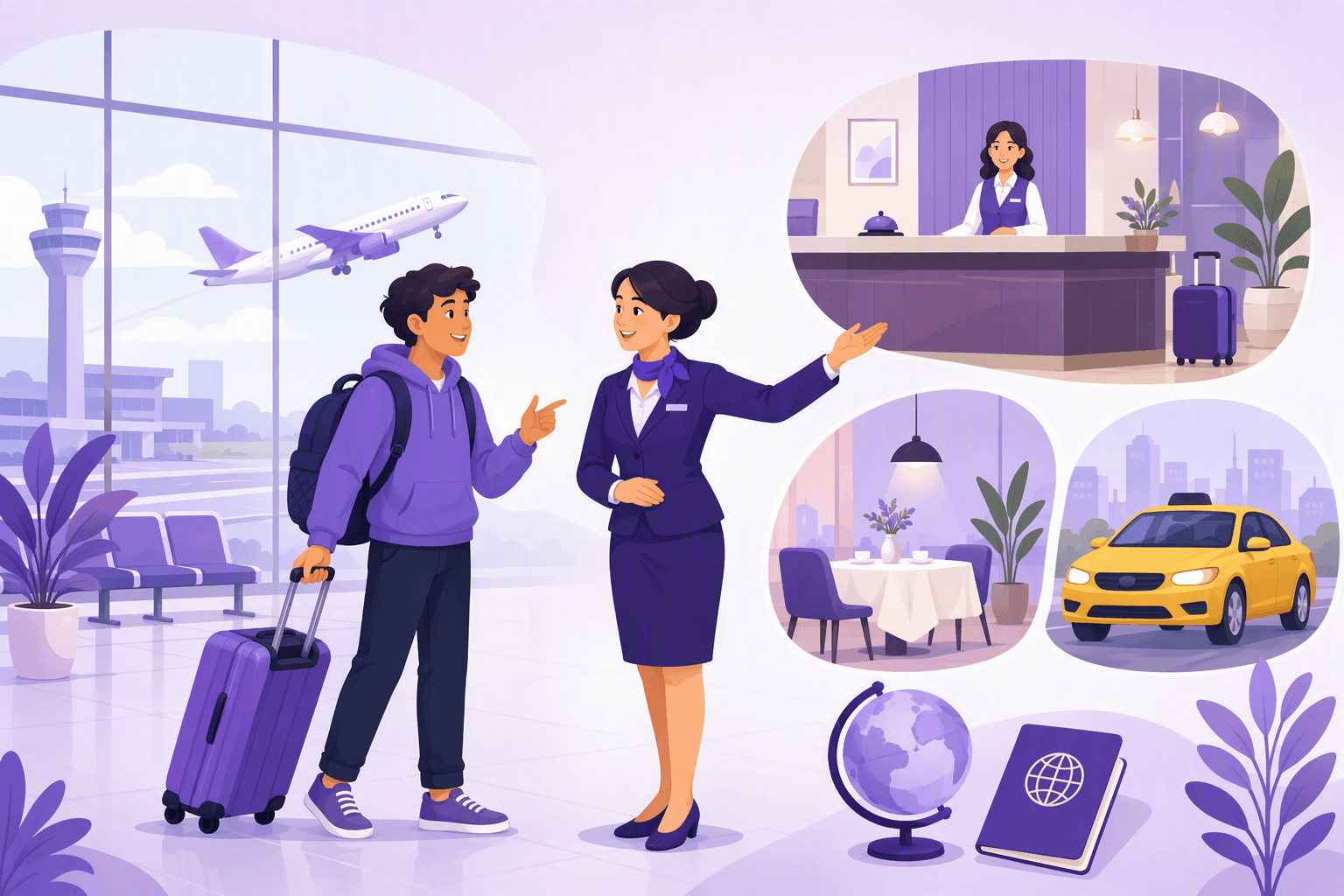
クイック概要, 最重要の英語旅行フレーズ12選
| 英語 | 発音 | 丁寧さ |
|---|---|---|
| Where is...? | /wɛr ɪz/ | polite |
| How much does this cost? | /haʊ mʌtʃ dʌz ðɪs kɒst/ | polite |
| Could you help me, please? | /kʊd juː hɛlp miː pliːz/ | polite |
| I have a reservation | /aɪ hæv ə rɛzərˈveɪʃən/ | formal |
| Could I have the bill, please? | /kʊd aɪ hæv ðə bɪl pliːz/ | polite |
| I don't understand | /aɪ doʊnt ʌndərˈstænd/ | polite |
| Please speak more slowly | /pliːz spiːk mɔːr ˈsloʊli/ | polite |
| I need a doctor | /aɪ niːd ə ˈdɒktər/ | polite |
| Help! | /hɛlp/ | casual |
| Thank you | /θæŋk juː/ | polite |
| Please | /pliːz/ | polite |
| Excuse me | /ɪkˈskjuːz miː/ | polite |
空港と税関
最近の空港では、ほぼどこでも英語の案内表示があります。それでも、重要な文をいくつか知っていると行動が楽になります。特に税関や入国審査では、係員が英語で質問することが多いので効果が大きいです。British Councilによると、主要な国際空港では英語が主要なコミュニケーション言語です。
Where is the gate?
//wɛr ɪz ðə ɡeɪt//
直訳: Where is the gate?
“Excuse me, where is gate B12?”
Excuse me, where is gate B12?
At the airport, 'gate' means the boarding gate, not the entrance. If you are lost, ask the staff. Airport workers are used to international passengers.
Where is...? は、英語で道を聞くときに最も汎用性が高い形です。場所を入れ替えるだけで使えます。例: Where is the baggage claim?, Where is the customs?, Where is the exit?。
Is this seat taken?
//ɪz ðɪs siːt ˈteɪkən//
直訳: Is this seat taken?
“Excuse me, is this seat taken? Can I sit here?”
Excuse me, is this seat taken? Can I sit here?
You can use this in a waiting area, on a bus, or on a plane. If the seat is free, the answer is: 'No, go ahead.' If it is taken: 'Yes, sorry.'
Do you have anything to declare?
//duː juː hæv ˈɛniθɪŋ tə dɪˈklɛr//
直訳: Do you have anything to declare?
“Do you have anything to declare?, No, just personal items.”
Do you have anything to declare?, No, just personal items.
Customs officers ask this question. A standard answer is: 'No, just personal belongings.' Stay calm and brief. Customs officers ask routine questions.
💡 空港で役立つ単語
案内表示でよく見る重要語: Departures, Arrivals, Boarding, Gate, Baggage claim, Customs, Immigration, Transit。これらは話せなくても大丈夫です。見て意味が分かれば十分です。それだけで移動に自信がつきます。
ホテルと宿泊
ロンドンでもニューヨークでもドバイでも、英語で対応するホテルスタッフは海外からの宿泊客に慣れています。喜んで手伝ってくれます。チェックインの流れはほぼどこでも同じです。名前を伝え、パスポートを見せ、鍵を受け取ります。
I have a reservation
//aɪ hæv ə rɛzərˈveɪʃən//
直訳: I have a reservation
“Good evening. I have a reservation under the name Kovács.”
Good evening. I have a reservation under the name Kovács.
At reception, greet first: 'Good morning / afternoon / evening.' This is basic politeness in English and sets a positive tone. The phrase 'under the name' means the booking is in that name.
Could I have a room for two nights?
//kʊd aɪ hæv ə ruːm fər tuː naɪts//
直訳: Could I have a room for two nights?
“Could I have a double room for two nights, please?”
Could I have a double room for two nights, please?
'Could I have...?' is a basic polite request in English. Room types: 'single room', 'double room', 'twin room', 'suite'.
What time is check-out?
//wɒt taɪm ɪz tʃɛk aʊt//
直訳: What time is check-out?
“What time is check-out? Can I leave my luggage here?”
What time is check-out? Can I leave my luggage here?
Check-out is usually between 11 a.m. and 12 p.m. If you want to stay longer, ask: 'Is a late check-out possible?' They usually allow it for an extra fee.
Could I have an extra towel?
//kʊd aɪ hæv ən ˈɛkstrə ˈtaʊəl//
直訳: Could I have an extra towel?
“Excuse me, could I have an extra towel and some more soap?”
Excuse me, could I have an extra towel and some more soap?
In hotels, requests work best with 'Could I have...' or 'Could you bring me...'. Avoid 'Give me...'. It sounds rude in English.
🌍 英語圏のホテルでのチップ
アメリカ合衆国では、ベルスタッフやハウスキーピングにチップを渡すのが一般的です。荷物1個につき$1から$2、清掃は1日$2から$5が目安です。イギリスでは必須ではありませんが、渡すと喜ばれます。オーストラリアとニュージーランドではチップは不要ですが、受け取ってもらえます。
レストランとカフェ
英語圏のレストラン文化は、特にアメリカ合衆国では日本と違って感じることがあります。店員が何度もテーブルに来ます。やり取りが多いスタイルです。注文と会計は、いくつかの文だけで十分にこなせます。
I'd like a table for two
//aɪd laɪk ə ˈteɪbl fər tuː//
直訳: I'd like a table for two
“Hi, I'd like a table for two, please. Do you have a reservation?”
Hi, I'd like a table for two, please. Do you have a reservation?
In the United States and the United Kingdom, many restaurants require a reservation. If you do not have one: 'We don't have a reservation, do you have anything available?'
Could I see the menu?
//kʊd aɪ siː ðə ˈmɛnjuː//
直訳: Could I see the menu?
“Could I see the menu, please? And could we get some water?”
Could I see the menu, please? And could we get some water?
In the United States, the menu is often already on the table, and the server usually brings free water automatically. In the United Kingdom and Australia, this is less automatic, so it is worth asking.
I'll have...
//aɪl hæv//
直訳: I'll have...
“I'll have the grilled salmon and a side salad, please.”
I'll have the grilled salmon and a side salad, please.
'I'll have...' is the natural way to order. 'I want...' is correct, but it can sound too direct in a restaurant. 'I'll have...' sounds more polite and natural.
The bill, please / Check, please
//ðə bɪl pliːz / tʃɛk pliːz//
直訳: The bill, please
“Excuse me, could we get the bill, please?”
Excuse me, could we get the bill, please?
Important cultural difference: in the United Kingdom and Australia people say 'bill'. In the United States and Canada people say 'check'. Both are understood everywhere. In the United States, the server often brings the check without you asking.
🌍 レストランのチップ, アメリカ合衆国とイギリスの違い
アメリカ合衆国では、レストランのチップは18から20%が一般的です。店員の収入の多くがチップに依存するため、これが実質的な最低ラインです。計算は簡単で、会計に0.2を掛けます。イギリスでは10から12%が一般的です。サービス料が自動で加算されることもあるので、支払い前に伝票を確認してください。オーストラリアとニュージーランドではチップは不要ですが、渡すと喜ばれます。
交通
ロンドンの地下鉄、ニューヨークの地下鉄、シドニーのバスなど、英語圏の都市の公共交通は英語の表示が基本です。アナウンスも多くは英語です。乗り換えを逃したり、降りる場所が分からないときに、短い文が役立ちます。
How do I get to...?
//haʊ duː aɪ ɡɛt tuː//
直訳: How do I get to...?
“Excuse me, how do I get to the city centre?”
Excuse me, how do I get to the city centre?
This is the most natural way to ask for directions in English. You can add: 'Is it far from here?', 'Can I walk?' or 'Should I take the bus or the subway?'
Where is the nearest...?
//wɛr ɪz ðə ˈnɪərɪst//
直訳: Where is the nearest...?
“Where is the nearest ATM / pharmacy / subway station?”
Where is the nearest ATM / pharmacy / subway station?
With the word 'nearest', you can find almost anything. Useful places: 'ATM', 'pharmacy', 'hospital', 'taxi stand', 'bus stop'.
Could you take me to...?
//kʊd juː teɪk miː tuː//
直訳: Could you take me to...?
“Could you take me to this address, please?”
Could you take me to this address, please?
One of the most useful sentences in a taxi. If you are not sure about pronunciation, show your phone with the destination. In the United States and the United Kingdom, Uber and Lyft or Bolt are very common. With these apps, you often do not need to say anything.
How much does it cost?
//haʊ mʌtʃ dʌz ɪt kɒst//
直訳: How much does it cost?
“How much does it cost to get to the airport by taxi?”
How much does it cost to get to the airport by taxi?
タクシーでは、特にメーターがない場合や、運転手が'flat rate'を提示した場合は、出発前に料金を確認してください。Uberなどのアプリでは予約前に料金が見えるので、より簡単です。
買い物
英語圏の国では、ショッピングモールでも屋外マーケットでも、値札が付いていることが多く、値段交渉は一般的ではありません。例外はアンティーク店、フリーマーケット、一部の観光客向け市場です。次の文があると買い物が楽になります。
How much is this?
//haʊ mʌtʃ ɪz ðɪs//
直訳: How much is this?
“Excuse me, how much is this? And is it on sale?”
Excuse me, how much is this? And is it on sale?
'How much is this?' と 'How much does this cost?' は同じ意味です。ただ前者のほうが少しカジュアルに聞こえます。'Is it on sale?' は割引があるか確認できます。'On sale' は割引中です。'For sale' は販売中、つまり買える状態です。
Do you have this in...?
//duː juː hæv ðɪs ɪn//
直訳: Do you have this in...?
“Do you have this in a larger size / in blue?”
Do you have this in a larger size / in blue?
服のサイズ表記は国によって違います。S, M, L, XLや数字サイズがあります。自分のサイズが分からない場合は、'Could I try this on?' と聞くと良いです。
Can I try this on?
//kæn aɪ traɪ ðɪs ɒn//
直訳: Can I try this on?
“Can I try this on? Where is the fitting room?”
Can I try this on? Where is the fitting room?
'Fitting room'(アメリカ合衆国では'dressing room')は試着室です。店によっては持ち込める点数に制限があります。'maximum 6 items'と言われても普通のルールで、個人への指摘ではありません。
助けを求めるときと緊急時
緊急事態は誰も望みませんが、こうした文が命綱になることがあります。アメリカ合衆国の緊急番号は 911、イギリスは 999、オーストラリアと多くの英語圏の国は 000 / 112 です。
I need help!
//aɪ niːd hɛlp//
直訳: I need help!
“I need help! Please call an ambulance!”
I need help! Please call an ambulance!
緊急時に最もシンプルで効果的な文です。'Help!' (/hɛlp/) だけでも十分です。英語圏ではすぐに通じます。
I don't understand
//aɪ doʊnt ʌndərˈstænd//
直訳: I don't understand
“I'm sorry, I don't understand. Could you repeat that?”
I'm sorry, I don't understand. Could you repeat that?
これを言うのを怖がらないでください。母語話者は学習者に慣れていて、繰り返したり簡単に言い換えたりしてくれます。'I'm sorry, my English is not very good' も便利な前置きです。相手がより辛抱強くなりやすいです。
Please speak slowly
//pliːz spiːk mɔːr ˈsloʊli//
直訳: Please speak more slowly
“Could you speak more slowly, please? I'm still learning English.”
Could you speak more slowly, please? I'm still learning English.
母語話者は速く話し、音をつなげたり省略したりします。特にアメリカ合衆国ではその傾向があります。'Could you speak more slowly?' にはたいてい親切に対応してくれます。'Could you write it down?' もとても役立ちます。
I've lost...
//aɪv lɒst//
直訳: I've lost...
“I've lost my passport. Where is the nearest police station?”
I've lost my passport. Where is the nearest police station?
書類を失くしたら、すぐ最寄りの警察署へ行き、遺失届の書類を作ってもらってください。保険会社や大使館が求めることがあります。パスポートのコピーは別に保管してください。
Call the police!
//kɔːl ðə pəˈliːs//
直訳: Call the police!
“Call the police! I've been robbed!”
Call the police! I've been robbed!
アメリカ合衆国: 911、イギリス: 999、オーストラリア: 000、カナダ: 911。電話できない場合は、'Help! Call the police!' と叫んでください。周りの人が動いてくれます。'I've been robbed' や 'I've been attacked' も緊急時に重要です。
文化のヒント
🌍 イギリスとアメリカ合衆国, 英語も習慣も違う
イギリスとアメリカ合衆国には、文化と言語の違いがたくさんあります。旅行者にとっては意外に感じることがあります。イギリスの人は、より丁寧で形式的な言い回しをよく使います。'Could I possibly...' や 'Would you mind...' は、アメリカ合衆国より一般的です。イギリスでは割り込みをしません。'queue'はほぼ神聖です。乱すと強い社会的な非難につながります。
アメリカ合衆国では、よりフレンドリーで直接的に話します。レジ係でも'How are you today?'と聞くことがあります。これは本当の質問ではありません。丁寧な定型表現です。良い返しは 'I'm great, thanks! And you?' です。イギリスの人は、このオープンさを強すぎると感じることもあります。どちらが合うかは、あなたの文化的背景によります。
緊急番号: アメリカ合衆国とカナダ: 911、イギリス: 999、オーストラリア: 000、ニュージーランド: 111、アイルランド: 112 / 999。
💡 旅行者向け, イギリス英語とアメリカ英語の重要な違い
両方で知っておくと便利な単語をいくつか紹介します。
| 日本語 | イギリス英語 | アメリカ英語 |
|---|---|---|
| トイレ | Toilet / Loo | Restroom / Bathroom |
| 地下鉄 | Underground / Tube | Subway |
| レストランの会計 | Bill | Check |
| 休暇 | Holiday | Vacation |
| 薬局 | Chemist / Pharmacy | Drugstore / Pharmacy |
| エレベーター | Lift | Elevator |
| ガソリンスタンド | Petrol station | Gas station |
| 荷物 | Luggage / Baggage | Luggage / Baggage |
どちらの国でも、両方の言い方は理解されます。アメリカ合衆国でイギリスの単語を使っても、逆でも、驚かれることはほぼありません。
旅行フレーズ集, まとめ
| 場面 | 役立つ英語フレーズ | 日本語の意味 |
|---|---|---|
| 空港 | Where is the gate? | 搭乗ゲートはどこですか? |
| 税関 | Just personal belongings. | 私物だけです。 |
| ホテルのチェックイン | I have a reservation under... | ...の名前で予約しています。 |
| ホテルでの依頼 | Could I have an extra...? | 追加で...をもらえますか? |
| チェックアウト | What time is check-out? | チェックアウトは何時ですか? |
| レストラン | I'll have... / The bill, please. | ...にします。/ お会計お願いします。 |
| 道案内 | How do I get to...? | ...へはどう行けばいいですか? |
| タクシー | Could you take me to...? | ...まで連れて行ってもらえますか? |
| 買い物 | How much is this? | これはいくらですか? |
| 試着 | Can I try this on? | 試着してもいいですか? |
| 助け | I need help! / Help! | 助けが必要です!/ 助けて! |
| 緊急 | Call the police! | 警察を呼んで! |
| コミュニケーション | Please speak more slowly. | もっとゆっくり話してください。 |
| 聞き返し | Could you repeat that? | もう一度言ってもらえますか? |
実際の英語コンテンツで練習する
これらのフレーズを覚える最も効果的な方法は、実際の場面で聞いて見て覚えることです。英語の映画、ドラマ、ポッドキャストは楽しいだけでなく、自然な発音、スピード、文化的な背景も学べます。
イギリス作品とアメリカ合衆国作品の両方から選んだおすすめをまとめた、英語学習におすすめの映画 も確認してください。旅行中にも上達したいなら、Wordyで英語を学ぶ ページで、好きなドラマを見ながら自然に単語とフレーズを学べます。
また、基本の英語あいさつフレーズのガイドも読んでください。旅行は文だけではありません。人とのつながりでもあります。
よくある質問
旅行で最低限覚えておくべき英語の例文は?
英語で「〜はどこですか?」は何て言う?
英語でホテルを予約するときの言い方は?
緊急時に英語で助けを求めるには?
英語で「わかりません、もう一度言ってください」は?
出典・参考資料
- Crystal, David (2019). 英語言語学のケンブリッジ百科事典. Cambridge University Press.
- British Council (2023). 英語教育: グローバル研究レポート.
- Merriam-Webster Dictionary (2026). merriam-webster.com.
- Ethnologue (2024). 英語: 世界言語としての位置づけ, 第27版.


