Quick Answer
The most common way to express emotions in Spanish uses the verb 'estar' (to be, temporarily): estoy feliz (I'm happy), estoy triste (I'm sad), estoy enojado (I'm angry). Spanish distinguishes between temporary emotional states (estar) and permanent traits (ser), and many feelings use 'tener' instead: tener miedo (to be afraid, literally 'to have fear'), tener vergüenza (to be ashamed). This guide covers 40+ emotion words with pronunciation, grammar patterns, and cultural insights unique to the Spanish-speaking world.
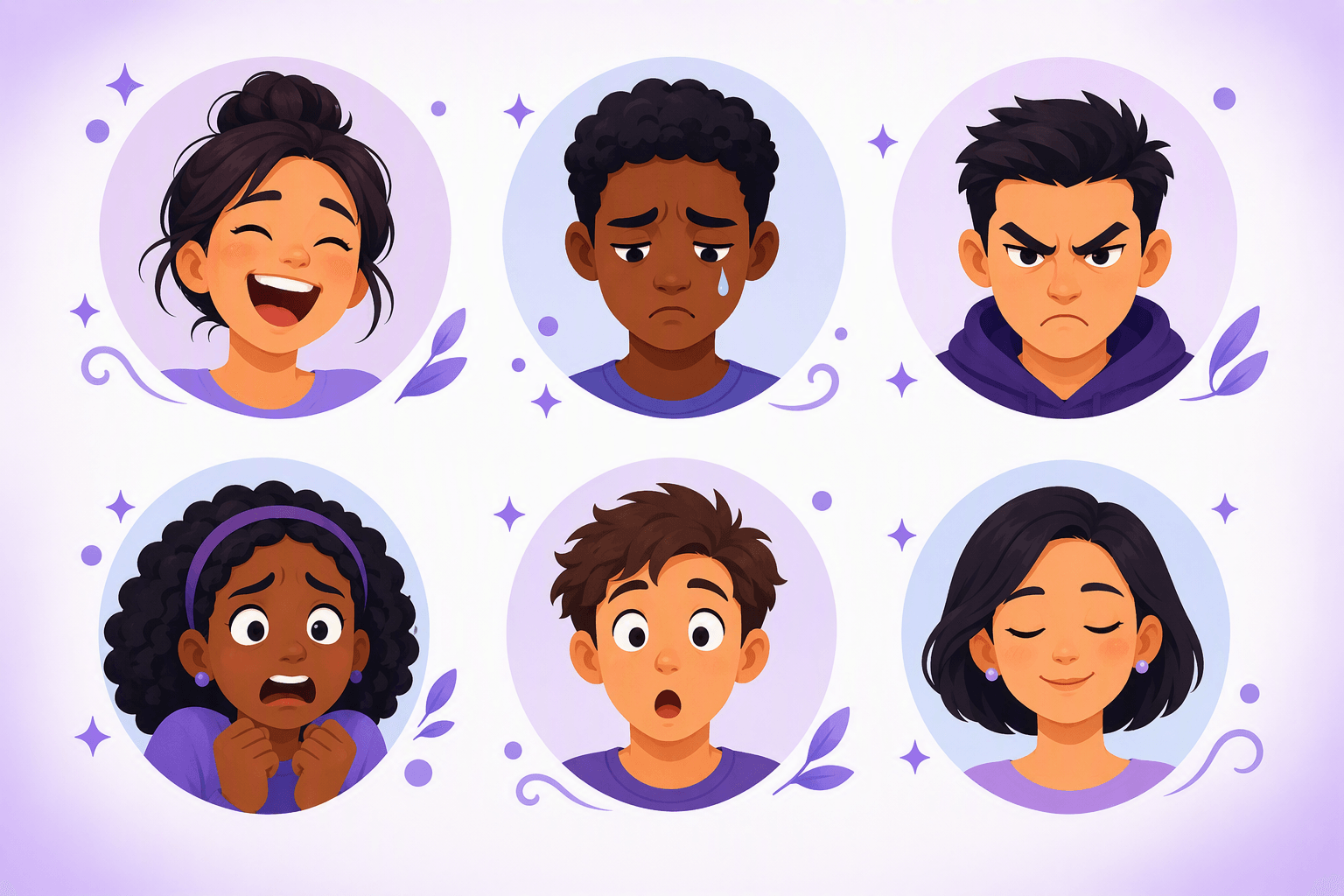
The six basic emotions identified by psychologist Paul Ekman (happiness, sadness, anger, fear, surprise, and disgust) are universal across cultures. But the words each language uses to describe them, and the nuances layered on top, differ dramatically. Spanish, with over 559 million speakers across 21 countries according to Ethnologue's 2024 data, has developed one of the richest emotional vocabularies in any language.
What makes Spanish emotions particularly interesting for learners is the grammar that surrounds them. Unlike English, where you simply "are" happy or scared, Spanish splits emotional expression across three different verb structures: estar for temporary states, ser for permanent traits, and tener for emotions framed as possessions. Mastering these patterns is as important as learning the vocabulary itself.
"Emotions are not universal readouts of internal states. They are culturally constructed categories that each language carves differently from the continuous flow of human experience." (Lisa Feldman Barrett, How Emotions Are Made, 2017)
This guide covers 40+ Spanish emotion words organized by category, with pronunciation, grammar notes, and cultural insights you will not find in a standard dictionary.

| Spanish | English | Pronunciation |
|---|---|---|
| Feliz | Happy | feh-LEES |
| Triste | Sad | TREES-teh |
| Enojado(a) | Angry | eh-noh-HAH-doh |
| Asustado(a) | Scared | ah-soos-TAH-doh |
| Emocionado(a) | Excited | eh-moh-see-oh-NAH-doh |
| Tranquilo(a) | Calm | trahn-KEE-loh |
| Nervioso(a) | Nervous | nehr-bee-OH-soh |
| Preocupado(a) | Worried | preh-oh-koo-PAH-doh |
| Alegre | Joyful | ah-LEH-greh |
| Tener miedo | To be afraid | teh-NEHR mee-EH-doh |
Basic Emotions
These are the core emotions that every Spanish learner should know first. Ekman's research on universal emotions maps closely onto these foundational Spanish words, though each carries its own cultural weight.
| English | Spanish | Pronunciation | Note |
|---|---|---|---|
| Happy | Feliz / Contento(a) | feh-LEES / kon-TEN-toh | Feliz = deep happiness; contento = satisfied, pleased |
| Sad | Triste | TREES-teh | Same form for masculine and feminine |
| Angry | Enojado(a) / Enfadado(a) | eh-noh-HAH-doh / en-fah-DAH-doh | Enojado = Latin America; enfadado = Spain |
| Scared / Afraid | Asustado(a) | ah-soos-TAH-doh | For sudden fright; use 'tener miedo' for general fear |
| Surprised | Sorprendido(a) | sor-pren-DEE-doh | Gender agrees with the person |
| Disgusted | Asqueado(a) | ahs-keh-AH-doh | Also 'dar asco' = to disgust (me da asco) |
Notice the regional split for "angry": enojado dominates in Mexico, Central America, and most of South America, while enfadado is the standard in Spain. Both are universally understood, but using the regional form marks you as a more aware speaker. According to the RAE, both forms are equally correct standard Spanish.
💡 Gender Agreement with Emotions
Adjectives ending in -o change to -a for feminine speakers: estoy contento (male) vs. estoy contenta (female). Adjectives ending in -e (triste, alegre) or a consonant (feliz) remain the same regardless of gender: él está triste, ella está triste.
Positive Emotions
Beyond basic happiness, Spanish offers a rich palette of positive emotional states. Many of these words have subtle distinctions that do not map neatly onto English equivalents. A 2019 study published in the Proceedings of the National Academy of Sciences found that positive emotion words tend to be used more frequently than negative ones across nearly all languages, and Spanish is no exception. Words like alegre, emocionado, and tranquilo appear constantly in everyday conversation.
| English | Spanish | Pronunciation | Note |
|---|---|---|---|
| Excited | Emocionado(a) | eh-moh-see-oh-NAH-doh | NOT 'excitado', that has sexual connotations |
| Grateful | Agradecido(a) | ah-grah-deh-SEE-doh | From 'agradecer' (to thank) |
| Proud | Orgulloso(a) | or-goo-YOH-soh | Can be positive or negative (arrogant) |
| Calm / Peaceful | Tranquilo(a) | trahn-KEE-loh | Also used as a command: ¡Tranquilo! = Calm down! |
| Hopeful | Esperanzado(a) | es-peh-rahn-SAH-doh | From 'esperanza' (hope) |
| Content / Satisfied | Satisfecho(a) | sah-tees-FEH-choh | Irregular past participle of 'satisfacer' |
| Joyful | Alegre | ah-LEH-greh | Gender-neutral ending; livelier than 'feliz' |
| In love | Enamorado(a) | eh-nah-moh-RAH-doh | Estar enamorado = to be in love (temporary/current state) |
| Amused | Divertido(a) | dee-behr-TEE-doh | Also means 'fun' as a general adjective |
| Relieved | Aliviado(a) | ah-lee-bee-AH-doh | From 'alivio' (relief) |
⚠️ False Friend: Excitado
One of the most common mistakes English speakers make is translating "excited" as excitado. In Spanish, excitado has strong sexual connotations. Always use emocionado(a) for the English sense of "excited": Estoy emocionada por el viaje (I'm excited about the trip). This distinction is critical in professional and social settings.
The distinction between feliz and alegre is worth noting. Feliz describes a stable, deeper state of happiness; you might say soy feliz con mi vida (I am happy with my life). Alegre is more immediate and energetic, closer to "cheerful" or "joyful": está muy alegre hoy (she is very cheerful today). Choosing the right word shows a deeper understanding of emotional nuance in Spanish.
Another useful word is tranquilo, which goes far beyond "calm." Spanish speakers use it as a reassurance (¡Tranquilo, todo va a salir bien!, meaning "Relax, everything will be fine"), as a personality descriptor (es una persona muy tranquila, "she is a very easygoing person"), and even as a way to describe a neighborhood (un barrio tranquilo, "a quiet neighborhood"). It is one of the most versatile emotion-adjacent words in the language.
Negative Emotions
Negative emotions in Spanish often use tener (to have) instead of estar (to be), which gives them a different grammatical flavor. Pay attention to which verb each emotion requires. Spanish also makes finer distinctions between negative emotions than English does in many cases. For example, the difference between molesto (mildly annoyed) and harto (completely fed up) is a gradient that English covers with the single word "annoyed."
| English | Spanish | Pronunciation | Note |
|---|---|---|---|
| Anxious / Nervous | Ansioso(a) / Nervioso(a) | ahn-see-OH-soh / nehr-bee-OH-soh | Ansioso = deeper anxiety; nervioso = situational nerves |
| Frustrated | Frustrado(a) | froos-TRAH-doh | Same cognate structure as English |
| Jealous | Celoso(a) | seh-LOH-soh | Also: 'tener celos' = to be jealous |
| Lonely | Solo(a) / Solitario(a) | SOH-loh / soh-lee-TAH-ree-oh | Solo = alone; solitario = deeper loneliness |
| Ashamed | Avergonzado(a) | ah-behr-gohn-SAH-doh | Also: 'tener vergüenza' = to be ashamed |
| Guilty | Culpable | kool-PAH-bleh | Gender-neutral ending; 'sentirse culpable' = to feel guilty |
| Disappointed | Decepcionado(a) | deh-sep-see-oh-NAH-doh | False friend: NOT 'deception', it means disappointment |
| Worried | Preocupado(a) | preh-oh-koo-PAH-doh | Very common: 'estoy preocupado por ti' = I'm worried about you |
| Annoyed / Fed up | Harto(a) / Molesto(a) | AHR-toh / moh-LES-toh | Harto = fed up (stronger); molesto = annoyed (milder) |
| Overwhelmed | Agobiado(a) | ah-goh-bee-AH-doh | Common in Spain; also 'abrumado' in Latin America |
The word agobiado deserves special attention. Widely used in Spain, it captures a feeling of being suffocated by stress, responsibilities, or even heat. Latin American speakers more commonly use abrumado or estresado for similar feelings. According to linguist Anna Wierzbicka's research on cross-cultural emotion vocabulary, these subtle regional differences reflect distinct cultural attitudes toward stress and social pressure.
The false friend decepcionado also trips up many English speakers. It means "disappointed," not "deceived." If someone says estoy muy decepcionado contigo (I am very disappointed in you), they are not accusing you of deception. The actual Spanish word for "deceived" is engañado. Mixing these up can create awkward misunderstandings, so it is worth burning this distinction into memory early.
Spanish also distinguishes between preocupado (worried about something specific) and ansioso (a more generalized, clinical anxiety). You might say estoy preocupada por el examen (I'm worried about the exam) versus soy una persona ansiosa (I'm an anxious person). This mirrors the distinction psychologists make between situational worry and trait anxiety.
Complex and Nuanced Emotions
These are the emotions that make Spanish truly expressive. Several of these words have no direct English equivalent, reflecting cultural concepts unique to the Spanish-speaking world. Wierzbicka's research demonstrates that every language has emotion words that resist translation, and Spanish is particularly rich in these untranslatable feelings.
| English | Spanish | Pronunciation | Note |
|---|---|---|---|
| Nostalgic | Nostálgico(a) | nohs-TAHL-hee-koh | Also 'añoranza' (noun) = deep longing |
| Bittersweet | Agridulce | ah-gree-DOOL-seh | Literally 'sour-sweet'; used for emotions and food |
| Homesick | Morriña | moh-RREE-nyah | Galician origin; deep homesickness, no exact English match |
| Secondhand embarrassment | Vergüenza ajena | behr-GWEN-sah ah-HEH-nah | Embarrassment felt on behalf of someone else |
| Excited anticipation | Ilusión | ee-loo-see-OHN | Untranslatable: joyful hope/anticipation (NOT 'illusion') |
| Moved / Touched | Conmovido(a) | kohn-moh-BEE-doh | Emotionally moved by something touching |
| Melancholy | Melancólico(a) | meh-lahn-KOH-lee-koh | Poetic sadness; more literary than 'triste' |
| Indifferent | Indiferente | een-dee-feh-REN-teh | Also 'me da igual' = I don't care |
🌍 Untranslatable Spanish Emotions
Three Spanish emotion concepts have no single-word English equivalent. Morriña comes from Galician and describes a deep, aching homesickness, stronger than simple "missing home." Vergüenza ajena is the cringe you feel when someone else embarrasses themselves. And ilusión describes the positive, hopeful excitement about something in the future: me hace mucha ilusión (I'm really looking forward to it). These words reveal how Spanish-speaking cultures conceptualize emotional experience differently.
Estar vs. Ser with Emotions
This is the single most important grammar concept for expressing emotions in Spanish. The verb you choose completely changes the meaning. No other European language makes this distinction as clearly as Spanish does, and it fundamentally shapes how Spanish speakers think about emotional experience.
| English | Spanish | Pronunciation | Note |
|---|---|---|---|
| I am sad (right now) | Estoy triste | es-TOY TREES-teh | Estar = temporary emotional state |
| He is a sad person | Es triste / Es una persona triste | ehs TREES-teh | Ser = inherent characteristic |
| She is happy (today) | Está feliz | es-TAH feh-LEES | Estar = current feeling |
| He is a happy person | Es feliz | ehs feh-LEES | Ser = general disposition |
| I am bored (now) | Estoy aburrido | es-TOY ah-boo-RREE-doh | Estar = current state of boredom |
| I am boring (as a trait) | Soy aburrido | soy ah-boo-RREE-doh | Ser = personality trait, careful! |
The estar vs. ser distinction is not just grammar; it reflects how Spanish conceptualizes human experience. Emotions with estar are treated as passing weather: they come and go. The same adjective with ser becomes an identity statement. Saying soy nervioso (I am a nervous person) is fundamentally different from estoy nervioso (I am nervous right now). Research by Wierzbicka suggests this grammatical distinction encourages Spanish speakers to view emotions as transient states rather than fixed identities.
💡 The Aburrido Trap
Estoy aburrido means "I am bored." Soy aburrido means "I am boring." This is one of the most frequent errors learners make. The same pattern applies to other adjectives: estoy cansado (I am tired) vs. soy cansado (I am a tiring person, which is insulting). When in doubt, use estar for emotions.
Tener Expressions for Emotions
Spanish uses tener (to have) for many emotions that English expresses with "to be." These are idiomatic and must be memorized as fixed patterns. This grammatical quirk reflects a metaphorical framework where emotions are treated as possessions rather than states: you "have" fear rather than "being" afraid. The RAE lists over a dozen established tener + noun expressions for emotional states in standard Spanish.
| English | Spanish | Pronunciation | Note |
|---|---|---|---|
| To be afraid | Tener miedo | teh-NEHR mee-EH-doh | Literally 'to have fear' |
| To be ashamed | Tener vergüenza | teh-NEHR behr-GWEN-sah | Literally 'to have shame' |
| To be jealous | Tener celos | teh-NEHR SEH-lohs | Literally 'to have jealousies' (always plural) |
| To be envious | Tener envidia | teh-NEHR en-BEE-dee-ah | Literally 'to have envy' |
| To be excited about | Tener ilusión por | teh-NEHR ee-loo-see-OHN por | Literally 'to have excitement for' |
| To feel like / To want | Tener ganas de | teh-NEHR GAH-nahs deh | Literally 'to have desires for' |
You can intensify these expressions with mucho/a: tengo mucho miedo (I am very afraid), tiene mucha vergüenza (he/she is very ashamed). The adjective agrees with the noun, not the person: miedo is masculine, so it is always mucho miedo; vergüenza is feminine, so it is always mucha vergüenza.
A particularly interesting case is tener ilusión. In English, "illusion" means something false or deceptive. In Spanish, ilusión means hopeful excitement about something upcoming: tengo mucha ilusión por las vacaciones (I am really looking forward to the holidays). This is one of the most commonly used emotion words in Spain and is essentially untranslatable. No single English word captures its blend of hope, excitement, and positive anticipation.
Softening Emotions with Diminutives
One of the most charming features of Spanish emotional expression is the use of diminutives. Adding -ito/-ita to an emotion word softens it, adds affection, or minimizes the feeling. This is far more common in spoken Spanish than textbooks suggest, and it gives speakers a powerful tool for emotional calibration. A mother might tell her child estás asustadito, ¿verdad? (you're a little scared, right?), where the diminutive signals empathy and warmth simultaneously.
| English | Spanish | Pronunciation | Note |
|---|---|---|---|
| A little sad | Tristecito(a) | trees-teh-SEE-toh | Softens 'triste'; implies vulnerability |
| A bit angry | Enfadadito(a) | en-fah-dah-DEE-toh | Playful; not used for serious anger |
| A little scared | Asustadito(a) | ah-soos-tah-DEE-toh | Tender; often used with children |
| A little worried | Preocupadito(a) | preh-oh-koo-pah-DEE-toh | Minimizes the worry; affectionate tone |
| A little alone | Solito(a) | soh-LEE-toh | Implies sympathy; 'estás solita' = you're all alone, poor thing |
🌍 Diminutives Across Regions
Diminutive usage for emotions varies dramatically across the Spanish-speaking world. In Mexico and Colombia, diminutives are extremely common and even expected in emotional contexts, and estoy tristecita feels natural and warm. In Argentina, the diminutive -ito competes with -ín and -ico depending on the region. In Spain, diminutives with emotions are used more sparingly and can sound childish if overused. Understanding regional diminutive norms is key to sounding natural.
Expressing Emotions with Sentirse and Dar
Beyond estar, ser, and tener, Spanish has two more essential verb patterns for emotions: sentirse (to feel) and dar (to give, used impersonally). Together, these five verb structures give Spanish one of the most grammatically diverse systems for emotional expression in any European language.
The reflexive verb sentirse works similarly to English "to feel" and is the most versatile option when you are unsure which verb to use. The impersonal dar structure flips the sentence around: instead of you being the subject who feels something, the emotion or situation becomes the subject that "gives" you the feeling. This is a fundamentally different way of framing emotional experience; it places the cause front and center.
| English | Spanish | Pronunciation | Note |
|---|---|---|---|
| I feel good | Me siento bien | meh see-EN-toh bee-EN | Sentirse = reflexive 'to feel' |
| I feel bad / guilty | Me siento mal / culpable | meh see-EN-toh mahl | Very common in daily conversation |
| It makes me angry | Me da rabia | meh dah RAH-bee-ah | Dar + emotion = something causes the feeling |
| It scares me | Me da miedo | meh dah mee-EH-doh | The thing is the subject, not the person |
| It embarrasses me | Me da vergüenza | meh dah behr-GWEN-sah | Also 'me da pena' in Mexico |
| It makes me sad | Me da pena / Me entristece | meh dah PEH-nah | 'Pena' = sadness in Spain, embarrassment in Mexico |
⚠️ Watch Out for 'Pena'
The word pena is a classic regional trap. In Spain, me da pena means "it makes me sad." In Mexico and much of Central America, me da pena means "it embarrasses me." If you say me da pena hablar en público in Spain, people think public speaking makes you sad. In Mexico, they understand you find it embarrassing. Always consider your audience when using this word.
Practice with Spanish Movies and TV
Emotions are everywhere in Spanish-language media, making movies and television one of the best ways to internalize this vocabulary in context. Telenovelas are especially useful because their dramatic plots cycle through the entire emotional spectrum (jealousy, rage, love, betrayal, joy), often within a single episode. Films by directors like Pedro Almodóvar are masterclasses in emotional Spanish, featuring characters who express feelings with an intensity and specificity that textbooks cannot replicate.
Listen for the grammar patterns covered in this guide. When a character in a Mexican drama says me da mucha pena, notice whether they mean sadness or embarrassment based on context. When a Spanish protagonist whispers tengo miedo, observe how natural the tener construction sounds compared to the less common estoy asustado. Real-world exposure cements these patterns in a way that flashcards alone cannot.
Pay attention to how characters use estar vs. ser, and listen for tener expressions in heated dialogue. You will hear tengo miedo far more often than estoy asustado in natural speech. Check out our guide to the best movies for learning Spanish for curated recommendations across different dialects and difficulty levels.
Wordy lets you practice emotion vocabulary in real context by watching Spanish content with interactive subtitles. When a character says estoy harta or me da vergüenza, you can tap the phrase to see the full breakdown, hear the pronunciation, and save it for review. Explore our blog for more Spanish learning guides, or visit our Spanish learning page to start building your emotional vocabulary today.
Frequently Asked Questions
What is the difference between estar and ser for emotions in Spanish?
How do you say 'I am scared' in Spanish?
Do Spanish emotion adjectives change for gender?
What is 'vergüenza ajena' in Spanish?
What are 'tener' expressions for emotions in Spanish?
How do you say 'I feel' in Spanish?
Sources & References
- Real Academia Española (RAE), Diccionario de la lengua española, 23rd edition
- Ekman, P. (1992), An Argument for Basic Emotions, Cognition & Emotion (universal emotions framework)
- Wierzbicka, A. (1999), Emotions Across Languages and Cultures (Cambridge University Press)
- Ethnologue: Languages of the World, 27th edition (2024), Spanish language entry
- Barrett, L.F. (2017), How Emotions Are Made: The Secret Life of the Brain
Start learning with Wordy
Watch real movie clips and build your vocabulary as you go. Free to download.


