Korean Food Vocabulary: 30 Essential Words for Dishes, Drinks, and Restaurant Phrases
Quick Answer
The most essential Korean food words to learn first are '밥' (bap, rice/meal), '김치' (gimchi, kimchi), '국' (guk, soup), and '고기' (gogi, meat). Korean dining revolves around communal sharing, free side dishes called '반찬' (banchan), and ritual phrases like '잘 먹겠습니다' (jal meokgesseumnida, I will eat well) spoken before every meal.
Korean food, known as 한식 (hansik), has become one of the most celebrated cuisines on the planet. From kimchi and Korean BBQ to street food stalls and late-night chimaek sessions, understanding food vocabulary is one of the fastest ways to connect with Korean culture and navigate real dining situations.
According to Ethnologue's 2024 data, approximately 82 million people speak Korean worldwide, and the Korean Food Foundation reports that the global Korean restaurant market has more than tripled since 2010. Whether you are ordering bibimbap at a restaurant in Seoul, watching a mukbang (먹방) on YouTube, or shopping at a Korean grocery store, these 30+ words and phrases will serve you in every food-related situation.
"Korean cuisine is distinguished by its emphasis on fermentation, communal dining, and the philosophical balance of five flavors (오미, omi) and five colors (오색, osaek). Understanding the vocabulary of Korean food is inseparable from understanding Korean social values." (Korean Food Foundation, Global Hansik Promotion Report, 2024; Ho-min Sohn, The Korean Language, Cambridge University Press)
This guide covers staple ingredients, iconic dishes, street food, drinks, and the essential restaurant phrases you need to dine like a local. For interactive practice with Korean content, visit our Korean learning page.
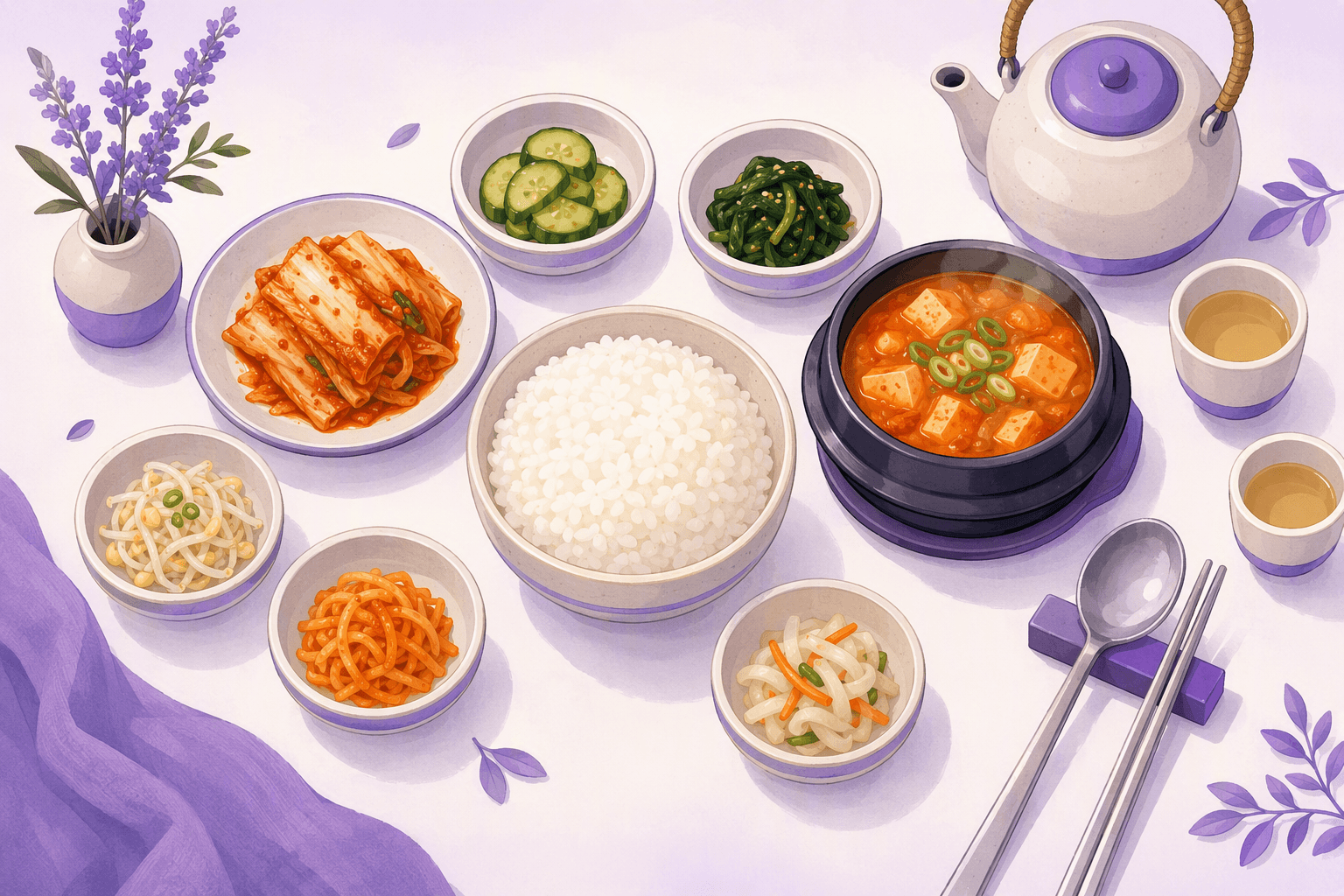
Staple Ingredients and Basics
Korean cuisine is built on a foundation of rice, fermented vegetables, and soup. These staple words appear in virtually every meal and form the backbone of the Korean diet.
| English | Korean | Pronunciation | Note |
|---|---|---|---|
| Rice / Meal | 밥 | bap | Also means 'meal' in general |
| Kimchi | 김치 | gimchi | UNESCO heritage; 200+ varieties |
| Soup | 국 | guk | Broth-based; lighter than 찌개 |
| Stew | 찌개 | jjigae | Thicker than 국, served bubbling |
| Meat | 고기 | gogi | General term for all meat |
| Vegetable | 야채 | yachae | Also 채소 (chaeso) |
| Side dishes | 반찬 | banchan | Always free; refillable |
| Noodles | 면 | myeon | Sino-Korean; 국수 (guksu) = native |
| Water | 물 | mul | 물 주세요 = water please |
| Sauce / Seasoning | 양념 | yangnyeom | As in yangnyeom chicken |
🌍 밥 (Bap): More Than Just Rice
In Korean, 밥 (bap) is far more than a grain. It is synonymous with eating itself. The greeting 밥 먹었어요? (bap meogeosseoyo, "have you eaten rice?") is a way of asking "how are you?" that reflects Korea's agrarian heritage and the cultural centrality of the shared meal. Saying you have not eaten 밥 implies something is fundamentally wrong. Every Korean meal, no matter how elaborate, revolves around a bowl of steamed white rice.
김치
Kimchi deserves special attention. UNESCO inscribed Kimjang (the communal process of making and sharing kimchi) on its Representative List of the Intangible Cultural Heritage of Humanity in 2013. The National Institute of the Korean Language documents over 200 regional varieties, from the iconic 배추김치 (baechu gimchi, napa cabbage kimchi) to 깍두기 (kkakdugi, cubed radish kimchi) and 열무김치 (yeolmu gimchi, young radish kimchi).
Kimchi is served at virtually every meal in Korea: breakfast, lunch, and dinner. It appears as banchan, as the base for stews (김치찌개, gimchi jjigae), fried rice (김치볶음밥, gimchi bokkeumbap), and even as a pancake (김치전, gimchijeon).
Iconic Korean Dishes
These are the dishes that define Korean cuisine on the global stage. Knowing their names and what they contain will help you order with confidence at any Korean restaurant.
| English | Korean | Pronunciation | Note |
|---|---|---|---|
| Bibimbap (mixed rice) | 비빔밥 | bibimbap | 비빔 (mix) + 밥 (rice) |
| Bulgogi (marinated beef) | 불고기 | bulgogi | 불 (fire) + 고기 (meat) |
| Samgyeopsal (pork belly) | 삼겹살 | samgyeopsal | 삼 (three) + 겹 (layers) + 살 (flesh) |
| Tteokbokki (spicy rice cakes) | 떡볶이 | tteokbokki | Korea's #1 street food |
| Gimbap (Korean rice roll) | 김밥 | gimbap | 김 (seaweed) + 밥 (rice) |
| Japchae (glass noodles) | 잡채 | japchae | Party and holiday dish |
| Sundubu jjigae (soft tofu stew) | 순두부찌개 | sundubu jjigae | 순 (soft/pure) + 두부 (tofu) |
| Samgyetang (ginseng chicken soup) | 삼계탕 | samgyetang | Eaten on hottest summer days |
비빔밥
Bibimbap literally breaks down to 비빔 (bibim, mixing) + 밥 (bap, rice). It is a bowl of warm rice topped with seasoned vegetables, gochujang (고추장, red chili paste), a fried egg, and sometimes sliced meat. The key is in the mixing: you stir everything together before eating. The city of Jeonju is considered the birthplace of bibimbap and is a UNESCO Creative City of Gastronomy.
불고기
Bulgogi means "fire meat," from 불 (bul, fire) + 고기 (gogi, meat). Thin slices of beef are marinated in a sweet soy-based sauce with garlic, sesame oil, and pear juice, then grilled. It has been one of Korea's most popular exports, appearing on menus worldwide.
삼겹살
Samgyeopsal literally means "three-layer flesh," referring to the alternating layers of fat and meat in pork belly. It is the centerpiece of Korean BBQ culture and one of Korea's most consumed meats. According to the Korean Food Foundation, pork consumption in Korea averages over 27 kg per person annually, and samgyeopsal accounts for a significant portion of that.
💡 Korean BBQ Etiquette
At a Korean BBQ restaurant, the youngest person at the table typically handles the grilling, as it is considered a sign of respect toward elders. Meat is grilled on a shared table grill, then wrapped in lettuce leaves (상추, sangchu) with garlic, ssamjang (쌈장, dipping paste), and other accompaniments. Never start eating before the eldest person at the table, and always use both hands or your right hand when pouring drinks for elders.
Street Food
Korean street food (길거리 음식, gilgeori eumsik) is a cultural institution, concentrated in night markets and pojangmacha (포장마차, tent stalls). These are the words you will see on every street corner in Seoul.
| English | Korean | Pronunciation | Note |
|---|---|---|---|
| Spicy rice cakes | 떡볶이 | tteokbokki | Most popular street food |
| Korean sweet pancake | 호떡 | hotteok | Filled with brown sugar and nuts |
| Blood sausage | 순대 | sundae | Not ice cream! Glass noodle-stuffed |
| Fish cake (skewered) | 어묵 | eomuk | Also 오뎅 (odeng); served with broth |
| Korean corn dog | 핫도그 | hatdogeu | Often coated in french fries |
| Egg bread | 계란빵 | gyeranbang | Winter street snack |

떡볶이
Tteokbokki is the undisputed king of Korean street food. Chewy rice cakes (떡, tteok) are simmered in a fiery gochujang sauce, often with fish cakes and boiled eggs added. The dish is cheap, filling, and addictive. You will find it at virtually every street food stall and convenience store in Korea. Regional variations include 궁중떡볶이 (gungjung tteokbokki), a royal court version with soy sauce instead of chili paste.
순대
Do not confuse 순대 (sundae) with the frozen dessert. Korean sundae is a type of blood sausage made by stuffing pig intestines with glass noodles, barley, and pork blood. It is typically served sliced with a salt-and-pepper dip, or added to tteokbokki for the popular combo 떡순이 (tteoksuni, a tteokbokki + sundae combo).
Drinks
Korean drinking culture is deeply social, with its own vocabulary and etiquette. These words cover the essentials from water to Korea's most famous spirits.
| English | Korean | Pronunciation | Note |
|---|---|---|---|
| Soju | 소주 | soju | Korea's national spirit; ~17% ABV |
| Rice wine | 막걸리 | makgeolli | Milky, slightly sweet, traditional |
| Beer | 맥주 | maekju | 맥 (barley) + 주 (alcohol) |
| Coffee | 커피 | keopi | Korea is Asia's top coffee market |
| Tea | 차 | cha | 보리차 (boricha, barley tea) is ubiquitous |
| Fried chicken + Beer | 치맥 | chimaek | 치킨 + 맥주 portmanteau |
소주
Soju is the world's best-selling spirit by volume. This clear, slightly sweet liquor is made from rice, wheat, or sweet potatoes, and sits at around 17% ABV in its modern form. It is drunk from small green bottles and poured into shot glasses. A critical cultural rule: never pour your own soju. You pour for others, and they pour for you. When receiving a pour from an elder, hold your glass with both hands as a sign of respect.
치맥
치맥 (chimaek), a blend of 치킨 (chikin, fried chicken) and 맥주 (maekju, beer), is a modern Korean cultural phenomenon. Koreans order crispy fried chicken (often in flavors like yangnyeom or garlic soy) paired with ice-cold beer, typically as a late-night gathering. The chimaek craze went global after the 2014 K-drama 별에서 온 그대 (My Love from the Star), where the main character's love of chimaek caused chicken sales to spike across Asia.
🌍 Korean Drinking Etiquette
Korean drinking culture has strict age-based etiquette. When drinking with someone older: receive your glass with both hands, turn your head slightly away when taking a sip, and never refill your own glass. The call to cheers is 건배 (geonbae, "dry glass"), and if someone says 원샷 (wonsyat, "one shot"), you are expected to drink the entire glass in one go. Refusing a drink from an elder can be seen as disrespectful, though younger generations are increasingly relaxed about this.
Essential Restaurant Phrases
Knowing these phrases will transform your Korean dining experience from stressful pointing to confident ordering. Korean restaurants expect certain verbal rituals that signal politeness and cultural awareness.
| English | Korean | Pronunciation | Note |
|---|---|---|---|
| I will eat well (before eating) | 잘 먹겠습니다 | jal meokgesseumnida | Said to the cook/host |
| I ate well (after eating) | 잘 먹었습니다 | jal meogeosseumnida | Expresses gratitude |
| I'd like to order | 주문할게요 | jumunhalgeyo | Polite ordering phrase |
| Please give me ~ | ~ 주세요 | ~ juseyo | Most useful phrase |
| The check, please | 계산이요 | gyesaniyo | Or 계산해 주세요 |
| Excuse me (calling staff) | 저기요 | jeogiyo | Lit. 'over there' |
| It's delicious | 맛있어요 | masisseoyo | Best compliment to a cook |
| More banchan please | 반찬 더 주세요 | banchan deo juseyo | Refills are always free |
잘 먹겠습니다
This phrase (jal meokgesseumnida, "I will eat well") is spoken before every meal in Korea. It is directed at whoever prepared or is paying for the food, expressing gratitude and respect. After the meal, you close the ritual with 잘 먹었습니다 (jal meogeosseumnida, "I ate well"). Skipping these phrases is considered rude, especially in someone's home or when a senior is treating you. Think of them as the Korean equivalent of saying grace: culturally mandatory, not optional.
반찬
반찬 (banchan), the small side dishes that arrive with every Korean meal, are one of the most distinctive features of Korean dining. A standard meal includes at least three to five banchan, always including kimchi. Banchan are communal: everyone shares from the same plates. And here is the part that surprises many foreigners: refills are always free. Simply say 반찬 더 주세요 (banchan deo juseyo, "more side dishes please"), and fresh portions will arrive. The number of banchan reflects the restaurant's generosity and quality; some traditional restaurants serve over a dozen.
⚠️ Tipping in Korea
Do not tip at Korean restaurants. Tipping is not part of Korean culture and can actually cause confusion or embarrassment. The price on the menu is the final price. Service charges, if applicable, are already included. This applies to all restaurants, from street food stalls to high-end establishments.
Korean BBQ Vocabulary
Korean BBQ (고기집, gogijip, literally "meat house") has its own specialized vocabulary. Knowing these terms will help you navigate the menu and participate in the communal grilling experience.
| English | Korean | Pronunciation | Note |
|---|---|---|---|
| Grill / Grilled meat restaurant | 고기집 | gogijip | 고기 (meat) + 집 (house) |
| Lettuce wrap | 쌈 | ssam | Wrap meat in lettuce leaves |
| Dipping paste | 쌈장 | ssamjang | Soybean + chili paste mix |
| Sesame oil + salt dip | 참기름 | chamgireum | For dipping grilled meat |
| One serving / portion | 1인분 | il-inbun | Most places require min. 2인분 |
At a Korean BBQ restaurant, meat is grilled on a shared tabletop grill. The standard process: grill the meat, dip it in sesame oil with salt (참기름 + 소금) or ssamjang, place it on a lettuce leaf (상추, sangchu) with garlic and condiments, wrap it into a bundle (쌈, ssam), and eat it in one bite. Most BBQ restaurants require a minimum order of 2인분 (i-inbun, two servings) per meat type.
Mukbang and Modern Food Culture
No discussion of Korean food vocabulary is complete without 먹방 (meokbang), the eating broadcast phenomenon that Korea exported to the world.
먹방 is a portmanteau of 먹다 (meokda, to eat) and 방송 (bangsong, broadcast). It began on Korean streaming platform AfreecaTV in the early 2010s and has since become a global content genre. Mukbang creators eat large quantities of food on camera while interacting with viewers, and the format has generated its own vocabulary: ASMR먹방 (ASMR eating sounds), 쿡방 (cookbang, cooking broadcast), and 혼밥 (honbap, eating alone).
The word 혼밥 (honbap), from 혼자 (honja, alone) + 밥 (bap, meal), reflects a major shift in Korean dining culture. Traditionally, eating alone was unusual and even stigmatized. Today, 혼밥 restaurants with individual booths and single-portion menus are thriving in Seoul, reflecting changing social patterns among younger Koreans.
🌍 Food as a Social Connector in Korea
In Korean culture, food is fundamentally communal. Phrases like 같이 밥 먹자 (gachi bap meokja, "let's eat together") are invitations to deepen a relationship. Business deals are often sealed over a meal and soju. Refusing a meal invitation, especially from someone senior, carries social weight. The Korean Food Foundation notes that the communal structure of Korean dining, from shared banchan to hotpots to BBQ, is designed to reinforce group bonds.
Practice Food Vocabulary With Real Korean Content
The best way to internalize Korean food vocabulary is to encounter it in context. Korean cooking shows, mukbang videos, and food-centered K-dramas are packed with the words in this guide. Shows like 삼시세끼 (Three Meals a Day) and 나 혼자 산다 (I Live Alone) feature extensive cooking and eating scenes where you will hear 밥, 김치, 고기, and 맛있어요 used naturally.
Wordy lets you practice food vocabulary by watching Korean content with interactive subtitles. When a food word appears in dialogue, you can tap it to see the Hangul, pronunciation, and meaning in context, which is far more effective than memorizing from a list alone.
Explore our blog for more Korean guides, or check out the best movies and dramas to learn Korean for viewing recommendations that bring this vocabulary to life.
Frequently Asked Questions
What are the most important Korean food words to learn first?
What do you say before eating in Korean?
What is banchan in Korean dining?
How do you order food in Korean?
What is chimaek (치맥) in Korean culture?
Sources & References
- National Institute of the Korean Language (국립국어원), Standard Korean Dictionary (표준국어대사전)
- UNESCO, Kimjang: Making and Sharing Kimchi, Inscribed 2013 on the Representative List of the Intangible Cultural Heritage of Humanity
- Korean Food Foundation (한식재단), Global Hansik Promotion Report (2024)
- Ethnologue: Languages of the World, Korean language entry (2024)
Start learning with Wordy
Watch real movie clips and build your vocabulary as you go. Free to download.


