Quick Answer
The most common way to say yes in Korean is '네' (Ne), and the most common way to say no is '아니요' (Aniyo). Both are polite-level expressions safe for everyday use with strangers, coworkers, and acquaintances. However, Korean has multiple ways to express agreement and disagreement depending on formality, closeness, and context, from the casual '응' (Eung) among friends to the emphatic '절대로' (Jeoldaero, absolutely not) for strong refusal.
The Short Answer
The most common way to say yes in Korean is 네 (Ne), and the most common way to say no is 아니요 (Aniyo). Both are polite-level expressions appropriate for the vast majority of everyday interactions, from strangers and shopkeepers to coworkers and acquaintances.
Korean is spoken by over 80 million people worldwide, and its system of speech levels means that even simple words like "yes" and "no" shift form depending on the listener's age, social status, and your relationship. According to the National Institute of Korean Language (국립국어원), the polite speech level (-요 ending) dominates everyday conversation, but casual and formal variants are just as essential to sound natural.
"Affirmation and negation in Korean are not simple binary acts. The speaker must encode social distance, deference, and emotional stance into every response, even a one-syllable 'yes' or 'no.'"
(Ho-Min Sohn, The Korean Language, Cambridge University Press, 1999)
This guide covers 13 essential ways to say yes and no in Korean, organized by speech level and situation. Each expression includes Hangul, romanization, pronunciation, an example sentence, and cultural context so you know exactly when and how to use it.

Quick Reference: Korean Yes and No at a Glance
| English | Korean | Pronunciation | Formality |
|---|---|---|---|
| Yes (polite) | 네 | Ne | polite |
| Yes (formal) | 예 | Ye | formal |
| Yeah (casual) | 응 | Eung | casual |
| That's right | 맞아요 | Ma-ja-yo | polite |
| Of course | 물론이죠 | Mul-lo-ni-jyo | polite |
| Sure / Yeah (casual) | 그래 | Geu-rae | casual |
| Naturally / Obviously | 당연하죠 | Dang-yeon-ha-jyo | polite |
| No (polite) | 아니요 | A-ni-yo | polite |
| No (casual) | 아니 | A-ni | casual |
| You can't / Not allowed | 안 돼요 | An dwae-yo | polite |
| I don't want to | 싫어요 | Shi-reo-yo | polite |
| Absolutely not | 절대로 | Jeol-dae-ro | formal |
| I'm okay (polite decline) | 괜찮아요 | Gwaen-chan-a-yo | polite |
Speech Levels for Yes and No
Before diving into individual expressions, it helps to understand how Korean speech levels shape even the simplest responses. The word you choose for "yes" or "no" immediately signals your relationship with the listener.
| Speech Level | Yes | No | When to Use |
|---|---|---|---|
| Formal (격식체) | 예 (Ye) | 아닙니다 (Animnida) | Military, interviews, ceremonies, news |
| Polite (존댓말) | 네 (Ne) | 아니요 (Aniyo) | Default for strangers, coworkers, elders |
| Casual (반말) | 응 (Eung) / 어 (Eo) | 아니 (Ani) | Close friends, younger people, children |
As Yeon and Brown explain in Korean: A Comprehensive Grammar (Routledge, 2011), the polite level with the -요 ending is the "unmarked default" of modern Korean conversation. Using formal speech in a casual situation sounds stiff; using casual speech with the wrong person causes genuine offense.
⚠️ Yes Does Not Always Mean Agreement
In Korean, 네 (Ne) often functions as a conversation filler meaning "I'm listening" or "I understand," not necessarily "I agree." A Korean speaker might say 네, 네, 네 repeatedly during a phone call simply to signal attentiveness. Do not assume that hearing 네 means the person agrees with you. Listen to the full response.
Ways to Say Yes in Korean
These expressions range from the everyday polite 네 to emphatic affirmations like 당연하죠. Each serves a different social and emotional function.
네 (Ne)
/Ne/
Literal meaning: Yes
“네, 알겠습니다. 바로 하겠습니다.”
Yes, I understand. I'll do it right away.
The default polite 'yes' for everyday Korean. Works with strangers, coworkers, shopkeepers, and elders. Also functions as a listening signal ('uh-huh') during conversation, especially on the phone.
This is the single most important affirmative word in Korean. You will hear it dozens of times in any conversation, not just as "yes," but as a backchannel signal meaning "I'm listening" or "go on." The King Sejong Institute identifies 네 as one of the very first words Korean learners should master.
Pronunciation tip: it sounds close to English "neh" with a short, clean vowel. Some Korean speakers pronounce it closer to "de" in rapid speech, but this is a natural phonological shift and not a different word.
예 (Ye)
/Ye/
Literal meaning: Yes (formal)
“예, 사장님. 보고서 준비하겠습니다.”
Yes, sir. I will prepare the report.
The formal variant of 네. Preferred in military contexts, formal interviews, and when addressing superiors in hierarchical organizations. Sounds more deferential and crisp than 네.
While 네 and 예 are technically interchangeable, 예 carries a slightly higher register of formality. You will hear it in Korean military dramas, corporate boardroom scenes, and formal press conferences. In daily life, 네 is far more common, but 예 is never wrong. It simply sounds more deferential.
응 (Eung)
/Eung/
Literal meaning: Yeah
“응, 나도 가고 싶어.”
Yeah, I want to go too.
The casual 'yeah' used exclusively with close friends, siblings, or people younger than you. Very common in text messages and KakaoTalk. Never use with elders or strangers.
The casual equivalent of 네. Korean friends texting each other will use 응 constantly. It is warm, informal, and effortless. A close variant is 어 (Eo), which carries the same casual tone and is sometimes used interchangeably. Using 응 with someone older or unfamiliar would be a clear breach of speech level etiquette.
맞아요 (Majayo)
/Ma-ja-yo/
Literal meaning: That's right / That's correct
“맞아요, 그 식당이 정말 맛있어요.”
That's right, that restaurant is really delicious.
Used to confirm a fact or agree with a statement, rather than answering a yes/no question. Think of it as 'exactly' or 'that's correct.' Very common in conversation when validating what someone else said.
While 네 answers yes/no questions, 맞아요 confirms statements. If someone says "You're from Seoul, right?" the natural response is 맞아요, meaning "That's right." It adds a layer of active agreement beyond simple acknowledgment. The casual form is 맞아 (Maja), and the formal form is 맞습니다 (Matseumnida).
물론이죠 (Mullonijyo)
/Mul-lo-ni-jyo/
Literal meaning: Of course it is
“도와줄 수 있어요? 물론이죠!”
Can you help me? Of course!
An enthusiastic, emphatic yes meaning 'of course' or 'absolutely.' Conveys willingness and eagerness. Common when someone asks for help or a favor and you want to respond positively.
This goes beyond simple agreement into enthusiastic affirmation. It signals not just "yes" but "yes, and I'm happy about it." Use it when you want to express willingness, not just acknowledgment. It is polite but warm, making it perfect for workplace and social situations alike.
그래 (Geurae)
/Geu-rae/
Literal meaning: That's so / Sure
“그래, 내일 보자.”
Sure, let's meet tomorrow.
A casual affirmative meaning 'sure,' 'okay,' or 'yeah.' Very versatile among friends. The polite form is '그래요' (Geuraeyo). Also used as a filler to keep conversation flowing.
A multipurpose casual affirmative that functions like "sure," "okay," or "right" in English. It is one of the most frequent words in casual Korean conversation. The polite version 그래요 (Geuraeyo) works in slightly more formal contexts while maintaining warmth.
당연하죠 (Dangyeonhajyo)
/Dang-yeon-ha-jyo/
Literal meaning: It is natural / Obviously
“한국어 계속 공부할 거예요? 당연하죠!”
Are you going to keep studying Korean? Of course!
An emphatic 'of course' with a nuance of 'obviously' or 'it goes without saying.' Slightly stronger than 물론이죠. Used when the answer feels self-evident to the speaker.
Where 물론이죠 means "of course," 당연하죠 pushes further toward "obviously" or "naturally." It implies the answer is so clear it barely needed asking. The casual form 당연하지 (Dangyeonhaji) is common among friends.
Ways to Say No in Korean
Saying no in Korean requires more social awareness than saying yes. Korean culture values indirect communication and preserving the other person's face (체면, chemyeon). A blunt "no" can feel harsh, so Koreans often soften refusals with hedging, alternatives, or indirect expressions.
🌍 The Art of Indirect Refusal
Direct refusal is relatively uncommon in Korean social interaction. According to research in Korean pragmatics, speakers frequently use softening strategies: trailing off mid-sentence, offering an excuse before the refusal, saying "it's a little difficult" (좀 어려울 것 같아요) instead of a flat "no," or using 괜찮아요 (I'm fine) to decline without explicitly refusing. Understanding this cultural pattern is just as important as learning the words themselves.
아니요 (Aniyo)
/A-ni-yo/
Literal meaning: No
“아니요, 저는 학생이 아니에요.”
No, I am not a student.
The standard polite 'no' for everyday situations. Safe with strangers, coworkers, and elders. Often softened with a slight head bow or an apologetic tone to reduce bluntness.
The default polite "no." It answers direct questions factually: "Are you Korean?" "아니요, 미국 사람이에요" (No, I'm American). While it is perfectly polite, Koreans often pair it with additional softening phrases to avoid sounding too abrupt, especially when declining invitations or requests.
Pronunciation tip: three clean syllables, "a-ni-yo." The older formal variant 아닙니다 (Animnida) appears in very formal contexts like military speech or news broadcasts.
아니 (Ani)
/A-ni/
Literal meaning: No (casual)
“아니, 그게 아니라 다른 거야.”
No, it's not that / it's something else.
The casual form of 아니요. Used with close friends and younger people. Also functions as a surprised interjection meaning 'wait, what?' or 'no way!' at the start of a sentence.
The casual counterpart to 아니요. Beyond simple negation, 아니 frequently appears as a conversational interjection expressing surprise or disbelief, similar to starting a sentence with "No, wait..." or "Hold on..." in English. You will hear this constantly in K-dramas during dramatic revelations.
안 돼요 (An Dwaeyo)
/An dwae-yo/
Literal meaning: It doesn't work / Not allowed
“여기서 사진 찍어도 돼요? 안 돼요, 죄송합니다.”
Can I take photos here? No, you can't. I'm sorry.
Expresses prohibition or impossibility rather than simple disagreement. Used by parents denying children, authorities enforcing rules, and anyone refusing permission. Stronger and more definitive than 아니요.
While 아니요 negates a fact, 안 돼요 denies permission or declares something impossible. It is the Korean equivalent of "you can't" or "that won't work." Parents use it with children, security guards use it at restricted areas, and friends use the casual form 안 돼 (An dwae) to object to bad ideas. In K-dramas, the dramatic cry of "안 돼!" during emotional scenes is practically a genre staple.
싫어요 (Shireoyo)
/Shi-reo-yo/
Literal meaning: I dislike it / I don't want to
“매운 음식 좋아해요? 아니요, 싫어요.”
Do you like spicy food? No, I don't like it.
Expresses personal dislike or unwillingness. Stronger than a simple 'no' because it communicates emotional rejection. The casual form '싫어' (Shireo) is common among close friends and in dramatic K-drama refusals.
This goes beyond "no" into "I don't want to" or "I dislike it." It carries emotional weight: using 싫어요 makes your personal feelings explicit, which is stronger than a neutral 아니요. The casual form 싫어 (Shireo) is one of the most dramatic words in K-drama vocabulary, often delivered with visible emotion during confrontation scenes.
절대로 (Jeoldaero)
/Jeol-dae-ro/
Literal meaning: Absolutely / Never
“절대로 포기하지 마세요.”
Never give up, absolutely.
An emphatic adverb meaning 'absolutely' or 'never.' Used to intensify both affirmative and negative statements. '절대로 안 돼요' means 'absolutely not.' Carries strong conviction and finality.
An intensifier rather than a standalone "no," 절대로 adds absolute finality to any statement. Paired with negation (절대로 안 돼요, "absolutely not allowed," or 절대로 아니에요, "absolutely not"), it creates the strongest possible refusal in Korean. Use it sparingly; it carries serious weight.
괜찮아요 (Gwaenchanayo): The Polite Decline
/Gwaen-chan-a-yo/
Literal meaning: It's okay / I'm fine
“커피 한 잔 더 드릴까요? 괜찮아요, 감사합니다.”
Shall I pour you another coffee? I'm okay, thank you.
The most common way to politely decline in Korean. Literally means 'it's okay' but functions as a soft 'no thank you.' Preserves social harmony by avoiding direct refusal. Essential for navigating Korean politeness culture.
This is arguably the most culturally important "no" in Korean. Rather than directly refusing, 괜찮아요 lets you decline while maintaining warmth and social harmony. When a shopkeeper offers help, a host offers more food, or a colleague suggests plans you cannot join, 괜찮아요 paired with a smile is the Korean way to say no without saying no.
Head Gestures and Body Language
Korean body language for yes and no can confuse foreigners accustomed to Western conventions.
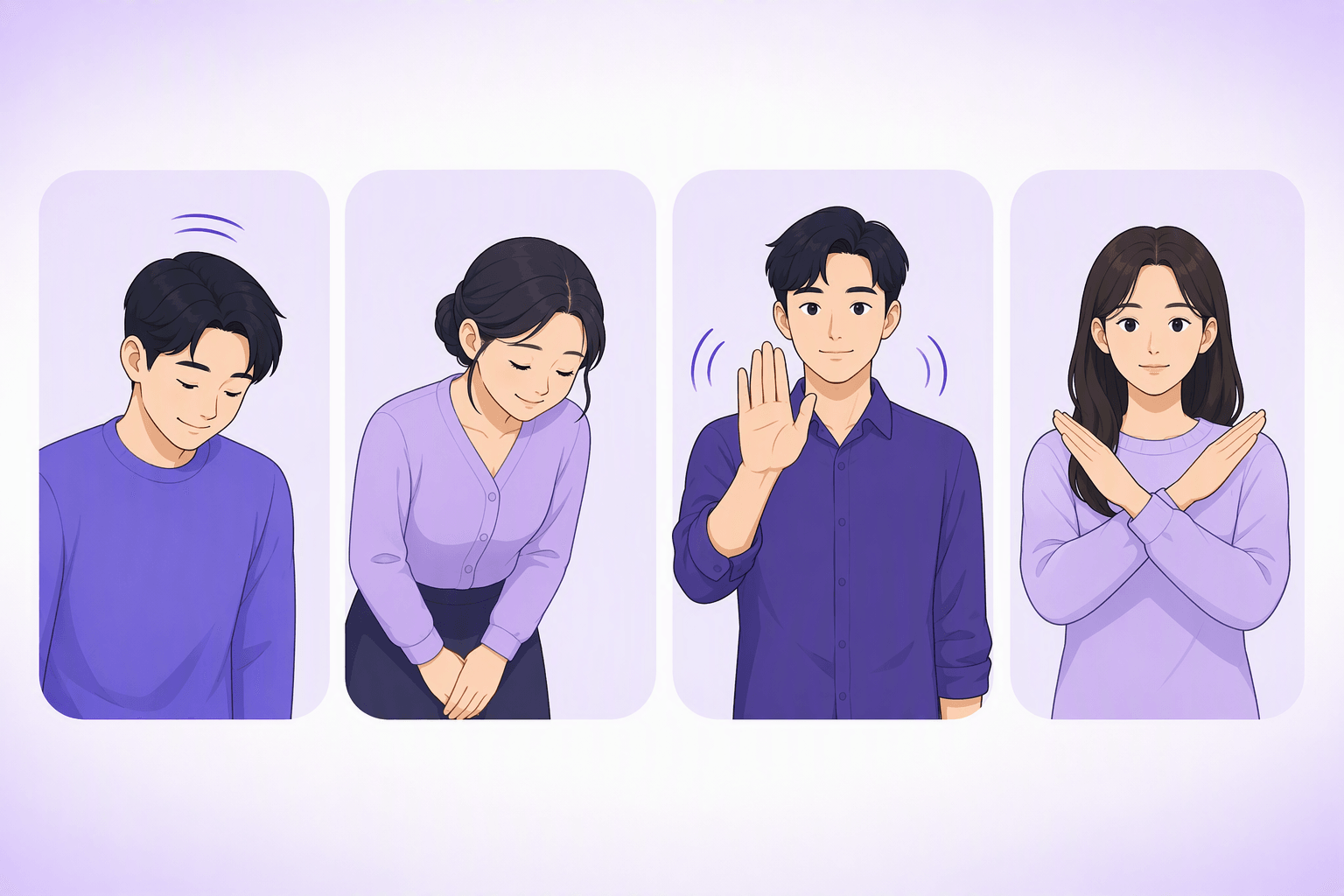
| Gesture | Meaning | Notes |
|---|---|---|
| Slight nod | Acknowledgment / "I'm listening" | Does NOT always mean "yes"; often just signals attention |
| Deeper nod with 네 | Genuine agreement | The verbal confirmation matters more than the nod |
| Slight bow while saying 아니요 | Polite refusal | The bow adds courtesy to the negation |
| Waving hand side to side (palm out) | "No" / "Not at all" | Common casual gesture to dismiss praise or decline offers |
| Crossing arms in an X shape | Strong "no" / "Not available" | Used by staff at businesses, ticket counters, and in casual gestures |
💡 Watch the Words, Not Just the Head
Koreans often give a small nod even while saying 아니요 (no). This nod is a politeness gesture that acknowledges your question respectfully, not a sign of agreement. Foreigners frequently misread this as a "yes." Always prioritize the spoken word over the head movement.
Yes/No Patterns in K-Dramas
Korean dramas are one of the best resources for hearing yes and no used naturally across different speech levels. Here are patterns to listen for.
| Drama Context | Yes Pattern | No Pattern |
|---|---|---|
| Romantic scenes (friends/lovers) | 응 (Eung), 그래 (Geurae) | 싫어 (Shireo), 아니 (Ani) |
| Corporate/workplace scenes | 네 (Ne), 예 (Ye) | 아니요 (Aniyo), 안 됩니다 (An deomnida) |
| Military/historical dramas | 예 (Ye), 알겠습니다 (Algetseumnida) | 아닙니다 (Animnida) |
| Family scenes with elders | 네 (Ne) | 아니요 (Aniyo), 괜찮아요 (Gwaenchanayo) |
| Dramatic confrontations | 맞아 (Maja, "That's right!") | 안 돼! (An dwae!), 절대로! (Jeoldaero!) |
Check out our guide to the best Korean movies to find content where you can hear these patterns in action. Military dramas like D.P. showcase formal yes/no speech, while romantic dramas like Crash Landing on You highlight the contrast between North and South Korean casual affirmatives.
Polite Refusal Strategies
Direct refusal is rare in Korean communication. Here are the most common softening strategies, ranked from most indirect to most direct.
| Strategy | Korean Expression | Literal Meaning | How It Functions |
|---|---|---|---|
| "I'm fine" | 괜찮아요 | It's okay | Soft decline without explanation |
| "It's a bit difficult" | 좀 어려울 것 같아요 | It seems it would be a little difficult | Signals refusal without flat "no" |
| "I'll think about it" | 생각해 볼게요 | I'll try thinking about it | Delayed refusal (often means no) |
| "Next time" | 다음에요 | Next time | Declines the current offer politely |
| Direct no | 아니요 | No | Used when clarity is essential |
According to the King Sejong Institute's language education guidelines, Korean learners should master indirect refusal patterns early, as they are essential for social fluency. Understanding that "I'll think about it" often means "no" and that "it's a little difficult" is a refusal (not a request for help) prevents misunderstandings.
Practice With Real Korean Content
Reading about yes and no builds knowledge, but hearing them in natural conversation is what builds instinct. Korean dramas, films, and variety shows expose you to dozens of yes/no variations per episode, each shaped by the characters' relationships and social dynamics.
Wordy lets you watch Korean content with interactive subtitles, tapping on any word to see its meaning, speech level, and usage context in real time. When a character says 괜찮아요 to politely decline or shouts 안 돼! in a dramatic scene, you can instantly understand the social mechanics behind the word choice.
For more Korean resources, explore our blog for guides on everything from the best movies to learn Korean to greetings and expressions. You can also visit our Korean learning page to start practicing with real content today.
Frequently Asked Questions
What is the most common way to say yes in Korean?
What is the difference between 네 (Ne) and 예 (Ye)?
How do you politely say no in Korean?
Why do Koreans nod when saying no?
What does 안 돼요 mean compared to 아니요?
How do K-drama characters say yes and no differently?
Sources & References
- National Institute of Korean Language (국립국어원), Standard Korean Language Dictionary
- Yeon, J. & Brown, L. (2011). 'Korean: A Comprehensive Grammar.' Routledge.
- Sohn, H.-M. (1999). 'The Korean Language.' Cambridge University Press.
- King Sejong Institute Foundation, Korean Language Education Guidelines (2024)
Start learning with Wordy
Watch real movie clips and build your vocabulary as you go. Free to download.


