Quick Answer
The 12 months in Italian are: gennaio, febbraio, marzo, aprile, maggio, giugno, luglio, agosto, settembre, ottobre, novembre, dicembre. They are always lowercase (unless starting a sentence), always masculine, and Italian is the Romance language whose month names remain closest to the original Latin. Use 'a' or 'in' with months: 'a gennaio' or 'in gennaio' both mean 'in January.'
The 12 Italian months are gennaio, febbraio, marzo, aprile, maggio, giugno, luglio, agosto, settembre, ottobre, novembre, dicembre. If you already know the English months, learning Italian months is remarkably straightforward because Italian preserves the original Latin month names more faithfully than any other Romance language.
With approximately 68 million native speakers according to Ethnologue's 2024 data, Italian is spoken across Italy, Switzerland, San Marino, and Vatican City, with significant communities in Argentina, Brazil, and the United States. Understanding the calendar is essential whether you are booking a pensione in Tuscany, navigating Italian bureaucracy, or simply reading a restaurant menu that changes ogni mese (every month).
"Italian maintains a closer morphological relationship to Latin than any other major Romance language. This is nowhere more evident than in its calendar terminology, where the month names have undergone minimal phonological change from their Latin originals."
(Bernard Comrie, The World's Major Languages, Routledge)
This guide covers all 12 months with pronunciation, their Latin origins, the grammar rules you need, and the cultural calendar that makes Italy unique.

The 12 Months in Italian
Here are all twelve months with English pronunciation approximations. Every Italian month is masculine and written in lowercase.
| English | Italian | Pronunciation |
|---|---|---|
| January | Gennaio | jen-NAH-yoh |
| February | Febbraio | feb-BRAH-yoh |
| March | Marzo | MAR-tsoh |
| April | Aprile | ah-PREE-leh |
| May | Maggio | MAHD-joh |
| June | Giugno | JOON-yoh |
| July | Luglio | LOOL-yoh |
| August | Agosto | ah-GOH-stoh |
| September | Settembre | set-TEM-breh |
| October | Ottobre | ot-TOH-breh |
| November | Novembre | noh-VEM-breh |
| December | Dicembre | dee-CHEM-breh |
💡 Lowercase Rule
Italian months are always lowercase: gennaio, febbraio, marzo. The only time you capitalize a month is when it starts a sentence. This same rule applies to Italian days of the week, a sharp contrast with English, where both are always capitalized.
Latin Origins: Why Italian Months Sound Familiar
Italian month names are the most direct descendants of Latin among all Romance languages. If you compare Italian, Spanish, and French side by side, Italian consistently stays closest to the original Latin form.
| English | Italian | Pronunciation |
|---|---|---|
| Latin: Ianuarius | Gennaio | Named for Janus, god of beginnings |
| Latin: Februarius | Febbraio | From februum, purification ritual |
| Latin: Martius | Marzo | Named for Mars, god of war |
| Latin: Aprilis | Aprile | Possibly from aperire (to open) |
| Latin: Maius | Maggio | Named for Maia, goddess of growth |
| Latin: Iunius | Giugno | Named for Juno, goddess of marriage |
| Latin: Iulius | Luglio | Named for Julius Caesar |
| Latin: Augustus | Agosto | Named for Emperor Augustus |
| Latin: September | Settembre | From septem (seven) |
| Latin: October | Ottobre | From octo (eight) |
| Latin: November | Novembre | From novem (nine) |
| Latin: December | Dicembre | From decem (ten) |
The last four months reveal something fascinating about Roman history. Settembre through dicembre derive from the Latin numbers 7 through 10 because the original Roman calendar started in March, making September the seventh month. When January and February were added by King Numa Pompilius around 713 BC, the number-based names were never corrected.
The Treccani encyclopedia notes that luglio underwent the most dramatic phonological shift from its Latin source Iulius, with the initial "I" transforming to "L" through a process unique to Italian among Romance languages. Spanish retained julio and French kept juillet, both closer to the Latin original in their initial consonant.
Pronunciation Patterns
Italian month pronunciation follows consistent rules that make the system learnable once you know a few patterns.
The -embre / -obre Cluster
The final four months share a rhythmic pattern: settembre, ottobre, novembre, dicembre. They all stress the second-to-last syllable and end in -bre. Once you master one, the others follow naturally.
Double Consonants Matter
Italian distinguishes between single and double consonants. Febbraio has a double B (feb-BRAH-yoh), maggio has a double G (MAHD-joh), settembre has a double T (set-TEM-breh), and ottobre has a double T (ot-TOH-breh). Pronouncing double consonants means holding the sound slightly longer. Skip this and native speakers will notice immediately.
The GN and GL Sounds
Gennaio and giugno both contain the Italian gn combination, which sounds like the "ny" in "canyon." Luglio contains the gl combination (before i), which produces a "ly" sound similar to the "lli" in "million." These are two of the most distinctively Italian sounds and appear nowhere in English.
💡 Practice Trick
Say "canyon" slowly, then isolate the "ny" sound in the middle. That is exactly the Italian gn. Now say "million" and isolate the "lli": that is the Italian gli. Practice with giugno (JOON-yoh) and luglio (LOOL-yoh) until these sounds feel natural.
Grammar Rules for Italian Months
Gender and Articles
All Italian months are masculine. When you need an article, use il for months starting with a consonant and l' for aprile, agosto, and ottobre (which start with vowels):
- il gennaio più freddo (the coldest January)
- l'agosto più caldo (the hottest August)
- l'aprile scorso (last April)
Prepositions with Months
This is where learners often hesitate. The Accademia della Crusca confirms that three forms are all equally correct when expressing "in" a particular month:
| English | Italian | Pronunciation | Note |
|---|---|---|---|
| in January (form 1) | A gennaio | ah jen-NAH-yoh | Most common in speech |
| in January (form 2) | In gennaio | een jen-NAH-yoh | Equally correct |
| in January (form 3) | Nel mese di gennaio | nel MEH-zeh dee jen-NAH-yoh | Formal / emphatic |
In everyday conversation, a gennaio is the most frequently heard form. In gennaio is equally natural. The longer nel mese di gennaio (in the month of January) is reserved for formal writing or when you want extra emphasis.
Writing Dates in Italian
Italian date format is day-month-year, the opposite of American English. The definite article il precedes the day number, and the first of any month always uses the ordinal primo:
- il primo marzo (March 1st): ordinal for the first
- il 2 marzo (March 2nd): cardinal for all other days
- il 25 dicembre 2026 (December 25, 2026)
- il 14 febbraio (February 14)
🌍 Date Format Differences
When writing dates with numbers, Italy uses the European format: 25/12/2026 (day/month/year). This is the opposite of the American 12/25/2026. Confusing the two can lead to real problems with travel bookings, visa dates, and appointments. The safest approach is to write the month name: 25 dicembre 2026 leaves no room for ambiguity.
The Italian Cultural Calendar
Italy's calendar is packed with traditions, festivals, and holidays that vary by region. Knowing the months means understanding when and why Italy celebrates.
Gennaio
The year begins with Capodanno (New Year's Day) on January 1st and Epifania on January 6th. The Epiphany is a major holiday in Italy, when children receive gifts from La Befana, a folklore figure who flies on a broomstick delivering candy to good children and coal to naughty ones. Many Italians consider the holiday season officially over only after January 6th.
Febbraio
February brings Carnevale, the legendary pre-Lenten festival. The Carnevale di Venezia is among the most famous in the world, with elaborate masks, costumes, and events spanning roughly two weeks. The exact dates shift each year since Carnival ends on Martedì Grasso (Fat Tuesday), which depends on Easter's date.
Marzo
March 8th is Festa della Donna (International Women's Day), celebrated across Italy with the gifting of mimosa flowers. Italian men give mimosa branches to the women in their lives: colleagues, mothers, partners, friends. The bright yellow flowers become ubiquitous at every street corner and market.
Aprile
Easter (Pasqua) often falls in April, and it is one of Italy's most important holidays. The Monday after Easter, Pasquetta (Little Easter), is a national holiday when Italians traditionally have outdoor picnics. April 25th is Festa della Liberazione, commemorating Italy's liberation from Nazi occupation in 1945.
Giugno
June 2nd is Festa della Repubblica, Italy's national day celebrating the 1946 referendum that established the Italian Republic. Rome hosts a military parade along Via dei Fori Imperiali, and le Frecce Tricolori (the Italian Air Force aerobatic team) paint the sky in green, white, and red.
Luglio e Agosto
July and August are defined by il Palio di Siena, the famous bareback horse race held in Siena's Piazza del Campo on July 2nd and August 16th. Each race represents centuries of rivalry between the city's contrade (neighborhoods).
Agosto
Ferragosto on August 15th is perhaps Italy's most culturally distinctive holiday. Originating from Emperor Augustus's Feriae Augusti in 18 BC, it has evolved into a mass vacation phenomenon. For roughly two to three weeks surrounding Ferragosto, factories close, shops shutter their doors, and cities empty as Italians flock to the coasts and mountains. Trying to conduct business in Italian cities during mid-August is nearly impossible, a fact that regularly surprises foreign visitors.
🌍 The Ferragosto Shutdown
If you are planning a trip to Italy, avoid scheduling any business, medical appointments, or administrative tasks during the first three weeks of August. Most Italian companies give employees the entire period off. Restaurants in tourist areas stay open, but many neighborhood establishments close entirely. Rome, Milan, and Florence become ghost towns of their usual selves, while coastal towns like Rimini, Positano, and the Sardinian coast overflow with vacationers.
Dicembre
December revolves around Natale (Christmas) on the 25th and Santo Stefano (St. Stephen's Day) on the 26th. Italian Christmas traditions vary dramatically by region: panettone dominates in the north while pandoro is the sweet bread of choice in Verona and the northeast. The season extends through January 6th, making the Italian holiday period one of the longest in Europe.
Seasons and Month Groupings
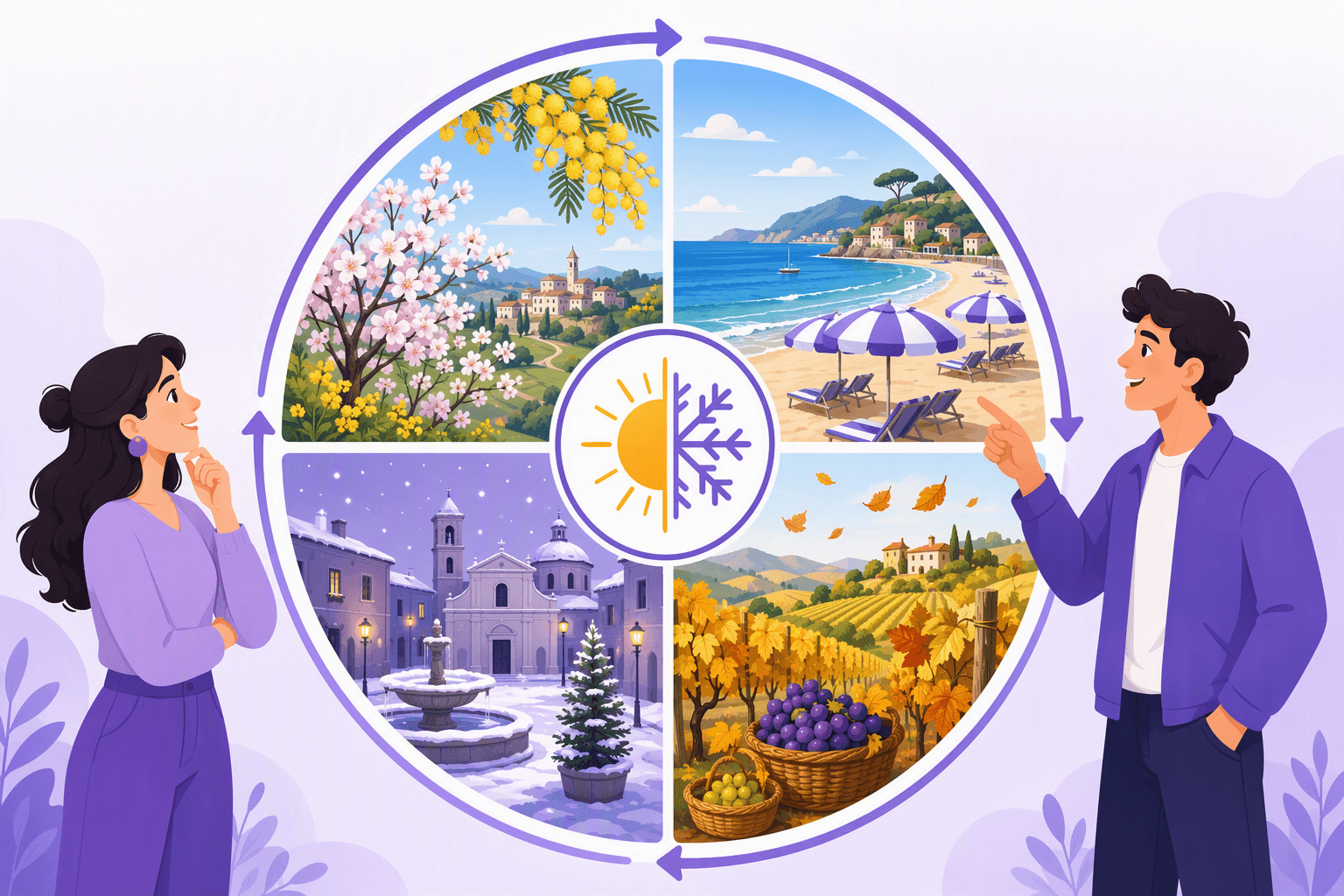
Italians group months into seasons slightly differently than some English speakers might expect. The meteorological seasons are:
| English | Italian | Pronunciation | Note |
|---|---|---|---|
| Spring | Primavera | pree-mah-VEH-rah | Marzo, aprile, maggio |
| Summer | Estate | eh-STAH-teh | Giugno, luglio, agosto |
| Autumn | Autunno | ow-TOON-noh | Settembre, ottobre, novembre |
| Winter | Inverno | een-VEHR-noh | Dicembre, gennaio, febbraio |
With seasons, Italian uses in without an article: in primavera (in spring), in estate (in summer), in autunno (in autumn), in inverno (in winter). This differs from the month prepositions where you can use either a or in.
Useful Phrases with Months
Once you know the month names, these expressions will help you use them naturally in conversation:
| English | Italian | Pronunciation | Note |
|---|---|---|---|
| What month is it? | Che mese è? | keh MEH-zeh eh | |
| We are in February | Siamo a febbraio | see-AH-moh ah feb-BRAH-yoh | |
| I was born in March | Sono nato/a a marzo | SOH-noh NAH-toh ah MAR-tsoh | nato (m) / nata (f) |
| Last month | Il mese scorso | eel MEH-zeh SKOR-soh | |
| Next month | Il mese prossimo | eel MEH-zeh PROS-see-moh | |
| Every month | Ogni mese | ON-yee MEH-zeh | |
| From June to August | Da giugno ad agosto | dah JOON-yoh ahd ah-GOH-stoh |
Notice that nato changes to nata for women because Italian past participles agree with the subject's gender when used with essere (to be). This is a fundamental Italian grammar rule you will encounter constantly.
Practice with Real Italian Content
The months appear everywhere in Italian daily life, from train schedules and museum hours to news broadcasts and film dialogue. Repeated exposure in real contexts is the fastest way to internalize them.
Italian cinema offers excellent calendar-related vocabulary practice. Films like Ferragosto scenes in Italian comedies, period dramas referencing historical dates, and everyday conversations about plans and schedules all reinforce month names naturally. Check out our guide to the best movies for learning Italian for recommendations across different genres and difficulty levels.
Wordy helps you practice Italian vocabulary in real context through movies and TV shows with interactive subtitles. When a month or date appears in dialogue, you can tap it to see the meaning, hear the pronunciation, and build your calendar vocabulary naturally. Explore our blog for more Italian learning guides, including Italian days of the week and Italian numbers to complete your foundational vocabulary.
Frequently Asked Questions
What are the 12 months in Italian?
Are Italian months capitalized?
How do you say dates in Italian?
Do you use 'a' or 'in' with Italian months?
Why does Italy shut down in August?
Sources & References
- Accademia della Crusca, Italian language usage guidance on prepositions with months
- Treccani, Enciclopedia e Vocabolario online, month etymologies
- Ethnologue: Languages of the World, 27th edition (2024), Italian: 68 million native speakers
- Comrie, B. (ed.), The World's Major Languages (Routledge)
Start learning with Wordy
Watch real movie clips and build your vocabulary as you go. Free to download.


