Quick Answer
The Italian word for family is 'la famiglia' (lah fah-MEE-lyah). Core members include madre (mother), padre (father), fratello (brother), and sorella (sister). Italian family vocabulary has a unique grammar rule: possessive adjectives drop the article with singular family members (mio padre, mia madre) but keep it for plural or modified forms (i miei fratelli, il mio caro papà).
Few words carry as much emotional weight in Italian as la famiglia. Italian is spoken by approximately 68 million native speakers according to Ethnologue's 2024 data, and across every region of Italy, from the Alps of Trentino to the coasts of Sicily, family remains the absolute cornerstone of social life. Whether you're looking up "italian family words" for travel, study, or conversation, this guide covers everything you need.
Whether you are introducing your relatives, following the plot of an Italian film, or simply trying to understand why your Italian friend calls home three times a day, knowing family vocabulary is essential. Italian family terms also come with a grammar quirk that trips up nearly every learner: the possessive article rule, which we will break down in full.
"The Italian kinship system reflects a bilateral structure typical of European societies, but the cultural weight placed on extended family bonds, particularly the mother-child relationship, distinguishes Italy from most of its Western European neighbors."
(G.P. Murdock, Social Structure, 1949)
This guide covers 25+ family terms organized by category: immediate family, extended relatives, in-laws, and affectionate forms, plus the grammar and cultural context you need to use them naturally.
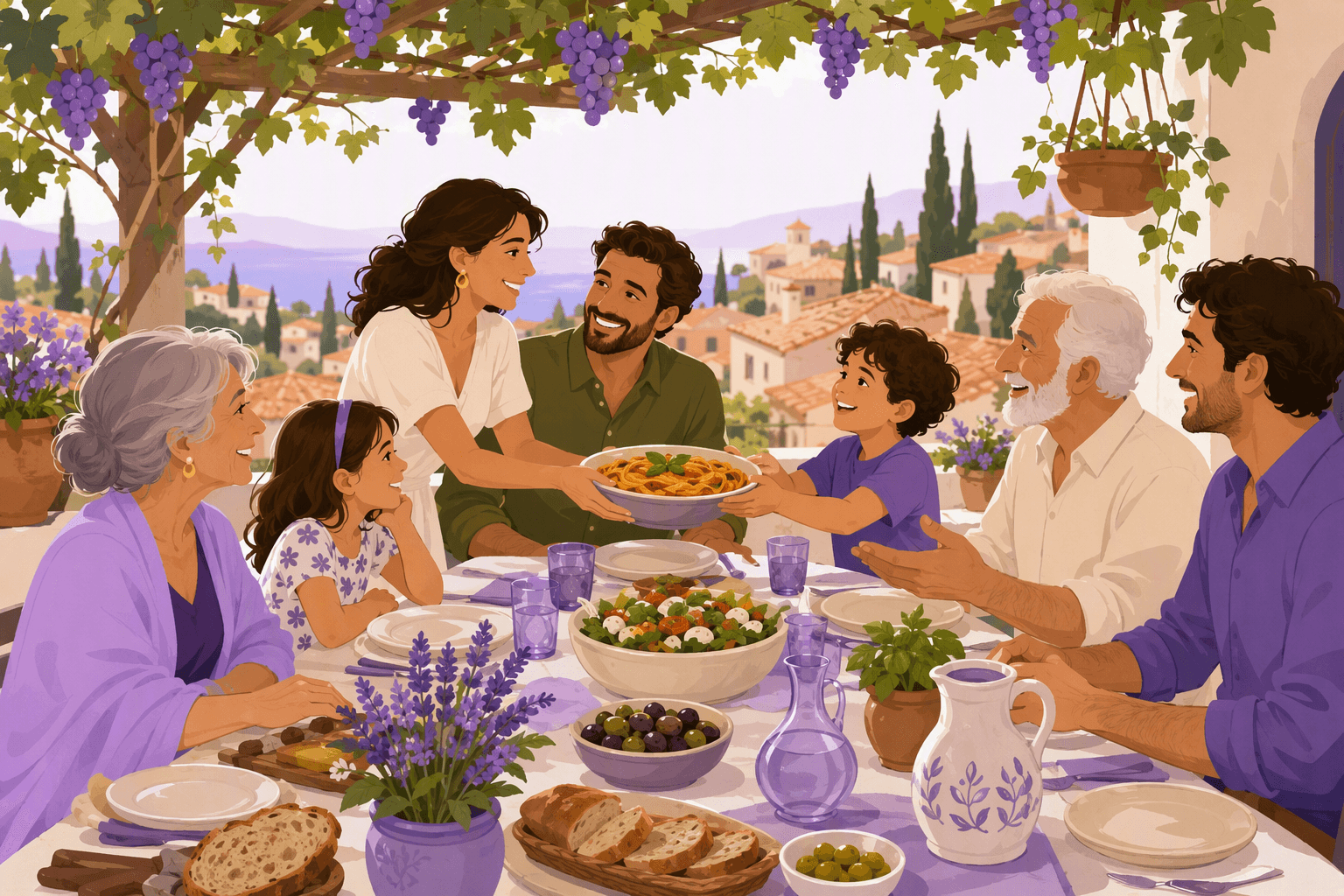
Immediate Family. La Famiglia Nucleare
These are the core family members you will use most often in everyday conversation. Italian distinguishes clearly between masculine and feminine forms.
| English | Italian | Pronunciation | Note |
|---|---|---|---|
| Family | La famiglia | lah fah-MEE-lyah | |
| Mother | Madre | MAH-dreh | Formal |
| Father | Padre | PAH-dreh | Formal |
| Brother | Fratello | frah-TEL-loh | Plural: fratelli |
| Sister | Sorella | soh-REL-lah | Plural: sorelle |
| Son | Figlio | FEE-lyoh | Plural: figli |
| Daughter | Figlia | FEE-lyah | Plural: figlie |
| Husband | Marito | mah-REE-toh | |
| Wife | Moglie | MOH-lyeh | Irregular plural: mogli |
Madre
The formal word for mother. You will see madre in official documents, literature, and expressions like lingua madre (mother tongue) and madrepatria (motherland). In everyday speech, however, almost every Italian says mamma instead.
Padre
The formal counterpart for father. Padre appears in religious contexts (il Santo Padre = the Holy Father/the Pope), legal documents, and formal prose. Day-to-day, Italians say papà.
Fratello
Brother. The plural fratelli follows the standard Italian rule: masculine nouns ending in -ello become -elli. The word also means "friars" in religious contexts (i fratelli francescani). The diminutive fratellino means "little brother."
Sorella
Sister. The plural sorelle follows the feminine pattern: -ella becomes -elle. The diminutive sorellina (little sister) is commonly used as a term of endearment even between adult siblings.
💡 Italian Plural Rules for Family Words
Italian family nouns follow predictable plural patterns: fratello → fratelli (-o → -i for masculine), sorella → sorelle (-a → -e for feminine). But watch out for moglie → mogli (an irregular plural) and figlio → figli (the -gli- cluster stays). Mastering these plurals early saves you from common mistakes.
Extended Family. La Famiglia Allargata
Italian has precise terms for every extended family member. The grandparent and uncle/aunt terms are among the first words Italian children learn.
| English | Italian | Pronunciation | Note |
|---|---|---|---|
| Grandfather | Nonno | NOHN-noh | Plural: nonni |
| Grandmother | Nonna | NOHN-nah | Plural: nonne |
| Grandparents | I nonni | ee NOHN-nee | |
| Uncle | Zio | TSEE-oh | Plural: zii |
| Aunt | Zia | TSEE-ah | Plural: zie |
| Male cousin | Cugino | koo-JEE-noh | Plural: cugini |
| Female cousin | Cugina | koo-JEE-nah | Plural: cugine |
| Nephew / Grandson | Nipote (m) | nee-POH-teh | Same word for both |
| Niece / Granddaughter | Nipote (f) | nee-POH-teh | Same word for both |

Nonno / Nonna
Grandfather and grandmother. These are warm, familiar terms already. Unlike the padre/papà split, there is no more formal alternative in common use. I nonni (the grandparents) often refers to the grandparent couple collectively. The Accademia della Crusca notes that nonno derives from a Latin children's word, making it one of Italian's oldest family terms.
Zio / Zia
Uncle and aunt. In southern Italian culture especially, zio and zia are also used as respectful titles for older non-relatives, similar to how some English speakers use "uncle" and "auntie" loosely. You might hear a child call a family friend zio Marco even if they are not related.
Nipote
One of Italian's most versatile family words. Nipote means both "nephew/niece" AND "grandson/granddaughter," and context tells you which. The article clarifies gender: il nipote (male), la nipote (female). The plural is i nipoti (masculine or mixed) or le nipoti (all female).
🌍 The Sunday Lunch Tradition
The pranzo della domenica (Sunday lunch) remains a sacred institution in Italian family life. Extended families (grandparents, aunts, uncles, cousins) gather weekly for a multi-course meal that can last three to four hours. According to ISTAT, over 70% of Italian families still practice some form of regular extended-family dining. Knowing your family vocabulary is not optional if you are invited to one of these meals.
In-Laws. I Parenti Acquisiti
Italian has dedicated terms for every in-law relationship. These words are essential once you enter the world of Italian weddings and family gatherings.
| English | Italian | Pronunciation |
|---|---|---|
| Father-in-law | Suocero | SWOH-cheh-roh |
| Mother-in-law | Suocera | SWOH-cheh-rah |
| Brother-in-law | Cognato | koh-NYAH-toh |
| Sister-in-law | Cognata | koh-NYAH-tah |
| Son-in-law | Genero | JEH-neh-roh |
| Daughter-in-law | Nuora | NWOH-rah |
Suocero / Suocera
Father-in-law and mother-in-law. The collective i suoceri refers to both parents-in-law. These terms derive from the Latin socer/socra. In Italian culture, the suocera (mother-in-law) features prominently in jokes and proverbs. Suocera e nuora, tempesta e gragnuola ("mother-in-law and daughter-in-law, storm and hail") is a well-known saying.
Cognato / Cognata
Brother-in-law and sister-in-law. From the Latin cognatus (blood relative), which ironically now refers to relatives by marriage, not by blood. These are straightforward terms used frequently in everyday Italian.
Genero / Nuora
Son-in-law and daughter-in-law. Genero comes from Latin gener and nuora from nurus. Both are formal-register words that have no informal alternative. Unlike the madre/mamma split, Italians use genero and nuora in all contexts.
Affectionate & Informal Family Terms
Italians are famously expressive, and family language is no exception. These are the terms you will actually hear in Italian homes.
| English | Italian | Pronunciation | Note |
|---|---|---|---|
| Mom / Mum | Mamma | MAHM-mah | Universal everyday term |
| Dad | Papà | pah-PAH | Stress on final syllable |
| Grandpa | Nonnino | nohn-NEE-noh | Diminutive of nonno |
| Grandma | Nonnina | nohn-NEE-nah | Diminutive of nonna |
| Big brother | Fratellone | frah-tel-LOH-neh | Augmentative |
| Little sister | Sorellina | soh-rel-LEE-nah | Diminutive |
| Mama's boy | Mammone | mahm-MOH-neh | Cultural phenomenon |
Mamma
Perhaps the most iconic Italian word in the world. Mamma transcends mere vocabulary; it is a cultural symbol. The exclamation Mamma mia! has entered virtually every language on Earth. Italians use mamma from childhood through adulthood without any stigma. A 40-year-old Italian professional calling his mother mamma on the phone is entirely normal and expected.
According to the Treccani encyclopedia, mamma has been documented in Italian since the 13th century and appears in Dante's Divina Commedia. It is one of the few words that remained essentially unchanged from Latin mamma (breast) through to modern Italian.
Papà
The everyday word for dad. Note the stress falls on the final syllable: pah-PAH, not PAH-pah (which would sound like papa, meaning "pope" without the accent). This stress distinction is important because getting it wrong changes the meaning entirely.
Mammone
This word deserves special attention. A mammone is an adult man who remains deeply attached to and dependent on his mother. While it can be used mockingly, it reflects a genuine cultural reality. ISTAT data shows that over 60% of Italians aged 18-34 live with their parents, one of the highest rates in Europe. The mammone phenomenon is a regular topic in Italian media, sociology, and comedy. The female equivalent, mammona, exists but is rarely used, as the cultural spotlight falls almost exclusively on men.
🌍 Mamma Mia. More Than an Exclamation
Mamma mia literally means "my mother" but functions as an all-purpose exclamation expressing surprise, frustration, admiration, or disbelief. It is used across all regions and social classes. The phrase became globally famous through the Italian-American diaspora, the 1975 ABBA song, and the subsequent musical and film. In Italy itself, people say it dozens of times a day without thinking twice.
The Possessive Article Rule. Italian's Unique Grammar Quirk
This is the single most important grammar rule for Italian family vocabulary. Getting it right instantly marks you as a competent speaker.
The rule: With singular, unmodified family nouns, possessive adjectives DROP the definite article.
| Correct | Incorrect | Why |
|---|---|---|
| mio padre | Singular, unmodified family noun | |
| mia madre | Singular, unmodified family noun | |
| tuo fratello | Singular, unmodified family noun | |
| sua sorella | Singular, unmodified family noun |
But the article RETURNS in these cases:
| Correct | Rule |
|---|---|
| i miei fratelli | Plural → article required |
| le tue sorelle | Plural → article required |
| il mio caro papà | Modified by adjective → article required |
| la mia mamma | Affectionate/informal form → article required |
| il loro padre | With loro → article always required |
| la mia sorellina | Diminutive/augmentative → article required |
The Accademia della Crusca confirms this as one of the most frequently asked grammar questions by Italian learners. The rule exists because Italian historically treated singular family members as so closely identified with the possessor that the definite article (which implies some distance or generality) was considered unnecessary.
"The omission of the article with possessive adjectives before singular kinship terms is a distinctive feature of Italian among Romance languages. Neither Spanish, French, nor Portuguese share this restriction."
(Accademia della Crusca, Consulenza linguistica)
⚠️ Common Mistake: Mamma and Papà Take the Article
Even though mamma and papà mean mother and father, they are considered affectionate forms, not standard kinship terms. So you say la mia mamma (with article), not mia mamma. The same applies to nonnino, sorellina, fratellone, and all other diminutives and augmentatives. Only the "neutral" forms (madre, padre, fratello, sorella, figlio, figlia, nonno, nonna, zio, zia, cugino, cugina) drop the article.
La Famiglia as Cultural Cornerstone
Understanding Italian family vocabulary means understanding Italy itself. The concept of la famiglia goes far beyond a list of relatives. It shapes Italian society, politics, business, and daily life in ways that can surprise outsiders.
Family businesses dominate the economy. According to ISTAT, over 85% of Italian companies are family-owned, from global luxury brands like Ferragamo, Benetton, and Barilla to the neighborhood trattoria. The phrase azienda di famiglia (family business) is not just common; it describes the backbone of the Italian economy.
Multi-generational living is normal. Unlike in many Northern European or Anglophone countries, Italian families frequently share homes across three generations. A nonna living with her figlio, nuora, and nipoti is a standard arrangement, not an exception. The concept of "moving out at 18" barely exists.
Family loyalty is paramount. The Italian proverb il sangue non è acqua ("blood is not water," equivalent to "blood is thicker than water") reflects a deep cultural value. Family obligations often take precedence over individual ambitions, friendships, and even career opportunities. This value system is neither positive nor negative. It simply is, and understanding it is key to understanding Italian behavior.
Practice with Italian Movies and Media
Italian cinema is famously rich in family drama. Films like La Famiglia (1987), Mine vaganti (2010), and virtually any work by Luca Guadagnino or Paolo Sorrentino feature extensive family vocabulary in natural context. Dinner-table scenes alone will expose you to dozens of these terms.
Check out our guide to the best movies for learning Italian for recommendations across genres and difficulty levels. Family-centered films are particularly useful because the vocabulary is repeated naturally throughout the story.
Wordy lets you practice family vocabulary in real context by watching Italian content with interactive subtitles. When a family term appears in dialogue, you can tap it to see the translation, hear the pronunciation, and review related words. Explore our blog for more Italian learning guides, or visit our Italian learning page to start building your vocabulary today.
Frequently Asked Questions
How do you say 'family' in Italian?
What is the difference between 'madre' and 'mamma' in Italian?
Why do Italians drop the article with family possessives?
What does 'mammone' mean in Italian?
How do you say 'in-laws' in Italian?
Sources & References
- Treccani, Vocabolario della lingua italiana online (treccani.it)
- Accademia della Crusca, Consulenza linguistica, Italian grammar guidance
- Ethnologue: Languages of the World, 27th edition (2024), Italian language entry
- Murdock, G.P., Social Structure (1949), kinship terminology classification
- ISTAT (Istituto Nazionale di Statistica), Italian family and demographic reports
Start learning with Wordy
Watch real movie clips and build your vocabulary as you go. Free to download.


