Quick Answer
The days of the week in Italian are lunedì (Monday), martedì (Tuesday), mercoledì (Wednesday), giovedì (Thursday), venerdì (Friday), sabato (Saturday), and domenica (Sunday). Italian days are not capitalized, the week starts on Monday, and only domenica is feminine.
The Short Answer
The seven days of the week in Italian are lunedì, martedì, mercoledì, giovedì, venerdì, sabato, and domenica. They are never capitalized, the week starts on Monday, and there is one important quirk: domenica (Sunday) is the only feminine day, while all others are masculine.
Italian is spoken by approximately 68 million native speakers, primarily in Italy, San Marino, parts of Switzerland, and Italian diaspora communities worldwide, according to Ethnologue's 2024 data. As a direct descendant of Latin, Italian preserves the ancient Roman planetary naming system more transparently than almost any other European language.
"Italian is the closest living language to Latin, and nowhere is this more visible than in the days of the week, where the planetary gods of Rome still govern the calendar."
(Accademia della Crusca, Vocabolario)
This guide covers every day with pronunciation, etymology, grammar rules, and cultural insights so you can use them naturally in conversation.
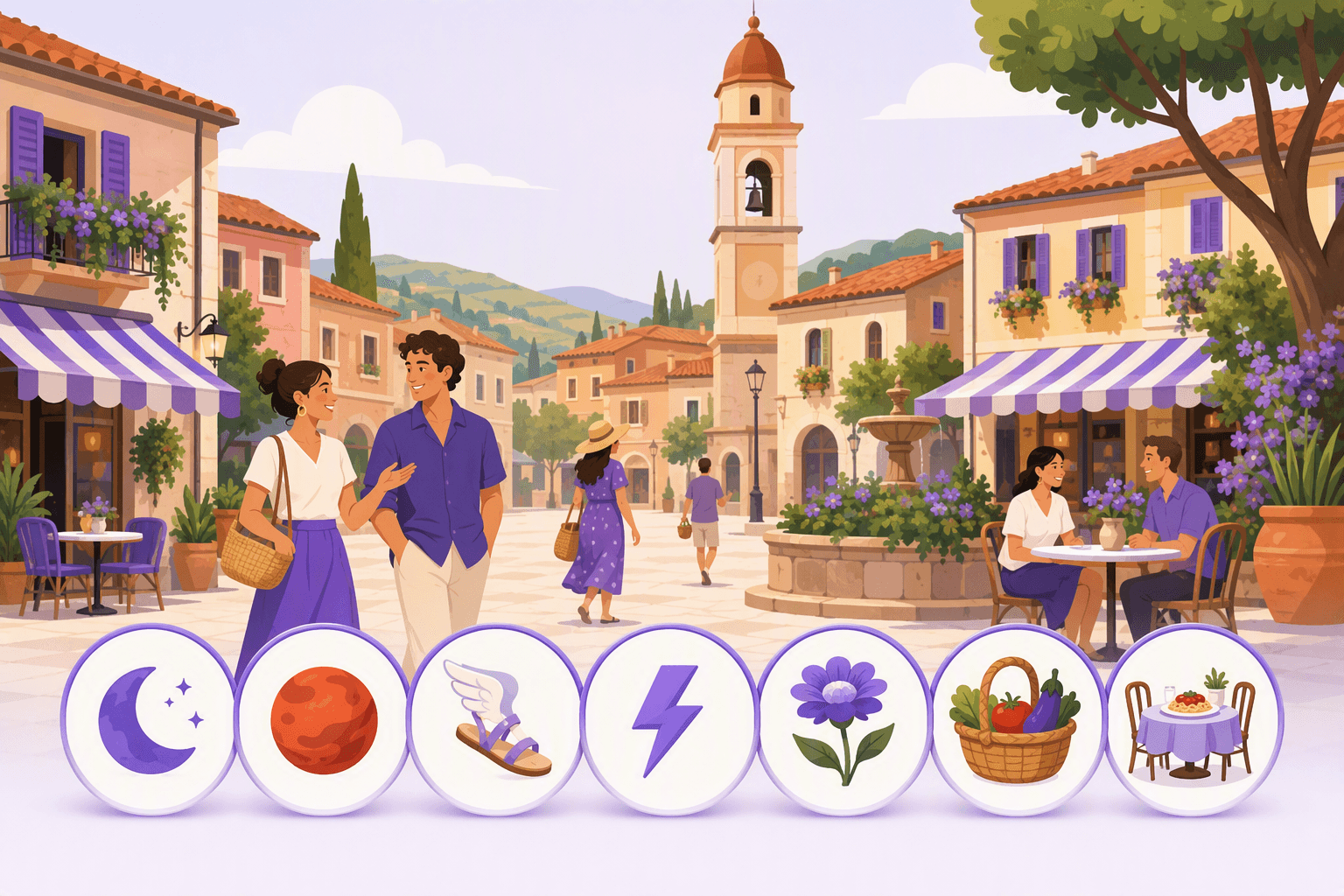
All 7 Days at a Glance
| English | Italian | Pronunciation | Note |
|---|---|---|---|
| Monday | lunedì | loo-neh-DEE | From Luna (Moon) |
| Tuesday | martedì | mar-teh-DEE | From Marte (Mars) |
| Wednesday | mercoledì | mehr-koh-leh-DEE | From Mercurio (Mercury) |
| Thursday | giovedì | joh-veh-DEE | From Giove (Jupiter) |
| Friday | venerdì | veh-nehr-DEE | From Venere (Venus) |
| Saturday | sabato | SAH-bah-toh | From Shabbat (Sabbath) |
| Sunday | domenica | doh-MEH-nee-kah | From Dominica (Lord's day) |
Notice the clear pattern: Monday through Friday all end in -dì (from Latin dies, meaning "day"), with the accent mark indicating stress on the final syllable. Saturday and Sunday break this pattern entirely.
Planetary Origins: The Roman Legacy in Every Day
Italian's weekday names are among the most transparent windows into the ancient Roman calendar anywhere in the modern world. The connection between the Italian word and the Latin original is often immediately obvious.
Lunedì
Lunedì comes from the Latin Lunae dies (day of the Moon). Italian still uses luna for "moon" and lunare for "lunar," making the etymology crystal clear. The English equivalent, "Monday," follows the same logic through its Germanic translation of "Moon's day."
Mondays in Italy carry no special superstition, but they do mark the start of the Italian workweek. Many museums and monuments in Italy are closed on Mondays (chiuso il lunedì), a pattern that trips up many tourists.
💡 Museum Tip for Travelers
Most Italian state museums and archaeological sites are closed on Mondays. If you are planning a trip to Italy, schedule your museum visits for Tuesday through Sunday. Notable exceptions include the Colosseum and Vatican Museums, which have their own schedules.
Martedì
Martedì derives from Martis dies (day of Mars), the Roman god of war. The Italian name for the planet Mars is Marte, and the month of March is marzo, all from the same root.
Like in Spanish-speaking countries, martedì 17 (Tuesday the 17th) is considered unlucky in Italy. The Italian proverb warns: "Né di Venere né di Marte, non si sposa e non si parte", meaning: Neither on Venus's day (Friday) nor on Mars's day (Tuesday) should one marry or depart.
Mercoledì
Mercoledì comes from Mercurii dies (day of Mercury), the god of commerce, travel, and communication. The word mercato (market) shares the same root, connecting commerce and Mercury linguistically.
Pronunciation note: mercoledì has four syllables (mehr-koh-leh-DEE), with stress on the final syllable. The "c" before "o" is hard, like a "k."
Giovedì
Giovedì descends from Iovis dies (day of Jupiter, or Jove). Italian uniquely preserves the "Jove" form as Giove, the name for both the god and the planet Jupiter. In English, "Thursday" comes from Thor, the Norse thunder god, the same mythological substitution seen across Germanic languages.
The Italian "gi" is pronounced like a soft "j" in English, making giovedì sound like "joh-veh-DEE."
🌍 Giovedì Grasso: Fat Thursday
While most people know Mardi Gras (Fat Tuesday), Italy celebrates Giovedì Grasso (Fat Thursday) as the official start of Carnival season. In Venice, this is when the famous Carnevale di Venezia kicks off with elaborate masks, costumes, and festivities. The celebration then continues until Martedì Grasso (Shrove Tuesday).
Venerdì
Venerdì comes from Veneris dies (day of Venus), the goddess of love and beauty. The Italian word for the planet Venus is Venere, and the adjective venerdiano (of or relating to Friday) occasionally appears in literary Italian.
Friday the 17th (venerdì 17), not Friday the 13th, is the unlucky day in Italian culture. The superstition around 17 traces back to the Roman numeral XVII, which can be rearranged to spell VIXI ("I have lived," implying death).
Sabato
Sabato breaks the planetary pattern. It comes from the Hebrew Shabbat (שַׁבָּת) via Latin Sabbatum. English "Saturday" retained the Roman name (Saturn's day), but Italian, like Spanish and French, adopted the religious term.
Sabato is the day of fare la spesa (grocery shopping) in many Italian households. The Saturday morning market is a cornerstone of Italian life, especially in smaller towns.
Domenica
Domenica comes from the Latin dies Dominica (day of the Lord). It is the only feminine day of the week, which affects articles and adjectives: la domenica (on Sundays), domenica scorsa (last Sunday), domenica prossima (next Sunday).
Sunday in Italy revolves around two things: church and the pranzo della domenica (Sunday lunch). The extended family Sunday meal remains a deeply important cultural tradition, even in modern, secular Italian households. It is often the longest and most elaborate meal of the week.
Grammar: How to Use Days in Sentences
Italian has specific grammar rules for days of the week that differ from English in important ways.
No Capitalization
The Accademia della Crusca confirms that days of the week are common nouns in Italian. They are never capitalized unless they begin a sentence.
- Ci vediamo mercoledì. = See you on Wednesday.
- Mercoledì ci vediamo. = On Wednesday we'll meet. (capitalized only at the sentence start)
"On Monday": No Preposition Needed
For a specific, one-time occurrence, simply use the day name with no article or preposition.
- Parto venerdì. = I leave on Friday.
- L'esame è giovedì. = The exam is on Thursday.
For habitual actions (every week), add the definite article.
| Construction | Meaning | Example |
|---|---|---|
| lunedì (no article) | This Monday / next Monday | Arrivo lunedì. (I arrive on Monday.) |
| il lunedì (with article) | Every Monday | Il lunedì lavoro da casa. (On Mondays I work from home.) |
| di lunedì (with di) | Every Monday (alternative) | Di lunedì vado in palestra. (On Mondays I go to the gym.) |
Both il lunedì and di lunedì express habitual actions. They are interchangeable, though il lunedì is slightly more common in standard Italian.
Gender: The Domenica Exception
Monday through Saturday are masculine: il lunedì, il martedì, il mercoledì, il giovedì, il venerdì, il sabato. Only domenica is feminine: la domenica.
This matters for adjectives:
- sabato scorso = last Saturday (masculine)
- domenica scorsa = last Sunday (feminine)
- il prossimo venerdì = next Friday (masculine)
- la prossima domenica = next Sunday (feminine)
💡 Memory Aid for Gender
If the day ends in -dì, it is masculine. If it ends in -a (domenica), it is feminine. Sabato ends in -o and is also masculine. This covers all seven days without exception.
The Week Structure: Monday First
Italy follows the European standard of starting the week on Monday. The Italian word for "week" is settimana (from Latin septimana, "a period of seven"), and it is feminine: la settimana.
- Workweek: dal lunedì al venerdì (from Monday to Friday)
- Weekend: il fine settimana or il weekend (the English loanword is widely used in Italy)
- Midweek: a metà settimana (midweek, usually Wednesday)
Italian calendars always show lunedì in the first column. This is consistent across Italy and Italian-speaking Switzerland (Ticino).
Useful Phrases With Days of the Week
| English | Italian | Pronunciation |
|---|---|---|
| What day is it today? | Che giorno è oggi? | keh JOHR-noh eh OH-jee |
| Today is Monday. | Oggi è lunedì. | OH-jee eh loo-neh-DEE |
| See you on Friday. | Ci vediamo venerdì. | chee veh-dee-AH-moh veh-nehr-DEE |
| I work Monday to Friday. | Lavoro dal lunedì al venerdì. | lah-VOH-roh dahl loo-neh-DEE ahl veh-nehr-DEE |
| The weekend | Il fine settimana | eel FEE-neh seh-tee-MAH-nah |
| Every Tuesday | Ogni martedì | OH-nyee mar-teh-DEE |
| Last Wednesday | Mercoledì scorso | mehr-koh-leh-DEE SKOHR-soh |
| Next Thursday | Giovedì prossimo | joh-veh-DEE PROHS-see-moh |
Months of the Year: A Quick Companion Reference
Since dates combine days and months, here are the 12 months in Italian. Like the days, they are never capitalized and are all masculine.
| English | Italian | Pronunciation |
|---|---|---|
| January | gennaio | jehn-NAH-yoh |
| February | febbraio | fehb-BRAH-yoh |
| March | marzo | MAR-tsoh |
| April | aprile | ah-PREE-leh |
| May | maggio | MAH-joh |
| June | giugno | JOON-yoh |
| July | luglio | LOOL-yoh |
| August | agosto | ah-GOHS-toh |
| September | settembre | seht-TEHM-breh |
| October | ottobre | oht-TOH-breh |
| November | novembre | noh-VEHM-breh |
| December | dicembre | dee-CHEM-breh |
Italian dates use the format: il + number + month. For example, il 25 dicembre (December 25th). The first of the month can use either il primo (the first) or simply l'uno (the one): il primo gennaio or l'uno gennaio (January 1st).
Cultural Notes: How Days Shape Italian Life
The Italian Weekly Rhythm
Italian life follows a distinctive weekly pattern. The workweek runs from Monday to Friday, with many businesses closing for a long lunch break (pausa pranzo) between approximately 1:00 and 3:30 PM. Saturday mornings are often used for shopping at local markets, and Sunday is dedicated to family and rest.
Ferragosto and the August Exception
While not specifically a day of the week, Ferragosto (August 15th) deserves mention because it effectively shuts down the entire country regardless of what day it falls on. Most Italians take vacation during the weeks surrounding this date, and many businesses close for the entire second half of August.
🌍 The Passeggiata Tradition
Every evening, especially on weekends, Italians participate in la passeggiata, a leisurely stroll through the town center. This daily ritual is most vibrant on Saturday and Sunday evenings and is one of the simplest ways to experience authentic Italian culture. You do not need to speak fluent Italian to join; just walk, observe, and perhaps stop for a gelato.
Practice With Real Italian Content
Reading vocabulary lists builds your foundation, but hearing lunedì and venerdì in the flow of real Italian conversation is what makes them stick. Italian cinema and television are filled with scheduling scenes, appointment-making, and weekly routine discussions.
Wordy lets you watch Italian movies and shows with interactive subtitles. Tap on any word to see its meaning, pronunciation, and grammar details instantly. Instead of memorizing words in isolation, you learn them in the context of authentic Italian speech.
For more Italian learning resources, explore our blog for guides covering everything from greetings to the best movies for learning Italian. Visit our Italian learning page to begin practicing today.
Frequently Asked Questions
What are the 7 days of the week in Italian?
Does the week start on Monday or Sunday in Italy?
How do you say 'on Monday' in Italian?
Are Italian days of the week masculine or feminine?
Why do Italian days from Monday to Friday end in -dì?
Where do the Italian names for the weekend days come from?
Sources & References
- Accademia della Crusca, Vocabolario degli Accademici della Crusca
- Istituto Treccani, Enciclopedia dell'Italiano (2011)
- Ethnologue: Languages of the World, Italian language entry (2024)
- Maiden, M. & Robustelli, C. (2013). A Reference Grammar of Modern Italian. Routledge, 2nd edition.
- ISO 8601, International standard for date and time representations
Start learning with Wordy
Watch real movie clips and build your vocabulary as you go. Free to download.


