Colors in Italian: 30+ Essential Color Words With Grammar, Shades, and Cultural Meaning
Quick Answer
The most essential Italian colors are rosso (red), blu (blue), giallo (yellow), verde (green), bianco (white), and nero (black). Most Italian color adjectives change form to match the noun's gender and number (rosso/rossa/rossi/rosse), but several common colors like blu, rosa, viola, and arancione are invariable and never change.
The most important Italian colors to learn first are rosso (red), blu (blue), giallo (yellow), verde (green), bianco (white), and nero (black). Italian color vocabulary is rich, precise, and deeply tied to the country's artistic heritage, and it comes with a grammar rule that trips up nearly every learner: some colors change form to agree with the noun, while others never change at all.
With approximately 68 million native speakers according to Ethnologue's 2024 data, Italian is spoken across Italy, southern Switzerland, San Marino, and communities worldwide. Color words appear constantly in daily life, from ordering vino rosso at a trattoria to describing a cielo azzurro over Florence to shopping for a gonna nera in Milan.
"Italian preserves a lexical distinction between blu and azzurro that mirrors the ancient Greek separation of dark and light blue, a distinction that most modern European languages have collapsed into a single category."
(David Crystal, The Cambridge Encyclopedia of Language, Cambridge University Press)
This guide covers 30+ Italian colors organized by category, with pronunciation, grammar rules, shades, cultural significance, and the vivid color idioms Italians use every day.
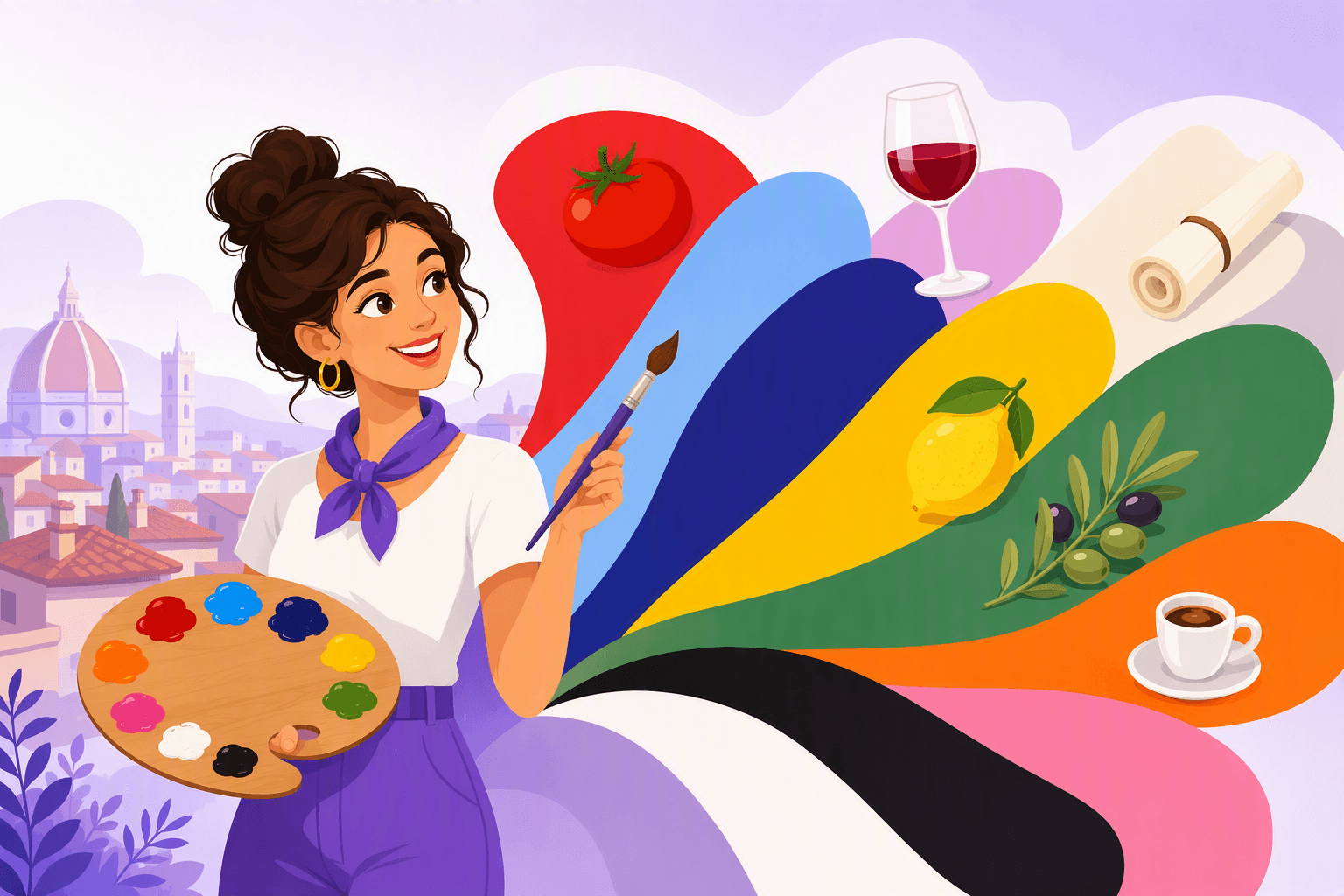
Quick Reference: Essential Italian Colors
| English | Italian | Pronunciation | Note |
|---|---|---|---|
| Red | Rosso | ROHS-soh | rosso/rossa/rossi/rosse |
| Blue (dark) | Blu | bloo | Invariable |
| Blue (sky) | Azzurro | ahd-DZOOR-roh | azzurro/azzurra/azzurri/azzurre |
| Yellow | Giallo | JAHL-loh | giallo/gialla/gialli/gialle |
| Green | Verde | VEHR-deh | verde/verde/verdi/verdi |
| Orange | Arancione | ah-rahn-CHOH-neh | Invariable |
| Purple | Viola | vee-OH-lah | Invariable |
| White | Bianco | BYAHN-koh | bianco/bianca/bianchi/bianche |
| Black | Nero | NEH-roh | nero/nera/neri/nere |
| Grey | Grigio | GREE-joh | grigio/grigia/grigi/grigie |
| Brown | Marrone | mahr-ROH-neh | Invariable |
| Pink | Rosa | ROH-zah | Invariable |
| Gold | Oro / Dorato | OH-roh / doh-RAH-toh | oro invariable; dorato 4-form |
| Silver | Argento / Argentato | ahr-JEHN-toh | argento invariable; argentato 4-form |
💡 Invariable vs. Four-Form Colors
Check the Note column above. Colors marked "Invariable" never change regardless of the noun's gender or number: una rosa rosa, due rose rosa. Colors with four forms (like rosso/rossa/rossi/rosse) must agree with the noun. This is the single most important grammar rule for Italian colors.
Primary Colors
The three primary colors in Italian (rosso, blu, and giallo) each have distinct grammar behavior. Two follow standard adjective agreement; one is completely invariable.
Rosso
| English | Italian | Pronunciation | Note |
|---|---|---|---|
| Red | Rosso | ROHS-soh | 4-form: rosso/rossa/rossi/rosse |
| Dark red | Rosso scuro | ROHS-soh SKOO-roh | Compound = invariable |
| Bright red | Rosso acceso | ROHS-soh ah-CHEH-zoh | Lit. 'lit-up red' |
| Crimson | Cremisi | KREH-mee-zee | Invariable |
Rosso is a standard four-form adjective: il vestito rosso (the red dress, masculine), la macchina rossa (the red car, feminine), i fiori rossi (the red flowers, masculine plural), le scarpe rosse (the red shoes, feminine plural). It appears everywhere in Italian culture: vino rosso (red wine), la Croce Rossa (the Red Cross), and the iconic Le Scarpette Rosse fairy tale.
Blu
Blu is Italy's most common invariable color. It never changes form: il cielo blu (the blue sky), la gonna blu (the blue skirt), i pantaloni blu (the blue pants), le penne blu (the blue pens). This word entered Italian from French bleu in the medieval period and kept its foreign spelling, which is why it behaves differently from native Italian adjectives.
Giallo
Giallo follows the standard four-form pattern: giallo/gialla/gialli/gialle. Beyond its literal meaning, giallo has a unique cultural significance in Italy: it refers to the entire mystery and thriller genre. A mystery novel is un giallo, a crime show is un film giallo, and the detective fiction section in any Italian bookstore is labeled Gialli. This usage dates back to 1929, when publisher Mondadori launched its mystery series with distinctive yellow covers.
🌍 Giallo: Italy's Word for Mystery
When Italians say giallo, they often mean "mystery" or "thriller." Arnoldo Mondadori's 1929 I Libri Gialli (The Yellow Books) series had such bright yellow covers that the color became synonymous with the entire genre. Today, saying è un giallo about a real-life event means "it's a mystery." Italian filmmakers like Dario Argento and Mario Bava created the giallo film genre, now a recognized international cinema category.
Secondary Colors
Italian's secondary colors include two invariable forms (arancione and viola) and one standard adjective (verde).
Verde
| English | Italian | Pronunciation | Note |
|---|---|---|---|
| Green | Verde | VEHR-deh | 2-form: verde/verdi |
| Orange | Arancione | ah-rahn-CHOH-neh | Invariable |
| Purple | Viola | vee-OH-lah | Invariable |
| Light green | Verde chiaro | VEHR-deh KYAH-roh | Compound = invariable |
| Dark purple | Viola scuro | vee-OH-lah SKOO-roh | Invariable |
Verde is a two-form adjective: the same in masculine and feminine singular (il prato verde, la foglia verde), changing only in the plural to verdi (i prati verdi, le foglie verdi). It features in one of Italian's best-known idioms: essere al verde means "to be broke," literally "to be at the green." The expression traces back to when candles were dipped in green wax at the base; when you could see the green, you had burned through everything.
Arancione
Arancione derives from arancia (orange fruit) and is invariable: un fiore arancione, dei fiori arancione. You may also hear arancio used informally, though the Accademia della Crusca recommends arancione as the standard form for the color. The word's fruit origin explains its invariability: when a noun is borrowed to serve as a color adjective, Italian freezes it in a single form. The same logic applies to rosa (from the rose flower), viola (from the violet), and marrone (from the chestnut).
Viola
Viola comes directly from the flower name (la viola = the violet) and is invariable: un vestito viola, due magliette viola. In spoken Italian, you will sometimes hear violetto/violetta as a variable alternative, but viola remains far more common. Historically, viola carried negative superstitious connotations in Italian theater: actors consider it bad luck to wear purple on stage, a belief traced back to medieval Lenten traditions when theaters were closed and actors went hungry, making purple (the liturgical color of Lent) a symbol of unemployment.
Neutral Colors
Neutral colors form the backbone of everyday Italian, from fashion to architecture to food.
Bianco
| English | Italian | Pronunciation | Note |
|---|---|---|---|
| White | Bianco | BYAHN-koh | bianco/bianca/bianchi/bianche |
| Black | Nero | NEH-roh | nero/nera/neri/nere |
| Grey | Grigio | GREE-joh | grigio/grigia/grigi/grigie |
| Brown | Marrone | mahr-ROH-neh | Invariable |
| Beige | Beige | behzh | Invariable (French loanword) |
| Cream | Panna | PAHN-nah | Invariable (from cream/panna) |
Bianco follows the standard four-form pattern but has a spelling change in the masculine plural: bianchi (not bianci), because Italian requires an h after c before i to maintain the hard /k/ sound. The same applies to bianche in the feminine plural.
Nero
Nero follows the regular four-form pattern: nero/nera/neri/nere. It appears frequently in Italian culture and media. La cronaca nera (the black chronicle) is the Italian term for crime news, a fixture of every Italian newspaper and TV broadcast. Nero also features in food: pasta al nero di seppia (pasta with cuttlefish ink) is a famous Venetian dish, its dramatic black color as striking as its briny flavor.
Grigio
Grigio follows four-form agreement: grigio/grigia/grigi/grigie. Wine lovers will recognize it from Pinot Grigio, Italy's famous grey-skinned grape variety. The grigio in the wine's name refers to the greyish-pink hue of the grape skin, not the color of the wine itself.
Marrone
Marrone is invariable, derived from marrone (chestnut). It never changes: un cappotto marrone, delle scarpe marrone. For hair color, Italians more commonly use castano/castana/castani/castane (chestnut-colored) rather than marrone, which sounds overly literal when applied to people. Similarly, for eye color, nocciola (hazel, literally "hazelnut") is invariable and very commonly used: occhi nocciola (hazel eyes).
Additional Colors
Rosa
| English | Italian | Pronunciation | Note |
|---|---|---|---|
| Pink | Rosa | ROH-zah | Invariable |
| Light blue | Azzurro | ahd-DZOOR-roh | azzurro/azzurra/azzurri/azzurre |
| Sky blue (pale) | Celeste | cheh-LEH-steh | 2-form: celeste/celesti |
| Gold | Dorato | doh-RAH-toh | dorato/dorata/dorati/dorate |
| Silver | Argentato | ahr-jehn-TAH-toh | argentato/argentata/argentati/argentate |
| Turquoise | Turchese | toor-KEH-zeh | Invariable |
| Bordeaux/Burgundy | Bordeaux | bohr-DOH | Invariable (French loanword) |
Rosa comes from the flower name and is invariable: una maglietta rosa, dei guanti rosa. It is one of the most frequently used invariable colors, and its fixed form is a common source of errors for learners who instinctively want to write roso or rose.
Azzurro
Azzurro is perhaps Italy's most culturally significant color. It follows standard four-form agreement (azzurro/azzurra/azzurri/azzurre) and describes a bright, vivid sky blue, distinct from both blu (dark blue) and celeste (pale, heavenly blue). The word comes from Arabic lazaward (lapis lazuli), via medieval Latin lazurium.
Celeste
Celeste literally means "heavenly" or "celestial" and refers to a very pale, ethereal blue: the color of a clear sky at midday. It is a two-form adjective: celeste in the singular, celesti in the plural. Italian's three-way blue distinction (blu/azzurro/celeste) is one of the language's most fascinating lexical features. Research in color linguistics has shown that languages with more basic color terms allow speakers to distinguish hues faster and more accurately.
Italian Color Grammar: The Complete Rules
Understanding how Italian colors agree with nouns is the key to using them correctly. There are three categories:
Category 1: Standard four-form colors (change for gender AND number)
| Masc. Sing. | Fem. Sing. | Masc. Plur. | Fem. Plur. |
|---|---|---|---|
| rosso | rossa | rossi | rosse |
| nero | nera | neri | nere |
| bianco | bianca | bianchi | bianche |
| giallo | gialla | gialli | gialle |
| grigio | grigia | grigi | grigie |
| azzurro | azzurra | azzurri | azzurre |
Category 2: Two-form colors (change for number only)
| Singular | Plural |
|---|---|
| verde | verdi |
| celeste | celesti |
Category 3: Invariable colors (never change)
Blu, rosa, viola, arancione, marrone, turchese, beige, bordeaux, cremisi, lilla
⚠️ The Compound Color Rule
When you add any modifier to a color, the entire expression becomes invariable, even if the base color normally changes. Rosso alone agrees with the noun (scarpe rosse), but rosso scuro stays fixed (scarpe rosso scuro). This applies to all modifiers: chiaro, scuro, acceso, pallido, vivace.
"The invariability of compound color expressions in Italian reflects a broader Romance language pattern where multi-word adjective phrases resist internal agreement, preserving the base form as a kind of lexicalized unit."
(Treccani, Enciclopedia e Vocabolario online)
Shades and Modifiers
Italian uses a set of modifier words to describe lighter, darker, or more vivid versions of any color.
| English | Italian | Pronunciation | Note |
|---|---|---|---|
| Light | Chiaro | KYAH-roh | verde chiaro = light green |
| Dark | Scuro | SKOO-roh | blu scuro = dark blue |
| Bright / Vivid | Vivace / Acceso | vee-VAH-cheh / ah-CHEH-zoh | giallo vivace = bright yellow |
| Pale / Dull | Pallido / Spento | PAHL-lee-doh / SPEHN-toh | rosa pallido = pale pink |
| Deep / Intense | Intenso | een-TEHN-soh | rosso intenso = deep red |
| Warm | Caldo | KAHL-doh | bianco caldo = warm white |
| Cool | Freddo | FREHD-doh | grigio freddo = cool grey |
Remember: all compound color expressions (color + modifier) are invariable. You say due magliette rosso scuro (two dark red t-shirts), never rosse scure. This is one of the most consistent rules in Italian color grammar and a significant simplification once you internalize it.
Cultural Significance of Colors in Italy
Azzurro: Italy's National Color
Azzurro is to Italy what no single English color word quite captures. It is the color of the national sports teams (football, rugby, basketball, volleyball, and every other sport where Italy competes internationally). The teams are collectively called gli Azzurri (the light blues).
This tradition dates to 1911, when the Italian national football team first wore blue jerseys. The color was chosen to honor the House of Savoy, the royal dynasty that unified Italy in 1861. The Savoy family's official color was azzurro Savoia, a specific shade of bright blue that appeared on their coat of arms. Even after Italy abolished the monarchy in 1946, azzurro remained the sporting color, now a symbol of national identity rather than royal heritage.
Adriano Celentano's 1968 hit song Azzurro further cemented the color in Italian popular culture. The song, about summer longing and blue skies, remains one of Italy's most beloved and recognized melodies worldwide.
Color Idioms Italians Actually Use
Italian idioms involving colors are vivid, expressive, and used constantly in everyday speech and Italian cinema:
- Vedere rosso (to see red): to be furious, to lose one's temper
- Essere al verde (to be at the green): to be broke, penniless
- Cronaca nera (black chronicle): crime news
- Passare la notte in bianco (to spend the night in white): to have a sleepless night
- Principe azzurro (blue prince): Prince Charming
- Avere una fifa blu (to have a blue fear): to be terrified
- Giallo (yellow): a mystery or thriller (see the Mondadori history above)
- Mettere nero su bianco (to put black on white): to put something in writing
- Essere in rosso (to be in red): to be in debt, to have an overdrawn account
- Un periodo nero (a black period): a difficult time, a bad stretch
🌍 Passare la Notte in Bianco
One of Italian's most charming idioms, passare la notte in bianco (to spend the night in white), means to have a sleepless night. The origin likely comes from medieval monks who wore white during all-night prayer vigils, or from the image of lying awake staring at white sheets and ceiling. Either way, Italians reach for this expression constantly, and Ho passato la notte in bianco is far more natural than the literal non ho dormito.
Colors in Italian Food and Wine
Italian cuisine is inseparable from color vocabulary:
- Vino rosso / bianco / rosato: red / white / rosé wine
- Pasta al nero di seppia: cuttlefish-ink pasta (Venetian specialty, strikingly black)
- Salsa verde: green sauce (parsley-based condiment from Piedmont)
- Peperone rosso / giallo / verde: red / yellow / green bell pepper
- Pinot Grigio: the famous "grey Pinot" grape
- Riso nero / Riso Venere: black rice, a prized Italian variety
The Italian flag itself (il tricolore) is green, white, and red (verde, bianco, e rosso), and Italians frequently reference its colors when describing food presentation that echoes the national flag, such as a caprese salad (green basil, white mozzarella, red tomato).
The Three Blues: Blu vs. Azzurro vs. Celeste
One of the most distinctive features of Italian color vocabulary is its three-way division of what English simply calls "blue." Understanding this distinction is essential for sounding natural.
| Italian | Shade | English Equivalent | Example |
|---|---|---|---|
| Blu | Dark, deep blue | Navy / dark blue | una giacca blu (a navy jacket) |
| Azzurro | Bright, vivid blue | Sky blue / royal blue | il cielo azzurro (the blue sky) |
| Celeste | Very light, pale blue | Baby blue / powder blue | una camicia celeste (a light blue shirt) |

For Italians, calling a celeste object blu would be like calling something pink "red" in English: technically in the same family, but clearly wrong. Research by linguists Paul Kay and Terry Regier has demonstrated that languages with distinct basic terms for light and dark blue (like Italian, Russian, and Greek) enable speakers to perceive and categorize blue shades more efficiently than speakers of languages without this distinction.
This three-blue system is a remnant of Italian's rich artistic vocabulary. Renaissance painters needed precise color terms for the expensive pigments they worked with: blu oltremare (ultramarine blue, made from lapis lazuli), azzurrite (azurite blue), and the lighter celeste tones of fresco skies. The Zanichelli dictionary lists over a dozen blue-related terms in current Italian, more than for any other color family.
When shopping for clothing or describing objects in Italy, using the correct blue term matters. Asking for a camicia blu when you mean a light blue dress shirt will likely get you something far darker than intended. What you want is una camicia azzurra or celeste.
Regional Color Terms and Dialectal Variations
Italian regional dialects often preserve color terms that differ from the standard language. While standard Italian dominates formal and written contexts, knowing a few regional variations enriches your understanding:
- Celeste vs. Azzurro: In northern Italy, celeste is used more broadly for light blues, while in the south, azzurro covers a wider range
- Sicilian biancu: Sicilian dialect preserves the Latin -u ending (biancu for bianco, russu for rosso)
- Venetian moro: In Veneto, moro means dark or black (as in hair color), while standard Italian uses nero or scuro
- Neapolitan russo: In Neapolitan dialect, red is russo rather than rosso
The Accademia della Crusca notes that many regional color terms survive in place names, family names, and food vocabulary even when they have disappeared from everyday speech. Monte Bianco (Mont Blanc), Mar Nero (Black Sea), and Costa Azzurra (French Riviera) all use standard Italian color terms that replaced earlier regional forms.
Italian family names often encode colors too: Rossi (the most common Italian surname, meaning "reds"), Bianchi (whites), Neri (blacks), and Verdi (greens, as in the composer Giuseppe Verdi) all originate from color-based nicknames describing hair, complexion, or clothing preferences of ancestors.
Practice Colors With Real Italian Content
Color vocabulary comes alive when you encounter it in context, whether describing a Florentine sunset, a fashion collection in Milan, a Venetian carnival mask, or a plate of food in Naples. Italian cinema and television are rich with color references, from the yellow-drenched giallo thrillers of Dario Argento to the sun-bleached whites and blues of Mediterranean coastal films.
Wordy lets you practice Italian colors in real context by watching Italian content with interactive subtitles. When a color word appears in dialogue, tap it to see its gender forms, pronunciation, and usage. Instead of memorizing from tables alone, you hear rosso, azzurro, and nero the way native speakers actually use them.
Explore our blog for more Italian vocabulary guides, or check out the best movies to learn Italian for viewing recommendations that bring this vocabulary to life.
Frequently Asked Questions
What are the basic colors in Italian?
Do Italian colors change form like other adjectives?
What is the difference between blu, azzurro, and celeste in Italian?
Why is Italy's national team called 'gli Azzurri'?
What are some common Italian color idioms?
How do you say shades of colors in Italian?
Sources & References
- Accademia della Crusca, Vocabolario degli Accademici della Crusca
- Treccani, Enciclopedia e Vocabolario online
- Ethnologue: Languages of the World, 27th edition (2024)
- Crystal, D., The Cambridge Encyclopedia of Language (Cambridge University Press)
- Zanichelli, Il Nuovo Zingarelli: Vocabolario della lingua italiana
Start learning with Wordy
Watch real movie clips and build your vocabulary as you go. Free to download.


