Italian Body Parts: 35+ Essential Words With Pronunciation and Medical Phrases
Quick Answer
The most important Italian body parts to learn first are 'la testa' (head), 'il braccio' (arm), 'la gamba' (leg), and 'il cuore' (heart). All body part nouns in Italian carry grammatical gender, and several common ones have irregular plurals: 'il braccio' becomes 'le braccia,' switching from masculine singular to feminine plural.
Why Learn Body Parts in Italian?
Knowing body parts in Italian is essential for medical situations, understanding countless idioms, and appreciating one of Europe's most expressive languages. According to Ethnologue's 2024 data, approximately 68 million people speak Italian natively, with millions more studying it as a second language worldwide.
Italian body part vocabulary presents a unique grammatical challenge: several common body parts have irregular plurals that switch gender entirely. The masculine singular il braccio (arm) becomes the feminine plural le braccia (arms). This pattern, inherited from Latin neuter nouns, affects some of the most frequently used body words in the language.
"The irregular plurals of body-part nouns in Italian represent one of the most fascinating survivals of the Latin neuter gender. Words like braccio/braccia, dito/dita, and ginocchio/ginocchia preserve a grammatical pattern that disappeared from all other Romance languages." (Martin Maiden & Cecilia Robustelli, A Reference Grammar of Modern Italian, Routledge, 2013)
This guide covers 35+ body parts organized by region, with pronunciation, gender, irregular plurals, medical phrases, and the vivid idioms that Italians use daily. For interactive practice with authentic Italian content, visit our Italian learning page.
Head and Face
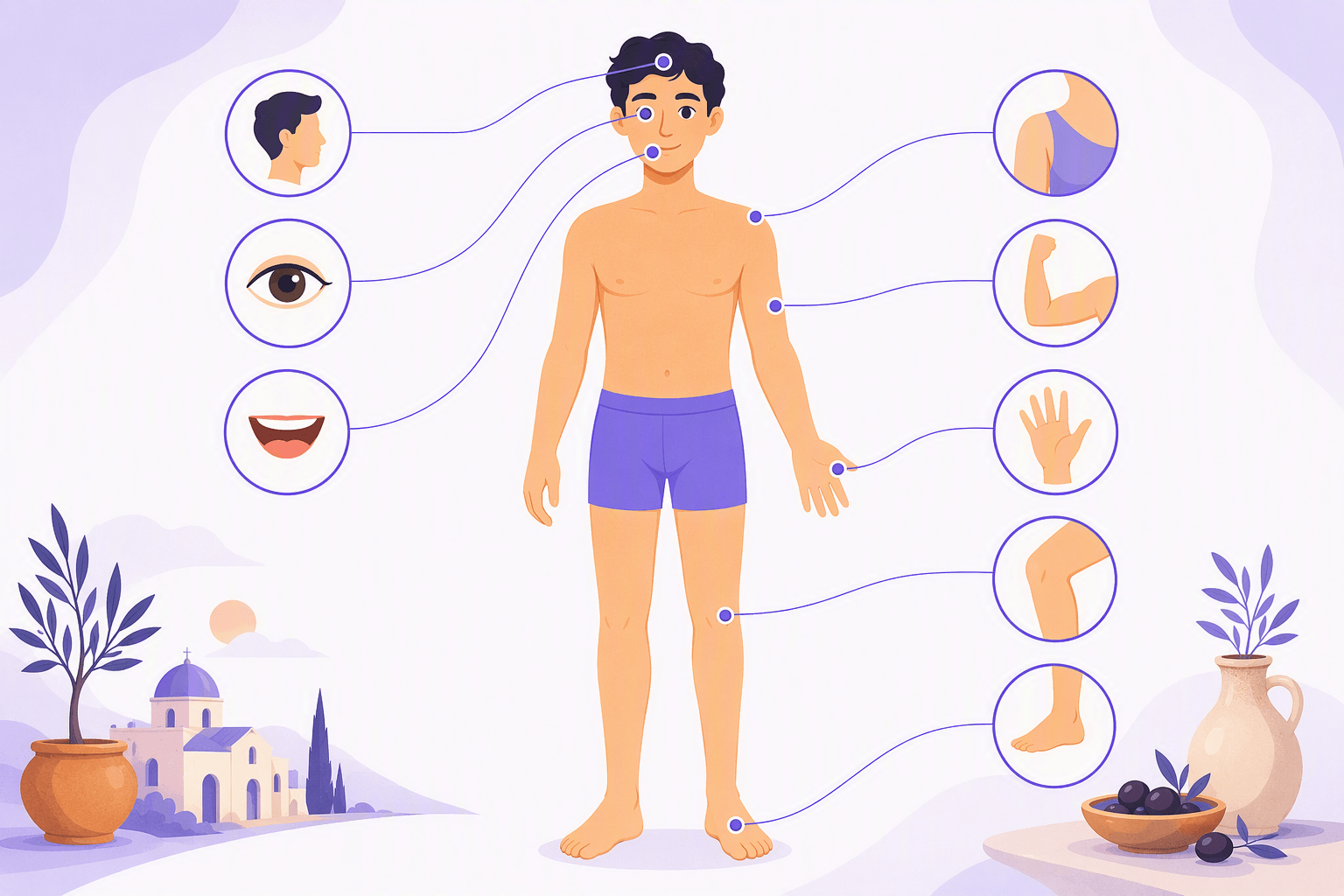
The head and face contain the highest density of essential vocabulary. Pay special attention to l'occhio / gli occhi (eye / eyes) and l'orecchio / le orecchie, which both feature gender-switching irregular plurals.
| English | Italian | Pronunciation | Note |
|---|---|---|---|
| Head | la testa (f) | lah TEH-stah | Also means 'mind' |
| Face | la faccia (f) | lah FAH-chah | Also 'il viso' (m) |
| Eye | l'occhio (m) | LOHK-kyoh | Plural: gli occhi (m) |
| Ear | l'orecchio (m) | loh-REHK-kyoh | Plural: le orecchie (f!) |
| Nose | il naso (m) | eel NAH-zoh | |
| Mouth | la bocca (f) | lah BOHK-kah | Used in many idioms |
| Tongue | la lingua (f) | lah LEEN-gwah | Also means 'language' |
| Tooth | il dente (m) | eel DEHN-teh | Plural: i denti |
| Lip | il labbro (m) | eel LAHB-broh | Plural: le labbra (f!) |
| Chin | il mento (m) | eel MEHN-toh | |
| Forehead | la fronte (f) | lah FROHN-teh | Also means 'front' |
| Cheek | la guancia (f) | lah GWAHN-chah | Plural: le guance |
| Eyebrow | il sopracciglio (m) | eel soh-prah-CHEE-lyoh | Plural: le sopracciglia (f!) |
| Hair | i capelli (m pl) | ee kah-PEHL-lee | Always plural; one hair = un capello |
⚠️ Gender-Switching Plurals in Head Vocabulary
Several head-related nouns switch from masculine singular to feminine plural: il labbro → le labbra (lip/lips), l'orecchio → le orecchie (ear/ears), il sopracciglio → le sopracciglia (eyebrow/eyebrows). This is one of the trickiest aspects of Italian grammar. The pattern comes from Latin neuter nouns, which took -a endings in the plural, a form Italian preserved for body parts.
Key Medical Phrases for Head and Face
When visiting a doctor or pharmacy in Italy, these phrases are invaluable:
- Mi fa male la testa (mee fah MAH-leh lah TEH-stah): "My head hurts"
- Ho mal di testa (oh mahl dee TEH-stah): "I have a headache"
- Mi fanno male gli occhi (mee FAHN-noh MAH-leh lyee OHK-kee): "My eyes hurt"
- Ho mal di denti (oh mahl dee DEHN-tee): "I have a toothache"
- Mi sanguina il naso (mee sahn-GWEE-nah eel NAH-zoh): "My nose is bleeding"
Italian uses two main constructions for pain: fare male (to do/make pain), where the body part is the subject, and avere mal di (to have pain of) for common ailments like headaches and stomachaches.
Upper Body and Torso
Upper body vocabulary is essential for medical descriptions and everyday conversation. The word la schiena (back) is one of the most frequently used body words in Italian, given how common back pain complaints are.
| English | Italian | Pronunciation | Note |
|---|---|---|---|
| Neck | il collo (m) | eel KOHL-loh | Also means 'collar' of a bottle |
| Shoulder | la spalla (f) | lah SPAHL-lah | Plural: le spalle |
| Chest | il petto (m) | eel PEHT-toh | Also 'il torace' (medical) |
| Back | la schiena (f) | lah SKYEH-nah | Very common in daily speech |
| Stomach | lo stomaco (m) | loh STOH-mah-koh | Belly = la pancia |
| Waist | la vita (f) | lah VEE-tah | Also means 'life'! |
| Hip | l'anca (f) | LAHN-kah | Also 'il fianco' |
| Rib | la costola (f) | lah KOHS-toh-lah | Plural: le costole |
🌍 La Vita: Life and Waist
The word la vita means both "life" and "waist" in Italian. Context always clarifies the meaning: una vita lunga (a long life) versus una vita stretta (a narrow waist). This double meaning produces charming ambiguity in Italian poetry and song lyrics, where references to la vita can evoke both physical beauty and the preciousness of existence.
Medical Phrases for the Upper Body
- Mi fa male la schiena (mee fah MAH-leh lah SKYEH-nah): "My back hurts"
- Ho mal di stomaco (oh mahl dee STOH-mah-koh): "I have a stomachache"
- Mi fa male il petto (mee fah MAH-leh eel PEHT-toh): "My chest hurts" (seek immediate help)
- Ho la nausea (oh lah NOW-zeh-ah): "I feel nauseous"

Arms and Hands
The arm-and-hand group showcases Italian's most dramatic irregular plurals. Il braccio (arm) becomes le braccia (arms), and il dito (finger) becomes le dita (fingers), both switching from masculine to feminine.
| English | Italian | Pronunciation | Note |
|---|---|---|---|
| Arm | il braccio (m) | eel BRAH-choh | Plural: le braccia (f!) |
| Elbow | il gomito (m) | eel GOH-mee-toh | Alzare il gomito = drink too much |
| Wrist | il polso (m) | eel POHL-soh | Also means 'pulse' |
| Hand | la mano (f) | lah MAH-noh | Feminine despite -o ending! |
| Finger | il dito (m) | eel DEE-toh | Plural: le dita (f!) |
| Thumb | il pollice (m) | eel POHL-lee-cheh | |
| Nail | l'unghia (f) | LOON-gyah | Plural: le unghie |
💡 Il Braccio → Le Braccia: The Neuter Survival
When Italian body parts switch gender in the plural (il braccio → le braccia, il dito → le dita, il ginocchio → le ginocchia), they are preserving Latin's neuter gender. Latin neuter nouns had -um singulars and -a plurals. Italian reinterpreted the -a plurals as feminine. This is why you say le mie braccia (my arms) with feminine agreement. No other major Romance language preserves this pattern so visibly.
Body Part Idioms: Arms and Hands
Italian hand and arm idioms are colorful and widely used:
- Avere le mani in pasta (to have hands in the dough): to be involved in something, to have connections
- Dare una mano (to give a hand): to help out
- Alzare il gomito (to raise the elbow): to drink too much
- Avere le mani bucate (to have holed hands): to be a spendthrift
- Stare con le mani in mano (to stay with hands in hand): to do nothing, to be idle
- Mettere le mani avanti (to put the hands forward): to cover yourself, to make excuses in advance
Lower Body and Legs
Lower body vocabulary features another set of gender-switching plurals, most notably il ginocchio → le ginocchia (knee/knees).
| English | Italian | Pronunciation | Note |
|---|---|---|---|
| Leg | la gamba (f) | lah GAHM-bah | In gamba = in good shape |
| Thigh | la coscia (f) | lah KOH-shah | Plural: le cosce |
| Knee | il ginocchio (m) | eel jee-NOHK-kyoh | Plural: le ginocchia (f!) |
| Shin | lo stinco (m) | loh STEENK-oh | |
| Calf | il polpaccio (m) | eel pohl-PAH-choh | Plural: i polpacci |
| Ankle | la caviglia (f) | lah kah-VEE-lyah | |
| Foot | il piede (m) | eel PYEH-deh | Plural: i piedi |
| Toe | il dito del piede (m) | eel DEE-toh dehl PYEH-deh | Lit. 'finger of the foot' |
| Heel | il tallone (m) | eel tahl-LOH-neh | Tallone d'Achille = Achilles' heel |
Lower Body Idioms
- In gamba (in leg): capable, sharp, on the ball ("Quel ragazzo è in gamba!")
- Prendere in giro (to take around): to make fun of, to pull someone's leg
- Non stare in piedi (to not stand on feet): to make no sense
- Mettere un piede in fallo (to put a foot in error): to make a misstep
- Avere i piedi per terra (to have feet on the ground): to be grounded, practical
🌍 In Gamba: Italy's Favorite Compliment
In gamba is one of Italy's most common compliments. Literally "in leg," it means capable, sharp, and reliable. Telling someone Sei proprio in gamba! (You're really on the ball!) is high praise. The expression likely comes from the idea of standing firmly on your own legs, self-sufficient and steady.
Internal Organs
Internal organ vocabulary is essential for medical communication. The Società Dante Alighieri notes that Italian medical terminology, rooted in Latin, often closely mirrors the formal anatomical terms used internationally.
| English | Italian | Pronunciation | Note |
|---|---|---|---|
| Heart | il cuore (m) | eel KWOH-reh | Term of endearment: cuore mio |
| Brain | il cervello (m) | eel cher-VEHL-loh | Plural: le cervella (f!) or i cervelli |
| Lung | il polmone (m) | eel pohl-MOH-neh | Plural: i polmoni |
| Liver | il fegato (m) | eel FEH-gah-toh | Avere fegato = to have guts |
| Kidney | il rene (m) | eel REH-neh | Plural: i reni |
| Bone | l'osso (m) | LOHS-soh | Plural: le ossa (f!) |
| Blood | il sangue (m) | eel SAHN-gweh | |
| Skin | la pelle (f) | lah PEHL-leh | Also means 'leather' |
| Muscle | il muscolo (m) | eel MOO-skoh-loh |
Essential Medical Phrases With Organs
- Mi batte forte il cuore (mee BAHT-teh FOHR-teh eel KWOH-reh): "My heart is beating hard"
- Mi fanno male i reni (mee FAHN-noh MAH-leh ee REH-nee): "My kidneys hurt"
- Ho la pelle irritata (oh lah PEHL-leh ee-rree-TAH-tah): "My skin is irritated"
- Mi sono rotto un osso (mee SOH-noh ROHT-toh oon OHS-soh): "I broke a bone"
💡 Avere Fegato: Liver = Courage in Italian
In Italian, il fegato (the liver) is metaphorically associated with courage and boldness. Avere fegato means "to have guts." Conversely, mangiarsi il fegato (to eat one's own liver) means to be consumed by anger or envy. This association between the liver and strong emotions dates back to ancient Roman medicine, which held that the liver was the seat of passion.
The Fare Male Construction: Expressing Pain in Italian
Italian has two main patterns for describing pain:
Pattern 1: Fare male (the body part does pain to you)
| English | Italian | Literal Translation |
|---|---|---|
| My head hurts | Mi fa male la testa | To me does pain the head |
| My eyes hurt | Mi fanno male gli occhi | To me do pain the eyes |
| Does your back hurt? | Ti fa male la schiena? | To you does pain the back? |
Pattern 2: Avere mal di (you have pain of)
| English | Italian | Literal Translation |
|---|---|---|
| I have a headache | Ho mal di testa | I have pain of head |
| I have a stomachache | Ho mal di stomaco | I have pain of stomach |
| I have a toothache | Ho mal di denti | I have pain of teeth |
Pattern 1 works with any body part. Pattern 2 is used for common, recurring ailments and drops the article entirely.
Body Part Idioms Native Speakers Actually Use
Italian is extraordinarily rich in body-part expressions. The Accademia della Crusca, Italy's premier language authority, has documented hundreds of these across centuries of Italian literature and speech. Here are the ones you will hear most, and that appear frequently in Italian films:
- In bocca al lupo (in the mouth of the wolf): good luck (reply: crepi il lupo!, may the wolf die!)
- Costare un occhio della testa (to cost an eye of the head): to be extremely expensive
- Non avere peli sulla lingua (to have no hairs on the tongue): to speak bluntly
- Avere il sangue freddo (to have cold blood): to be calm under pressure
- Rompersi la testa (to break one's head): to rack one's brain
- A occhio e croce (by eye and cross): approximately, roughly
"The body metaphor in Italian proverbial language constitutes the most productive semantic field in the entire idiomatic lexicon, with over 800 documented expressions in the Crusca archives." (Accademia della Crusca, Vocabolario degli Accademici della Crusca)
Practice Body Parts With Real Italian Content
Learning vocabulary from tables provides essential structure, but hearing these words in authentic Italian conversation is what makes them permanent. Italian cinema, from Fellini to contemporary comedies, is packed with body-part vocabulary, medical scenes, and idiomatic expressions.
Wordy lets you watch Italian content with interactive subtitles. Tap any body-part word to see its gender, irregular plural, pronunciation, and meaning in context. Instead of just memorizing from lists, you encounter la testa, il cuore, and le braccia naturally, the way native speakers use them.
Explore our blog for more Italian guides, or check out the best movies to learn Italian for viewing recommendations that bring this vocabulary to life.
Frequently Asked Questions
What are the most common body parts in Italian?
How do you say 'my head hurts' in Italian?
Why does 'il braccio' become 'le braccia' in the plural?
How do you describe symptoms to an Italian doctor?
What are some Italian idioms that use body parts?
Is 'la mano' masculine or feminine in Italian?
Sources & References
- Accademia della Crusca, Vocabolario degli Accademici della Crusca
- Ethnologue: Languages of the World, Italian language entry (2024)
- Maiden, M. & Robustelli, C. (2013). A Reference Grammar of Modern Italian, 2nd edition. Routledge.
- Società Dante Alighieri, L'italiano nel mondo, 2024 report
- World Health Organization, Multilingual Health Phrase Guide (2023)
Start learning with Wordy
Watch real movie clips and build your vocabulary as you go. Free to download.


