Quick Answer
The most essential Italian animal words are cane (dog), gatto (cat), cavallo (horse), uccello (bird), and pesce (fish). Italian animal nouns each have a fixed grammatical gender (il cane is masculine, la mucca is feminine), and some have separate masculine and feminine forms (il gatto/la gatta), while others use a single form for both sexes (la giraffa, il delfino).
The most important Italian animal words to learn first are il cane (dog), il gatto (cat), il cavallo (horse), l'uccello (bird), and il pesce (fish). Italian animal vocabulary is rich, culturally loaded, and tightly bound to the country's diverse ecosystems, from the Alpine ibex of the Dolomites to the Mediterranean monk seal off the coast of Sardinia.
With approximately 68 million native speakers according to Ethnologue's 2024 data and an additional 17 million second-language speakers worldwide, Italian is spoken across a country whose geography spans Alpine peaks, volcanic islands, dense Apennine forests, and over 7,600 kilometers of coastline. This ecological diversity is reflected directly in the language: Italian has distinct, widely known vocabulary for animals found in each of these habitats. Whether you're looking up "animals in italian" for travel, study, or conversation, this guide covers everything you need.
"The relationship between a culture's environment and its lexicon is nowhere clearer than in animal vocabulary: languages spoken in ecologically diverse regions consistently maintain richer, more differentiated fauna terminology than those in more uniform environments." (David Crystal, The Cambridge Encyclopedia of Language, Cambridge University Press)
This guide covers 50+ Italian animal names organized by category: pets, farm animals, wild animals, sea creatures, birds, and insects. Each section includes pronunciation, gender and plural rules, cultural symbolism, and the vivid animal idioms Italians use every day.
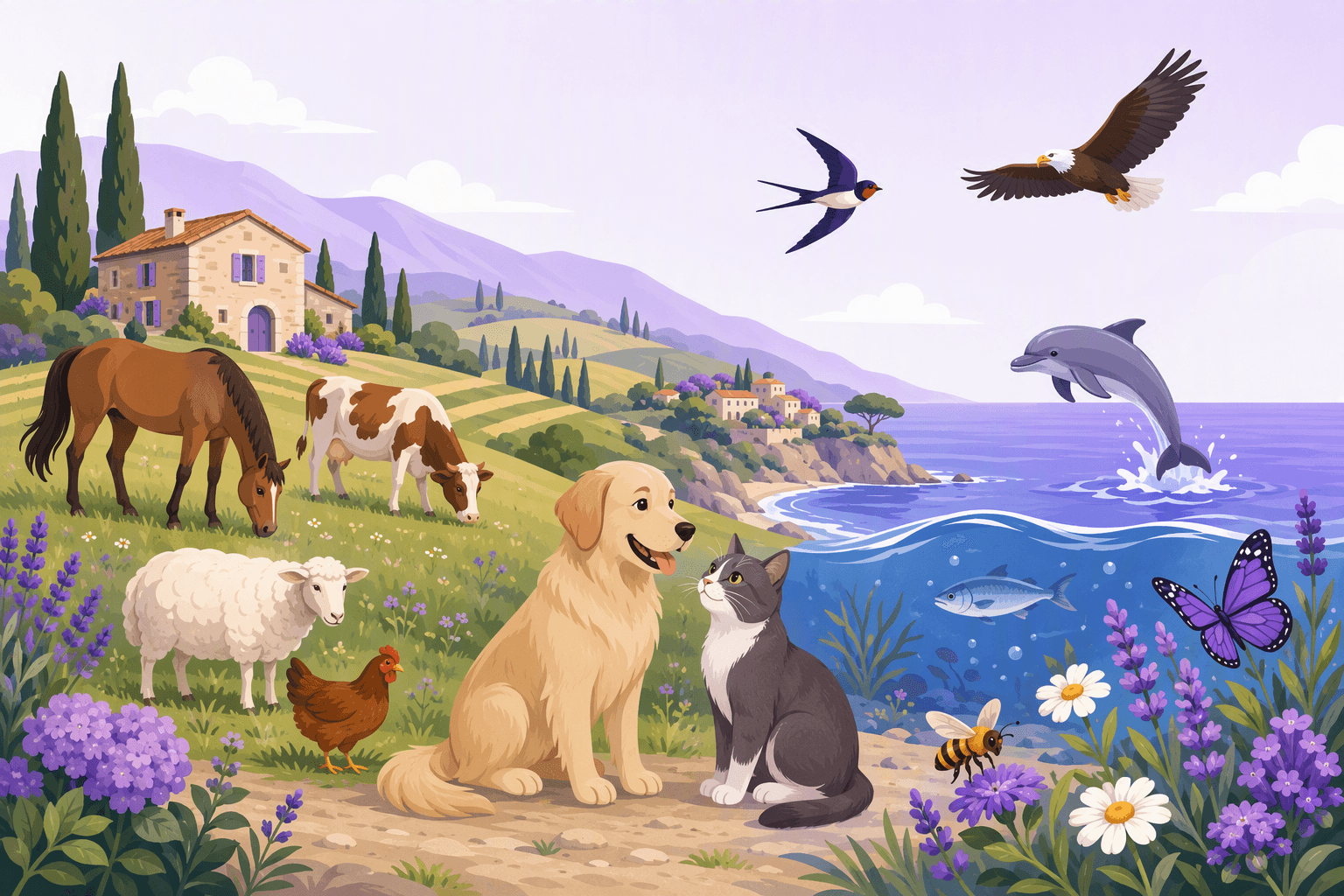
Pets (Animali Domestici)
Pets are among the first animal words any learner encounters. Italy has over 65 million pets according to national surveys, making these words essential for everyday conversation.
Il cane
| English | Italian | Pronunciation | Note |
|---|---|---|---|
| Dog | Il cane | eel KAH-neh | m. / pl. i cani; f. la cagna |
| Cat | Il gatto | eel GAHT-toh | m. / pl. i gatti; f. la gatta |
| Bird | L'uccello | loo-CHEHL-loh | m. / pl. gli uccelli |
| Fish | Il pesce | eel PEH-sheh | m. / pl. i pesci |
| Rabbit | Il coniglio | eel koh-NEE-lyoh | m. / pl. i conigli; f. la coniglia |
| Turtle / Tortoise | La tartaruga | lah tahr-tah-ROO-gah | f. / pl. le tartarughe |
| Hamster | Il criceto | eel kree-CHEH-toh | m. / pl. i criceti |
| Goldfish | Il pesce rosso | eel PEH-sheh ROHS-soh | m. / pl. i pesci rossi |
Il cane is masculine, but the female form la cagna exists for specifically referring to a female dog. In everyday speech, il cane covers both sexes, and you would only specify la cagna for breeding or veterinary contexts. The plural i cani is one of the most regular forms in Italian: masculine nouns ending in -e simply change to -i.
Il gatto and la gatta are among the few animal pairs where both gender forms are commonly used in casual conversation. Italians often say la mia gatta (my female cat) or il mio gatto (my male cat) with natural ease.
💡 Gender Rules for Animal Nouns
Italian animal nouns fall into three patterns. Pair nouns have distinct masculine and feminine forms: il gatto / la gatta, il cane / la cagna, il leone / la leonessa. Fixed masculine nouns use the same form regardless of sex: il delfino, il pesce, il ragno. Fixed feminine nouns work the same way: la giraffa, la volpe, la balena. Learn the article with every animal noun, since it determines all adjective agreement.
Farm Animals (Animali da Fattoria)
Italy's agricultural traditions run deep, and farm animal vocabulary appears everywhere from children's songs to regional cuisine names.
La mucca
| English | Italian | Pronunciation | Note |
|---|---|---|---|
| Cow | La mucca | lah MOOK-kah | f. / pl. le mucche; m. il toro (bull) |
| Horse | Il cavallo | eel kah-VAHL-loh | m. / pl. i cavalli; f. la cavalla |
| Pig | Il maiale | eel mah-YAH-leh | m. / pl. i maiali; also il porco |
| Chicken / Hen | La gallina | lah gahl-LEE-nah | f. / pl. le galline; m. il gallo (rooster) |
| Sheep | La pecora | lah PEH-koh-rah | f. / pl. le pecore |
| Goat | La capra | lah KAH-prah | f. / pl. le capre; m. il caprone |
| Donkey | L'asino | LAH-zee-noh | m. / pl. gli asini; f. l'asina |
| Duck | L'anatra | LAH-nah-trah | f. / pl. le anatre |
La mucca is the everyday word for cow, while the more formal term la vacca exists but carries vulgar connotations when used metaphorically, so avoid using it about people. The male counterpart is il toro (bull), a completely different word rather than a gender variant, which is common for domesticated animals across Romance languages.
Il maiale and il porco both mean pig, but with a distinction. Il maiale is neutral and standard; il porco carries stronger associations and is frequently used in figurative expressions (often negative). Italian cured meats (prosciutto, salame, pancetta) all come from il maiale, and Italy's pork-based culinary tradition makes this one of the most culturally significant farm animals in the language.
Wild Animals (Animali Selvatici)
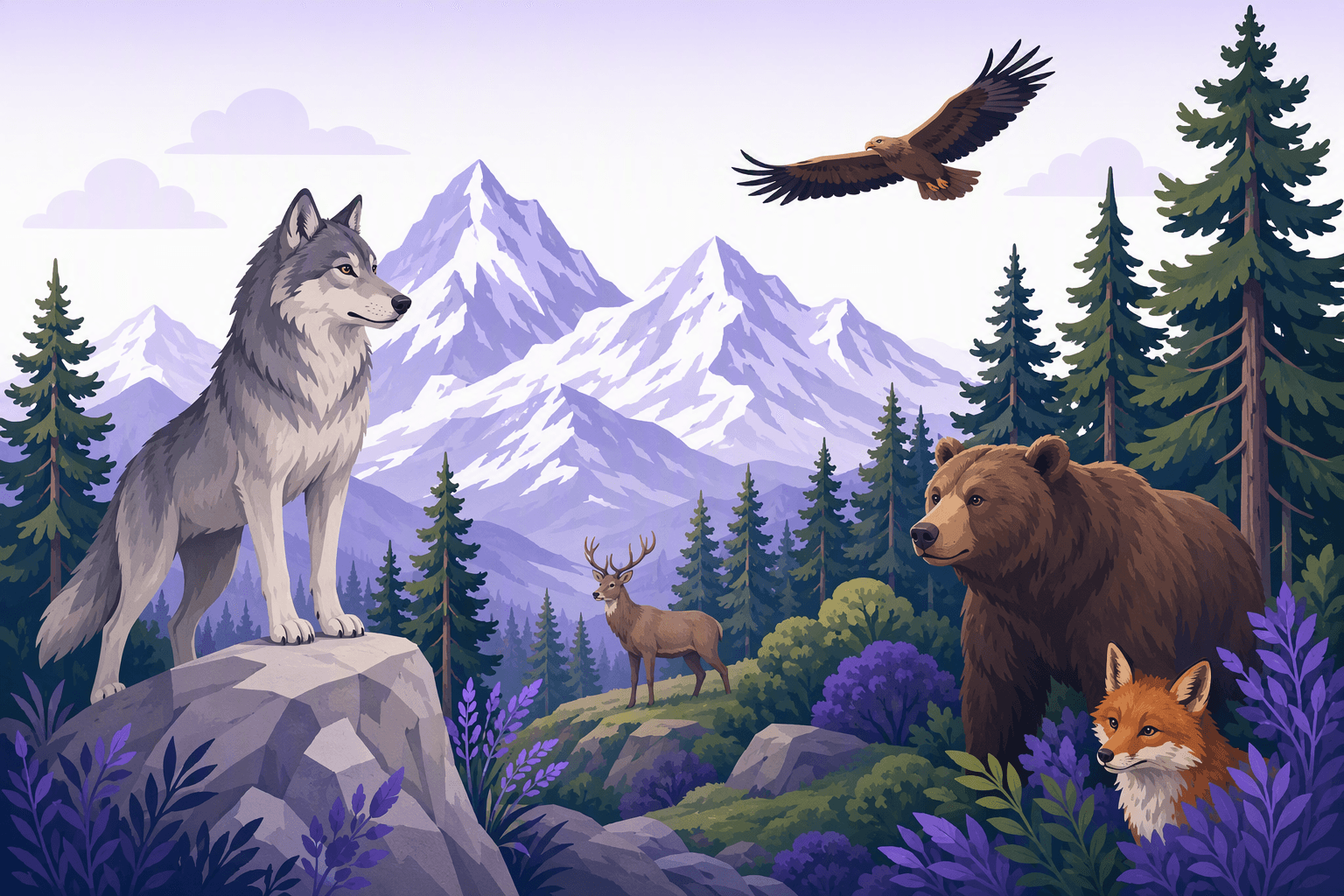
Italy's wild animal vocabulary is deeply embedded in the national identity, from Rome's founding myth to regional coat of arms symbols.
Il leone
| English | Italian | Pronunciation | Note |
|---|---|---|---|
| Lion | Il leone | eel leh-OH-neh | m. / pl. i leoni; f. la leonessa |
| Tiger | La tigre | lah TEE-greh | f. / pl. le tigri |
| Bear | L'orso | LOHR-soh | m. / pl. gli orsi; f. l'orsa |
| Wolf | Il lupo | eel LOO-poh | m. / pl. i lupi; f. la lupa |
| Fox | La volpe | lah VOHL-peh | f. / pl. le volpi |
| Deer | Il cervo | eel CHEHR-voh | m. / pl. i cervi; f. la cerva |
| Monkey | La scimmia | lah SHEEM-myah | f. / pl. le scimmie |
| Elephant | L'elefante | leh-leh-FAHN-teh | m. / pl. gli elefanti |
Il lupo (wolf) is arguably Italy's most culturally significant wild animal. The lupa romana (she-wolf of Rome) nursed the mythical twins Romulus and Remus, and the Capitoline Wolf bronze sculpture remains one of Italy's most recognized national symbols. The lupo appenninico (Apennine wolf) is a subspecies native to the Italian peninsula; after nearly going extinct in the 1970s with fewer than 100 individuals, conservation efforts have brought the population to over 3,300 according to IUCN monitoring data.
Il leone does not live wild in Italy, but it dominates Italian heraldry. The leone di San Marco (Lion of Saint Mark), a winged lion holding a book, has been Venice's symbol since the 9th century and appears throughout the city on buildings, flags, and official documents.
🌍 L'orso marsicano: Italy's Rarest Predator
The orso bruno marsicano (Marsican brown bear) is a critically endangered subspecies found only in central Italy's Abruzzo region, primarily within the Parco Nazionale d'Abruzzo, Lazio e Molise. With an estimated population of only 50-60 individuals, it is one of Europe's rarest large mammals. Italians take fierce pride in this animal, and l'orso appears frequently in Abruzzo's regional branding and cultural identity.
Sea Animals (Animali Marini)
With over 7,600 kilometers of coastline and a culinary tradition built on seafood, Italian has precise and widely known vocabulary for marine life.
La balena
| English | Italian | Pronunciation | Note |
|---|---|---|---|
| Whale | La balena | lah bah-LEH-nah | f. / pl. le balene |
| Dolphin | Il delfino | eel dehl-FEE-noh | m. / pl. i delfini |
| Shark | Lo squalo | loh SKWAH-loh | m. / pl. gli squali |
| Octopus | Il polpo | eel POHL-poh | m. / pl. i polpi |
| Crab | Il granchio | eel GRAHN-kyoh | m. / pl. i granchi |
| Jellyfish | La medusa | lah meh-DOO-zah | f. / pl. le meduse |
| Shrimp / Prawn | Il gambero | eel GAHM-beh-roh | m. / pl. i gamberi |
| Swordfish | Il pesce spada | eel PEH-sheh SPAH-dah | m. / invariable compound |
Il polpo is the standard Italian for octopus, but you will also encounter il polipo in some regions and older texts. The Accademia della Crusca has clarified that polpo is the preferred culinary and zoological term, while polipo technically refers to a polyp. In practice, both are understood, but using polpo marks you as someone who knows the distinction.
La medusa takes its name directly from the Greek mythological figure Medusa, whose snake-covered head resembles a jellyfish's trailing tentacles. The plural le meduse is a word every beachgoer in Italy learns quickly. Attenzione, ci sono le meduse! (Watch out, there are jellyfish!) is a common summer warning along Italian coasts.
Il pesce spada (swordfish) is a compound noun that stays invariable in the plural: i pesce spada, not i pesci spada. This fish is central to Sicilian cuisine, grilled, baked, or served as involtini di pesce spada (swordfish rolls).
Birds (Uccelli)
Italian birdwatching vocabulary reflects the country's position on major migration routes between Europe and Africa.
L'aquila
| English | Italian | Pronunciation | Note |
|---|---|---|---|
| Eagle | L'aquila | LAH-kwee-lah | f. / pl. le aquile |
| Owl | Il gufo | eel GOO-foh | m. / pl. i gufi |
| Parrot | Il pappagallo | eel pahp-pah-GAHL-loh | m. / pl. i pappagalli |
| Pigeon | Il piccione | eel pee-CHOH-neh | m. / pl. i piccioni |
| Penguin | Il pinguino | eel peen-GWEE-noh | m. / pl. i pinguini |
| Flamingo | Il fenicottero | eel feh-nee-KOHT-teh-roh | m. / pl. i fenicotteri |
| Swallow | La rondine | lah ROHN-dee-neh | f. / pl. le rondini |
| Seagull | Il gabbiano | eel gahb-BYAH-noh | m. / pl. i gabbiani |
L'aquila (eagle) gives its name to the capital city of Abruzzo, L'Aquila, literally "The Eagle." The eagle was the standard of the Roman legions (aquila romana), carried into battle as the legion's most sacred symbol. Losing the eagle in combat was considered the ultimate disgrace.
Il piccione (pigeon) is inseparable from Italian urban life, particularly in Venice's Piazza San Marco and nearly every other Italian piazza. The related word la colomba (dove) carries a more poetic, positive connotation and is also the name of Italy's famous Easter cake, la colomba pasquale, shaped like a dove.
La rondine (swallow) holds a special place in Italian folk culture. The proverb una rondine non fa primavera (one swallow doesn't make a spring), meaning a single positive event doesn't guarantee a trend, is one of Italy's most frequently quoted sayings.
Insects (Insetti)
Insect vocabulary is practical and surprisingly common in daily Italian conversation, especially during the warm Mediterranean months.
La farfalla
| English | Italian | Pronunciation | Note |
|---|---|---|---|
| Butterfly | La farfalla | lah fahr-FAHL-lah | f. / pl. le farfalle |
| Bee | L'ape | LAH-peh | f. / pl. le api |
| Ant | La formica | lah fohr-MEE-kah | f. / pl. le formiche |
| Spider | Il ragno | eel RAH-nyoh | m. / pl. i ragni |
| Fly | La mosca | lah MOH-skah | f. / pl. le mosche |
| Mosquito | La zanzara | lah dzahn-DZAH-rah | f. / pl. le zanzare |
| Ladybug | La coccinella | lah koh-chee-NEHL-lah | f. / pl. le coccinelle |
| Wasp | La vespa | lah VEH-spah | f. / pl. le vespe |
La farfalla (butterfly) is also the name of the famous bow-tie pasta shape (le farfalle) whose ruffled edges resemble butterfly wings. This dual meaning is a perfect example of how Italian animal vocabulary permeates food culture.
La vespa (wasp) is the origin of the iconic Piaggio Vespa scooter's name. When Enrico Piaggio first saw the 1946 prototype, he reportedly said "Sembra una vespa!" (It looks like a wasp!) because of the narrow waist connecting the body to the engine. The name stuck, and the scooter became one of Italy's most recognized exports.
La zanzara (mosquito) is a word every traveler to Italy learns by necessity, especially near lakes and coastal areas in summer. The double z is pronounced /dz/, giving the word an onomatopoeic quality that mimics the insect's buzz.
Italian Animal Idioms
Animal idioms are woven throughout Italian daily speech. Knowing these expressions is the difference between textbook Italian and natural conversation.
🌍 In Bocca al Lupo! Italy's Favorite Good Luck Expression
The most famous Italian animal idiom is in bocca al lupo! (in the mouth of the wolf!), used to wish someone good luck before an exam, interview, performance, or any challenge. The only correct reply is "Crepi!" (may it die!) or "Crepi il lupo!" Never say "Grazie", which Italians consider jinxing. The expression likely originated from the observation that a mother wolf carries her cubs in her mouth to protect them, so being "in the mouth of the wolf" actually means being protected. An even stronger version exists: in culo alla balena! (in the whale's backside!), with the reply "Speriamo che non scorreggi!" (let's hope it doesn't fart!).
Here are the animal idioms Italians use most frequently:
- Furbo come una volpe (sly as a fox): describing someone clever or cunning
- Avere una memoria da elefante (to have an elephant's memory): to remember everything
- Essere un pesce fuor d'acqua (to be a fish out of water): to feel out of place
- Can che abbaia non morde (a barking dog doesn't bite): someone who threatens rarely acts
- Prendere due piccioni con una fava (to catch two pigeons with one fava bean): to kill two birds with one stone
- Essere una pecora nera (to be a black sheep): the odd one out in a family or group
- Avere il latte alle ginocchia (to have milk at the knees): to be extremely boring (from slow-milking cows)
- Chi dorme non piglia pesci (who sleeps doesn't catch fish): the early bird catches the worm
- Muto come un pesce (mute as a fish): to keep a secret, to stay completely silent
These idioms appear constantly in Italian films and television, making them essential for understanding natural spoken Italian.
Animal Gender and Plural Patterns
Italian animal nouns follow several patterns that are worth memorizing early, as they apply broadly across the vocabulary.
Pair nouns (distinct male/female forms):
| Male | Female | Meaning |
|---|---|---|
| il gatto | la gatta | cat |
| il cane | la cagna | dog |
| il lupo | la lupa | wolf |
| il leone | la leonessa | lion/lioness |
| il gallo | la gallina | rooster/hen |
| il toro | la mucca/vacca | bull/cow |
Fixed-gender nouns (one form for both sexes):
| Noun | Gender | Add for specificity |
|---|---|---|
| la volpe | always f. | la volpe maschio (male fox) |
| la giraffa | always f. | la giraffa maschio |
| il delfino | always m. | il delfino femmina (female dolphin) |
| il ragno | always m. | il ragno femmina |
| la tigre | always f. | la tigre maschio |
💡 The -essa Suffix for Female Animals
Some animal nouns form their feminine with the suffix -essa: leone → leonessa (lion → lioness), elefante → elefantessa (elephant → female elephant). However, this pattern is not productive for all animals; you cannot say lupo → lupessa (the correct form is la lupa). When in doubt, use the base noun plus femmina: il delfino femmina.
Practice Animal Vocabulary With Real Italian Content
Animal vocabulary appears everywhere in Italian culture: in Aesop's fables retold in Italian (le favole di Esopo), in children's songs like Nella vecchia fattoria (Old MacDonald's Italian equivalent), in nature documentaries narrated in Italian, and throughout the country's rich tradition of cinema.
Wordy lets you practice Italian animal vocabulary in authentic context by watching Italian content with interactive subtitles. When an animal word appears in dialogue, tap it to see its gender, plural form, pronunciation, and usage examples. Hearing il lupo, la farfalla, and il pesce used by native speakers builds the kind of instinctive recognition that flashcards alone cannot achieve.
Explore our blog for more Italian vocabulary guides, including Italian body parts and Italian colors, or discover the best movies to learn Italian for content that brings this vocabulary to life.
Frequently Asked Questions
What are the most common animal names in Italian?
Do Italian animal nouns have gender?
What does 'in bocca al lupo' mean in Italian?
What is the symbol animal of Italy?
How do you form the plural of animal names in Italian?
What are some Italian animal idioms?
Sources & References
- Accademia della Crusca, Vocabolario degli Accademici della Crusca
- Treccani, Enciclopedia e Vocabolario online
- Crystal, D., The Cambridge Encyclopedia of Language (Cambridge University Press)
- IUCN Red List, Regional assessments for the Mediterranean basin
- Ethnologue: Languages of the World, 27th edition (2024)
Start learning with Wordy
Watch real movie clips and build your vocabulary as you go. Free to download.


