Quick Answer
To tell time in Spanish, use Es la for 1 o'clock and Son las for all other hours, then add y for minutes past (Son las dos y diez) or menos for minutes to (Son las tres menos cuarto). For half past, use y media, and for quarter past, use y cuarto. In everyday speech, Spanish also uses de la mañana, de la tarde, and de la noche to clarify AM vs PM.
To tell time in Spanish, use Es la for 1 o'clock and Son las for every other hour, then add minutes with y (past) or menos (to), plus everyday shortcuts like y cuarto (quarter past) and y media (half past).
| English | Spanish | Pronunciation | Formality |
|---|---|---|---|
| What time is it? | ¿Qué hora es? | keh OH-rah ess | polite |
| It's one o'clock. | Es la una. | ess lah OO-nah | neutral |
| It's two o'clock. | Son las dos. | sohn lahs dohs | neutral |
| It's 3:10. | Son las tres y diez. | sohn lahs trehs ee dyehs | neutral |
| It's 4:15. | Son las cuatro y cuarto. | sohn lahs KWAH-troh ee KWAR-toh | neutral |
| It's 5:30. | Son las cinco y media. | sohn lahs SEEN-koh ee MEH-dyah | neutral |
| It's 7:45. | Son las ocho menos cuarto. | sohn lahs OH-choh MEH-nohs KWAR-toh | casual |
| At what time...? | ¿A qué hora...? | ah keh OH-rah | polite |
Spanish is a global language with roughly 500 million native speakers and official status in 20 countries, plus Puerto Rico, according to widely cited 2024 reference data (Ethnologue; Instituto Cervantes). That scale matters because time-telling conventions are broadly shared, but there are small regional preferences you will notice in movies, series, and everyday life.
If you are building your basics, pair this with our guide to saying hello in Spanish so you can greet someone and ask the time naturally in one smooth exchange.
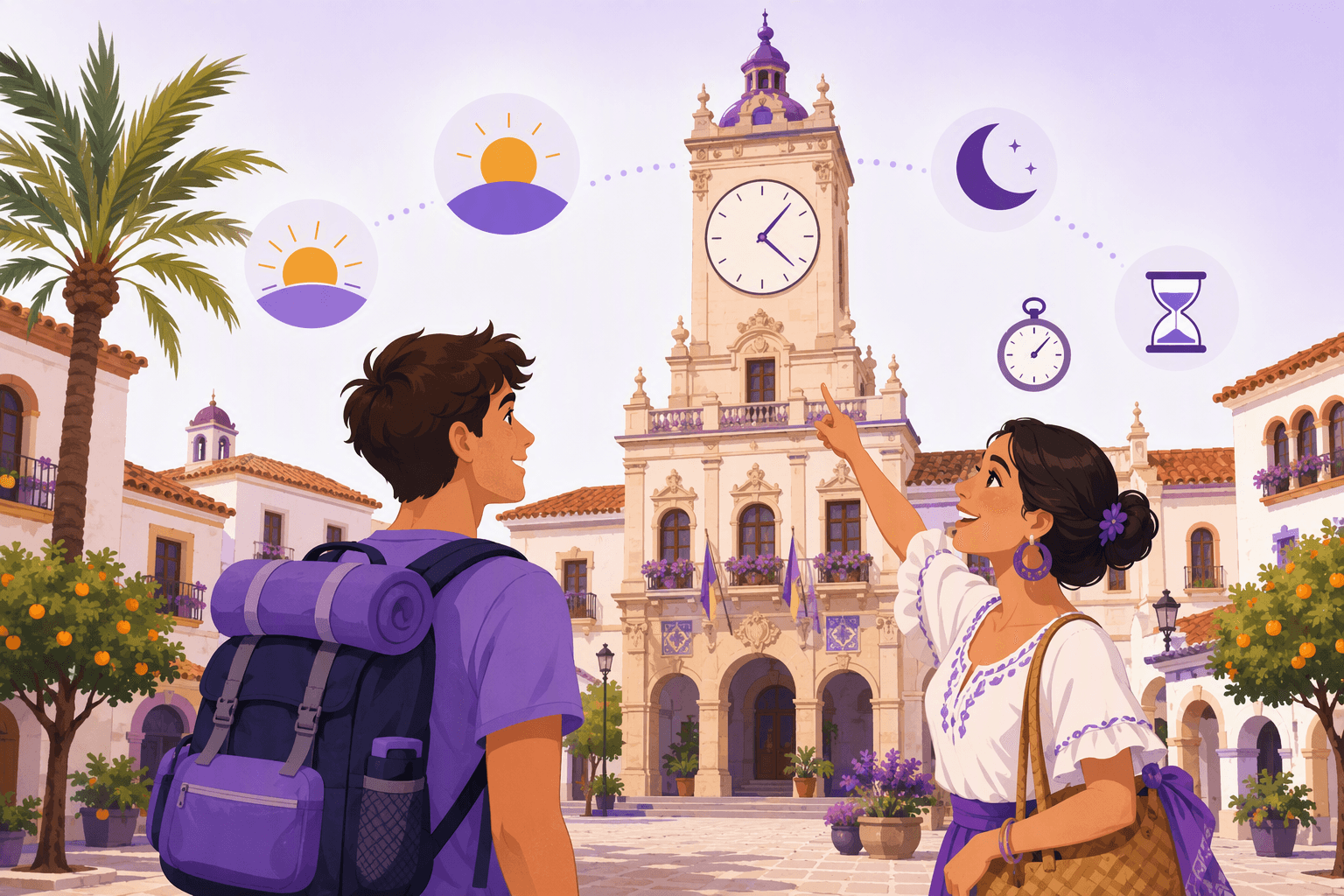
The core pattern: "Es la" vs "Son las"
Spanish treats time as a statement about "the hour". That is why the verb changes between singular and plural.
Es la
Es la una (ess lah OO-nah) is the only singular hour form you need. It literally aligns with "la hora" (the hour), singular.
Use it for:
- 1:00
- 1:05
- 1:30
- 1:55
Son las
Son las (sohn lahs) is used for 2 through 12. The idea is "las horas" (the hours), plural.
Use it for:
- 2:00 through 12:59
- and also 0:xx on a 24-hour clock when you say it as "las doce"
💡 Fast confidence check
If the hour is "una", say "Es la". If the hour is anything else, say "Son las". This one rule removes most beginner mistakes.
Asking for the time (and sounding normal)
There are two common ways to ask, and one of them is more "textbook" than the other.
¿Qué hora es?
¿Qué hora es? (keh OH-rah ess) is universal and safe. It works in Spain, Mexico, Argentina, and everywhere else.
You can soften it with:
- Perdón (pehr-DOHN), "sorry"
- Disculpe (dees-KOOL-peh), "excuse me" (more formal)
¿Qué hora tienes?
¿Qué hora tienes? (keh OH-rah TYEH-ness) is common in casual speech, especially in Spain. It is like "What time do you have?"
In Latin America, many people still understand it, but ¿Qué hora es? is the better default.
Telling time with minutes "past": y + minutes
For minutes after the hour, Spanish uses y (ee), meaning "and".
The structure is:
Son las + hour + y + minutes
Examples:
- Son las dos y cinco. (sohn lahs dohs ee SEEN-koh), 2:05
- Son las nueve y veinte. (sohn lahs NWAY-veh ee VAYN-teh), 9:20
- Es la una y diez. (ess lah OO-nah ee dyehs), 1:10
y cuarto
y cuarto (ee KWAR-toh) means "and a quarter", used for :15.
- Son las cuatro y cuarto. (sohn lahs KWAH-troh ee KWAR-toh), 4:15
y media
y media (ee MEH-dyah) means "and a half", used for :30.
- Son las seis y media. (sohn lahs SEH-ees ee MEH-dyah), 6:30
🌍 Why 'cuarto' and 'media' feel so common in Spanish dialogue
In everyday conversation, Spanish often favors chunked, rhythmic time phrases. "Y cuarto" and "y media" are short, high-frequency units that fit naturally into fast speech, which is why you hear them constantly in TV dialogue and street conversations.
Telling time with minutes "to": menos + minutes
For times close to the next hour, Spanish often counts backward using menos (MEH-nohs), "minus".
The structure is:
Son las + next hour + menos + minutes
Examples:
- Son las cinco menos diez. (sohn lahs SEEN-koh MEH-nohs dyehs), 4:50
- Son las ocho menos cuarto. (sohn lahs OH-choh MEH-nohs KWAR-toh), 7:45
- Son las doce menos cinco. (sohn lahs DOH-seh MEH-nohs SEEN-koh), 11:55
menos cuarto
menos cuarto (MEH-nohs KWAR-toh) means "minus a quarter", used for :45.
- Son las nueve menos cuarto. (sohn lahs NWAY-veh MEH-nohs KWAR-toh), 8:45
⚠️ Common learner mistake
Do not say "son las siete menos quince" in normal conversation unless you are being very precise. Native speakers strongly prefer "menos cuarto" for :45, and "y cuarto" for :15.
AM vs PM: de la mañana, de la tarde, de la noche
Spanish can be clear without "AM" and "PM" by adding a time-of-day phrase.
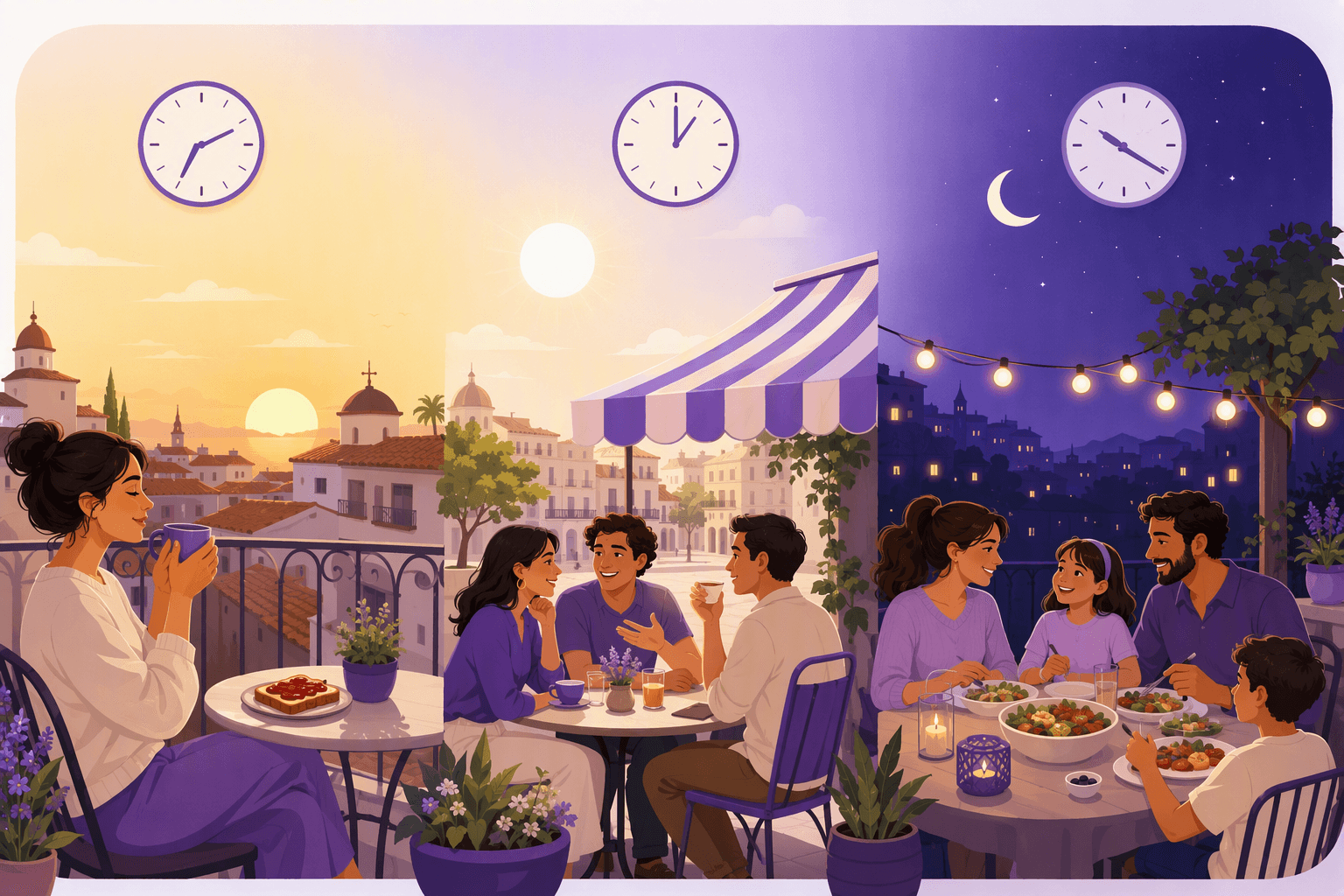
de la mañana
de la mañana (deh lah mah-NYAH-nah) is morning. Roughly from waking up until around noon.
- Son las nueve de la mañana. (sohn lahs NWAY-veh deh lah mah-NYAH-nah), 9:00 AM
de la tarde
de la tarde (deh lah TAR-deh) is afternoon. Often from around noon until sunset, but it is flexible.
- Son las cuatro de la tarde. (sohn lahs KWAH-troh deh lah TAR-deh), 4:00 PM
de la noche
de la noche (deh lah NOH-cheh) is evening or night.
- Son las diez de la noche. (sohn lahs dyehs deh lah NOH-cheh), 10:00 PM
🌍 Spain's schedule makes time-of-day labels extra useful
In much of Spain, dinner commonly starts later than in many other countries, and prime-time TV can run late. In that context, saying "a las diez de la noche" is more informative than "at ten", because it matches how people actually plan their evenings.
Noon and midnight: mediodía and medianoche
Two words are worth memorizing because they show up on signs, tickets, and in dialogue.
mediodía
mediodía (meh-dee-oh-DEE-ah) means noon, 12:00 PM.
You will hear:
- a mediodía (ah meh-dee-oh-DEE-ah), "at noon"
- sobre el mediodía (SOH-breh el meh-dee-oh-DEE-ah), "around noon"
medianoche
medianoche (meh-dee-ah-NOH-cheh) means midnight, 12:00 AM.
You will hear:
- a medianoche (ah meh-dee-ah-NOH-cheh), "at midnight"
24-hour time: how it appears vs how people say it
In many Spanish-speaking places, 24-hour time is standard in writing for:
- train and bus timetables
- flight itineraries
- hospital appointments
- official notices
But in speech, people often convert it to 12-hour time with a time-of-day phrase.
Here is a practical conversion table:
| Written (24h) | Common spoken Spanish | Pronunciation |
|---|---|---|
| 13:00 | Son la una de la tarde. | sohn lah OO-nah deh lah TAR-deh |
| 14:30 | Son las dos y media. | sohn lahs dohs ee MEH-dyah |
| 18:15 | Son las seis y cuarto. | sohn lahs SEH-ees ee KWAR-toh |
| 21:45 | Son las diez menos cuarto. | sohn lahs dyehs MEH-nohs KWAR-toh |
| 00:10 | Son las doce y diez de la noche. | sohn lahs DOH-seh ee dyehs deh lah NOH-cheh |
💡 When to say the full minutes
If you are meeting a friend, "y cuarto" and "y media" are common. If you are catching a train, saying the exact minutes (y veintidós, y cuarenta y siete) avoids confusion, especially in noisy stations.
The most useful time vocabulary (with pronunciation)
| English | Spanish | Pronunciation | Note |
|---|---|---|---|
| time (as in 'the time') | la hora | lah OH-rah | Also means 'hour' depending on context. |
| clock/watch | el reloj | el reh-LOH | Used for both wall clocks and watches. |
| minute | el minuto | el mee-NOO-toh | Plural: los minutos. |
| quarter (15 minutes) | el cuarto | el KWAR-toh | Used in y cuarto, menos cuarto. |
| half (30 minutes) | la media | lah MEH-dyah | Used in y media. |
| noon | mediodía | meh-dee-oh-DEE-ah | 12:00 PM. |
| midnight | medianoche | meh-dee-ah-NOH-cheh | 12:00 AM. |
| morning | la mañana | lah mah-NYAH-nah | de la mañana = AM. |
| afternoon | la tarde | lah TAR-deh | de la tarde = PM (afternoon). |
| night | la noche | lah NOH-cheh | de la noche = PM (evening/night). |
| around (approximately) | sobre | SOH-breh | sobre las tres = around three. |
| sharp (exactly) | en punto | en POON-toh | Son las dos en punto = exactly 2:00. |
en punto, y pico, and other real-life add-ons
Once you can say the time, Spanish gives you small add-ons that make you sound like you actually live in the language.
en punto
en punto (en POON-toh) means "exactly" or "on the dot".
- Son las tres en punto. (sohn lahs trehs en POON-toh), exactly 3:00
y pico
y pico (ee PEE-koh) means "and a bit", used when you do not want to be exact.
- Son las cinco y pico. (sohn lahs SEEN-koh ee PEE-koh), a bit after five
más o menos
más o menos (mahs oh MEH-nohs) means "more or less", another way to be approximate.
- Son las ocho, más o menos. (sohn lahs OH-choh, mahs oh MEH-nohs), around eight
sobre las...
sobre las... (SOH-breh lahs) means "around".
- Llegamos sobre las nueve. (yeh-GAH-mohs SOH-breh lahs NWAY-veh), we arrive around nine
Expert insight: why time phrases are social tools
Time expressions are not only grammar, they are coordination. That is why native speakers develop strong preferences for certain patterns.
"Politeness is not a simple matter of saying 'please' and 'thank you'. It is a system for managing social relationships, including how we make requests and coordinate actions in time."
Stephen C. Levinson, linguist, in Brown & Levinson's framework as discussed in pragmatics research (see Levinson's work on politeness and interaction)
In practice, this is why ¿A qué hora quedamos? (ah keh OH-rah keh-DAH-mohs), "What time are we meeting?" often comes with softeners like más o menos or sobre, especially when plans are flexible.
The phrases you will hear in movies and shows
These are high-frequency lines that show up constantly in real dialogue.
/keh OH-rah ess/
Literal meaning: What hour is it?
“Perdón, ¿qué hora es?”
Sorry, what time is it?
Universal and safe in any Spanish-speaking country.
/ah keh OH-rah em-PYEH-sah/
Literal meaning: At what hour does it begin?
“¿A qué hora empieza la película?”
What time does the movie start?
Common for cinema, classes, appointments, and events.
/keh-DAH-mohs ah lahs/
Literal meaning: We agree at the...
“Quedamos a las siete y media.”
Let's meet at 7:30.
Extremely common in Spain and Latin America for making plans.
/YEH-goh TAR-deh/
Literal meaning: I arrive late.
“Perdona, llego tarde, hay tráfico.”
Sorry, I'm late, there's traffic.
A natural apology starter, often followed by a reason.
/en SEEN-koh mee-NOO-tohs/
Literal meaning: In five minutes.
“Salgo en cinco minutos.”
I'm leaving in five minutes.
Useful for texting and quick updates.
If you want more everyday openers and closers for scenes like this, learn a few from how to say goodbye in Spanish so you can end the conversation naturally too.
Common regional and situational differences
Spanish time-telling is consistent across countries, but usage preferences vary by context.
Public announcements vs friend talk
- Announcements (airports, stations) often use exact minutes and 24-hour time: dieciocho treinta (dyeh-see-OH-choh TREYN-tah), 18:30.
- Friends often use chunks: y media, menos cuarto, y pico.
Spain: "y cuarto" and "menos cuarto" are everywhere
In Spain, you will hear backward counting constantly for :40 to :59. It is not "more correct", it is simply the default rhythm.
Latin America: exact minutes can be more common in some settings
In many Latin American cities, people still use menos cuarto, but you may also hear more direct minute statements in daily planning, especially when coordinating transport or work schedules.
💡 What to copy from native speakers
Copy the style that matches the situation. Use "menos cuarto" with friends, and use exact minutes when precision matters. Both are native, the difference is social, not grammatical.
Mini practice: convert these times
Try saying these out loud, then check the suggested answers.
| Time | Suggested Spanish | Pronunciation |
|---|---|---|
| 1:05 | Es la una y cinco. | ess lah OO-nah ee SEEN-koh |
| 2:15 | Son las dos y cuarto. | sohn lahs dohs ee KWAR-toh |
| 3:30 | Son las tres y media. | sohn lahs trehs ee MEH-dyah |
| 6:50 | Son las siete menos diez. | sohn lahs SYEH-teh MEH-nohs dyehs |
| 11:45 | Son las doce menos cuarto. | sohn lahs DOH-seh MEH-nohs KWAR-toh |
Learning with clips: what to listen for
When you learn time phrases through TV and movies, focus on a few audio cues.
- The verb: listen for es vs son.
- The connector: y (past) vs menos (to).
- The chunk: cuarto and media are your anchors.
- The time-of-day label: de la mañana, de la tarde, de la noche.
This is also a great place to train your ear for Spanish rhythm and vowel clarity. If pronunciation is your bottleneck, our Spanish pronunciation guide will make these phrases much easier to hear and repeat.
A quick note on politeness and tone
Asking the time is usually low-stakes, but tone still matters. A quick perdón or disculpe makes you sound considerate, especially with strangers.
If you are learning Spanish for travel or dating, pairing time language with emotional language is powerful. For example, you can plan a meetup and add warmth with phrases from how to say I love you in Spanish, but keep it context-appropriate.
Keep your Spanish "safe" in stressful moments
Time pressure can make people swear, especially in traffic, missed trains, or late-night chaos. If you watch Spanish-language shows, you will hear that side too.
If you want to understand it without copying it, read our guide to Spanish swear words so you recognize what is being said and how strong it is.
Recap: the 5 rules that cover almost everything
- Es la una, but Son las for all other hours.
- Use y + minutes for times after the hour.
- Use menos + minutes for times before the next hour.
- Use y cuarto (:15) and y media (:30) as default shortcuts.
- Add de la mañana / de la tarde / de la noche when clarity matters.
To keep building, explore the Spanish learning page and practice these phrases with real clips so your timing, pronunciation, and listening all improve together.
Frequently Asked Questions
How do you ask 'What time is it?' in Spanish?
Do Spanish speakers use 24-hour time?
Why is it 'Es la una' but 'Son las dos'?
How do you say 12:00 AM and 12:00 PM in Spanish?
What is the most natural way to say 7:45 in Spanish?
Sources & References
- Real Academia Española (RAE), Diccionario panhispánico de dudas, entries on 'hora' and time expressions, 2005
- Instituto Cervantes, El español en el mundo, 2024 annual report
- Ethnologue: Languages of the World, Spanish language entry, 27th edition, 2024
- Butt, J. & Benjamin, C. A New Reference Grammar of Modern Spanish, 6th edition, Routledge, 2019
Start learning with Wordy
Watch real movie clips and build your vocabulary as you go. Free to download.


