Quick Answer
The most common way to say please in Spanish is 'por favor' (por fah-BOR). But Spanish politeness works differently from English, verb conjugation, tone, and indirect phrasing often replace the word 'please' entirely. Native speakers use subjunctive mood, softeners like 'porfa,' and regional expressions like 'anda' (Spain) or 'dale' (Argentina) to make requests polite.
The Short Answer
The most common way to say please in Spanish is por favor (por fah-BOR). It is universal across all 21 Spanish-speaking countries and works in every register, from casual conversation to formal correspondence.
But here is what textbooks rarely explain: Spanish does not rely on the word "please" nearly as much as English does. Where an English speaker might say "Could you please pass me the salt, please?" a Spanish speaker would simply ask ¿Me pasas la sal? and it would already sound perfectly polite. The verb form, tone, and sentence structure carry the politeness that English packs into the word "please."
"Politeness in language is not a matter of magic words but of the entire system of social indexing: verb forms, pronouns, intonation, and indirectness work together to signal respect."
(Claire Kramsch, Language and Culture, Oxford University Press, 1998)
Spanish is spoken by approximately 559 million people across 21 countries, according to Ethnologue's 2024 data. With that global reach, the ways speakers express politeness vary enormously, from Mexico's deeply deferential mande to Argentina's breezy dale. This guide covers 15 polite expressions organized by formality, with pronunciation, examples, and cultural context for each.

Quick Reference: Spanish Polite Expressions at a Glance
| English | Spanish | Pronunciation | Formality |
|---|---|---|---|
| Please | Por favor | por fah-BOR | polite |
| Please (casual) | Porfa | POR-fah | casual |
| If you would be so kind | Si me hace el favor | see meh AH-seh el fah-BOR | formal |
| I beg you (formal) | Le ruego | leh RRWEH-goh | very formal |
| Have the kindness to... | Tenga la amabilidad de... | TEHN-gah lah ah-mah-bee-lee-DAHD deh | very formal |
| Do the favor of... | Haga el favor de... | AH-gah el fah-BOR deh | formal |
| Go on, come on (Spain) | Anda | AHN-dah | casual |
| Come on (Spain) | Venga | BEHN-gah | casual |
| Go ahead / Sure (Argentina) | Dale | DAH-leh | casual |
| Could you...? | ¿Me podrías...? | meh poh-DREE-ahs | polite |
| Would you be so kind as to...? | ¿Sería tan amable de...? | seh-REE-ah tahn ah-MAH-bleh deh | formal |
| I would appreciate if... | Le agradecería que... | leh ah-grah-deh-seh-REE-ah keh | formal |
Standard "Please" Expressions
These are the workhorses of Spanish politeness, expressions that every learner should master first. According to the Asociación de Academias de la Lengua Española (ASALE), por favor has been the standard polite marker across all varieties of Spanish for centuries.
Por favor
/por fah-BOR/
Literal meaning: As a favor / For a favor
“¿Me puede traer la cuenta, por favor?”
Could you bring me the check, please?
Universal across all 21 Spanish-speaking countries. Works in every situation from street vendors to presidential addresses. Position is flexible, beginning, middle, or end of a sentence.
Por favor is the direct equivalent of "please" in English. It literally means "as a favor" and can be placed almost anywhere in a sentence. The most common positions are at the end (Un café, por favor) or at the beginning (Por favor, siéntese).
One key difference from English: Spanish speakers use por favor less frequently than English speakers use "please." Research in cross-cultural pragmatics shows that English relies more heavily on explicit politeness markers, while Spanish builds politeness into verb conjugation and sentence structure. Adding por favor to every request in Spanish can actually sound excessive or even sarcastic.
Si me hace el favor
/see meh AH-seh el fah-BOR/
Literal meaning: If you do me the favor
“Pase por aquí, si me hace el favor.”
Come this way, if you would be so kind.
A polite step above 'por favor.' Common in customer service, formal invitations, and professional settings across all Spanish-speaking countries.
This expression adds a layer of courtesy beyond plain por favor. It is frequently heard in restaurants, hotels, and offices. The conditional form si me hiciera el favor is even more formal, using the subjunctive mood to add distance and deference.
Formal Requests
In professional, academic, and bureaucratic contexts, Spanish offers several elevated expressions. These are the phrases you will encounter in business emails, official letters, and government offices. Moreno Fernandez notes in Variedades de la lengua espanola (Routledge, 2020) that formal register in Spanish varies significantly by country, with Latin American Spanish tending toward more formal address than Peninsular Spanish.
Le ruego
/leh RRWEH-goh/
Literal meaning: I beg you (formal)
“Le ruego que me envíe los documentos antes del viernes.”
I beg you to send me the documents before Friday.
Common in formal correspondence and bureaucratic language. Despite the English translation 'I beg you,' it does not sound desperate in Spanish, it is simply the highest register of polite request.
Le ruego sounds dramatic in English, but in Spanish it is standard formal correspondence. You will see it in business emails, legal documents, and official communications. The verb rogar (to beg, to request) carries no sense of desperation in this context; it is simply the most respectful way to frame a request.
Tenga la amabilidad de...
/TEHN-gah lah ah-mah-bee-lee-DAHD deh/
Literal meaning: Have the kindness to...
“Tenga la amabilidad de esperar en la sala.”
Have the kindness to wait in the lobby.
Highly formal. Used in official settings, written notices, and by staff addressing clients in upscale establishments. Can sound stiff in casual conversation.
This is the kind of phrase you will see printed on signs in government offices or hear from a receptionist at a high-end hotel. It belongs firmly in the formal register and would sound awkward among friends.
Haga el favor de...
/AH-gah el fah-BOR deh/
Literal meaning: Do the favor of...
“Haga el favor de cerrar la puerta al salir.”
Please close the door when you leave.
Formal but slightly less elevated than 'Tenga la amabilidad.' Common in professional settings. Can also carry a tone of irritation if said sharply: 'Haga el favor!' alone means 'Come on!' or 'How dare you!'
Be aware of tone with this one. Said calmly and with a full sentence, Haga el favor de... is polite and formal. But said sharply on its own (¡Haga el favor!), it flips into an expression of indignation, similar to "How dare you!" or "The nerve!" Context and intonation make the difference.
⚠️ When Formal Becomes Too Formal
Using Le ruego or Tenga la amabilidad in casual conversation will sound strange and overly stiff. Reserve these for written communication, professional settings, or when addressing someone of significantly higher status. Among friends or peers, stick to por favor or even just the conditional verb form.
Casual Softeners
These are the expressions that make Spanish feel alive and natural. Rather than translating directly as "please," they function as softeners that make requests friendlier. Using them correctly will make you sound far more natural than someone who adds por favor to every sentence.
Porfa
/POR-fah/
Literal meaning: Please (abbreviated)
“Pásame el teléfono, porfa.”
Pass me the phone, please.
Extremely common across all Spanish-speaking countries. Used in texting, casual speech, and among friends and family. Think of it as the Spanish equivalent of 'pls', informal but never rude.
Porfa is simply a shortened por favor, and it is everywhere in casual Spanish. You will hear it among friends, in text messages, and in any relaxed setting. It is not slang exactly, more like a natural abbreviation that has become universally accepted.
Some speakers extend it playfully to porfis or porfi for an extra dose of charm, especially when asking a favor from someone close. You might hear Porfis, porfis, porfis as a lighthearted way to plead, similar to "pretty please" in English. This playful repetition is particularly common among younger speakers and in family settings.
Anda
/AHN-dah/
Literal meaning: Walk / Go on
“Anda, ven conmigo al cine.”
Come on, come to the movies with me.
Primarily used in Spain. Functions as an encouraging nudge, somewhere between 'please' and 'come on.' Can also express surprise: '¡Anda!' (Wow! / No way!). Very common in daily Peninsular Spanish.
Anda is one of those distinctly Spanish (as in Spain) expressions that learners rarely encounter in textbooks. It softens a request by turning it into a friendly encouragement. Anda, quédate un rato más (Come on, stay a bit longer) is warmer and more natural than adding por favor. You will hear it constantly in Spanish films and TV series. Check out our guide to the best movies for learning Spanish for great examples.
Venga
/BEHN-gah/
Literal meaning: Come / Come on
“Venga, que llegamos tarde.”
Come on, we're going to be late.
Distinctly Peninsular Spanish (Spain). Used as an encourager, an agreement marker ('OK then'), and a softener for requests. Extremely versatile, one of the most common filler words in Spanish from Spain.
Venga is Spain's Swiss Army knife of casual speech. It can mean "come on," "OK then," "let's go," or function as a friendly push to accept a request. In Latin America, you would not hear venga used this way; it remains a distinctly Peninsular expression.
A typical exchange in Spain might end with Venga, venga, nos vemos mañana (OK, OK, see you tomorrow), where the repetition functions as both agreement and a casual sign-off. It is one of those words that, once you notice it, you will hear it in every conversation in Madrid or Barcelona.
Dale
/DAH-leh/
Literal meaning: Give it / Hit it
“¿Vamos a cenar afuera? (¡Dale!”
Shall we go out for dinner?) Sure, let's do it!
Quintessentially Argentine. Functions as 'sure,' 'go ahead,' 'OK,' and a casual softener. In other Latin American countries, 'dale' exists but is not used as extensively as in Argentina and Uruguay.
Dale is to Argentine Spanish what venga is to Peninsular Spanish: an all-purpose casual affirmation. While it does not translate directly as "please," it functions as an encouraging agreement that softens requests and suggestions. An Argentine saying Dale, ayudame con esto (Come on, help me with this) is making a polite casual request.
In Argentina and Uruguay, dale has become so ubiquitous that it can open a conversation, close one, express agreement, and soften a command, sometimes all in the same exchange. You might also hear dale que va (go for it) or dale, dale as enthusiastic encouragement.
Indirect Politeness: When Spanish Skips "Please" Entirely
This is where Spanish politeness gets fascinating for English speakers. In many everyday situations, the verb form itself does all the polite work, with no explicit "please" needed.
¿Me podrías...?
/meh poh-DREE-ahs/
Literal meaning: Could you (for me)...?
“¿Me podrías ayudar con las maletas?”
Could you help me with the suitcases?
The conditional tense ('podrías' instead of 'puedes') is the most common way to soften a request in Spanish. Adding 'por favor' is optional and often unnecessary, the verb form already signals politeness.
The conditional tense is the workhorse of indirect politeness in Spanish. By changing ¿Me puedes ayudar? (Can you help me?) to ¿Me podrías ayudar? (Could you help me?), the request becomes softer without any explicit "please." This is how most native speakers make everyday polite requests.
¿Sería tan amable de...?
/seh-REE-ah tahn ah-MAH-bleh deh/
Literal meaning: Would you be so kind as to...?
“¿Sería tan amable de firmar aquí?”
Would you be so kind as to sign here?
Formal and courteous. Common in customer service, professional requests, and situations where you are asking a stranger for something. The conditional 'sería' does the politeness work.
This is the formal end of indirect politeness. You will hear it from bank tellers, hotel staff, and in any professional service interaction. The conditional mood (sería instead of es) combined with tan amable (so kind) creates a very respectful request without the word por favor.
You can also swap amable for gentil (kind/gentle): ¿Sería tan gentil de indicarme el camino? (Would you be so kind as to show me the way?). Both versions are interchangeable in formal contexts, though amable is slightly more common in everyday formal speech.
When "Please" Is Implicit: The Subjunctive Secret
One of the most important things for English speakers to understand about Spanish politeness is that verb conjugation often replaces the word "please" entirely. The subjunctive mood and conditional tense are built-in politeness markers.
| English (needs "please") | Spanish (polite without "please") | Why It Works |
|---|---|---|
| Pass me the salt, please | ¿Me pasas la sal? | Question form + informal "you" = polite enough among friends |
| Could you open the window, please? | ¿Podrías abrir la ventana? | Conditional tense = built-in softener |
| I would like a coffee, please | Quisiera un café | Subjunctive "quisiera" = inherently polite |
| Please sit down | Siéntese | Formal imperative (usted) = respectful command |
| I'd appreciate it if you could call me | Le agradecería que me llamara | Conditional + subjunctive = maximum politeness |
Notice the pattern: where English adds "please" as an external word, Spanish builds the politeness into the verb itself. The subjunctive quisiera (I would like) is inherently more polite than quiero (I want), and the formal imperative siéntese already includes the respectful usted form.
🌍 Why English 'Please' Can Sound Excessive in Spanish
English speakers learning Spanish often add por favor to every request out of habit. While this is never wrong, native Spanish speakers may find it slightly excessive or overly formal. In a casual restaurant, Un café, por favor is natural, but among friends at home, ¿Me pasas el café? is perfectly polite without any "please." The key insight from cross-cultural pragmatics research is that politeness is systemic, not word-based. Spanish distributes it across verb forms, pronouns, and intonation rather than concentrating it in a single word.
Regional Politeness: Mande and Beyond
Spanish politeness customs vary significantly by region. One of the most striking examples is Mexico's mande.
Mande (MAHN-deh), literally "command me," is used in Mexico as a polite response when someone calls your name or when you did not hear what was said. It functions like "yes?" or "pardon?" but carries a deeper cultural layer of deference rooted in colonial-era social hierarchies. While outsiders sometimes mistake it for "please," it is actually a response marker, not a request word.
In much of Latin America outside Mexico, ¿Cómo? or ¿Perdón? serves the same function. In Mexico, answering with ¿Qué? (What?) instead of Mande is considered rude, and parents actively teach children to use mande from a young age. This is one of the clearest examples of how Spanish politeness norms are culturally transmitted and region-specific.
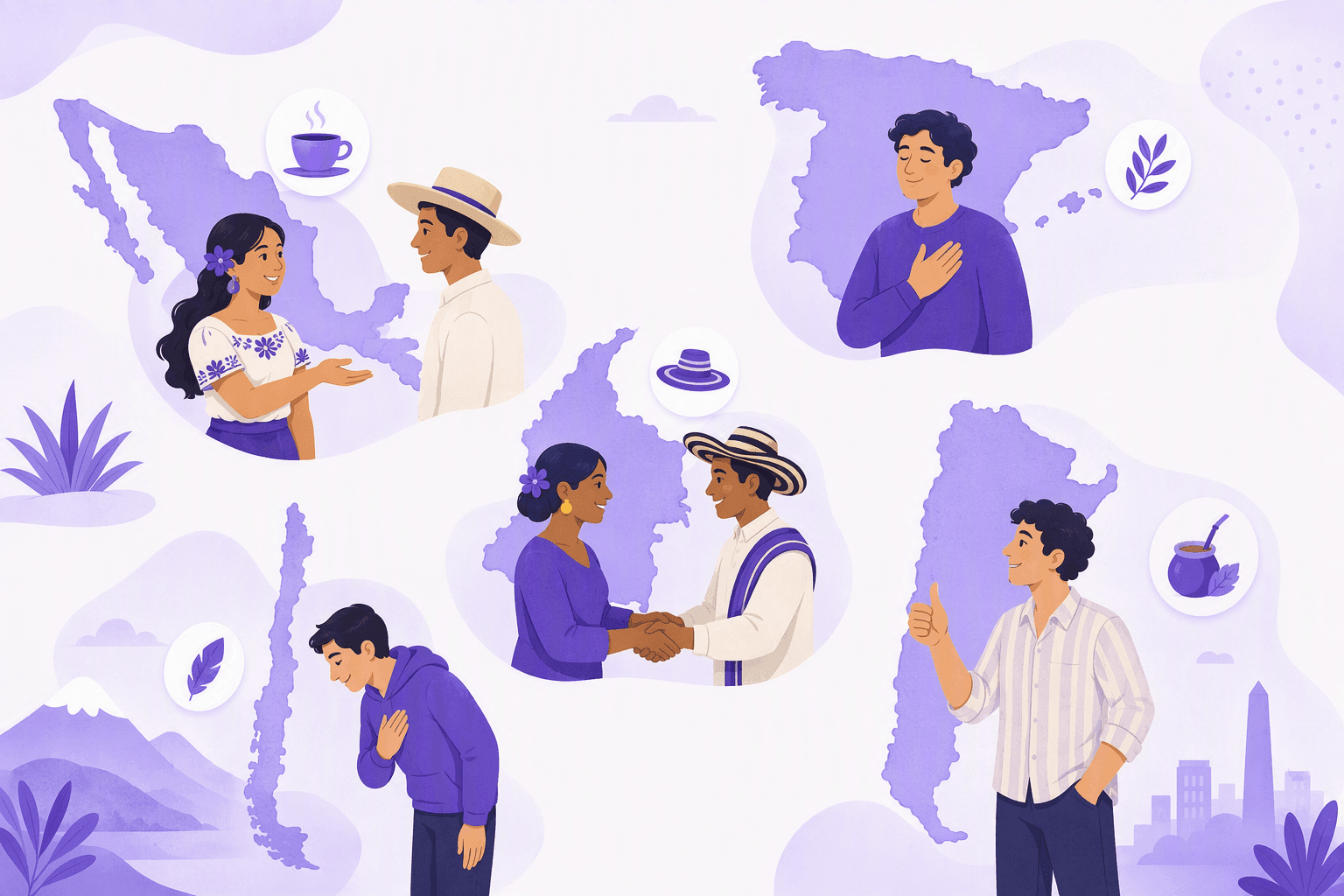
| Region | Casual Softener | Polite Response | Cultural Note |
|---|---|---|---|
| Spain | Anda, Venga | ¿Dígame? | Directness is valued; excessive formality can seem cold |
| Mexico | Porfa, Órale | Mande | Deep deference culture; "mande" reflects colonial-era courtesy |
| Argentina | Dale, Che | ¿Cómo? | Casual warmth; "vos" pronoun creates intimacy |
| Colombia | Porfa, Hágame el favor | ¿Señor/Señora? | Known for formal courtesy; "sumercé" in Boyacá region |
| Chile | Porfa, Po | ¿Ah? / ¿Cómo? | "Po" (from "pues") softens everything: "ya po," "sí po" |
Practice With Real Spanish Content
Understanding these polite expressions on paper is a strong start, but hearing them in natural conversation is what makes them feel instinctive. Spanish-language films and shows are full of these expressions. Listen for porfa in casual scenes, le ruego in formal dialogue, and anda in any scene set in Spain.
Wordy lets you watch Spanish movies and shows with interactive subtitles. Tap on any polite expression to see its meaning, formality level, and cultural context in real time. Instead of memorizing a list, you absorb politeness patterns from real conversations with authentic intonation.
For more Spanish content, explore our blog for guides on everything from greetings to the best movies for learning Spanish. Visit our Spanish learning page to start practicing today.
Frequently Asked Questions
What is the most common way to say please in Spanish?
Is 'porfa' rude or acceptable?
Do Spanish speakers always say 'please'?
What does 'mande' mean in Mexican Spanish?
How do you say please formally in Spanish?
Sources & References
- Asociación de Academias de la Lengua Española (ASALE), Diccionario de americanismos, 2010
- Moreno Fernández, F. (2020). 'Variedades de la lengua española.' Routledge.
- Ethnologue: Languages of the World, Spanish language entry (2024)
- Kramsch, C. (1998). 'Language and Culture.' Oxford University Press.
Start learning with Wordy
Watch real movie clips and build your vocabulary as you go. Free to download.


