Quick Answer
The most common way to say please in French is 's'il vous plaît' (seel voo PLEH), literally 'if it pleases you.' Use 's'il te plaît' with friends and family. French culture treats politeness as non-negotiable: ordering a coffee without 's'il vous plaît' is considered genuinely rude.
The Short Answer
The most common way to say please in French is s'il vous plaît (seel voo PLEH). It literally means "if it pleases you," one of the most beautifully courteous etymologies in any language. With friends and family, the informal version is s'il te plaît (seel tuh PLEH).
French is spoken by approximately 321 million people across 29 countries, according to the Organisation internationale de la Francophonie's 2022 report. Across every one of those countries, politeness markers like s'il vous plaît are not optional decorations but load-bearing structures of daily communication. Ordering a coffee without it? You will notice the difference in the waiter's demeanor.
"Politeness in French is not merely a social nicety but a deeply embedded linguistic system. The choice between tu and vous alone carries more social information than entire sentences in many other languages."
(Brown & Levinson, Politeness: Some Universals in Language Usage, Cambridge University Press, 1987)
This guide covers 15+ ways to say please in French, organized by formality level: standard, formal, casual, and indirect. Each includes pronunciation, usage context, and the cultural knowledge you need to sound genuinely polite rather than just grammatically correct.

Quick Reference: French "Please" Expressions at a Glance
| English | French | Pronunciation | Formality |
|---|---|---|---|
| Please (formal/neutral) | S'il vous plaît | seel voo PLEH | polite |
| Please (informal) | S'il te plaît | seel tuh PLEH | casual |
| Please (formal written) | Veuillez | vuh-YAY | very formal |
| I beg of you | Je vous en prie | zhuh vooz ahn PREE | formal |
| I beg of you (informal) | Je t'en prie | zhuh tahn PREE | casual |
| Please (texting, formal) | SVP | seel voo PLEH | polite |
| Please (texting, informal) | STP | seel tuh PLEH | casual |
| Please (casual spoken) | S'te plaît | stuh PLEH | casual |
| Could you...? | Pourriez-vous... ? | poo-ree-AY voo | polite |
| Could you...? (informal) | Pourrais-tu... ? | poo-REH tew | casual |
| Would you be so kind as to | Auriez-vous l'amabilité de | oh-ree-AY voo lah-mah-bee-lee-TAY duh | very formal |
| I would like | Je voudrais | zhuh voo-DREH | polite |
Standard "Please", The Essential Two
These are the two forms every French learner must know from day one. The only difference between them is the tu/vous distinction, one of the most important social markers in French.
S'il vous plaît
/seel voo PLEH/
Literal meaning: If it pleases you (formal)
“Un café, s'il vous plaît.”
A coffee, please.
The default 'please' for strangers, service interactions, professional settings, and anyone you address as 'vous.' Used dozens of times per day by native speakers.
S'il vous plaît breaks down into three words: s'il (if it), vous (you, formal), plaît (pleases). This etymology ("if it pleases you") reflects the deep respect embedded in French politeness culture. According to the Académie française, this construction has been in continuous use since at least the 16th century.
In practice, this is the phrase you will use most. At a bakery, at a restaurant, asking for directions, in a meeting: any interaction where vous is appropriate. And when in doubt, vous is always the safer choice.
S'il te plaît
/seel tuh PLEH/
Literal meaning: If it pleases you (informal)
“Passe-moi le sel, s'il te plaît.”
Pass me the salt, please.
Used with people you address as 'tu': friends, family, children, close colleagues. Switching from 's'il vous plaît' to 's'il te plaît' with someone signals a shift in your relationship.
The informal twin. The only change is the pronoun: te (informal you) replaces vous (formal you). This mirrors the broader tu/vous system that governs all of French social interaction.
🌍 Tu vs. Vous: It Changes Everything
The tu/vous distinction doesn't just affect "please." It reshapes every polite expression. S'il te plaît vs. s'il vous plaît, je t'en prie vs. je vous en prie, pourrais-tu vs. pourriez-vous. Getting the register wrong is one of the most common mistakes French learners make. When in doubt, always default to vous. A French person will invite you to use tu when the relationship is ready, often with the phrase On peut se tutoyer (We can use tu with each other).
Formal and Elegant "Please"
French has an exceptionally rich set of formal politeness expressions. These go beyond everyday s'il vous plaît and signal refinement, respect, or professional register. As Le Petit Robert documents, each occupies a specific niche in the formality hierarchy.
Je vous en prie
/zhuh vooz ahn PREE/
Literal meaning: I beg you of it
“Je vous en prie, asseyez-vous.”
Please, have a seat.
Doubles as both 'please' (when making a request) AND 'you're welcome' (when responding to thanks). Context determines the meaning. Very polished and elegant.
This expression has a fascinating dual function. When used before a request (Je vous en prie, entrez, "Please, come in"), it means "please." But when used as a response to merci (Je vous en prie), it means "you're welcome." This dual role confuses many learners, but context always makes the meaning clear.
The informal version is je t'en prie, used with people you address as tu. Both carry a gracious, generous tone: the speaker is essentially saying "I implore you" or "it is my pleasure."
Veuillez
/vuh-YAY/
Literal meaning: Be willing to / Kindly
“Veuillez trouver ci-joint mon CV.”
Please find attached my CV.
The formal imperative of 'vouloir' (to want). Almost exclusively written: used in business letters, official emails, legal documents, and formal announcements. Rarely spoken except in very official contexts.
Veuillez is the formal imperative of vouloir (to want). It literally means "be willing to" and is the gold standard of written French politeness. You will encounter it in every formal French letter, government notice, and professional email. The classic French letter closing (Veuillez agréer l'expression de mes salutations distinguées) is a cultural institution unto itself.
Auriez-vous l'amabilité de
/oh-ree-AY voo lah-mah-bee-lee-TAY duh/
Literal meaning: Would you have the kindness to
“Auriez-vous l'amabilité de fermer la porte ?”
Would you be so kind as to close the door?
Extremely formal and courteous. Used in high-register written correspondence or when making a delicate request to someone of higher status. The French conditional tense at its most elaborate.
This is French politeness at its most ornate. You are unlikely to use this in daily conversation, but you will encounter it in formal letters, academic correspondence, and situations requiring maximum deference. Variations include Auriez-vous l'obligeance de (Would you have the obligingness to) and Auriez-vous la gentillesse de (Would you have the kindness to).
Casual and Spoken "Please"
In fast-paced spoken French, native speakers naturally shorten and abbreviate. These casual forms are what you will actually hear on the streets of Paris, Lyon, or Montreal.
S'te plaît
/stuh PLEH/
Literal meaning: If it pleases you (contracted)
“Eh, s'te plaît, tu peux m'aider ?”
Hey, please, can you help me?
A spoken contraction of 's'il te plaît' where the 'il' disappears entirely. Extremely common in casual speech, especially among younger speakers. Never written in formal contexts.
In rapid spoken French, s'il te plaît often contracts to s'te plaît (the il simply vanishes). This is standard casual pronunciation, not sloppy speech. You will hear it constantly among friends and family. It mirrors how English speakers say "please" rather than "if you please."
SVP
/seel voo PLEH/
Literal meaning: S'il vous plaît (abbreviation)
“Merci de répondre SVP avant vendredi.”
Please respond before Friday.
The written abbreviation of 's'il vous plaît.' Universal in French text messages, casual emails, notes, and signs. Always pronounced as the full phrase, never letter by letter.
STP
/seel tuh PLEH/
Literal meaning: S'il te plaît (abbreviation)
“Appelle-moi ce soir STP !”
Call me tonight please!
The informal equivalent of SVP. Ubiquitous in French texting culture. Like SVP, it's always read as the full phrase.
SVP and STP are to French texting what "pls" is to English, except they are far more widely accepted. You will see SVP on signs in shops (Fermez la porte SVP), in work emails, and across every messaging platform. They are not considered lazy or rude; they are simply efficient.
Indirect Politeness. The Conditional Tense
French has a built-in grammatical tool for politeness: the conditional tense. Using the conditional automatically softens any request, turning a demand into a courteous question. Brown and Levinson's foundational research on linguistic politeness identifies this as a "negative politeness" strategy that avoids imposing on the listener by framing the request as hypothetical.
Pourriez-vous... ?
/poo-ree-AY voo/
Literal meaning: Could you... ? (formal)
“Pourriez-vous répéter, s'il vous plaît ?”
Could you repeat that, please?
The conditional form of 'pouvoir' (can/to be able to) + 'vous.' This is the standard way to make polite requests of strangers and in professional settings. Often combined with 's'il vous plaît' for extra courtesy.
This is the workhorse of polite French requests. Compare: Répétez ! (Repeat! a direct command) vs. Pourriez-vous répéter ? (Could you repeat? a courteous request). The conditional tense transforms the entire tone. The informal version is Pourrais-tu... ? for people you address as tu.
Est-ce que vous pourriez... ?
/ess-kuh voo poo-ree-AY/
Literal meaning: Is it that you could... ?
“Est-ce que vous pourriez m'indiquer la gare ?”
Could you point me to the train station?
Adding 'est-ce que' at the beginning creates an even softer question format. Less direct than inversion ('pourriez-vous'), making it slightly more conversational while remaining fully polite.
Adding est-ce que at the front creates a softer, more conversational question. While Pourriez-vous uses formal inversion, Est-ce que vous pourriez feels slightly warmer without sacrificing any politeness. Both are perfectly correct.
Je voudrais
/zhuh voo-DREH/
Literal meaning: I would like
“Je voudrais une baguette, s'il vous plaît.”
I would like a baguette, please.
The conditional of 'vouloir' (to want). Compare with the present tense 'je veux' (I want), which sounds demanding. 'Je voudrais' is the polite standard for ordering food, making requests, and expressing wishes.
The difference between je veux (I want) and je voudrais (I would like) is the difference between sounding demanding and sounding civilized. French speakers overwhelmingly prefer the conditional for any request. At a restaurant, Je veux un café would raise eyebrows. Je voudrais un café, s'il vous plaît is the natural, polite form.
💡 The Conditional = Built-In Politeness
Whenever you need to ask for something in French, shift any verb into the conditional tense and you've instantly made it more polite. Tu peux m'aider ? (Can you help me?) becomes Tu pourrais m'aider ? (Could you help me?). Vous avez l'heure ? (Do you have the time?) becomes Vous auriez l'heure ? (Would you have the time?). This pattern works with virtually any verb.
Formal Written Requests in French
French business and administrative writing has its own ecosystem of polite request formulas. Here are the most common:
| French Expression | English Equivalent | Usage Context |
|---|---|---|
| Veuillez trouver ci-joint... | Please find attached... | Business emails, formal letters |
| Merci de bien vouloir... | Thank you for kindly... | Professional requests |
| Prière de... | Please... (notice style) | Signs, official notices |
| Je vous serais reconnaissant(e) de... | I would be grateful if you... | Formal written requests |
| Je vous prie de bien vouloir... | I kindly ask you to... | Legal, administrative, academic |
| Auriez-vous l'obligeance de... | Would you be so obliging as to... | Very formal correspondence |
These formulas may seem elaborate to English speakers, but they are standard in French professional communication. Skipping them in a formal email would be the equivalent of writing "Hey, send me that file" to a CEO in English: technically communicative, but socially tone-deaf.
How to Respond When Someone Says "Please"
| They Say | You Can Respond | Notes |
|---|---|---|
| S'il vous plaît / S'il te plaît | Bien sûr ! (Of course!) | Warm, accommodating |
| S'il vous plaît / S'il te plaît | Avec plaisir (With pleasure) | Slightly more formal |
| S'il vous plaît / S'il te plaît | Pas de problème (No problem) | Casual, friendly |
| Pourriez-vous... ? | Certainement (Certainly) | Professional, polished |
| Je vous en prie | (No response needed, this IS a politeness marker) | They're being courteous to you |
| Veuillez... | (Action expected, no verbal response needed) | Follow the instruction |
The Culture of Politeness in France
French politeness is not decorative; it is structural. Understanding this distinction is perhaps the single most valuable insight for anyone learning the language.
🌍 The 'Bonjour + S'il vous plaît + Merci + Au revoir' Rule
Every commercial interaction in France follows a near-sacred four-step formula: Bonjour (when entering), s'il vous plaît (when requesting), merci (when receiving), and au revoir (when leaving). Skipping any step (especially bonjour and s'il vous plaît) marks you immediately as impolite. This applies everywhere: bakeries, pharmacies, restaurants, post offices, even highway toll booths.
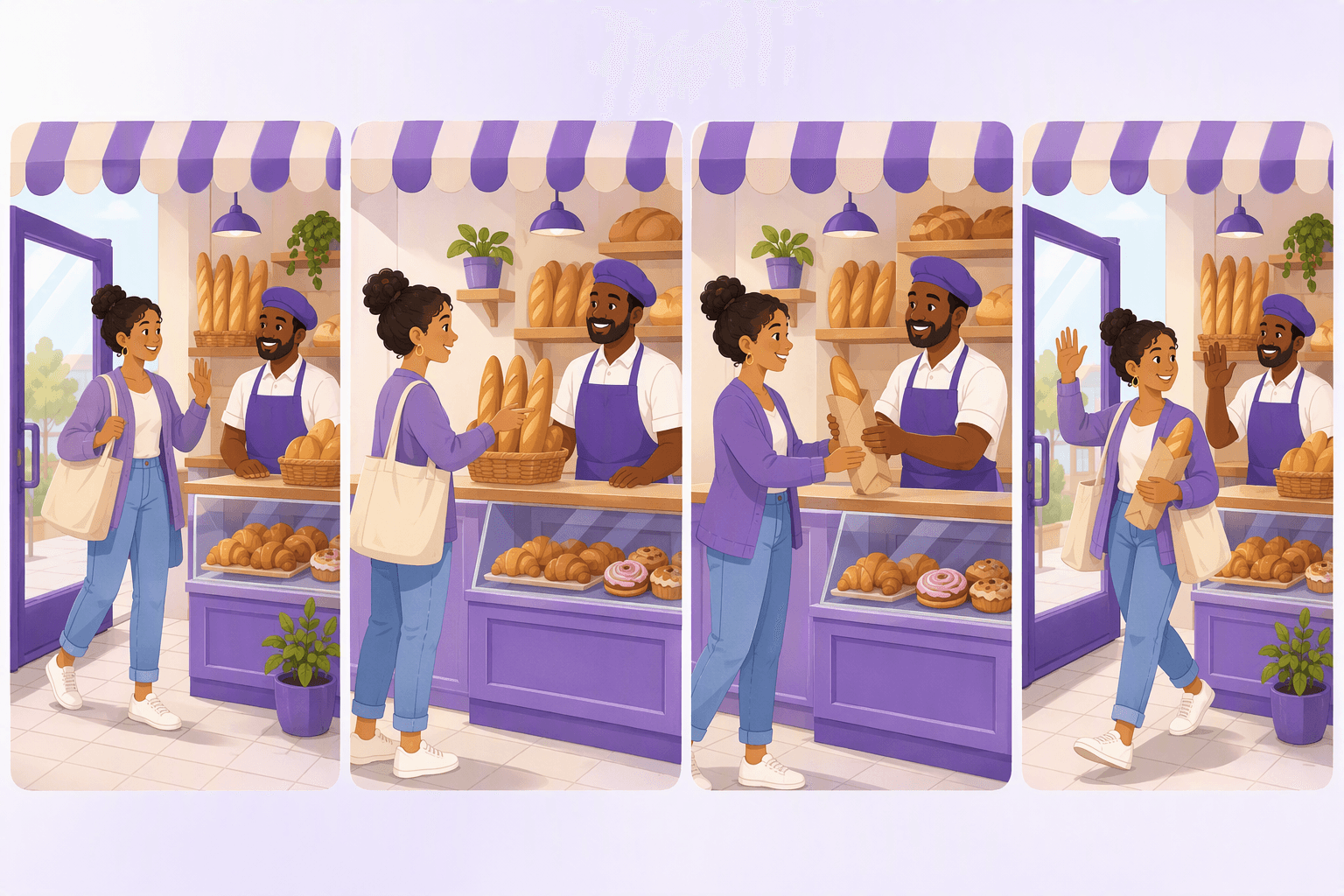
Research from the Centre National de Ressources Textuelles et Lexicales (CNRTL) shows that French has approximately three times more dedicated politeness expressions than English. This is not an accident; it reflects a culture where the form of a request matters as much as its content. A French waiter who receives a bare Un café without s'il vous plaît isn't being dramatic when they respond coldly. They are reacting to a genuine social transgression.
In Quebec and other Francophone regions, s'il vous plaît functions identically, though the overall conversational style may be slightly more relaxed. The core principle (that every request deserves a politeness marker) holds constant across the entire Francophone world.
Practice With Real French Content
Reading about politeness is essential, but hearing these expressions in natural conversation is what makes them second nature. French films are particularly valuable here because politeness registers shift constantly between characters: a scene between strangers uses vous forms, while the next scene among friends switches entirely to tu forms.
Wordy lets you watch French movies and shows with interactive subtitles, so you can tap on s'il vous plaît, je vous en prie, or any polite expression to see its meaning, formality level, and cultural context in real time. Instead of memorizing a table of phrases, you absorb them from authentic conversations with native speakers.
For more French content, explore our blog for guides including the best movies to learn French. You can also visit our French learning page to start practicing politeness in context today.
Frequently Asked Questions
What is the most common way to say please in French?
What is the difference between 's'il vous plaît' and 's'il te plaît'?
What do SVP and STP mean in French?
Is it rude to not say 's'il vous plaît' in France?
How do you say 'please' in a very formal French letter or email?
Sources & References
- Académie française, Dictionnaire de l'Académie française, 9th edition
- Le Petit Robert, Dictionnaire alphabétique et analogique de la langue française (2024)
- Ethnologue: Languages of the World, French language entry (2024)
- Brown, P. & Levinson, S. (1987). Politeness: Some Universals in Language Usage. Cambridge University Press.
- Organisation internationale de la Francophonie (OIF), La langue française dans le monde (2022)
Start learning with Wordy
Watch real movie clips and build your vocabulary as you go. Free to download.


