Quick Answer
The most common way to say 'nice to meet you' in Italian is 'Piacere' (pyah-CHEH-reh), meaning 'pleasure.' It works in every first-meeting situation, from a casual introduction at a dinner party to a formal business handshake. For extra formality, use 'Molto lieto' (men) or 'Molto lieta' (women), meaning 'very delighted.'
The Short Answer
The most common way to say "nice to meet you" in Italian is Piacere (pyah-CHEH-reh), which literally means "pleasure." This single, elegant word is the cornerstone of every Italian introduction, whether you are shaking hands at a business conference in Milan, being introduced to your partner's family in Rome, or meeting a fellow traveler at a café in Florence.
Italian is spoken by approximately 85 million people worldwide, including 64 million native speakers across four countries where it holds official status: Italy, Switzerland, San Marino, and Vatican City, according to Ethnologue's 2024 data. What makes Italian introductions distinctive is that they are never optional. In Italian culture, exchanging Piacere and your name is a mandatory social ritual, and skipping it is considered genuinely rude, not just a minor oversight. Whether you're looking up "nice to meet you in italian" for travel, study, or conversation, this guide covers everything you need.
"In Italian communicative culture, the introduction ritual is not a formality to be rushed through; it is the foundation upon which the entire subsequent relationship is built. The word piacere carries the full weight of this social contract."
(Anna Wierzbicka, Cross-Cultural Pragmatics, Mouton de Gruyter)

This guide covers 15+ ways to express "nice to meet you" in Italian, organized by formality level: universal, formal, casual, the name exchange ritual, and response phrases. Each includes pronunciation, an example sentence, and cultural context so you know exactly when to use it.
Quick Reference: Italian Introductions at a Glance
| English | Italian | Pronunciation | Formality |
|---|---|---|---|
| Nice to meet you | Piacere | pyah-CHEH-reh | polite |
| Nice to meet you (informal) | Piacere di conoscerti | pyah-CHEH-reh dee koh-NOH-shehr-tee | casual |
| Nice to meet you (formal) | Piacere di conoscerla | pyah-CHEH-reh dee koh-NOH-shehr-lah | formal |
| Very delighted (male) | Molto lieto | MOHL-toh LYEH-toh | very formal |
| Very delighted (female) | Molto lieta | MOHL-toh LYEH-tah | very formal |
| Pleased to make your acquaintance | Lieto di fare la Sua conoscenza | LYEH-toh dee FAH-reh lah SOO-ah koh-noh-SHEHN-tsah | very formal |
| It's an honor | È un onore | eh oon oh-NOH-reh | very formal |
| My name is... | Mi chiamo... | mee KYAH-moh | polite |
| What is your name? (formal) | Come si chiama? | KOH-meh see KYAH-mah | formal |
| What is your name? (informal) | Come ti chiami? | KOH-meh tee KYAH-mee | casual |
| Hi, I'm... | Ciao, io sono... | CHOW, EE-oh SOH-noh | casual |
| My pleasure | Piacere mio | pyah-CHEH-reh MEE-oh | polite |
| The pleasure is mine | Il piacere è mio | eel pyah-CHEH-reh eh MEE-oh | formal |
| Likewise | Altrettanto | ahl-treh-TAHN-toh | polite |
| I've heard a lot about you | Ho sentito parlare molto di Lei | oh sehn-TEE-toh pahr-LAH-reh MOHL-toh dee LAY | formal |
The Essential Word: Piacere
The word Piacere is the cornerstone of every Italian introduction. It is also one of the most fascinating words in the language because it carries multiple meanings: as a noun it means "pleasure," and as a verb it means "to like" or "to please." According to the Accademia della Crusca, piacere derives from the Latin placēre (to please, to be agreeable), and it has maintained this dual role for centuries.
Piacere
/pyah-CHEH-reh/
Literal meaning: Pleasure
“Piacere, sono Marco. Tu sei l'amica di Giulia?”
Nice to meet you, I'm Marco. Are you Giulia's friend?
The single most important introduction word in Italian. Works alone or as the start of a longer phrase. Always accompanied by a handshake in formal settings or cheek kisses in social ones.
When Italians meet someone new, the typical sequence is: greeting (Ciao or Buongiorno), then Piacere plus your first name. This is not optional; it is expected. Research by the Accademia della Crusca on contemporary Italian usage confirms that Piacere remains the dominant introduction expression across all age groups and regions, with no sign of declining.
The pronunciation is three syllables: pyah-CHEH-reh. The stress falls on the second syllable. A common learner mistake is placing equal weight on all three syllables. Instead, emphasize the middle: pyah-CHEH-reh.
💡 Piacere as a Verb: The Double Life
Piacere does double duty in Italian. As a noun in introductions, it means "pleasure." As a verb, it means "to like," but with an inverted structure. Instead of "I like pizza" (subject + verb + object), Italian says Mi piace la pizza (Pizza pleases me). So when you say Piacere upon meeting someone, you are essentially saying "it pleases me," compressed into one elegant word.
Piacere di conoscerti
/pyah-CHEH-reh dee koh-NOH-shehr-tee/
Literal meaning: Pleasure of knowing you (informal)
“Piacere di conoscerti! Luca mi ha parlato tanto di te.”
Nice to meet you! Luca has told me so much about you.
The extended informal version using the 'tu' form. The -ti ending signals informality. Perfect for meeting a friend's friend, a new colleague your age, or anyone in a relaxed social setting.
This is the full-sentence version using the informal tu form. The verb conoscere means "to know" or "to get to know," so you are literally saying "pleasure of getting to know you." Use it when the setting is clearly casual: a friend's dinner party, a weekend gathering, or meeting someone at a bar.
Piacere di conoscerla
/pyah-CHEH-reh dee koh-NOH-shehr-lah/
Literal meaning: Pleasure of knowing you (formal)
“Piacere di conoscerla, dottor Bianchi. Ho letto il Suo ultimo articolo.”
Pleased to meet you, Dr. Bianchi. I've read your latest article.
The formal version using the 'Lei' form. The -la ending signals formality. Essential for professional introductions, meeting elders, or any situation requiring respect.
The formal counterpart switches the pronoun ending from -ti (informal) to -la (formal). In Italian business culture, starting with Lei and letting the other person invite you to switch to tu is a sign of professionalism, as noted by the Treccani usage guide. Never make the switch to tu yourself if you are the younger or lower-ranking person.
🌍 Tu vs. Lei: The Social Compass of Italian
Italian has a clear formal/informal divide that shapes every introduction. Use Lei (formal you) with anyone older, higher-ranking, or whom you have just met in a professional context. Use tu (informal you) with peers, friends, and in casual settings. When uncertain, start with Lei. The other person will say Diamoci del tu (let's use tu with each other) if they want to switch. Getting this right at the moment of introduction matters enormously in Italian culture.
Formal Introduction Phrases
When the setting demands elevated language (a gala, a diplomatic reception, a high-stakes business meeting), Italian offers more refined alternatives to Piacere. The Accademia della Crusca notes that Italian maintains one of the most nuanced formal registers among modern European languages.
Molto lieto
/MOHL-toh LYEH-toh/
Literal meaning: Very delighted (male speaker)
“Molto lieto, avvocato. La ringrazio per avermi ricevuto.”
Very delighted, counselor. Thank you for receiving me.
Gender-specific: men say 'Molto lieto,' women say 'Molto lieta.' The -o/-a ending matches the SPEAKER's gender, not the person being addressed. A classic formal introduction.
Molto lieto is the elegant, formal alternative to Piacere. The word lieto comes from the Latin laetus (joyful), and it carries a sense of genuine delight that goes beyond simple politeness. This is the introduction phrase of corporate Italy, diplomatic receptions, and formal social events.
The crucial detail: the ending changes based on the speaker's gender, not the listener's. A man says Molto lieto (-o ending), a woman says Molto lieta (-a ending). This grammatical gender agreement is a fundamental feature of Italian.
Molto lieta
/MOHL-toh LYEH-tah/
Literal meaning: Very delighted (female speaker)
“Molto lieta, professore. Ho sentito parlare molto bene del Suo dipartimento.”
Very delighted, professor. I've heard wonderful things about your department.
The feminine form. Italian adjectives must agree with the speaker's gender. Women use 'lieta' (-a ending) while men use 'lieto' (-o ending). Strictly observed in formal settings.
In contemporary spoken Italian, especially among younger generations, some women use Molto lieto without the gender change in casual-formal settings. But in truly formal contexts (business, academia, diplomacy) the correct gendered form remains expected. Treccani notes that maintaining this distinction is a marker of educated, careful Italian.
💡 When Gender Feels Uncertain
Several Italian introduction phrases change based on the speaker's gender: Lieto/Lieta, Onorato/Onorata, Incantato/Incantata. If you are unsure or prefer to avoid the gendered choice, stick with Piacere, which is completely gender-neutral and always correct.
Lieto di fare la Sua conoscenza
/LYEH-toh dee FAH-reh lah SOO-ah koh-noh-SHEHN-tsah/
Literal meaning: Pleased to make your acquaintance
“Lieto di fare la Sua conoscenza, direttore. Mi hanno parlato molto del Suo lavoro.”
Pleased to make your acquaintance, director. I've heard a lot about your work.
The most formal introduction phrase in standard Italian. Women say 'Lieta di fare la Sua conoscenza.' Reserved for diplomatic, academic, and high-level business contexts.
This is the maximum-formality Italian introduction. You will encounter it in diplomatic receptions, formal academic settings, and high-level business meetings. The phrase carries an old-world elegance that Italians still appreciate in appropriate contexts.
È un onore
/eh oon oh-NOH-reh/
Literal meaning: It is an honor
“È un onore conoscerla, Presidente. L'Italia Le è grata.”
It is an honor to meet you, President. Italy is grateful to you.
Reserved for high-ranking officials, distinguished guests, or exceptionally important introductions. Using this casually would sound ironic or exaggerated.
Reserve this for situations that genuinely warrant it: meeting a dignitary, a renowned scholar, or someone whose work you deeply admire. Using È un onore at a casual dinner party would sound either sarcastic or comically over-the-top. Italians have a sharp ear for tonal mismatch.
The Name Exchange Ritual
In Italian culture, exchanging names during an introduction is not a nicety; it is a requirement. The Treccani encyclopedia describes the Italian introduction as a "bilateral ritual" that is incomplete without both parties stating their names. Skipping this step signals disinterest or, worse, arrogance.
Mi chiamo...
/mee KYAH-moh/
Literal meaning: I call myself...
“Piacere, mi chiamo Francesca. Sono la nuova collega del reparto marketing.”
Nice to meet you, my name is Francesca. I'm the new colleague in the marketing department.
The universal way to state your name. Works in every register. The reflexive verb 'chiamarsi' literally means 'to call oneself,' a distinctly Romance-language construction.
Mi chiamo is the standard way to state your name in any situation, formal or informal. The reflexive verb chiamarsi (to call oneself) is a beautiful example of how Italian approaches identity: rather than "my name is," Italian says "I call myself," implying that your name is something you actively own.
The typical Italian introduction formula runs: Piacere, mi chiamo [name] or Mi chiamo [name], piacere. Either order works perfectly.
Come si chiama?
/KOH-meh see KYAH-mah/
Literal meaning: How do you call yourself? (formal)
“Mi scusi, come si chiama? Vorrei presentarla al direttore.”
Excuse me, what is your name? I'd like to introduce you to the director.
The formal way to ask someone's name. Uses the 'Lei' reflexive form 'si chiama.' Essential when you need to learn someone's name respectfully in professional contexts.
The formal version uses si (the Lei reflexive pronoun) and the third-person conjugation chiama. Use this with anyone you would address as Lei: a new client, a colleague you have not met, an older acquaintance at a formal gathering.
Come ti chiami?
/KOH-meh tee KYAH-mee/
Literal meaning: How do you call yourself? (informal)
“Ciao! Come ti chiami? Io sono Valentina.”
Hi! What's your name? I'm Valentina.
The informal way to ask someone's name. Uses 'ti' (informal you). Natural at parties, among peers, and when meeting someone in a casual social setting.
The informal version switches from si to ti and from chiama to chiami. This is the version you will hear at parties, among university students, and in any setting where tu is the natural register.
Ciao, io sono...
/CHOW, EE-oh SOH-noh/
Literal meaning: Hi, I am...
“Ciao, io sono Matteo! Tu sei l'amica di Sara, vero?”
Hi, I'm Matteo! You're Sara's friend, right?
The most relaxed self-introduction. Dropping the 'Io' and just saying 'Sono Matteo' is equally natural. Common at house parties and informal gatherings, often followed by cheek kisses.
Sometimes the simplest approach is best. Ciao, io sono... skips the formality entirely and goes straight to friendliness. This is the introduction you will hear most at house parties, informal gatherings, and among young people. It signals immediately that the relationship will be on a tu basis.
⚠️ Never Skip the Name Exchange
In Italian culture, an introduction without exchanging names is incomplete. If someone says Piacere, sono Marco, you must give your name back. Responding with just Piacere and moving on would feel abrupt and rude. The full expected sequence is always bilateral: they give their name, you give yours.
How to Respond to Italian Introductions
Knowing the right response is just as important as initiating the introduction. Here is a complete guide.
| They Say | You Say | Notes |
|---|---|---|
| Piacere, sono Marco | Piacere, [your name] | Always give your name back |
| Piacere | Piacere / Piacere mio | Echo or add "mio" (my) |
| Molto lieto/a | Molto lieto/a / Il piacere è mio | Match their formality level |
| Piacere di conoscerla | Altrettanto / Il piacere è mio | "Likewise" or "The pleasure is mine" |
| Come si chiama? | Mi chiamo [name], piacere | Name + Piacere is the standard combo |
Piacere mio
/pyah-CHEH-reh MEE-oh/
Literal meaning: My pleasure
“Piacere, sono Andrea. / Piacere mio! Io sono Chiara.”
Nice to meet you, I'm Andrea. / My pleasure! I'm Chiara.
The most common response to 'Piacere.' Natural, warm, and works in every context. Adding your name afterward completes the exchange perfectly.
This is the warm, natural response that works in virtually any situation. The word order (Piacere mio rather than the fuller Il piacere è mio) gives it a conversational, approachable feel.
Il piacere è mio
/eel pyah-CHEH-reh eh MEE-oh/
Literal meaning: The pleasure is mine
“Molto lieto, sono l'ingegnere Moretti. / Il piacere è mio, ingegnere.”
Very delighted, I'm engineer Moretti. / The pleasure is mine, engineer.
The full, polished form. Using the other person's title (dottore, ingegnere, professore) adds an extra layer of Italian courtesy.
The definite article il and the verb è give this response a complete-sentence structure that sounds more deliberate and formal. Use it in professional settings and when you want to match elevated formality.
Altrettanto
/ahl-treh-TAHN-toh/
Literal meaning: Likewise / The same to you
“Piacere di conoscerla! / Altrettanto, signora!”
Pleased to meet you! / Likewise, madam!
A versatile response meaning 'likewise.' Also commonly used beyond introductions: when someone says 'Buon appetito,' you can respond 'Altrettanto.' Clean, efficient, always appropriate.
Altrettanto is the Swiss Army knife of Italian responses. It means "likewise" and works as a response to any introduction phrase, compliment, or well-wish. One word, universally useful.
Bonus Phrases That Add Polish
These phrases go beyond the basics and show genuine cultural fluency in Italian introductions.
Ho sentito parlare molto di Lei
/oh sehn-TEE-toh pahr-LAH-reh MOHL-toh dee LAY/
Literal meaning: I have heard much spoken about you (formal)
“Piacere di conoscerla. Ho sentito parlare molto di Lei dal professor Rossi.”
Pleased to meet you. Professor Rossi has told me a lot about you.
A flattering addition to any formal introduction. Use 'di te' instead of 'di Lei' in informal situations. In Italian networking culture, where personal connections carry enormous weight, this phrase opens doors.
Telling someone you have heard about them signals that you value the introduction and their reputation. In Italian culture, personal connections (conoscenze) matter enormously. A 2023 report by the Società Dante Alighieri noted that relationship-building remains central to Italian professional life in ways that differ significantly from Anglo-Saxon business culture.
Finalmente ci conosciamo!
/fee-nahl-MEHN-teh chee koh-noh-SHAH-moh/
Literal meaning: Finally we know each other!
“Finalmente ci conosciamo! Ti ho visto tante volte sui social.”
We finally meet! I've seen you so many times on social media.
Perfect for meeting someone you have interacted with online or heard about. Expresses genuine enthusiasm. Increasingly common in the age of remote work and social media.
In the age of social media and remote work, this phrase has become increasingly relevant. Use it when you finally meet someone in person after email exchanges, video calls, or hearing about them through mutual friends.
The Two-Kiss Greeting: Due Baci
No guide to Italian introductions is complete without addressing the physical component. Wierzbicka's research on cross-cultural communication confirms that Italian greeting rituals are among the most physically expressive in Europe.
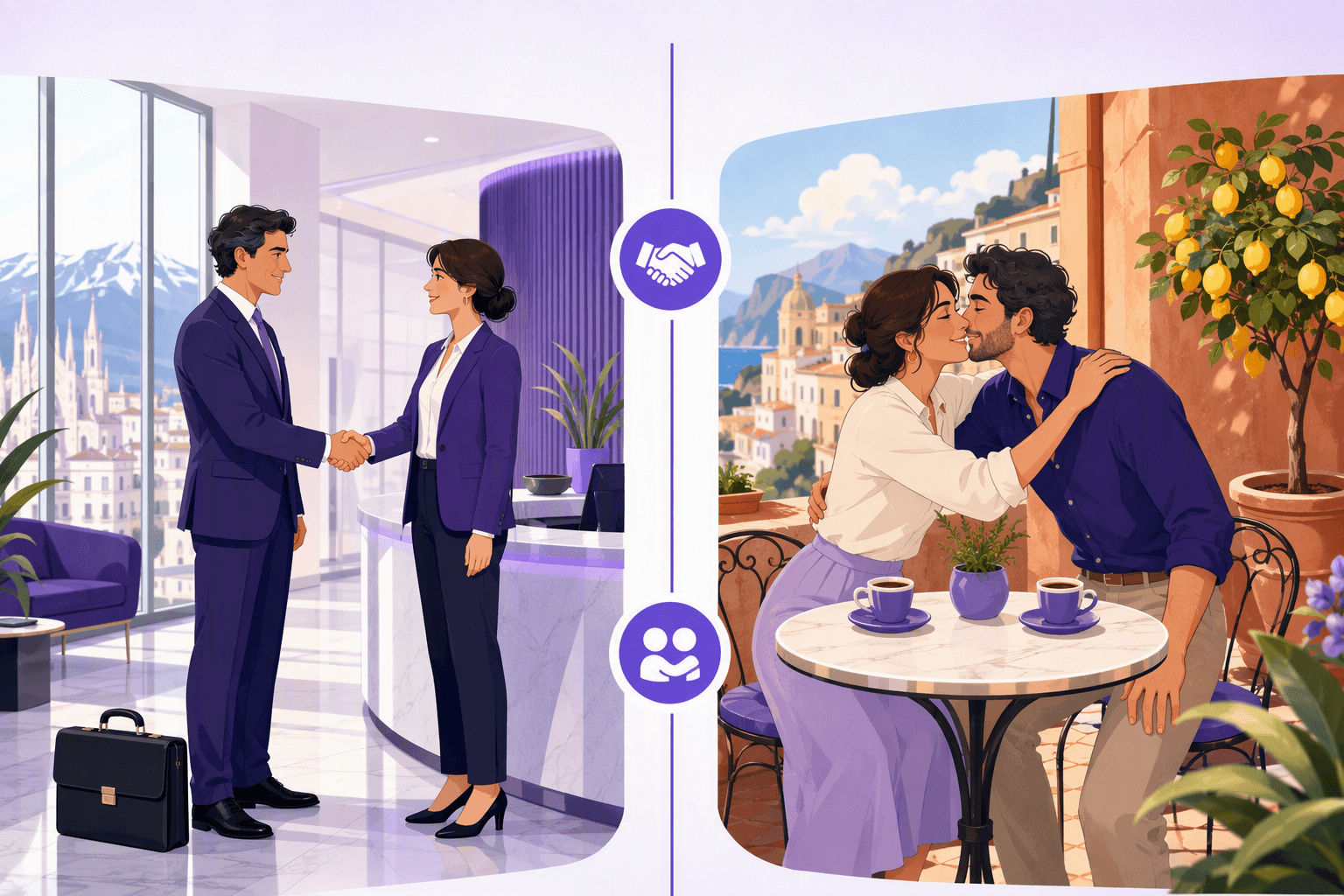
In formal and business settings, a firm handshake with direct eye contact is standard across all of Italy. A weak handshake or avoiding eye contact can be interpreted as disinterest.
In social settings, Italians exchange two kisses on the cheeks (due baci). The critical detail: start with the left cheek (meaning you move your head to your right first), then switch to the right cheek. These are light air-kisses, not lip-to-cheek contact.
Who gets due baci?
- Women meeting women in social settings: always
- Women meeting men in relaxed social contexts: very common
- Men meeting men: handshake is the default, unless they are close friends or family (especially in the south)
🌍 North vs. South: The Physical Greeting Divide
Northern Italians, particularly in business cities like Milan and Turin, tend to be more reserved. A handshake is common even in semi-social settings, and first introductions are often kept at arm's length. Southern Italians, especially in Naples, Sicily, and Calabria, are far more tactile: cheek kisses happen faster, embraces are warmer, and even initial business meetings may include more physical warmth than a northerner would expect. When in doubt, extend your hand for a handshake and let the Italian person escalate to kisses if appropriate.
Common Mistakes to Avoid
| Mistake | Why It's Wrong | What to Do Instead |
|---|---|---|
| Saying only Ciao without Piacere | Sounds like a regular hello, not a first meeting | Add Piacere + your name |
| Not giving your name back | Feels rude and incomplete | Always reciprocate: Piacere, sono... |
| Using Molto lieto at a casual bar | Sounds overly stiff and theatrical | Use Piacere or just Ciao, sono... |
| Wrong gender on lieto/lieta | Grammatically noticeable | Match your gender, not the other person's |
| Going for a cheek kiss in a first business meeting | Too familiar for a professional setting | Start with a handshake; let them initiate kisses |
| Starting cheek kisses from the right cheek | Creates the awkward "kiss collision" | Always start from the left cheek |
Practice With Real Italian Content
Reading about introduction phrases gives you the knowledge, but hearing them in natural conversation is what makes them instinctive. Italian cinema is full of memorable first-meeting scenes, from the elaborate formal introductions in period dramas like Il Gattopardo to the rapid-fire Piacere, piacere! exchanges at crowded Roman dinner parties in modern comedies.
Wordy lets you watch Italian movies and shows with interactive subtitles. Tap any introduction phrase to see its meaning, pronunciation, and formality level in real time. Instead of memorizing from a list, you absorb natural introduction patterns from authentic Italian conversations with native intonation and body language.
For more Italian content, explore our blog for guides including the best movies to learn Italian. You can also visit our Italian learning page to start practicing introductions in context today.
Frequently Asked Questions
What is the most common way to say nice to meet you in Italian?
What is the difference between 'Piacere' and 'Molto lieto'?
How do you respond when someone says 'Piacere' in Italian?
Do Italians shake hands or kiss cheeks when meeting someone new?
Is the name exchange mandatory in Italian introductions?
Sources & References
- Accademia della Crusca, Italy's foremost authority on the Italian language, founded 1583
- Treccani, Enciclopedia e Vocabolario online (2025)
- Ethnologue: Languages of the World, 27th edition (2024)
- Wierzbicka, A., Cross-Cultural Pragmatics: The Semantics of Human Interaction (Mouton de Gruyter)
Start learning with Wordy
Watch real movie clips and build your vocabulary as you go. Free to download.


