Quick Answer
The most common way to say happy birthday in Spanish is 'Feliz cumpleaños' (feh-LEES koom-pleh-AH-nyohs). It works in every Spanish-speaking country. Beyond that, native speakers use expressions like 'Felicidades,' 'Que cumplas muchos más,' and the beloved birthday songs 'Las Mañanitas' (Mexico) and 'Cumpleaños feliz' (Spain and Latin America).
The Short Answer
The most common way to say happy birthday in Spanish is Feliz cumpleaños (feh-LEES koom-pleh-AH-nyohs). It is universally understood across all 21 Spanish-speaking countries, from Madrid to Mexico City to Buenos Aires. But birthdays in Spanish-speaking cultures come with much richer traditions than a single phrase.
Spanish is spoken by approximately 559 million people worldwide, according to Ethnologue's 2024 data. Across that vast community, birthday celebrations vary dramatically, from the dawn serenades of Las Mañanitas in Mexico to the mordida cake-smashing tradition, from the elaborate quinceañera coming-of-age parties to the santo (saint's day) celebrations that function as a second birthday in many Catholic regions.
"Birthday rituals in the Hispanic world reveal layers of indigenous, Catholic, and modern influences that make each country's celebrations distinct, even as the core language of celebration remains shared."
(Instituto Cervantes, El español en el mundo, 2024)
This guide covers 16 essential birthday expressions organized by category: universal wishes, heartfelt messages, birthday songs, and regional traditions. Each includes pronunciation, usage context, and the cultural knowledge you need to celebrate like a native speaker.
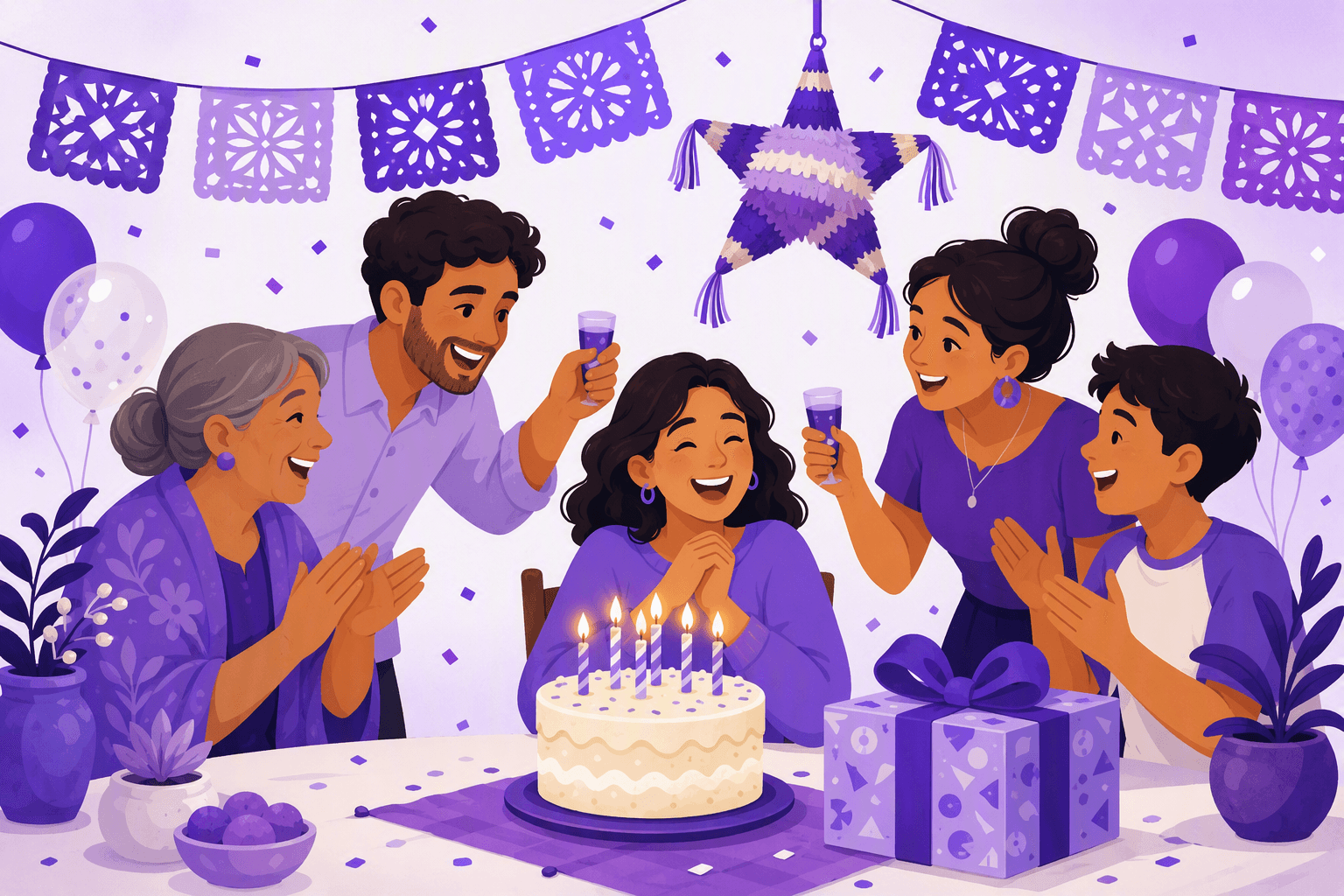
Quick Reference: Spanish Birthday Wishes at a Glance
| English | Spanish | Pronunciation | Formality |
|---|---|---|---|
| Happy birthday | Feliz cumpleaños | feh-LEES koom-pleh-AH-nyohs | casual |
| Congratulations | Felicidades | feh-lee-see-DAH-dehs | casual |
| Many congratulations | Muchas felicidades | MOO-chahs feh-lee-see-DAH-dehs | polite |
| May you have many more | Que cumplas muchos más | keh KOOM-plahs MOO-chohs MAHS | casual |
| Happy birthday (song) | Cumpleaños feliz | koom-pleh-AH-nyohs feh-LEES | casual |
| Happy day | Feliz día | feh-LEES DEE-ah | casual |
| Wishing you all the best | Te deseo lo mejor | teh deh-SEH-oh loh meh-HOR | polite |
| May all your wishes come true | Que todos tus deseos se hagan realidad | keh TOH-dohs toos deh-SEH-ohs seh AH-gahn reh-ah-lee-DAHD | polite |
| Happy anniversary | Feliz aniversario | feh-LEES ah-nee-vehr-SAH-ree-oh | polite |
| Happy birthday (informal) | Feliz cumple | feh-LEES KOOM-pleh | slang |
| Happy saint's day | Feliz santo | feh-LEES SAHN-toh | polite |
| Make a wish! | ¡Pide un deseo! | PEE-deh oon deh-SEH-oh | casual |
| Bite! Bite! (cake tradition) | ¡Mordida! ¡Mordida! | mor-DEE-dah mor-DEE-dah | slang |
| A toast to you! | ¡Un brindis por ti! | oon BREEN-dees por tee | casual |
| God bless you | Que Dios te bendiga | keh dee-OHS teh behn-DEE-gah | polite |
| Happy birthday (formal) | Le deseo un muy feliz cumpleaños | leh deh-SEH-oh oon mooy feh-LEES koom-pleh-AH-nyohs | formal |
Essential Birthday Wishes
These expressions work across every Spanish-speaking country. According to the Real Academia Española (RAE), cumpleaños literally means "fulfills years," marking the completion of another year of life.
Feliz cumpleaños
/feh-LEES koom-pleh-AH-nyohs/
Literal meaning: Happy fulfills-years
“¡Feliz cumpleaños, abuela! Te quiero mucho.”
Happy birthday, grandma! I love you so much.
The universal birthday greeting. Works in every country, every context, and every formality level. Often shortened to 'Feliz cumple' in texts and social media.
Feliz cumpleaños is the one phrase you absolutely need. It works at a children's party and at a formal dinner, in a WhatsApp message and on a greeting card. The word cumpleaños is invariable: it stays the same whether you are talking about one birthday or many.
A common pronunciation mistake is stressing the wrong syllable. The emphasis falls on AH in cumpleaños: koom-pleh-AH-nyohs. The ñ makes a "ny" sound, like the "ni" in "onion."
Felicidades
/feh-lee-see-DAH-dehs/
Literal meaning: Happinesses / Congratulations
“¡Felicidades en tu día! Espero que la pases increíble.”
Congratulations on your day! I hope you have an amazing time.
A versatile word used for birthdays, weddings, graduations, and any celebratory occasion. In many Latin American countries, people say 'Felicidades' even more frequently than 'Feliz cumpleaños.'
Felicidades is broader than Feliz cumpleaños. Think of it as "congratulations" and "best wishes" rolled into one. At a birthday party, you will hear both used interchangeably. The singular form felicidad means "happiness," but the plural felicidades is what you use for celebrations.
Muchas felicidades
/MOO-chahs feh-lee-see-DAH-dehs/
Literal meaning: Many congratulations
“Muchas felicidades, don Roberto. Que este año le traiga mucha salud.”
Many congratulations, Don Roberto. May this year bring you great health.
Adding 'muchas' intensifies the warmth. Frequently used in cards, formal messages, and when addressing elders. The extra word signals genuine affection and respect.
Adding muchas before felicidades bumps up the warmth without making it overly formal. This is a go-to expression for birthday cards, social media posts, and messages to people you care about but may not see daily.
Feliz cumple
/feh-LEES KOOM-pleh/
Literal meaning: Happy bday (abbreviated)
“¡Ey, feliz cumple! ¿Dónde es la fiesta?”
Hey, happy bday! Where's the party?
The casual, abbreviated form used heavily in texting, social media, and among friends. Extremely common among younger speakers across all Spanish-speaking countries.
Just as English speakers write "HBD" or "happy bday," Spanish speakers clip cumpleaños down to cumple. You will see Feliz cumple on virtually every Instagram birthday post and WhatsApp message among friends.
Heartfelt Birthday Messages
When you want to go beyond the basics, these expressions add genuine emotion. They are perfect for cards, toasts, and meaningful moments.
Que cumplas muchos más
/keh KOOM-plahs MOO-chohs MAHS/
Literal meaning: May you fulfill many more
“Feliz cumpleaños, hermano. Que cumplas muchos más rodeado de los que te quieren.”
Happy birthday, brother. May you have many more surrounded by those who love you.
One of the most traditional follow-up wishes after 'Feliz cumpleaños.' Essentially means 'many happy returns.' Often heard right after the birthday song ends.
This is the Spanish equivalent of "many happy returns." It almost always follows Feliz cumpleaños as a natural second line. At a party, after the song finishes and the candles are blown out, someone will inevitably call out ¡Que cumplas muchos más!
Que todos tus deseos se hagan realidad
/keh TOH-dohs toos deh-SEH-ohs seh AH-gahn reh-ah-lee-DAHD/
Literal meaning: May all your wishes become reality
“Sopla las velas y que todos tus deseos se hagan realidad.”
Blow out the candles and may all your wishes come true.
Typically said right before or after blowing out birthday candles. Connects to the universal candle-wish tradition. Works beautifully in written cards and spoken toasts alike.
This phrase ties directly to the candle-blowing moment. In Spanish-speaking birthday parties, just like in English-speaking ones, the birthday person makes a silent wish before blowing out the candles. This expression acknowledges that tradition with genuine warmth.
Te deseo lo mejor
/teh deh-SEH-oh loh meh-HOR/
Literal meaning: I wish you the best
“En este día tan especial, te deseo lo mejor. ¡Feliz cumpleaños!”
On this special day, I wish you the best. Happy birthday!
A warm, sincere wish that works in both written and spoken form. For formal situations, switch to 'Le deseo lo mejor' (using 'usted' form).
Simple, sincere, and universally appreciated. This works equally well spoken at a party or written in a card. For professional or formal contexts, switch to the usted form: Le deseo lo mejor.
Que Dios te bendiga
/keh dee-OHS teh behn-DEE-gah/
Literal meaning: May God bless you
“Feliz cumpleaños, mijo. Que Dios te bendiga y te proteja siempre.”
Happy birthday, my son. May God bless you and protect you always.
Very common in family settings across Latin America, where Catholic traditions run deep. Grandparents and parents frequently add this blessing to birthday wishes. Not considered overly religious in everyday use.
Given the strong Catholic heritage across Latin America and Spain, religious birthday blessings are extremely common and not considered preachy. Grandparents, parents, and aunts will naturally add Que Dios te bendiga to their birthday wishes, and it carries genuine warmth.
Birthday Songs
Birthday songs are where Spanish-speaking traditions diverge most dramatically by country. Knowing which song to sing (and when) will instantly mark you as culturally aware.
Cumpleaños feliz
/koom-pleh-AH-nyohs feh-LEES/
Literal meaning: Birthday happy
“♪ Cumpleaños feliz, cumpleaños feliz, te deseamos todos, cumpleaños feliz ♪”
♪ Happy birthday to you, happy birthday to you, we all wish you, happy birthday to you ♪
The Spanish version of 'Happy Birthday to You,' sung in Spain and most of Latin America while the cake is presented. The word order is reversed compared to English: 'birthday happy' instead of 'happy birthday.'
This is the Spanish adaptation of the familiar English tune. Notice the reversed word order: Cumpleaños feliz rather than Feliz cumpleaños. The melody is identical to the English version, making it easy to follow along even if your Spanish is just getting started.
In Spain, the full lyrics typically go: Cumpleaños feliz, cumpleaños feliz, te deseamos todos, cumpleaños feliz. Some versions replace todos (everyone) with the person's name.
🌍 Las Mañanitas: Mexico's Dawn Serenade
In Mexico, the most important birthday song is not Cumpleaños feliz but Las Mañanitas. This traditional folk song dates back to the 19th century and is deeply woven into Mexican identity. Families wake the birthday person at dawn by singing Las Mañanitas, often accompanied by mariachi musicians for milestone birthdays. The opening line, Estas son las mañanitas que cantaba el Rey David (These are the morning songs that King David used to sing), references a biblical connection that reflects Mexico's Catholic heritage. According to research published by UNAM, Las Mañanitas has become one of the most recognized songs in all of Mexican folk music, performed by legendary artists like Pedro Infante and Vicente Fernández.
Que los cumplas feliz
/keh lohs KOOM-plahs feh-LEES/
Literal meaning: May you fulfill them happily
“♪ Que los cumplas feliz, que los cumplas feliz, que los cumplas, que los cumplas, que los cumplas feliz ♪”
♪ Happy birthday to you, happy birthday to you, happy birthday, happy birthday, happy birthday to you ♪
An alternative birthday song melody popular in several Latin American countries, particularly in Central America and parts of South America. Often sung alongside or instead of 'Cumpleaños feliz.'
This alternative birthday song is popular across much of Latin America. The phrase que los cumplas refers to the years, meaning "may you fulfill them (happily)." In some countries, partygoers seamlessly transition from Cumpleaños feliz into Que los cumplas feliz as a second round.
Celebratory Expressions and Party Phrases
These are the expressions you will hear during the party itself, while cutting the cake, making toasts, and celebrating.
Feliz día
/feh-LEES DEE-ah/
Literal meaning: Happy day
“¡Feliz día, compadre! ¿Cuántos cumples hoy?”
Happy day, buddy! How old are you turning today?
A breezy, informal birthday greeting popular across Latin America. Also used for other celebrations like Mother's Day ('Feliz día de las madres') and Father's Day.
Feliz día is shorter and breezier than Feliz cumpleaños. It is used particularly often in Colombia, Venezuela, and other Latin American countries as a casual birthday greeting. The same construction works for other holidays: Feliz día de las madres (Happy Mother's Day).
¡Pide un deseo!
/PEE-deh oon deh-SEH-oh/
Literal meaning: Ask for a wish!
“Ya están encendidas las velas. ¡Pide un deseo y sopla!”
The candles are lit. Make a wish and blow!
Shouted by the group right before the birthday person blows out the candles. The formal version is '¡Pida un deseo!' In some countries, the group chants '¡Que pida un deseo!' (Let them make a wish!).
This is the moment right before the candles go out. The whole room leans in, someone shouts ¡Pide un deseo!, and the birthday person closes their eyes, makes a silent wish, and blows. Just like in English-speaking countries, telling anyone the wish supposedly prevents it from coming true.
¡Un brindis por ti!
/oon BREEN-dees por tee/
Literal meaning: A toast for you!
“Levanten sus copas. ¡Un brindis por María en su cumpleaños!”
Raise your glasses. A toast to María on her birthday!
Used at adult birthday celebrations when drinks are involved. The formal version is '¡Un brindis por usted!' Often followed by everyone clinking glasses and saying '¡Salud!' (Cheers!).
At adult birthday celebrations, toasts are a beloved tradition. Someone raises their glass, delivers a short speech or heartfelt wish, and closes with ¡Un brindis por ti! Everyone responds with ¡Salud! (Cheers!) and clinks glasses.
Feliz aniversario
/feh-LEES ah-nee-vehr-SAH-ree-oh/
Literal meaning: Happy anniversary
“Feliz aniversario, abuelos. Cincuenta años juntos es un regalo hermoso.”
Happy anniversary, grandparents. Fifty years together is a beautiful gift.
Primarily used for wedding anniversaries and milestone commemorations, not typically for birthdays. However, in some regions and contexts, 'aniversario' can refer to any yearly milestone, including a birthday.
While aniversario primarily refers to wedding anniversaries, you will occasionally hear it for milestone birthdays in formal contexts. For standard birthdays, stick with cumpleaños.
Feliz santo
/feh-LEES SAHN-toh/
Literal meaning: Happy saint's (day)
“Hoy es el día de San José. ¡Feliz santo a todos los Josés!”
Today is Saint Joseph's Day. Happy saint's day to all the Josés!
In Spain and parts of Latin America, your 'santo' is the feast day of the saint you were named after. It functions as a second birthday and is still celebrated in many traditional families, especially in Spain.
In the Catholic tradition, each day of the year is assigned to a saint. If you were named after that saint, the feast day is your santo, in effect a second birthday. While this tradition has faded among younger generations, it remains meaningful in Spain and traditional families across Latin America.
Birthday Traditions Across the Spanish-Speaking World
Understanding birthday customs is just as important as knowing the right words. Here are the traditions that make Spanish-language birthdays unique.
🌍 The Mordida: Mexico's Cake-Smashing Tradition
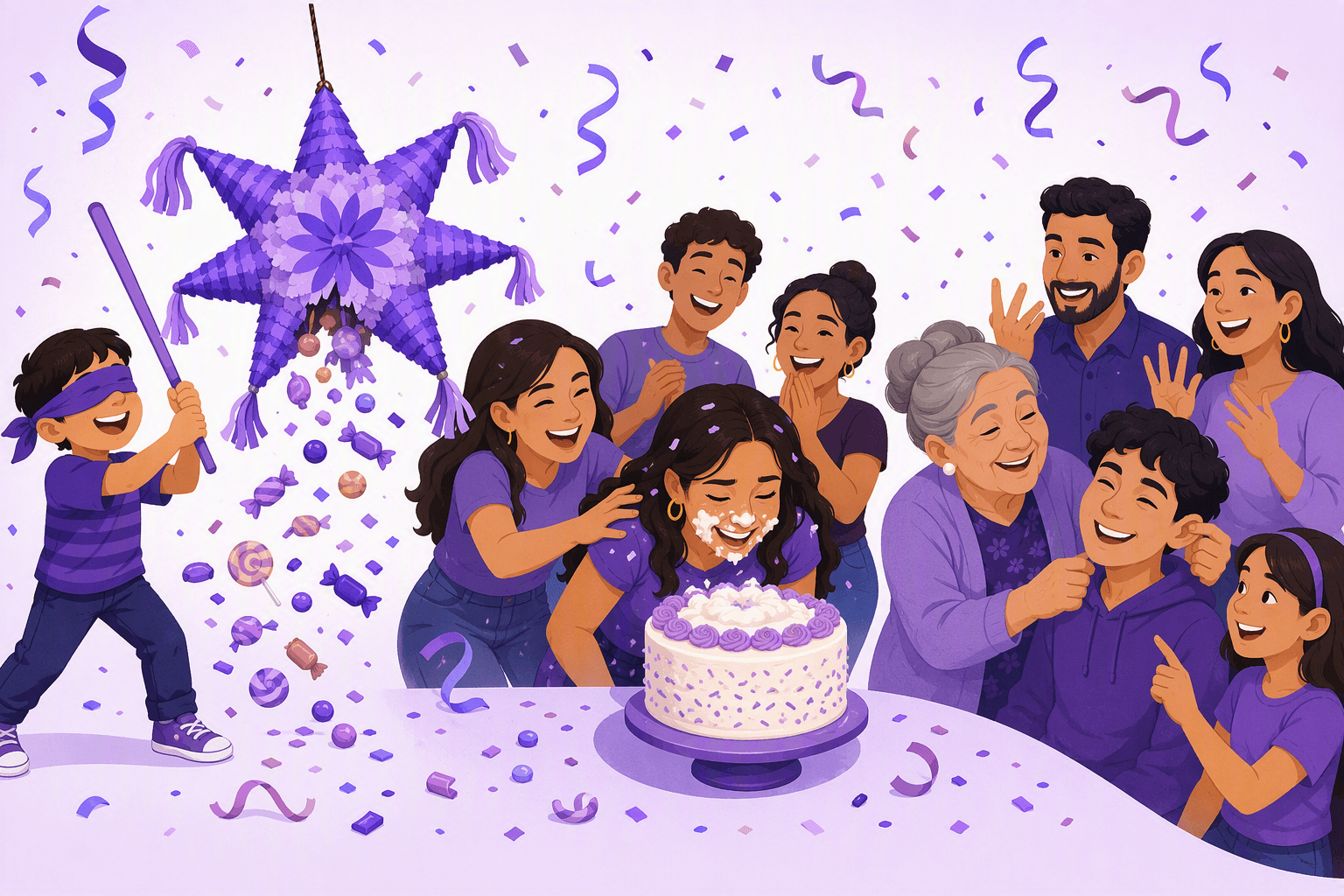
In Mexico, the mordida (bite) is a beloved and chaotic birthday ritual. After the candles are blown out, the birthday person takes the first bite of cake, but before they can pull away, friends and family push their face into the frosting while chanting ¡Mordida! ¡Mordida! The result is a frosting-covered face and roaring laughter. It is considered good luck and a sign of affection. Some birthday celebrants have learned to take the tiniest, most strategic bite possible to minimize the mess.
🌍 The Piñata: More Than Just a Game
While piñatas have become global party decorations, they originate from Mexican tradition and carry deeper symbolism. The traditional piñata has seven points, each representing one of the seven deadly sins. Being blindfolded represents faith, the stick represents virtue, and breaking the piñata symbolizes the triumph of good over evil. The candy that spills out represents the rewards of keeping faith. Today, piñatas come in every shape imaginable, and the game (¡Dale, dale, dale!, "Hit it, hit it, hit it!") remains a highlight of birthday parties across Mexico, Central America, and increasingly worldwide.
Regional Birthday Customs
| Country/Region | Tradition | Description |
|---|---|---|
| Mexico | Las Mañanitas | Dawn serenade, often with mariachi for milestone birthdays |
| Mexico | Mordida | Face pushed into birthday cake after first bite |
| Mexico, Central America | Piñata | Blindfolded guest hits a hanging figure filled with candy |
| Spain | Tirón de orejas | An ear pull for each year of age, plus one for good luck |
| Argentina | Tirón de orejas | Same ear-pulling tradition as Spain |
| Colombia | Flour and eggs | Friends throw flour, eggs, and water on the birthday person |
| Cuba | La fiesta de quince | Elaborate quinceañera celebrations for girls turning 15 |
| All countries | Quinceañera | Coming-of-age celebration for girls turning 15 |
The quinceañera deserves special mention. This elaborate celebration marks a girl's 15th birthday and her transition into adulthood. It can be as lavish as a wedding, with a formal gown, a choreographed waltz, and a multi-course dinner. While the tradition exists across all Spanish-speaking countries, it is particularly elaborate in Mexico, Cuba, and Central America.
Formal Birthday Wishes
For professional contexts, milestone celebrations, and when addressing elders, these more formal expressions demonstrate respect.
Le deseo un muy feliz cumpleaños
/leh deh-SEH-oh oon mooy feh-LEES koom-pleh-AH-nyohs/
Literal meaning: I wish you (formal) a very happy birthday
“Estimado señor Director, le deseo un muy feliz cumpleaños en nombre de todo el equipo.”
Dear Director, I wish you a very happy birthday on behalf of the entire team.
The 'usted' form (le deseo) signals formality and respect. Used in professional emails, formal cards, and when addressing elders or authority figures.
The usted form (le deseo instead of te deseo) elevates the expression to a formal register. This is the version for professional emails, formal greeting cards, and milestone birthday speeches. You will see it on corporate birthday messages and in official communications.
Practice With Real Spanish Content
Reading birthday phrases is helpful, but hearing them in natural conversation (the rhythm of Las Mañanitas sung by a mariachi band, the chaos of everyone shouting ¡Mordida!, the emotional toasts at a quinceañera) is what brings these expressions to life.
Spanish-language films and shows are full of birthday scenes that showcase these traditions beautifully. Check out our guide to the best movies for learning Spanish for viewing recommendations that include authentic celebrations.
Wordy lets you watch Spanish movies and shows with interactive subtitles, tapping on any word or phrase to see its meaning, pronunciation, and cultural context in real time. Instead of memorizing birthday phrases from a list, you absorb them from real celebrations with authentic emotion and intonation.
For more Spanish guides, explore our blog or visit our Spanish learning page to start practicing today.
Frequently Asked Questions
What is the most common way to say happy birthday in Spanish?
What is the Spanish birthday song?
What does 'Felicidades' mean and when do you use it?
What is the mordida tradition?
How do you wish someone a belated happy birthday in Spanish?
What do you say before blowing out birthday candles in Spanish?
Sources & References
- Real Academia Española (RAE), Diccionario de la lengua española, 23rd edition
- Instituto Cervantes, El español en el mundo, 2024 annual report
- Ethnologue: Languages of the World, Spanish language entry (2024)
- Pérez Martínez, H. (2003). 'Las Mañanitas: origen y tradición.' Revista de Literaturas Populares, III(1), UNAM.
Start learning with Wordy
Watch real movie clips and build your vocabulary as you go. Free to download.


