Quick Answer
The most common way to say happy birthday in French is 'Joyeux anniversaire' (zhwah-YUH ah-nee-vehr-SEHR). In Québec, 'Bonne fête' is the standard birthday greeting instead. Beyond these basics, French speakers use a range of warm wishes from casual 'Bon anniv' to formal 'Meilleurs vœux' depending on the relationship and occasion.
The Short Answer
The most common way to say happy birthday in French is Joyeux anniversaire (zhwah-YUH ah-nee-vehr-SEHR). This works in France, Belgium, Switzerland, and across Francophone Africa. In Québec, however, the standard birthday greeting is Bonne fête (bun FET), a distinction that catches many French learners off guard.
French is spoken by approximately 321 million people across 29 countries, according to the Organisation internationale de la Francophonie (OIF). Birthday customs vary considerably across this vast francophone world, from the cake-first singing tradition in France to the name day celebrations still observed in parts of Belgium and Switzerland.
"The word anniversaire carries a weight in French that 'birthday' does not in English. It marks the literal 'turning of the year,' connecting the personal milestone to the passage of time itself."
(Nadeau & Barlow, The Story of French, 2006)
This guide covers 16 essential French birthday expressions organized by category: standard wishes, casual and affectionate phrases, formal greetings, and regional variations. Each includes pronunciation, cultural context, and example sentences so you can wish anyone a happy birthday with confidence.
Quick Reference: French Birthday Wishes at a Glance
| English | French | Pronunciation | Formality |
|---|---|---|---|
| Happy birthday | Joyeux anniversaire | zhwah-YUH ah-nee-vehr-SEHR | polite |
| Happy birthday (alt.) | Bon anniversaire | bohn ah-nee-vehr-SEHR | polite |
| Happy birthday (Québec) | Bonne fête | bun FET | polite |
| Happy bday (casual) | Bon anniv | bohn ah-NEEV | casual |
| Best wishes | Meilleurs vœux | meh-YUHR VUH | formal |
| May all your wishes come true | Que tous tes souhaits se réalisent | kuh too tay sweh suh ray-ah-LEEZ | polite |
| I wish you a happy birthday | Je te souhaite un joyeux anniversaire | zhuh tuh swet uhn zhwah-YUH ah-nee-vehr-SEHR | polite |
| Happy birthday (formal) | Je vous souhaite un très heureux anniversaire | zhuh voo swet uhn treh uh-RUH ah-nee-vehr-SEHR | formal |
| Cheers to you! | À ta santé ! | ah tah sahn-TAY | casual |
| Many happy returns | Tous mes vœux de bonheur | too may VUH duh boh-NUHR | formal |
| Have a wonderful day | Passe une merveilleuse journée | pahs ewn mehr-veh-YUHZ zhoor-NAY | polite |
| Wishing you the best | Je te souhaite le meilleur | zhuh tuh swet luh meh-YUHR | polite |
| Happy belated birthday | Joyeux anniversaire en retard | zhwah-YUH ah-nee-vehr-SEHR ahn ruh-TAR | polite |
| May this year bring you joy | Que cette année t'apporte beaucoup de joie | kuh set ah-NAY tah-PORT boh-KOO duh ZHWAH | polite |
| Happy birthday, old man (playful) | Bon anniversaire, vieux ! | bohn ah-nee-vehr-SEHR VYUH | casual |
| Hip hip hip hooray! | Hip hip hip hourra ! | eep eep eep oo-RAH | casual |
Standard Birthday Wishes
These are the core birthday expressions every French learner should know. They work in any French-speaking country and suit most social situations.
Joyeux anniversaire
/zhwah-YUH ah-nee-vehr-SEHR/
Literal meaning: Joyous anniversary
“Joyeux anniversaire, Sophie ! Tes vingt-cinq ans te vont à merveille.”
Happy birthday, Sophie! Twenty-five looks wonderful on you.
The standard birthday greeting in France, Belgium, Switzerland, and Francophone Africa. Also the lyrics to the French birthday song, sung to the same melody as 'Happy Birthday to You.'
Joyeux anniversaire is the single most important birthday phrase in French. The word anniversaire comes from the Latin anniversarius (returning yearly) and in French it means both "birthday" and "anniversary." Context makes the meaning clear: when directed at a person on their special day, it always means birthday.
Pronunciation tip: joyeux begins with the "zh" sound (like the "s" in "pleasure"), and the stress falls on the final syllable of each word. The nasal "an" in anniversaire sounds like "ahn" without fully closing the "n."
🌍 The French Birthday Song
The French birthday song uses the same melody as the English "Happy Birthday to You," but with simply Joyeux anniversaire repeated: Joyeux anniversaire, joyeux anniversaire, joyeux anniversaire [name], joyeux anniversaire. No additional verses, just elegant and concise. Very French.
Bon anniversaire
/bohn ah-nee-vehr-SEHR/
Literal meaning: Good anniversary/birthday
“Bon anniversaire, Marc ! J'espère que tu passes une belle journée.”
Happy birthday, Marc! I hope you're having a lovely day.
Equally common as 'Joyeux anniversaire' in everyday speech. The choice between the two is largely a matter of personal preference; neither is more formal or more correct than the other.
The difference between Joyeux anniversaire and Bon anniversaire is one of the most common questions French learners ask. The honest answer: there is almost no practical difference. Joyeux emphasizes joy and celebration, while bon is a general wish for a good day. Both are universally correct and native speakers use them interchangeably.
If anything, Bon anniversaire feels slightly more understated and conversational, while Joyeux anniversaire carries more celebratory energy. Think of it as the difference between "Happy birthday!" and "Have a great birthday!", both perfectly natural.
Bonne fête
/bun FET/
Literal meaning: Good celebration/feast day
“Bonne fête, ma chérie ! On a préparé un gâteau au chocolat pour toi.”
Happy birthday, darling! We made a chocolate cake for you.
THE standard birthday greeting in Québec. In France, 'fête' traditionally refers to a name day (saint's day), not a birthday. This France vs. Québec distinction is one of the most well-known differences in francophone vocabulary.
This is where things get interesting. In Québec, Bonne fête is the default birthday greeting. It is what people write on cards, sing in songs, and say when handing over gifts. In France, however, fête historically refers to a name day (fête du prénom), the feast day of the Catholic saint whose name you share.
The distinction traces back to early French colonial history. As Nadeau and Barlow document in The Story of French, Québécois French preserved many older French usages that evolved differently in Metropolitan France. The broader meaning of fête as any personal celebration is one such holdover.
💡 France vs. Québec: A Quick Rule
In France, say Joyeux anniversaire for a birthday and Bonne fête for a name day. In Québec, say Bonne fête for a birthday. If unsure which French you are speaking, Joyeux anniversaire is understood everywhere.
Bon anniv
/bohn ah-NEEV/
Literal meaning: Good bday (abbreviated)
“Bon anniv, Alex ! On se voit ce soir pour fêter ça ?”
Happy bday, Alex! See you tonight to celebrate?
The casual, abbreviated form widely used in text messages, social media posts, and among friends. Think of it as the French equivalent of 'HBD': quick, warm, and informal.
Just as English speakers write "HBD" or "happy bday," French speakers shorten anniversaire to anniv in casual contexts. You will see Bon anniv constantly on social media, WhatsApp messages, and birthday posts. It is warm but decidedly informal, so do not use it in a professional card or with someone you address as vous.
Warm and Heartfelt Wishes
These expressions go beyond the basic "happy birthday" to convey deeper affection. Use them in cards, toasts, and messages to people you care about.
Que tous tes souhaits se réalisent
/kuh too tay sweh suh ray-ah-LEEZ/
Literal meaning: May all your wishes come true
“Joyeux anniversaire ! Que tous tes souhaits se réalisent cette année.”
Happy birthday! May all your wishes come true this year.
A classic birthday card phrase. Pairs naturally with the candle-blowing tradition. After making a wish, guests express this hope. Use 'tes' (informal) with friends or 'vos' (formal) in professional settings.
This is the quintessential birthday card phrase in French. It connects beautifully to the candle-blowing moment, since after the birthday person makes their silent wish, this expression extends that hope. For the formal vous version, replace tes with vos: Que tous vos souhaits se réalisent.
Je te souhaite un joyeux anniversaire
/zhuh tuh swet uhn zhwah-YUH ah-nee-vehr-SEHR/
Literal meaning: I wish you a happy birthday
“Je te souhaite un joyeux anniversaire et une année remplie de bonheur.”
I wish you a happy birthday and a year filled with happiness.
More personal than just 'Joyeux anniversaire' because it explicitly includes 'I wish you.' Common in written messages and spoken toasts. The 'te' makes it informal; switch to 'vous' for formal contexts.
Adding Je te souhaite (I wish you) before the birthday greeting makes it more personal and deliberate. This form is particularly common in written messages and spoken toasts where you want to express genuine warmth rather than just tossing off a quick "happy birthday."
Que cette année t'apporte beaucoup de joie
/kuh set ah-NAY tah-PORT boh-KOO duh ZHWAH/
Literal meaning: May this year bring you much joy
“Bon anniversaire, Camille. Que cette année t'apporte beaucoup de joie et de succès.”
Happy birthday, Camille. May this year bring you much joy and success.
A forward-looking wish that focuses on the year ahead. Common in heartfelt cards and messages. You can swap 'joie' for other nouns: 'amour' (love), 'bonheur' (happiness), 'réussite' (success).
This expression is perfect for birthday cards because it looks forward rather than just marking the day. French birthday wishes often emphasize the year ahead, the idea that a birthday is a turning point, a fresh start. You can customize it by swapping joie for bonheur (happiness), amour (love), or santé (health).
Passe une merveilleuse journée
/pahs ewn mehr-veh-YUHZ zhoor-NAY/
Literal meaning: Have a wonderful day
“Passe une merveilleuse journée ! Tu le mérites.”
Have a wonderful day! You deserve it.
A warm, versatile wish that works for birthdays and beyond. 'Merveilleuse' (marvelous/wonderful) adds elegance. For formal contexts, use 'Passez' instead of 'Passe.'
A warm all-purpose wish that pairs well with any birthday greeting. Merveilleuse (wonderful, marvelous) elevates it beyond a simple Bonne journée. For the formal register, switch to Passez une merveilleuse journée.
Formal Birthday Expressions
For professional colleagues, business contacts, elderly relatives, or anyone you address with vous, these formal expressions show respect while still conveying warmth.
Je vous souhaite un très heureux anniversaire
/zhuh voo swet uhn treh uh-RUH ah-nee-vehr-SEHR/
Literal meaning: I wish you a very happy birthday
“Cher Monsieur Dupont, je vous souhaite un très heureux anniversaire.”
Dear Mr. Dupont, I wish you a very happy birthday.
The gold standard for formal birthday wishes. Uses 'vous' and 'heureux' (happy/fortunate) instead of 'joyeux,' giving it a more distinguished, almost literary quality. Perfect for professional emails and formal cards.
When writing to a supervisor, client, or elder, this is the safest and most elegant choice. The use of heureux (happy, fortunate) instead of joyeux (joyous) gives it a slightly more refined, literary tone. According to the Académie française, heureux carries connotations of both happiness and good fortune.
Meilleurs vœux
/meh-YUHR VUH/
Literal meaning: Best wishes
“Meilleurs vœux pour votre anniversaire, Professeur Moreau.”
Best wishes for your birthday, Professor Moreau.
Versatile formal expression used for birthdays, New Year, and other celebrations. Often seen in business contexts. Can stand alone or be extended: 'Meilleurs vœux de bonheur et de santé' (Best wishes for happiness and health).
Meilleurs vœux is the Swiss army knife of French formal wishes. It works for birthdays, New Year, retirements, and virtually any celebration. For birthdays specifically, you can extend it: Meilleurs vœux pour votre anniversaire (Best wishes for your birthday) or Meilleurs vœux de bonheur et de santé (Best wishes for happiness and health).
The word vœux (wishes, vows) is one of those French words with a pronunciation that surprises English speakers: the "œu" sounds approximately like the "u" in "burn," and the final "x" is silent.
Tous mes vœux de bonheur
/too may VUH duh boh-NUHR/
Literal meaning: All my wishes of happiness
“Tous mes vœux de bonheur en ce jour spécial, chère Madame Laurent.”
All my wishes of happiness on this special day, dear Mrs. Laurent.
Elegant and effusive. The kind of expression you find in formal greeting cards and official correspondence. 'Bonheur' (happiness) elevates the sentiment beyond a simple birthday wish.
This is the expression for when you want to sound genuinely distinguished. It appears frequently in formal greeting cards and written correspondence. Bonheur (happiness, bliss) is one of the most beautiful words in French. It combines bon (good) and heur (an archaic word for fortune or luck).
Playful and Casual Expressions
For close friends, siblings, and people you joke around with, these expressions add humor and personality to your birthday wishes.
À ta santé !
/ah tah sahn-TAY/
Literal meaning: To your health!
“Allez, à ta santé ! Que cette nouvelle année soit aussi folle que toi !”
Come on, cheers! May this new year be as crazy as you!
A toast typically raised at birthday dinners and parties. The formal version is 'À votre santé !' French birthday celebrations almost always involve a shared meal with wine, making this toast a natural part of the festivities.
Birthday celebrations in France almost always involve a shared meal, and where there is a meal, there is wine. À ta santé ! is the natural toast raised at the table. It is not exclusively a birthday expression, but it is an essential part of French birthday celebrations.
Bon anniversaire, vieux !
/bohn ah-nee-vehr-SEHR VYUH/
Literal meaning: Happy birthday, old man!
“Eh, bon anniversaire, vieux ! Alors, ça fait quoi la trentaine ?”
Hey, happy birthday, old man! So, how does it feel to be thirty?
Playful teasing about age, common among male friends. 'Vieux' (old man) and 'vieille' (old woman, for female friends) are affectionate nicknames in casual French, not insults. Similar to calling a friend 'old man' in English.
French friends love to tease each other about age on birthdays. Calling someone vieux (old man) or vieille (old girl/woman) is an affectionate ribbing, not an insult, much the same way English speakers might say "happy birthday, old man." This only works with people you know very well.
Hip hip hip hourra !
/eep eep eep oo-RAH/
Literal meaning: Hip hip hip hooray!
“Et maintenant, tous ensemble : hip hip hip hourra !”
And now, everyone together: hip hip hip hooray!
Often chanted after the birthday song. One person calls out 'Hip hip hip...' and everyone responds with 'Hourra !' Can be repeated multiple times, once for each year of age in some families (mercifully shortened for older birthday celebrants).
After singing Joyeux anniversaire and blowing out the candles, many French families follow up with Hip hip hip hourra ! One person leads with "Hip hip hip..." and everyone responds with "Hourra!" Some families repeat it once per year of age, though this tradition tends to fade gracefully as the birthday person gets older.
Belated Birthday Wishes
Joyeux anniversaire en retard
/zhwah-YUH ah-nee-vehr-SEHR ahn ruh-TAR/
Literal meaning: Happy birthday late/delayed
“Joyeux anniversaire en retard ! Pardonne-moi, la semaine a été folle.”
Happy belated birthday! Forgive me, the week has been crazy.
The go-to expression when you missed someone's birthday. French culture takes birthdays seriously, and forgetting is a real faux pas, so adding an apology ('Pardonne-moi' or 'Désolé') is a good idea.
Forgetting a birthday is a genuine social misstep in France. If it happens, acknowledge the delay directly with en retard (late) and pair it with an apology. A common alternative is Joyeux anniversaire avec un peu de retard (happy birthday with a little delay), which sounds slightly softer.
Je te souhaite le meilleur
/zhuh tuh swet luh meh-YUHR/
Literal meaning: I wish you the best
“Je te souhaite le meilleur pour cette nouvelle année de ta vie.”
I wish you the best for this new year of your life.
A versatile warm wish that works as a standalone birthday message or as the closing line of a longer card. Simple, sincere, and always appropriate.
A beautifully simple expression that works as both a birthday wish and a general expression of goodwill. It is particularly effective as the closing line of a longer birthday message.
French Birthday Customs Worth Knowing
Understanding French birthday traditions helps you handle celebrations like a local. Here are the customs that most surprise visitors.
🌍 Cake First, Song Second
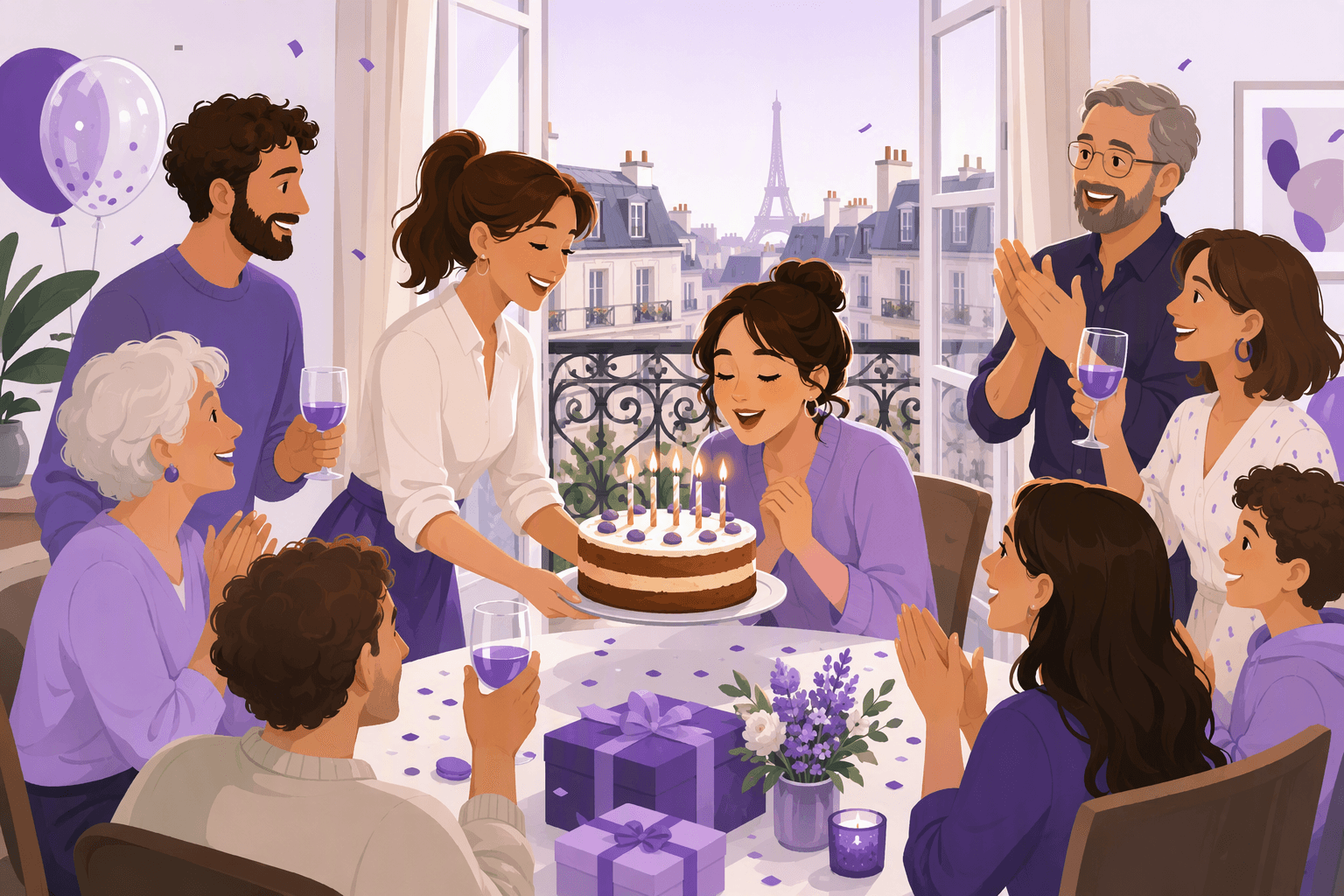
In France, the birthday cake is brought out with lit candles, and only then do guests sing Joyeux anniversaire. Singing before the cake appears would feel oddly premature. The sequence is: lights dim, cake enters, song begins, wish is made silently, candles are blown out, applause, cake is served.
🌍 Name Days vs. Birthdays
France has a historical tradition of fêtes du prénom (name days), where each day of the calendar is associated with a Catholic saint. If your name is Nicolas, your name day is December 6th. While name days have faded in importance in modern France, they remain culturally relevant in parts of Belgium, Switzerland, and especially Québec, where Bonne fête bridges both celebrations. Many French calendars still print the saint's name for each day.
French birthday parties also differ from Anglo-Saxon customs in a few notable ways. The birthday person is often expected to organize (and sometimes pay for) their own celebration, especially among adults. It is common for a French person to bring croissants or a cake to the office on their own birthday, rather than waiting for colleagues to surprise them.
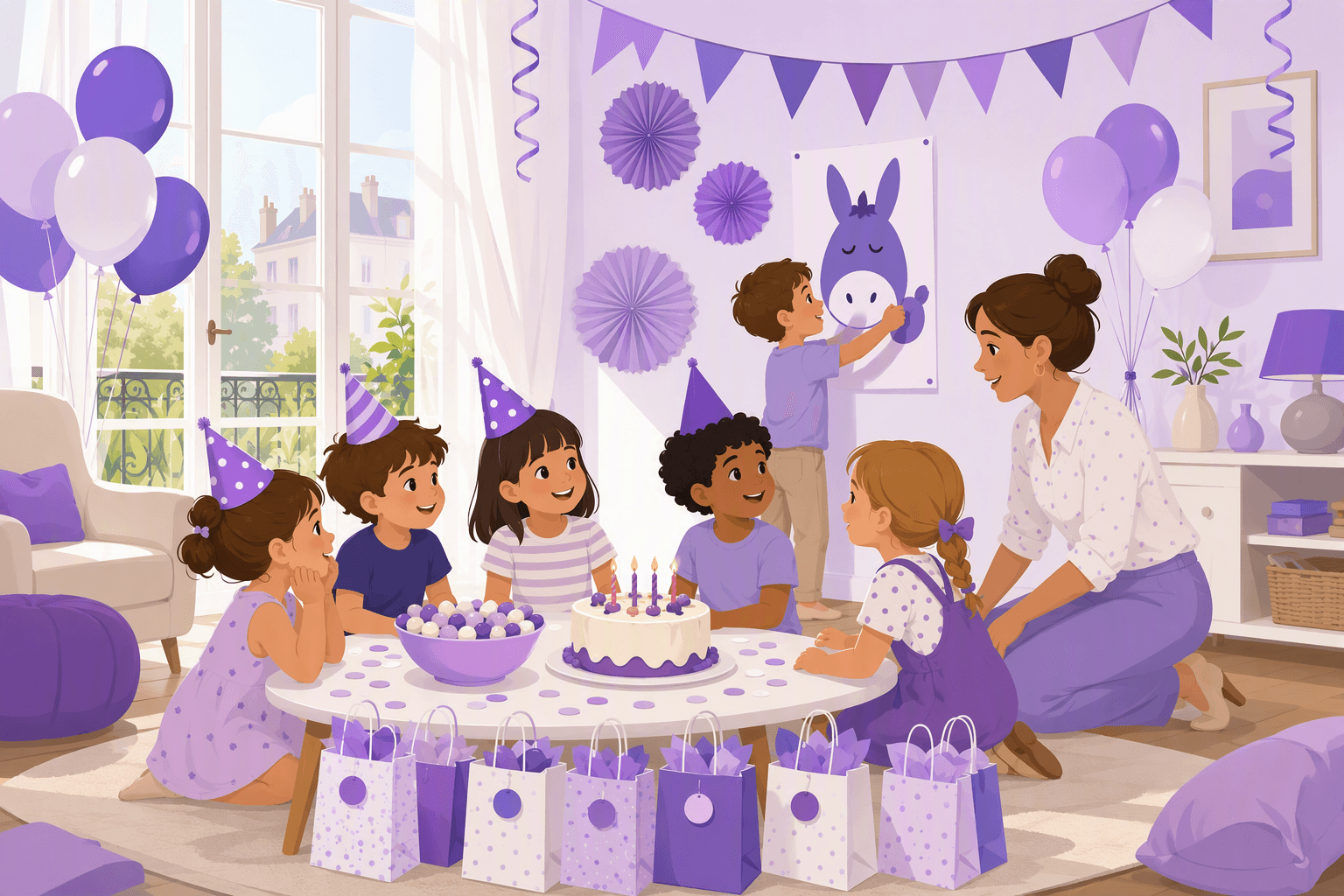
Children's birthdays, by contrast, follow a more familiar pattern. The goûter d'anniversaire (birthday snack party), typically held on Wednesday afternoons (when French schools are off), involves games, a gâteau d'anniversaire (birthday cake), and bags of candy sent home with each guest.
How to Write a French Birthday Card
Here are templates for different situations and relationships.
Casual (Friends, Family)
| French | English |
|---|---|
| Joyeux anniversaire ! Passe une super journée ! | Happy birthday! Have an awesome day! |
| Bon anniv ! Profite bien de ta journée ! | Happy bday! Enjoy your day! |
| Joyeux anniversaire ! Que cette année soit la meilleure ! | Happy birthday! May this year be the best! |
Formal (Colleagues, Elders)
| French | English |
|---|---|
| Je vous souhaite un très heureux anniversaire. | I wish you a very happy birthday. |
| Meilleurs vœux pour votre anniversaire. | Best wishes for your birthday. |
| Tous mes vœux de bonheur en ce jour spécial. | All my wishes of happiness on this special day. |
💡 Tu vs. Vous in Birthday Wishes
All of the casual expressions in this guide use tu (informal you). To convert them to formal vous forms: tes becomes vos, te becomes vous, ta becomes votre, and passe becomes passez. When in doubt, default to vous, since it is never wrong to be too polite in French.
Practice With Real French Content
Hearing birthday wishes spoken naturally (with the right intonation, the right warmth, the right rhythm) is what makes them stick. French-language films are full of celebration scenes that showcase these expressions in context.
Wordy lets you watch French movies and shows with interactive subtitles, so you can tap on any phrase to see its meaning, pronunciation, and cultural context in real time. Instead of memorizing phrases from a list, you absorb them from real conversations with authentic emotion and delivery.
For more French language guides, explore our blog or check out the best movies to learn French. You can also visit our French learning page to start practicing today.
Frequently Asked Questions
What is the most common way to say happy birthday in French?
What is the difference between 'Joyeux anniversaire' and 'Bon anniversaire'?
Why do Québécois say 'Bonne fête' instead of 'Joyeux anniversaire'?
What is the French birthday song?
Is it true that French people don't sing before the cake arrives?
How do you write happy birthday in a French card?
Sources & References
- Académie française, Dictionnaire de l'Académie française, 9th edition
- Organisation internationale de la Francophonie (OIF), La langue française dans le monde, 2022 report
- Ethnologue: Languages of the World, French language entry (2024)
- Nadeau, J.-B. & Barlow, J. (2006). 'The Story of French.' St. Martin's Press.
Start learning with Wordy
Watch real movie clips and build your vocabulary as you go. Free to download.


