Quick Answer
The standard way to say good morning in Spanish is 'Buenos días' (BWEH-nohs DEE-ahs), which literally means 'good days.' It works in every Spanish-speaking country from sunrise until noon, or as late as 2-3 PM in Spain, where the lunch schedule runs later. Beyond Buenos días, native speakers use a wide range of morning expressions depending on formality, region, and relationship.
The Short Answer
The most common way to say good morning in Spanish is Buenos días (BWEH-nohs DEE-ahs). It works in every Spanish-speaking country, in both formal and casual settings, and is appropriate from sunrise until roughly noon, or even later in Spain.
With approximately 559 million speakers worldwide according to Ethnologue's 2024 data, Spanish stretches across 21 countries and four continents. Morning routines, schedules, and greeting customs vary dramatically from Madrid to Mexico City to Buenos Aires, and the way people say good morning reflects those differences.
"Spanish morning greetings encode far more social information than their English equivalents. The choice between 'Buenos días' and '¿Cómo amaneciste?' signals the depth of the relationship, while regional variants like 'Buen día' immediately mark geographic origin."
(Francisco Moreno Fernández, Variedades de la lengua española, Routledge, 2020)
This guide covers 16 essential morning greetings and time-of-day expressions in Spanish. Each one includes pronunciation, formality level, an example sentence, and cultural context so you know exactly when and where to use it.

Quick Reference: Spanish Morning Greetings at a Glance
| English | Spanish | Pronunciation | Formality |
|---|---|---|---|
| Good morning | Buenos días | BWEH-nohs DEE-ahs | polite |
| Good morning (singular) | Buen día | bwehn DEE-ah | polite |
| Hey! (any time of day) | ¡Buenas! | BWEH-nahs | casual |
| How's it going? | ¿Qué tal? | keh TAHL | casual |
| How did you wake up? | ¿Cómo amaneciste? | KOH-moh ah-mah-neh-SEES-teh | casual |
| How did you sleep? | ¿Cómo dormiste? | KOH-moh dor-MEES-teh | casual |
| Good morning everyone | Buenos días a todos | BWEH-nohs DEE-ahs ah TOH-dohs | polite |
| Rise and shine! | ¡Arriba! | ah-RREE-bah | casual |
| What's up? (Mexico) | ¿Qué onda? | keh OHN-dah | slang |
| Good afternoon | Buenas tardes | BWEH-nahs TAR-dehs | polite |
| Good evening / Good night | Buenas noches | BWEH-nahs NOH-chehs | polite |
| You look great today | Te ves muy bien hoy | teh vehs mooy byehn oy | casual |
| Nice morning, isn't it? | Bonita mañana, ¿no? | boh-NEE-tah mah-NYAH-nah noh | casual |
| What a beautiful day! | ¡Qué hermoso día! | keh ehr-MOH-soh DEE-ah | casual |
| Good morning, how can I help you? | Buenos días, ¿en qué puedo ayudarle? | BWEH-nohs DEE-ahs ehn keh PWEH-doh ah-yoo-DAR-leh | formal |
| It's a pleasure, good morning | Un placer, buenos días | oon plah-SEHR BWEH-nohs DEE-ahs | formal |
The Essential Morning Greeting
This is the greeting you will use most. It is universal, works in every register, and is the first thing most Spanish learners should master for morning interactions.
Buenos días
/BWEH-nohs DEE-ahs/
Literal meaning: Good days (plural)
“Buenos días, señora López. ¿Cómo está usted?”
Good morning, Mrs. López. How are you?
The universal morning greeting across all 21 Spanish-speaking countries. Works in formal and casual settings alike. Used from sunrise until noon in Latin America, or until 2-3 PM in Spain.
Buenos días is the foundation of every morning interaction in Spanish. Notice the plural: it is literally "good days," not "good day." The Real Academia Española (RAE) notes that this plural form has been standard since at least the 16th century, reflecting the old custom of wishing someone multiple good days ahead.
The timing for when Buenos días ends and Buenas tardes begins is one of the biggest regional differences in daily Spanish. In most of Latin America, the switch happens around noon. In Spain, according to the CIS (Centro de Investigaciones Sociológicas), the average lunch time is 2:15 PM, which pushes the Buenos días window well past what most English speakers would expect.
🌍 The Spanish Schedule
Spain operates on a noticeably later daily schedule than Latin America or the English-speaking world. Breakfast is light (coffee and toast around 8-9 AM), lunch is the main meal (2-3 PM), and dinner often does not start until 9-10 PM. This shifts all time-of-day greetings later. You may hear Buenos días at 2 PM in Madrid and it is perfectly normal.
Regional Variations
Spanish-speaking countries do not all say good morning the same way. These variations immediately signal where a speaker is from.
Buen día
/bwehn DEE-ah/
Literal meaning: Good day (singular)
“Buen día, ¿cómo andás?”
Good morning, how are you doing?
The singular form preferred in Argentina, Uruguay, Paraguay, and parts of Central America. Equally correct as 'Buenos días', purely a regional preference, not an error.
If you hear Buen día instead of Buenos días, you are likely speaking with someone from the Southern Cone: Argentina, Uruguay, or Paraguay. The RAE recognizes both forms as correct. In Argentina especially, Buen día is far more common than the plural form in everyday conversation.
The difference also carries a subtle tonal quality. Buen día sounds slightly more modern and concise, while Buenos días can feel more traditional or ceremonious in countries where both forms coexist.
¡Buenas!
/BWEH-nahs/
Literal meaning: Good ones! (abbreviated)
“¡Buenas! ¿Me pone un café con leche?”
Morning! Can I get a coffee with milk?
Drops the time reference entirely. Works at any hour: morning, afternoon, or night. Extremely popular in casual settings across all Spanish-speaking countries.
This is the greeting that textbooks rarely teach but native speakers use constantly. By dropping días, tardes, or noches, you sidestep the guesswork about which time-of-day greeting is appropriate. Walking into a café at that awkward 11:45 AM moment? ¡Buenas! covers you perfectly.
Casual Morning Greetings
These expressions go beyond a simple good morning. They show familiarity, warmth, and genuine interest in how someone's day is starting.
¿Qué tal?
/keh TAHL/
Literal meaning: What such? / How so?
“Buenos días, ¿qué tal? ¿Listo para el día?”
Good morning, how's it going? Ready for the day?
The most versatile casual check-in after Buenos días. Often paired with it: 'Buenos días, ¿qué tal?' Works in every Spanish-speaking country and requires only a brief response like 'Bien, ¿y tú?'
¿Qué tal? is the perfect complement to Buenos días. The combination Buenos días, ¿qué tal? flows naturally and is probably the most common morning greeting sequence in the entire Spanish-speaking world. You can extend it with a topic: ¿Qué tal la mañana? (How's the morning going?) or ¿Qué tal el café? (How's the coffee?).
¿Cómo amaneciste?
/KOH-moh ah-mah-neh-SEES-teh/
Literal meaning: How did you dawn?
“Hola, mi amor. ¿Cómo amaneciste hoy?”
Hi, my love. How did you wake up today?
A warm, personal morning greeting used with family, partners, and close friends. The verb 'amanecer' (to dawn) poetically ties the person to the sunrise itself. Very common in Mexico, Central America, and Colombia.
This is one of the most beautiful morning expressions in Spanish. The verb amanecer means "to dawn," so you are literally asking "How did you dawn?" It implies that you care about the quality of someone's night and how they feel this morning. You will hear it most often between couples, parents and children, and close friends.
The formal version, ¿Cómo amaneció? (using usted), exists but is less common. In Mexico and Central America, ¿Cómo amaneciste? is an everyday greeting even among coworkers who are friendly with each other.
¿Cómo dormiste?
/KOH-moh dor-MEES-teh/
Literal meaning: How did you sleep?
“Buenos días, mamá. ¿Cómo dormiste anoche?”
Good morning, Mom. How did you sleep last night?
A caring morning question used with family and close friends. More direct than '¿Cómo amaneciste?', it specifically asks about sleep quality. Common across all Spanish-speaking countries.
While ¿Cómo amaneciste? is poetic, ¿Cómo dormiste? is direct. It specifically asks about sleep quality and is the phrase you would use with a family member at the breakfast table or a partner first thing in the morning. The standard responses are Bien, gracias (Well, thanks) or Mal, no pegué ojo (Badly, I didn't sleep a wink).
¡Arriba!
/ah-RREE-bah/
Literal meaning: Up! / Get up!
“¡Arriba, arriba! Ya son las siete, hay que levantarse.”
Up, up! It's already seven, time to get up.
An energetic wake-up call, not a formal greeting. Used playfully by parents waking children or among friends. Often doubled for emphasis: '¡Arriba, arriba!' The full expression '¡Arriba y afuera!' (Up and out!) is also common.
¡Arriba! is not a greeting you would use with a stranger; it is a wake-up call. Parents use it with children, roommates use it with each other, and drill sergeants use it with recruits. The doubling ¡Arriba, arriba! adds urgency and playfulness. You may also hear ¡Arriba y afuera! (Up and out!) for extra motivation.
Morning Greetings for Groups and Work
Starting the day at the office, in a classroom, or at a meeting requires greetings that address everyone present.
Buenos días a todos
/BWEH-nohs DEE-ahs ah TOH-dohs/
Literal meaning: Good morning to everyone
“Buenos días a todos. Empecemos la reunión.”
Good morning, everyone. Let's start the meeting.
The standard group morning greeting in professional and social settings. In gender-inclusive contexts, you may hear 'Buenos días a todas y todos' or simply 'Buenos días' directed at the room.
In Spanish workplaces, greeting everyone when you arrive is not optional; it is expected. According to the Instituto Cervantes, greeting customs in the professional sphere remain noticeably more formal in Spanish-speaking countries than in many English-speaking workplaces. Walking into an office without saying Buenos días is considered discourteous.
In meetings, Buenos días a todos is the standard opener. Some speakers use Buenos días a todas y todos to explicitly include both genders, while others opt for the traditional a todos as a gender-neutral collective. In casual office settings, a simple Buenos días as you walk past desks is sufficient. No need to add a todos unless you are addressing a group directly.
💡 Office Morning Protocol
In most Spanish-speaking offices, the morning routine involves greeting each colleague you pass with Buenos días or at minimum Buenas. In smaller offices, this might mean greeting each person individually. In larger ones, a general Buenos días as you enter the shared space is acceptable.
Buenos días, ¿en qué puedo ayudarle?
/BWEH-nohs DEE-ahs ehn keh PWEH-doh ah-yoo-DAR-leh/
Literal meaning: Good morning, how can I help you?
“Buenos días, ¿en qué puedo ayudarle? Bienvenido al Hotel Miraflores.”
Good morning, how can I help you? Welcome to Hotel Miraflores.
The standard professional service greeting in shops, hotels, banks, and offices. The 'le' (formal you) signals respect toward the customer or client.
This is the greeting you will hear from hotel receptionists, bank tellers, shop assistants, and customer service representatives across the Spanish-speaking world. The formal le (instead of te) signals professionalism and respect. If you are working in a customer-facing role, this phrase is essential.
Un placer, buenos días
/oon plah-SEHR BWEH-nohs DEE-ahs/
Literal meaning: A pleasure, good morning
“Un placer, buenos días. Soy el doctor Mendoza y lo atenderé hoy.”
A pleasure, good morning. I'm Dr. Mendoza and I'll be attending to you today.
A polished, professional morning greeting used in formal introductions. Common among doctors, lawyers, and professionals meeting clients for the first time.
This combination elevates a simple Buenos días into a formal introduction. You will encounter it in professional settings where first impressions matter: doctor's offices, law firms, business meetings, and formal events. It sets an immediate tone of professionalism and courtesy.
Regional Morning Expressions
Morning culture varies widely across the Spanish-speaking world. These expressions reveal those differences.
¿Qué onda?
/keh OHN-dah/
Literal meaning: What wave?
“¿Qué onda, güey? ¿Ya desayunaste?”
What's up, dude? Did you eat breakfast yet?
Distinctly Mexican. Works at any time of day, including mornings among friends. 'Onda' (wave) has taken on the slang meaning of 'vibe.' Very casual; do not use in formal morning settings.
While ¿Qué onda? is not exclusively a morning greeting, it is one of the most common ways young Mexicans greet each other in the morning. Arriving at school or a casual workplace, you will hear ¿Qué onda? as frequently as Buenos días. Mexican films and TV shows are full of it. Check out our guide to the best movies for learning Spanish to hear it in action.
🌍 Mexican Morning Culture
Breakfast is deeply important in Mexican culture. The morning greeting often transitions directly into food-related conversation: ¿Ya desayunaste? (Did you eat breakfast?), ¿Quieres unos chilaquiles? (Want some chilaquiles?). Offering morning food is an act of hospitality, and declining without a good reason can seem impolite.
Time-of-Day Greetings Beyond Morning
Understanding the full set of time-based greetings helps you know exactly when Buenos días ends and what comes next.
Buenas tardes
/BWEH-nahs TAR-dehs/
Literal meaning: Good afternoons
“Buenas tardes. Perdone la tardanza.”
Good afternoon. Sorry for the delay.
Takes over when Buenos días ends. In Latin America, this is roughly noon onward. In Spain, it can start as late as 2-3 PM. Notice the feminine 'buenas' matching 'tardes' (compared to masculine 'buenos' matching 'días').
Notice the grammatical shift from buenos (masculine, matching días) to buenas (feminine, matching tardes). This gender agreement is important and one of the first grammar rules morning greetings teach you about Spanish. The tardes window is the longest of the three, from noon until sunset, which in Spanish summers can be as late as 10 PM.
Buenas noches
/BWEH-nahs NOH-chehs/
Literal meaning: Good nights
“Buenas noches, vecino. ¿Qué tal el día?”
Good evening, neighbor. How was your day?
Unlike English, 'Buenas noches' serves as BOTH a greeting (hello in the evening) and a farewell (goodnight). Context makes the meaning clear. Takes over from 'Buenas tardes' after sunset.
This is the one that confuses English speakers most. In English, "good night" is only a farewell. In Spanish, Buenas noches works as both "good evening" (when arriving somewhere after dark) and "good night" (when leaving or going to bed). The context makes the meaning clear.
Morning Compliments and Small Talk
Spanish morning conversations often include warm compliments and observations about the day. These phrases help you go beyond the basic greeting.
Te ves muy bien hoy
/teh vehs mooy byehn oy/
Literal meaning: You look very good today
“Buenos días, te ves muy bien hoy. ¿Nuevo corte de pelo?”
Good morning, you look great today. New haircut?
A common morning compliment among friends and coworkers. In Spanish-speaking cultures, commenting on someone's appearance in the morning is more common and socially accepted than in many English-speaking contexts.
Morning compliments are more common in Spanish-speaking cultures than in many English-speaking ones. Telling a coworker Te ves muy bien hoy is a natural extension of the morning greeting, not an unusual statement. The formal version is Se ve muy bien hoy (using usted).
Bonita mañana, ¿no?
/boh-NEE-tah mah-NYAH-nah noh/
Literal meaning: Beautiful morning, no?
“Bonita mañana, ¿no? Perfecta para un café en la terraza.”
Beautiful morning, isn't it? Perfect for a coffee on the terrace.
Light morning small talk, especially common in outdoor settings, walking through neighborhoods, or at café terraces. A natural conversation starter with neighbors and acquaintances.
Weather-related morning small talk is universal, and Spanish is no exception. Bonita mañana is the standard way to comment on a pleasant morning. Variations include Linda mañana and Hermosa mañana, all meaning roughly the same thing.
¡Qué hermoso día!
/keh ehr-MOH-soh DEE-ah/
Literal meaning: What a beautiful day!
“¡Qué hermoso día! Vamos a desayunar afuera.”
What a beautiful day! Let's have breakfast outside.
An exclamation about beautiful weather that functions as a morning conversation opener. 'Hermoso' is stronger than 'bonito', it conveys genuine delight. Common across all countries.
This exclamation works as both a genuine weather observation and a morning conversation starter. The ¡Qué + adjective! structure is one of the most useful patterns in Spanish for expressing enthusiasm. You will hear it constantly in morning conversations, especially in countries with consistently good weather.
How to Respond to Morning Greetings
Knowing the right response is just as important as the greeting itself. Here is your complete reference.
| They Say | You Say | Notes |
|---|---|---|
| Buenos días | Buenos días | Echo the greeting back |
| Buen día | Buen día / Buenos días | Either form works as a response |
| ¿Qué tal? | Bien, ¿y tú? / Todo bien | Brief and positive is the norm |
| ¿Cómo amaneciste? | Bien, gracias a Dios. ¿Y tú? | "Gracias a Dios" (thank God) is very common |
| ¿Cómo dormiste? | Bien, como un tronco | "Like a log", same idiom as English |
| ¡Buenas! | ¡Buenas! / ¡Hola! | Casual echo |
| ¿Qué onda? | Aquí, ¿y tú? / Todo tranqui | Mexican casual responses |
| Buenos días a todos | Buenos días | Simple echo, no need to add "a todos" |
💡 The 'Gracias a Dios' Response
In many Latin American countries, Bien, gracias a Dios (Good, thank God) is the default response to morning inquiries about how you slept or how you are feeling. It does not necessarily signal strong religious belief; it is simply a cultural expression of gratitude that is deeply embedded in morning conversation.
Morning Customs Across the Spanish-Speaking World
Morning greetings do not exist in a vacuum. Understanding the cultural context behind them makes your Spanish sound natural rather than textbook-correct.
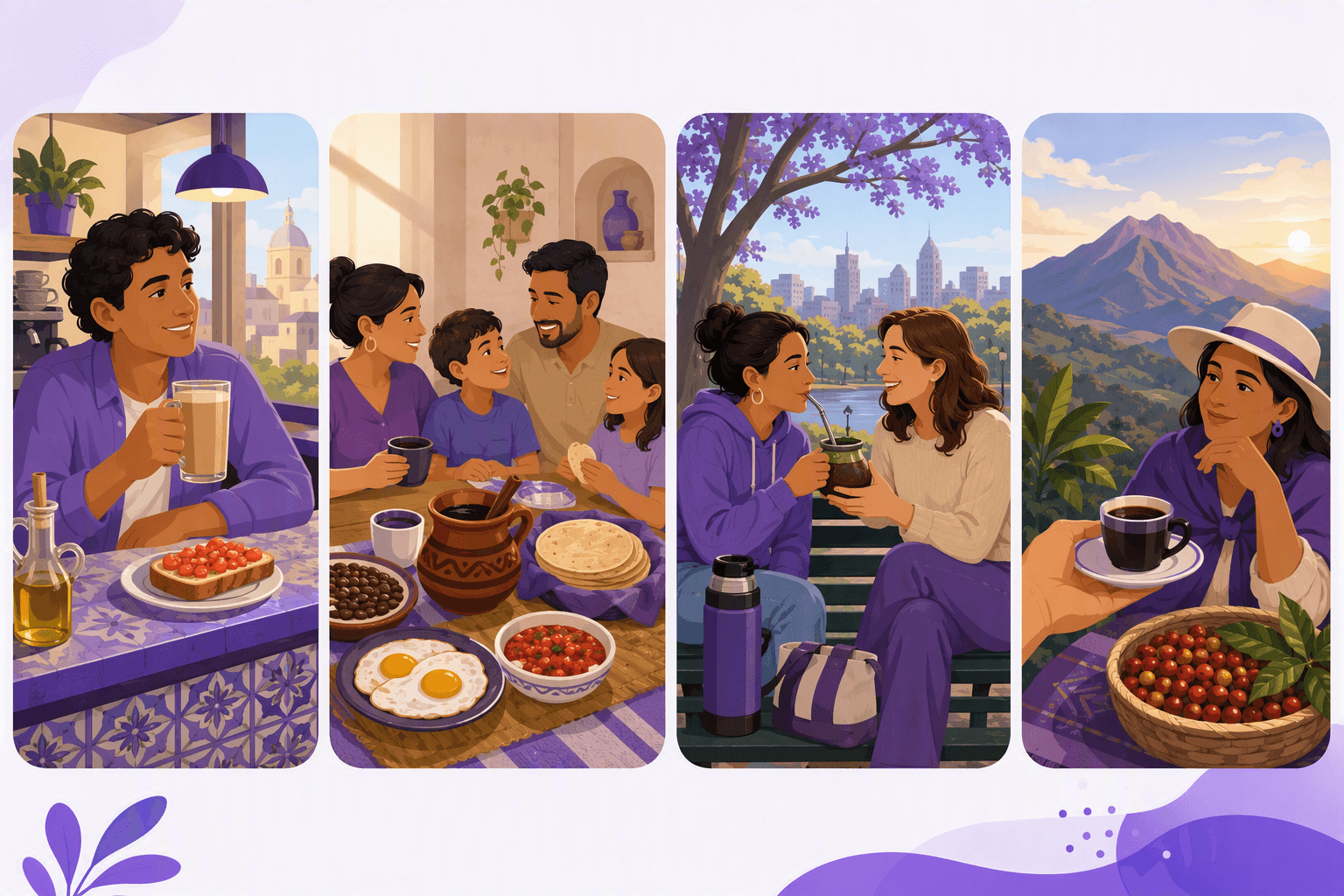
Spain: Mornings start slowly. A typical Spanish breakfast is a café con leche with toast (tostada) or a pastry at a local bar. The morning greeting window extends late because everything runs on a later schedule. In offices, a brief Buenos días to each colleague is standard etiquette.
Mexico: Breakfast is a substantial affair: eggs, beans, tortillas, salsa, and sometimes chilaquiles or tamales. Morning greetings often include asking whether someone has eaten: ¿Ya desayunaste? A café de olla (clay pot coffee with cinnamon and piloncillo) is a traditional morning drink.
Argentina: The morning ritual revolves around mate. Sharing mate with family or coworkers is both a greeting ritual and a bonding activity. Buen día (singular) is preferred over Buenos días, and the morning pace in Buenos Aires is brisk compared to other Latin American capitals.
Colombia: Colombians are known for their warmth in greetings. Morning exchanges tend to be longer, often including ¿Cómo amaneció? and genuine follow-up questions. Coffee culture is central, and a tinto (small black coffee) is offered almost immediately in any social or business interaction.
Practice With Real Spanish Content
Reading about morning greetings is a helpful start, but hearing them in natural conversation is what makes them stick. Spanish-language films and shows are an excellent resource for this. You will hear Buenos días in virtually every domestic scene, and regional variations like Buen día and ¿Cómo amaneciste? become immediately obvious in context.
Wordy lets you watch Spanish movies and shows with interactive subtitles. When you hear a morning greeting you do not recognize, tap it to see the meaning, pronunciation, and cultural context instantly. Instead of memorizing phrases from a list, you absorb them from real conversations with authentic intonation.
For more Spanish content, explore our blog for guides on everything from movies for learning Spanish to regional expressions. You can also visit our Spanish learning page to start practicing morning greetings in context today.
Frequently Asked Questions
What is the most common way to say good morning in Spanish?
Is it 'Buenos días' or 'Buen día'?
When do you stop saying 'Buenos días' and switch to 'Buenas tardes'?
How do you say 'good morning everyone' in Spanish?
What is the difference between 'Buenos días' and '¿Cómo amaneciste?'?
Do Spanish speakers really greet everyone they see in the morning?
Sources & References
- Real Academia Española (RAE), Diccionario de la lengua española, 23rd edition
- Instituto Cervantes, El español en el mundo, 2024 annual report
- Ethnologue: Languages of the World, Spanish language entry (2024)
- Moreno Fernández, F. (2020). 'Variedades de la lengua española.' Routledge.
- CIS (Centro de Investigaciones Sociológicas), Encuesta sobre hábitos y horarios, 2023
Start learning with Wordy
Watch real movie clips and build your vocabulary as you go. Free to download.


