Quick Answer
The standard way to say good morning in German is 'Guten Morgen' (GOO-ten MOR-gen). It works in every German-speaking country and across all levels of formality. Beyond Guten Morgen, Germans use regional morning greetings like 'Moin' in the north, 'Grüß Gott' in Bavaria and Austria, and 'Grüezi' in Switzerland. Coworkers often shorten it to just 'Morgen!' and near lunchtime the greeting shifts to 'Mahlzeit!'
The Short Answer
The most common way to say good morning in German is Guten Morgen (GOO-ten MOR-gen). It is universally understood across Germany, Austria, Switzerland, and every other German-speaking region, and it works in both casual and formal situations from sunrise until roughly noon.
But the way Germans greet each other in the morning reveals far more than just the time of day. German is spoken by over 130 million people across six countries, and according to Ethnologue's 2024 data, it ranks among the top twelve most spoken languages globally. That geographic spread across Central Europe means morning greetings vary dramatically by region. A Hamburger says Moin, a Münchener says Grüß Gott, and a Zürcher says Grüezi, all before their first cup of coffee.
"Regional greetings in German are not dialects to be corrected; they are fully legitimate linguistic forms that carry social prestige within their regions. A Bavarian Grüß Gott and a northern Moin each command equal respect in their respective territories."
(Ulrich Ammon, Die Stellung der deutschen Sprache in der Welt, De Gruyter, 2015)
This guide covers 16 German morning greetings and related expressions organized by category: standard, casual, regional, workplace, and wake-up phrases. Each includes pronunciation, an example sentence, and cultural context so you know exactly when and where to use it.

Quick Reference: German Morning Greetings at a Glance
| English | German | Pronunciation | Formality |
|---|---|---|---|
| Good morning | Guten Morgen | GOO-ten MOR-gen | polite |
| Morning! | Morgen! | MOR-gen | casual |
| A beautiful good morning | Schönen guten Morgen | SHUR-nen GOO-ten MOR-gen | polite |
| Good morning everyone | Guten Morgen zusammen | GOO-ten MOR-gen tsoo-ZAH-men | polite |
| Hello (Northern Germany) | Moin | moyn | casual |
| Hello hello (Northern Germany) | Moin Moin | moyn moyn | casual |
| Greet God (Bavaria/Austria) | Grüß Gott | GREWS GOT | polite |
| Hello (Switzerland) | Grüezi | GREW-eh-tsee | polite |
| Hi/Bye (Bavaria/Austria) | Servus | ZEHR-voos | casual |
| Good day | Guten Tag | GOO-ten TAHK | polite |
| Mealtime (lunchtime greeting) | Mahlzeit | MAHL-tsayt | casual |
| How did you sleep? | Wie hast du geschlafen? | vee HAHST doo geh-SHLAH-fen | casual |
| Did you sleep well? | Gut geschlafen? | goot geh-SHLAH-fen | casual |
| Get up! | Aufstehen! | OWF-shtay-en | casual |
| Rise and shine! | Raus aus den Federn! | ROWS ows den FEH-dern | casual |
| Good morning sunshine | Guten Morgen, Sonnenschein | GOO-ten MOR-gen ZON-nen-shyne | casual |
Standard Morning Greetings
These are the core morning greetings understood across every German-speaking country. The Duden, Germany's authoritative dictionary, classifies them as standard High German (Hochdeutsch).
Guten Morgen
/GOO-ten MOR-gen/
Literal meaning: Good morning
“Guten Morgen, Frau Müller! Wie geht es Ihnen heute?”
Good morning, Mrs. Müller! How are you today?
The universal German morning greeting. Used from sunrise until around noon. Works in every setting from a casual bakery visit to a formal boardroom meeting.
Guten Morgen is the default morning greeting in German and the safest choice in any situation. The stress falls evenly across both words: GOO-ten MOR-gen. It works from the moment you wake up until roughly noon, when the transition to Guten Tag begins.
Germans take their morning greetings seriously. Walking into a small shop, doctor's waiting room, or elevator without greeting the people inside is considered impolite. A clear Guten Morgen upon entering is not just polite; it is socially expected, especially in smaller towns.
Morgen!
/MOR-gen/
Literal meaning: Morning!
“Morgen! Kaffee steht schon in der Küche.”
Morning! Coffee's already in the kitchen.
The shortened everyday version. Extremely common among coworkers, friends, and family. Think of it as the German equivalent of English 'Morning!'
Drop the Guten and you get the casual, clipped version that dominates everyday life. Walking into the office and saying Morgen! to your colleagues is completely standard. In fact, using the full Guten Morgen every time might sound slightly stiff among people you see daily.
The abbreviation follows a broader pattern in German. Just as Guten Tag becomes Tag! and Guten Abend becomes Abend!, morning speakers naturally shorten to Morgen! for efficiency. According to the Duden, these clipped forms have been part of colloquial German for centuries.
Schönen guten Morgen
/SHUR-nen GOO-ten MOR-gen/
Literal meaning: A beautiful good morning
“Schönen guten Morgen, meine Damen und Herren! Willkommen zum Frühstück.”
A lovely good morning, ladies and gentlemen! Welcome to breakfast.
An enhanced, warmer version of Guten Morgen. Often used by radio hosts, hotel staff, and anyone wanting to add a touch of warmth and cheerfulness to the standard greeting.
This is Guten Morgen with an extra dose of warmth. The addition of schönen (beautiful, nice) elevates the greeting and signals genuine friendliness. You will hear it from hotel receptionists, radio presenters, and cheerful colleagues who are very much morning people.
It is never required, but it is always appreciated. Using Schönen guten Morgen can set a positive tone for an entire interaction, especially in hospitality and customer-facing roles.
Guten Morgen zusammen
/GOO-ten MOR-gen tsoo-ZAH-men/
Literal meaning: Good morning together (everyone)
“Guten Morgen zusammen! Fangen wir an mit dem Meeting.”
Good morning everyone! Let's start the meeting.
The standard way to greet a group in the morning. Common in offices, classrooms, and any setting where you address multiple people at once.
When you walk into a room with multiple people (a team meeting, a breakfast table, a classroom), Guten Morgen zusammen is the natural choice. The word zusammen (together) turns the greeting into a collective address.
In German workplace culture, greeting the entire room is expected. Research by the Goethe-Institut on German business etiquette highlights that failing to greet your colleagues in the morning can be interpreted as unfriendly or arrogant, especially in smaller teams.
Regional Morning Greetings
Morning greetings are where Germany's regional diversity shines most brightly. As linguist Werner König documents in the dtv-Atlas Deutsche Sprache, greeting patterns form one of the clearest dialect boundary markers across German-speaking Europe.
Moin
/moyn/
Literal meaning: Good/Pleasant (from Low German)
“Moin! Na, auch schon wach?”
Hey! You're awake too?
The signature greeting of northern Germany. Used at ALL times of day, including morning. Derived from Low German 'moi' (good/pleasant), not from 'Morgen.' Dominates in Hamburg, Schleswig-Holstein, Lower Saxony, and Bremen.
Moin is perhaps the most famous regional greeting in all of German, and it comes with a persistent misconception. Despite sounding like "morning," it has nothing to do with the time of day. The word derives from Low German (Plattdeutsch) moi, meaning "good" or "pleasant." You will hear Moin at 7 AM, 3 PM, and 11 PM equally.
In Hamburg, Schleswig-Holstein, Lower Saxony, and Bremen, Moin is the default greeting, period. While the rest of Germany distinguishes between Guten Morgen, Guten Tag, and Guten Abend, the north simplifies everything into one efficient syllable.
🌍 Moin vs. Moin Moin
The doubled form Moin Moin is also widely used, but opinions differ. Some purists (especially in Hamburg) insist that a single Moin is sufficient and that doubling it is "already too much talking." This joke perfectly captures the dry, understated humor of northern Germany. In practice, both forms are completely acceptable.
Moin Moin
/moyn moyn/
Literal meaning: Good good / Pleasant pleasant
“Moin Moin! Schönes Wetter heute, oder?”
Hey there! Nice weather today, right?
The doubled version of Moin. Slightly warmer and more conversational than a single Moin. Widespread across northern Germany, though Hamburg purists may call it redundant.
Moin Moin doubles the warmth. While a single Moin is efficient and slightly clipped, Moin Moin signals a bit more openness and willingness to chat. It is the northern German equivalent of the difference between a quick nod and a smile with eye contact.
The greeting has spread well beyond its Low German homeland. According to Ammon's research, Moin and Moin Moin have been steadily gaining recognition across all of Germany, partly through media exposure and partly through the cultural cachet of Hamburg as a trendy, cosmopolitan city.
Grüß Gott
/GREWS GOT/
Literal meaning: Greet God
“Grüß Gott! Zwei Semmeln und ein Croissant, bitte.”
Good morning! Two rolls and a croissant, please.
The standard greeting in Bavaria and Austria, used at all times of day including morning. Not a religious statement; it is simply the regional equivalent of 'Guten Tag' or 'Guten Morgen.'
In Bavaria and Austria, Grüß Gott replaces both Guten Morgen and Guten Tag. It works from early morning until late evening. The literal meaning ("Greet God," shortened from Gott grüße dich, or "May God greet you") no longer carries religious weight in everyday usage. It is simply what people say.
If you visit Munich, Salzburg, or Vienna in the morning, Grüß Gott is what you will hear at the bakery, in the elevator, and from the bus driver. Using it shows respect for local customs and will always be received warmly. Check out our guide to the best movies for learning German for Austrian and Bavarian films where you can hear Grüß Gott spoken naturally.
Grüezi
/GREW-eh-tsee/
Literal meaning: Greet you (Swiss German)
“Grüezi! Händ Sie scho zmorge gha?”
Good morning! Have you already had breakfast?
The standard greeting in German-speaking Switzerland. Works at any time of day, including morning. 'Grüezi mitenand' addresses a group. Immediately identifies the speaker as Swiss.
Grüezi is the unmistakable Swiss German greeting, used from morning until night. It comes from the same root as Grüß Gott (Gott grüeze dich, meaning "God greet you"), but with a distinctly Swiss pronunciation and form. In Switzerland, using Grüezi at a morning bakery visit is perfectly standard, while saying Guten Morgen would sound slightly foreign.
Swiss German (Schweizerdeutsch) differs substantially from standard High German, and greetings are the first place you notice this. The Goethe-Institut notes that Swiss speakers often switch to standard German for writing but maintain Grüezi and other Swiss forms in all spoken interactions.
Servus
/ZEHR-voos/
Literal meaning: At your service (from Latin)
“Servus, Markus! Magst an Kaffee?”
Hey, Markus! Want a coffee?
Used in Bavaria, Austria, and parts of Switzerland. Works as both a greeting and farewell at any time of day. Casual and friendly, derived from Latin 'servus' (servant).
Servus is the warm, casual alternative to Grüß Gott in southern German-speaking regions. Its origin is remarkable: it descends from the Latin servus humillimus (your most humble servant), but today it carries no sense of servility at all. It is simply a friendly, informal way to say both hello and goodbye.
In the morning, Servus works perfectly among friends and acquaintances. You might hear it at a Bavarian Frühstück (breakfast) table or between colleagues arriving at work in Vienna.
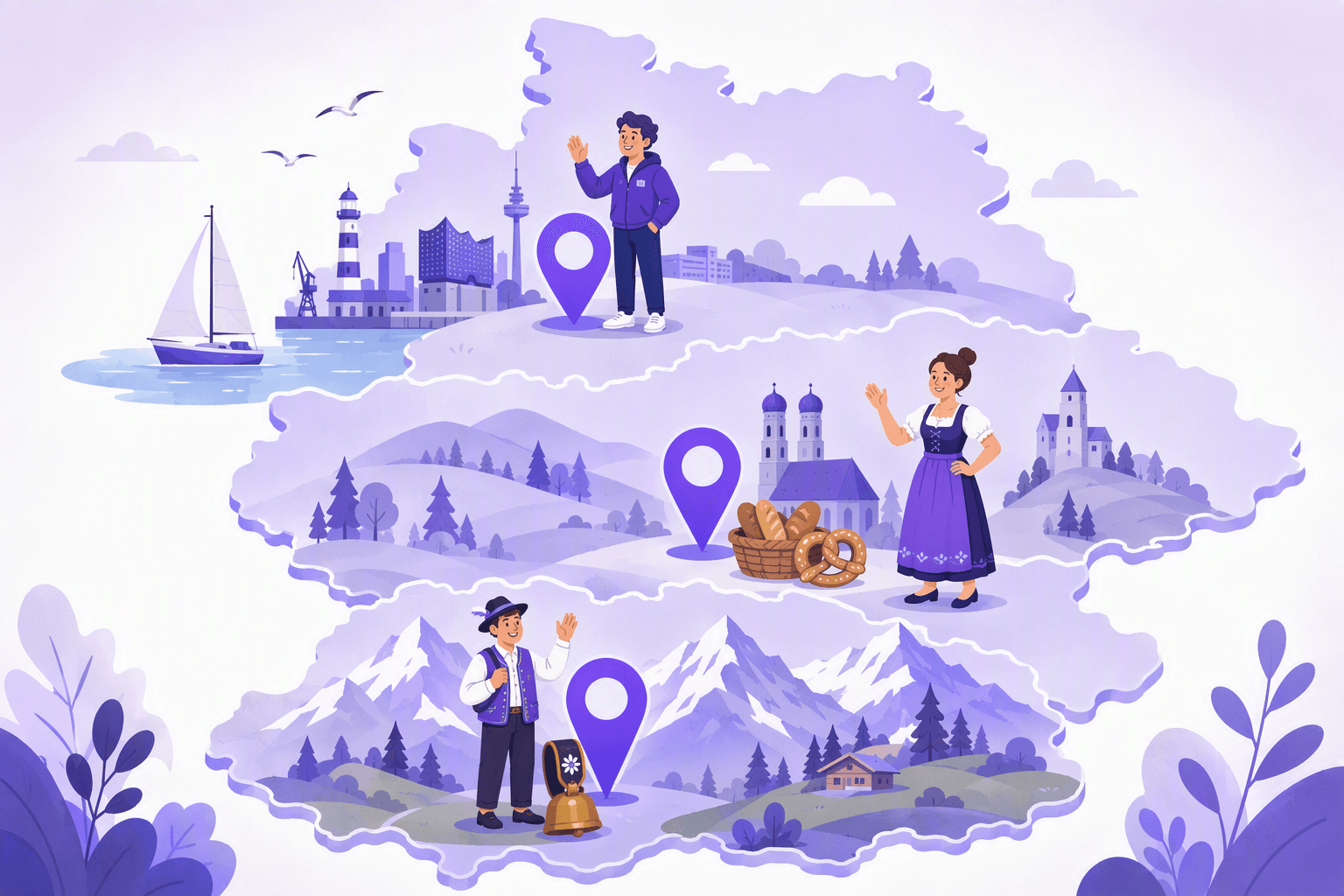
🌍 Germany's Morning Greeting Map
Germany's morning greeting geography is remarkably clear. In the north (Hamburg, Bremen, Kiel), it is Moin. In the center (Berlin, Hanover, Cologne), it is Guten Morgen or Morgen!. In the south (Munich, Stuttgart, Freiburg), Grüß Gott dominates. Cross into Austria and you hear Grüß Gott and Servus. Cross into Switzerland and it becomes Grüezi. Werner König's dtv-Atlas Deutsche Sprache maps these boundaries with remarkable precision.
Workplace and Transitional Greetings
German workplaces have their own greeting rhythms, especially around the transition from morning to midday. These phrases are essential for navigating the German Büroalltag (office routine).
Guten Tag
/GOO-ten TAHK/
Literal meaning: Good day
“Guten Tag, Herr Schneider. Wir haben um elf einen Termin.”
Good day, Mr. Schneider. We have an appointment at eleven.
Takes over from 'Guten Morgen' around noon. The standard polite greeting for the rest of the day. In northern Germany, the clipped 'Tag!' is common.
Guten Tag is where morning ends and the rest of the day begins. The transition from Guten Morgen to Guten Tag happens roughly between 11 AM and noon, though there is no strict rule. In practice, most Germans intuitively feel when the shift occurs.
In professional settings, Guten Tag is the safe default for any non-morning encounter. It carries a polite, neutral tone that works with clients, strangers, and anyone you address with the formal Sie.
Mahlzeit
/MAHL-tsayt/
Literal meaning: Mealtime
“Mahlzeit! Gehst du auch in die Kantine?”
Enjoy your meal! Are you going to the cafeteria too?
A uniquely German workplace greeting used around lunchtime, roughly 11:30 AM to 1:30 PM. Functions as both a greeting and a wish for a good meal. The standard response is simply 'Mahlzeit!' back.
Mahlzeit is one of the most uniquely German greeting conventions. Literally meaning "mealtime," it fills the transitional gap between Guten Morgen and the full afternoon. Starting around 11:30 AM in many offices, Mahlzeit becomes the default hallway greeting, especially near the cafeteria or kitchen.
According to the Duden, this usage has been documented since the 19th century and likely evolved from the longer phrase Gesegnete Mahlzeit (blessed mealtime). Today, it requires no religious or even literal meal context; you can say Mahlzeit to a colleague walking down the hallway even if neither of you is eating. The correct response is always Mahlzeit! echoed back.
💡 When Mahlzeit Gets Awkward
There is an unspoken time limit on Mahlzeit. Using it before 11 AM feels premature, and after about 2 PM it sounds strange. Some Germans enjoy testing these boundaries as a form of dry humor, saying Mahlzeit at 4 PM to get a confused reaction. If someone does this to you, they are joking.
Morning Phrases for Home and Family
Beyond formal greetings, German has a rich set of phrases for the domestic morning routine: waking someone up, asking about their night, and starting the day at the breakfast table.
Wie hast du geschlafen?
/vee HAHST doo geh-SHLAH-fen/
Literal meaning: How have you slept?
“Guten Morgen, Schatz. Wie hast du geschlafen?”
Good morning, darling. How did you sleep?
A warm morning question for family, partners, and close friends. The formal version is 'Wie haben Sie geschlafen?' Germans often answer honestly rather than with an automatic 'fine.'
This is the natural follow-up to Guten Morgen at the family breakfast table. Unlike in some cultures where "How did you sleep?" is purely rhetorical, Germans may give you a genuine answer, complete with details about their mattress, the temperature of the room, or the neighbor's dog.
The formal version, Wie haben Sie geschlafen?, might be used by hotel staff to a guest. In both cases, it signals genuine care about the other person's well-being.
Gut geschlafen?
/goot geh-SHLAH-fen/
Literal meaning: Slept well?
“Morgen! Gut geschlafen? Du siehst ausgeruht aus.”
Morning! Sleep well? You look well-rested.
The shortened, more casual version of the sleep question. Common between partners, roommates, and family members at the breakfast table.
A more casual, clipped version of the sleep question. Gut geschlafen? drops the subject and verb, leaving just the essentials, a pattern very common in spoken German. It works perfectly at the breakfast table or when you run into a housemate in the kitchen.
Aufstehen!
/OWF-shtay-en/
Literal meaning: Get up! / Stand up!
“Aufstehen! Es ist schon acht Uhr!”
Get up! It's already eight o'clock!
The direct command to get out of bed. Used by parents waking children and between partners. Firm but not harsh; it is simply the standard German way to say 'time to get up.'
Aufstehen is the separable verb aufstehen (to get up, to stand up) in its imperative form. German parents have been using this word to rouse their children for generations. It is direct (as German communication tends to be) but not rude. It simply means the time for sleeping is over.
The directness is a cultural feature, not a sign of impatience. The Goethe-Institut's resources on German communication styles note that German speakers generally value clarity and directness over softened, indirect phrasing.
Raus aus den Federn!
/ROWS ows den FEH-dern/
Literal meaning: Out of the feathers!
“Raus aus den Federn, Kinder! Das Frühstück ist fertig!”
Rise and shine, kids! Breakfast is ready!
A playful, idiomatic way to say 'get out of bed.' The 'feathers' refer to traditional feather-filled duvets (Federbetten). Warm and affectionate, often used with children.
This charming idiom literally means "out of the feathers!", a reference to the traditional German Federbett (feather duvet) that has been a staple of German bedding for centuries. It is the German equivalent of "rise and shine!" and carries the same playful, encouraging energy.
The phrase paints a vivid picture of someone burrowed deep into a warm feather duvet on a cold German morning, unwilling to face the day. It is used affectionately, especially by parents, and always with good humor.
Guten Morgen, Sonnenschein
/GOO-ten MOR-gen ZON-nen-shyne/
Literal meaning: Good morning, sunshine
“Guten Morgen, Sonnenschein! Hast du Lust auf Pfannkuchen?”
Good morning, sunshine! Do you feel like pancakes?
An affectionate morning greeting for loved ones, especially children and partners. Also the title of a famous German pop song by Nana Mouskouri that most Germans know.
Sonnenschein (sunshine) is used as a term of endearment in German, much like in English. This phrase is warm, affectionate, and slightly playful, perfect for greeting a child, a partner, or anyone you are fond of on a bright morning.
The phrase also echoes the famous German song Guten Morgen, Sonnenschein by Nana Mouskouri, which remains a cultural touchstone that most Germans over 30 can hum from memory.
How to Respond to German Morning Greetings
Knowing how to greet someone is half the equation. Here is how to respond naturally to the morning greetings you will encounter.
Standard Morning Responses
| They Say | You Say | Notes |
|---|---|---|
| Guten Morgen | Guten Morgen / Morgen! | Echo it back, shortened form is fine |
| Morgen! | Morgen! | Match their casual level |
| Schönen guten Morgen | Schönen guten Morgen / Guten Morgen | Echo or use the standard version |
| Guten Morgen zusammen | Guten Morgen / Morgen! | Individual response to the group greeting |
| Mahlzeit! | Mahlzeit! | Always echo Mahlzeit back |
Regional and Casual Responses
| They Say | You Say |
|---|---|
| Moin | Moin |
| Moin Moin | Moin / Moin Moin |
| Grüß Gott | Grüß Gott |
| Grüezi | Grüezi |
| Servus | Servus |
| Gut geschlafen? | Ja, danke! Und du? / Nicht so gut, leider. |
| Wie hast du geschlafen? | Gut, danke! Und du? / Wie ein Stein! (Like a rock!) |
💡 The Echo Rule for Mornings
When unsure how to respond to any German morning greeting, the safest strategy is to echo it back exactly. If someone says Grüß Gott, say Grüß Gott. If they say Moin, say Moin. Echoing shows you understand and respect the regional form. This rule applies to every German greeting, not just morning ones.
🌍 German Frühstück Culture
Morning greetings in Germany are inseparable from Frühstück (breakfast) culture. A traditional German breakfast features fresh bread rolls (Brötchen or Semmeln in Bavaria), cold cuts, cheese, jam, soft-boiled eggs, and strong coffee. Sunday breakfasts are especially elaborate and can stretch for hours. The greeting ritual at the breakfast table (Guten Morgen, followed by Wie hast du geschlafen?, followed by Guten Appetit before eating) is a small but meaningful daily ceremony.
Practice With Real German Content
Reading about morning greetings is a strong start, but hearing them spoken naturally is what makes them stick. German-language films and shows are excellent resources for absorbing authentic greetings: Dark for standard German, Tatort for regional dialects, and Austrian productions like Vorstadtweiber for hearing Grüß Gott and Servus over breakfast scenes.
Wordy lets you take this further. You can watch German movies and shows with interactive subtitles, tapping on any greeting to see its meaning, pronunciation, and cultural context in real time. Instead of memorizing phrases from a list, you absorb them from real conversations with authentic intonation and regional flavor.
For more German content, explore our blog for language guides including the best movies to learn German. You can also visit our German learning page to start practicing with native content today.
Frequently Asked Questions
What is the most common way to say good morning in German?
What is the difference between 'Guten Morgen' and 'Morgen'?
Can you say 'Moin' instead of 'Guten Morgen'?
What time do Germans stop saying 'Guten Morgen'?
How do you say good morning in Austrian German?
Is it rude to just say 'Morgen' in a formal setting?
Sources & References
- Duden, Deutsches Universalwörterbuch, 9th edition (2023)
- Goethe-Institut, German language and culture resources
- Ethnologue: Languages of the World, German language entry (2024)
- Ammon, Ulrich (2015). 'Die Stellung der deutschen Sprache in der Welt.' De Gruyter.
- König, Werner (2019). 'dtv-Atlas Deutsche Sprache.' Deutscher Taschenbuch Verlag.
Start learning with Wordy
Watch real movie clips and build your vocabulary as you go. Free to download.


