Quick Answer
The most common morning greeting in English is “Good morning” (/ɡʊd ˈmɔːrnɪŋ/) in formal and semi-formal situations, and the casual “Morning!” among friends and coworkers. “Rise and shine!” is a friendly but slightly old-fashioned wake-up phrase. From noon, use “Good afternoon” instead of “Good morning.”
The short answer
The most common morning greeting in English is Good morning (/ɡʊd ˈmɔːrnɪŋ/), which you can use from sunrise until around noon (12:00). In informal situations, most native English speakers prefer the shortened Morning! form, it feels as natural as saying “morning” in everyday speech.
English is spoken by about 1.5 billion people today, including about 380 million native speakers, according to Ethnologue 2024. Morning greeting habits vary a bit across American, British, and Australian English, but Good morning sounds natural everywhere.
“The point of morning greeting rituals in English-speaking communities is to signal connection, not to exchange information. ‘Good morning’ means: ‘I acknowledge your presence, and I start the day with friendly intent.’ This is a strongly fixed cultural expectation in offices and shared spaces.”
(David Crystal, The Cambridge Encyclopedia of the English Language, Cambridge University Press, 2019)
This guide shows 15 morning greetings and related phrases in English, grouped by category: formal, informal, wake-up, and workplace. For each phrase, you get IPA pronunciation, an example sentence, and cultural context. If you want to hear morning greetings in real context, visit the Wordy English learning page.

Quick overview: morning greetings in English
| English | English | Pronunciation | Formality |
|---|---|---|---|
| Good morning | Good morning | /ɡʊd ˈmɔːrnɪŋ/ | polite |
| Morning (shortened) | Morning! | /ˈmɔːrnɪŋ/ | casual |
| Good morning, how are you? | Good morning, how are you? | /ɡʊd ˈmɔːrnɪŋ haʊ ɑːr juː/ | polite |
| Rise and shine! | Rise and shine! | /raɪz ænd ʃaɪn/ | casual |
| Good morning, everyone | Good morning, everyone! | /ɡʊd ˈmɔːrnɪŋ ˈɛvrɪwʌn/ | polite |
| Have a good morning! | Have a good morning! | /hæv ə ɡʊd ˈmɔːrnɪŋ/ | polite |
| Hey, morning! | Hey, morning! | /heɪ ˈmɔːrnɪŋ/ | casual |
| How did you sleep? | How did you sleep? | /haʊ dɪd juː sliːp/ | casual |
| Good afternoon (from noon) | Good afternoon | /ɡʊd ˌæftərˈnuːn/ | polite |
| Good evening (after 18:00) | Good evening | /ɡʊd ˈiːvnɪŋ/ | formal |
| Wake up, sleepyhead! | Wake up, sleepyhead! | /weɪk ʌp ˈsliːpɪhɛd/ | casual |
| Time to get up! | Time to get up! | /taɪm tə ɡɛt ʌp/ | casual |
Formal morning greetings
Formal English morning greetings depend on the time of day. The British Council’s 2023 English teaching report highlights that time-of-day greetings matter a lot in business and institutional communication.
Good morning
//ɡʊd ˈmɔːrnɪŋ//
Literal meaning: Good morning
“Good morning! Could I get a coffee, please?”
Good morning! Could I get a coffee, please?
You can use it from sunrise until about 12:00. It sounds natural in an office, a shop, or a meeting. It also works in informal settings, it does not sound stiff. In both British and American English, this is the basic formal morning greeting.
The structure of Good morning is simple: adjective + noun. A common pronunciation issue for learners is the vowel in “morning.” The IPA /ɔː/ is a long, rounded vowel.
According to Merriam-Webster, Good morning is the one formal greeting that stays almost identical across English varieties and social contexts. That makes it the safest default for morning communication in English.
💡 How long can you say Good morning?
“Good morning” traditionally fits until noon (12:00). At noon and in the afternoon, “Good afternoon” is the correct form, and after 18:00, “Good evening.” In informal situations, like with friends, many people do not follow this strictly, they use “Hi” or “Hey” regardless of the time.
Good afternoon
//ɡʊd ˌæftərˈnuːn//
Literal meaning: Good afternoon
“Good afternoon, Dr. Patel. Your appointment is at two.”
Good afternoon, Dr. Patel. Your appointment is at two.
Used between 12:00 and 18:00. It is a natural opener in business meetings, at the start of a phone call, and in formal emails. Because it is long, many people switch to 'Hi' in informal afternoon situations.
Good afternoon is the standard polite greeting after noon. Pronunciation tip: the stress falls on the last syllable of “afternoon.” It works well to open business emails and phone calls in the afternoon, it sounds professional and shows you follow time-of-day etiquette.
Good evening
//ɡʊd ˈiːvnɪŋ//
Literal meaning: Good evening
“Good evening, ladies and gentlemen. Welcome to the ceremony.”
Good evening, ladies and gentlemen. Welcome to the ceremony.
Used after 18:00 as a greeting, NEVER as a goodbye. It is standard in restaurants, hotels, and events. Among friends, it is rare, 'Hi' or 'Hey' is the default.
A very common mistake is mixing up Good evening and Good night. The rule is simple: Good evening is a GREETING (you arrive somewhere in the evening), and Good night is a GOODBYE (you leave or go to bed). In English, you never say Good night when you meet someone, you only say it when you part at night.
⚠️ Good night is never a greeting
“Good night” in English is only used when saying goodbye, never when arriving. If you arrive somewhere in the evening: “Good evening.” If you leave at night: “Good night.” Native speakers will understand the mistake, but it sounds odd.
Informal morning greetings
Informal English morning greetings are much shorter than formal ones. According to the British Council, in English-speaking workplaces, at least 60% of morning greetings between colleagues use some shortened or relaxed form.
Morning!
//ˈmɔːrnɪŋ//
Literal meaning: Morning (shortened)
“Morning! Sleep well?”
Morning! Sleep well?
A relaxed, shortened version of 'Good morning.' It is the most common morning greeting among friends, familiar coworkers, and family members. It sounds natural, not rude or careless, it is simply informal. In offices, familiar coworkers often use this almost exclusively.
Morning! is the most common informal morning greeting in English. It relates to Good morning the same way a shortened greeting relates to a full one: same message, shorter form, friendlier tone.
Peter Trudgill and Jean Hannah’s International English (Routledge, 2008) notes that these elliptical greeting forms often signal closeness and familiarity in English-speaking cultures. If someone uses Morning!, they also signal that the full form is not necessary between you.
Hey, morning!
//heɪ ˈmɔːrnɪŋ//
Literal meaning: Hey, morning!
“Hey, morning! How was your weekend?”
Hey, morning! How was your weekend?
The 'Hey' + 'morning' combination sounds especially youthful and friendly. It is common in the US as a workplace greeting when coworkers know each other well. English is unusually flexible in how freely it combines greeting elements.
Hey, morning! shows how flexible English greetings can be. In English, you can mix elements freely: Hey + morning, Hi + morning, Oh, morning!, all of these can sound natural in informal office talk.
How's your morning going?
//haʊz jɔːr ˈmɔːrnɪŋ ˈɡoʊɪŋ//
Literal meaning: How's your morning going?
“Hey! How's your morning going so far?”
Hey! How's your morning going so far?
A friendly morning check-in that goes beyond a simple greeting and shows real interest. It sounds natural with friends and familiar coworkers. The expected answer is short and positive: 'Pretty good, thanks!' or 'Not bad, you?'
How's your morning going? is a friendly extension of an informal greeting. It suggests you actually care how the other person’s day is starting. A key cultural rule: native English speakers still expect a short, positive answer, do not launch into a detailed complaint about your commute.
🌍 The rule of English morning small talk
In English, morning greetings and the short follow-up questions (How are you? How's your morning?) are ritual exchanges, not real information gathering. The right answer stays short and positive: “Good, thanks!” or “Not bad, you?” Long complaining can feel socially awkward in English norms.
Wake-up phrases in the morning
English has specific phrases for when you try to wake someone up. These are not greetings in the strict sense. They are wake-up formulas that parents and roommates use often.
Rise and shine!
//raɪz ænd ʃaɪn//
Literal meaning: Rise and shine!
“Rise and shine, kids! Breakfast is ready.”
Rise and shine, kids! Breakfast is ready.
A cheerful, kind wake-up phrase, often used by parents with children. Many younger people find it a bit old-fashioned, but everyone knows it. People usually say it with a playful, energetic intonation, not as a command.
Rise and shine! is one of the best-known English wake-up formulas. The words “rise” and “shine” evoke sunrise imagery. It is like telling a child it is time to shine at the start of the day. Crystal notes that the phrase goes back at least to the mid-19th century, and it appears often in English-language literature and films.
Wake up, sleepyhead!
//weɪk ʌp ˈsliːpɪhɛd//
Literal meaning: Wake up, sleepyhead!
“Wake up, sleepyhead! You're going to be late for school.”
Wake up, sleepyhead! You're going to be late for school.
A sweet, playful wake-up phrase for kids and also in relationships. 'Sleepyhead' is an affectionate term, not an insult. It only fits close, warm relationships, it is not appropriate for strangers.
The word sleepyhead is an affectionate English term for someone who struggles to wake up. Parents and couples use it often. It always carries a playful, warm tone.
Time to get up!
//taɪm tə ɡɛt ʌp//
Literal meaning: Time to get up!
“Time to get up! The bus comes in twenty minutes.”
Time to get up! The bus comes in twenty minutes.
A direct wake-up line, a bit more firm than 'Rise and shine.' Parents say it to kids, and roommates say it to each other. It sounds more urgent, but not rude. It often comes with a reason: 'Time to get up! Breakfast is ready.'
Time to get up! is the simplest and most common wake-up formula. Its short, clear form makes it common across age groups. A close variant is Time to wake up!, which sounds just as natural in the same situations.
🌍 The tone of English wake-up phrases
English wake-up formulas, especially “Rise and shine!” and “Wake up, sleepyhead!”, usually aim for a positive, energizing tone. In many English-speaking cultures, people frame mornings as an upbeat, productive start, and that shows up in greeting rituals too. This is a cultural difference: in some cultures, morning greetings feel more neutral, but in English the tone often feels encouraging.
Workplace and business morning greetings
In English-speaking workplaces, morning greeting etiquette is simple, but a few details matter.
Based on the British Council’s 2023 English teaching report, in English-speaking workplaces, especially in British and Australian settings, people often expect a morning greeting. If someone arrives and says nothing, others may read it as distant or rude.
| Situation | Recommended greeting | Note |
|---|---|---|
| You walk into the office | Good morning! / Morning! | Affects everyone who sees you |
| Opening a meeting | Good morning, everyone. | A more formal group option |
| Email in the morning | Good morning, [Name]. | Standard business email opener |
| Phone call in the morning | Good morning, this is [Name]. | Professional phone greeting |
| More relaxed office vibe | Morning! How are you? | Informal but common |
| First meeting with a client | Good morning. [Handshake] | Formal first impression |
In English workplace culture, morning greetings and brief small talk (weather, weekend, plans) are “phatic communion.” This means talk that mainly signals and reinforces social connection, not information exchange.
💡 Morning office etiquette in English
In English-speaking workplaces, it is normal to greet coworkers briefly as you pass them in the morning. A one-word “Morning!” is enough. You do not need to stop and start a long conversation with each person, that would be distracting. A short, positive greeting signals that you are present and friendly.
Summary of time-of-day greetings
The English system of time-of-day greetings is simpler than in many other languages. The time boundaries stay fairly flexible in informal situations.
| Time of day | Greeting | Time window | Note |
|---|---|---|---|
| Morning | Good morning | from sunrise to 12:00 | Works in formal and casual settings |
| Morning (casual) | Morning! | from sunrise to 12:00 | Short informal form |
| Afternoon | Good afternoon | from 12:00 to 18:00 | Mostly in formal situations |
| Evening | Good evening | from 18:00 | A GREETING, not a goodbye |
| Goodbye at night | Good night | any time at night | NEVER a greeting, only a goodbye |
| Anytime, casual | Hi / Hey | all day | The informal default |
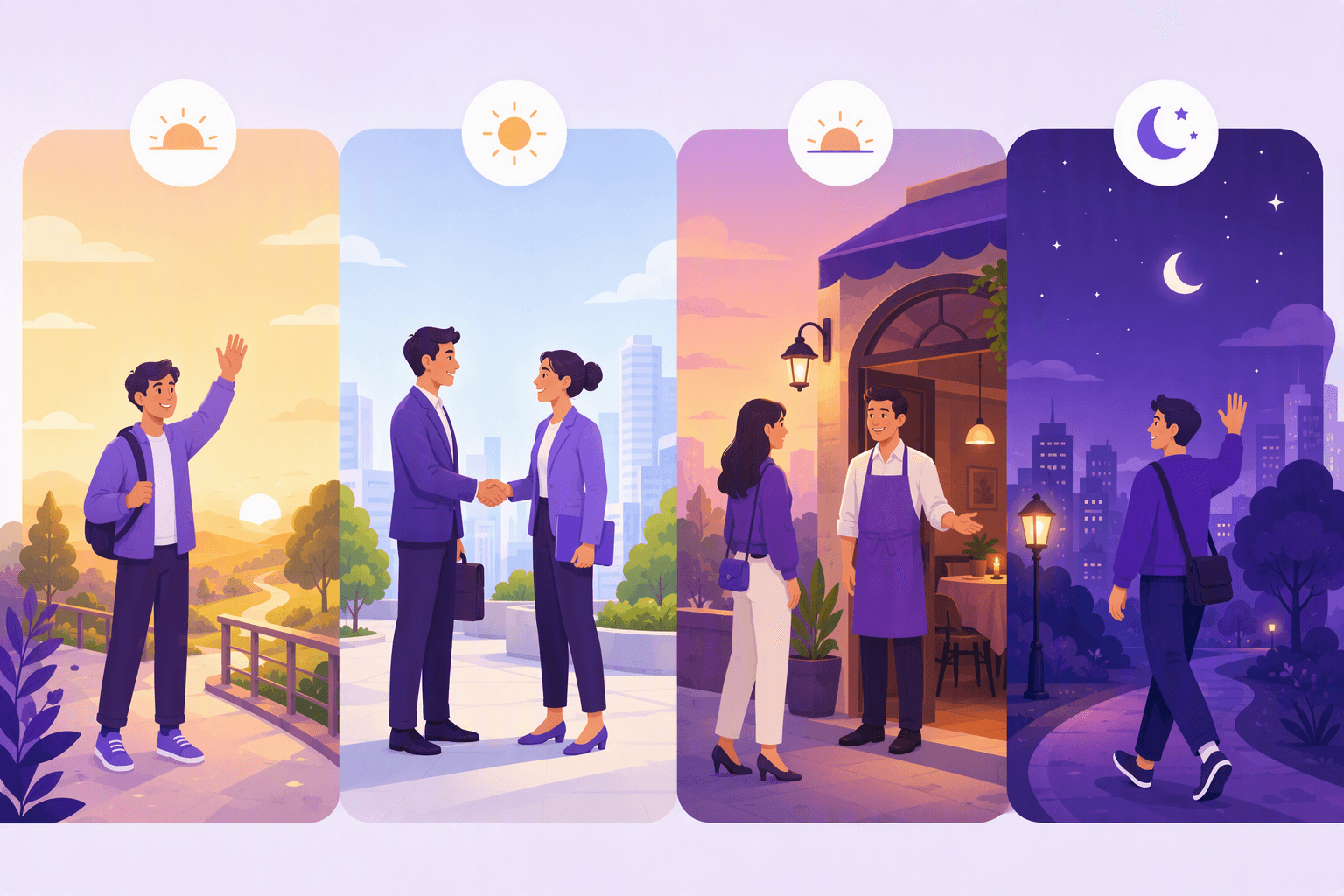
This system differs in one key way: in English, Good night is NEVER a greeting. It is always a goodbye. If you arrive somewhere in the evening, the correct form is Good evening, not Good night.
⚠️ The most common mistake: using Good night as a greeting
Many English learners say “Good night!” when they meet someone in the evening. This surprises most native speakers, because Good night in English is only a goodbye. In a meeting at 20:00, the correct opener is “Good evening, everyone,” not “Good night, everyone.”
How to respond to morning greetings
The right response matters as much as the greeting itself. The English expectation is: short, positive, then optionally ask back.
| Greeting | Formal response | Casual response |
|---|---|---|
| Good morning | Good morning! | Morning! |
| Morning! | Good morning! | Morning! / Hey! |
| How are you? | Fine, thank you. And you? | Good, thanks! You? |
| How's your morning? | Very well, thank you. | Pretty good! You? |
| Rise and shine! | (smiles and gets up) | Ugh, five more minutes... |
| How did you sleep? | Very well, thank you. | Good, thanks! |
Practice with real English content
You learn morning greetings best in natural context, when you hear them in real conversations. In the best movies to learn English guide, British series show Morning! and How are you? in almost every office scene. American shows often use Hey! and Good morning, everyone! as near-default office lines.
On the Wordy English learning page, you can watch films and series with interactive subtitles. If you hear a morning greeting you do not know, tap it. You will instantly see pronunciation, meaning, and cultural context. This helps you learn morning formulas inside real dialogue, with authentic intonation and body language.
Frequently Asked Questions
How do you say “jó reggelt” in English?
Until what time can you say “Good morning”?
What is the difference between “Good morning” and “Morning!”?
What does “Rise and shine” mean?
How should you greet people at work in the morning in English?
Sources & References
- Crystal, David (2019). The Cambridge Encyclopedia of the English Language. Cambridge University Press, 3rd edition.
- British Council (2023). English Language Teaching: Global Research Report.
- Merriam-Webster Dictionary (2026). merriam-webster.com.
- Trudgill, Peter and Hannah, Jean (2008). International English. Routledge, 5th edition.
Start learning with Wordy
Watch real movie clips and build your vocabulary as you go. Free to download.


