Quick Answer
The 12 months in German are Januar, Februar, März, April, Mai, Juni, Juli, August, September, Oktober, November, and Dezember. All are masculine (der), always capitalized, and used with the preposition 'im' (in January = im Januar). Austrian German uses Jänner instead of Januar and sometimes Feber instead of Februar.
The 12 months in German are remarkably similar to their English counterparts, making them among the easiest vocabulary for English speakers to learn. Most derive from the same Latin roots, and several are nearly identical in spelling: April, August, September, Oktober, November.
German is spoken by approximately 134 million people worldwide, according to Ethnologue's 2024 data, making it the most widely spoken native language in the European Union. Whether you are planning a trip to Berlin, enrolling in a German university, or navigating bureaucratic appointments in Austria, knowing the months is essential for scheduling, paperwork, and everyday conversation.
"The German month names are a direct inheritance from the Latin calendar system adopted across medieval Europe, yet German uniquely preserves the capitalization of all nouns, including months, reflecting the language's deep respect for nominal categories." (Gesellschaft für deutsche Sprache (GfdS), Sprachliche Zweifelsfälle)
This guide covers all 12 months with pronunciation, Latin and Germanic etymologies, grammar rules, Austrian and Swiss variations, and the cultural events that define the German calendar year.
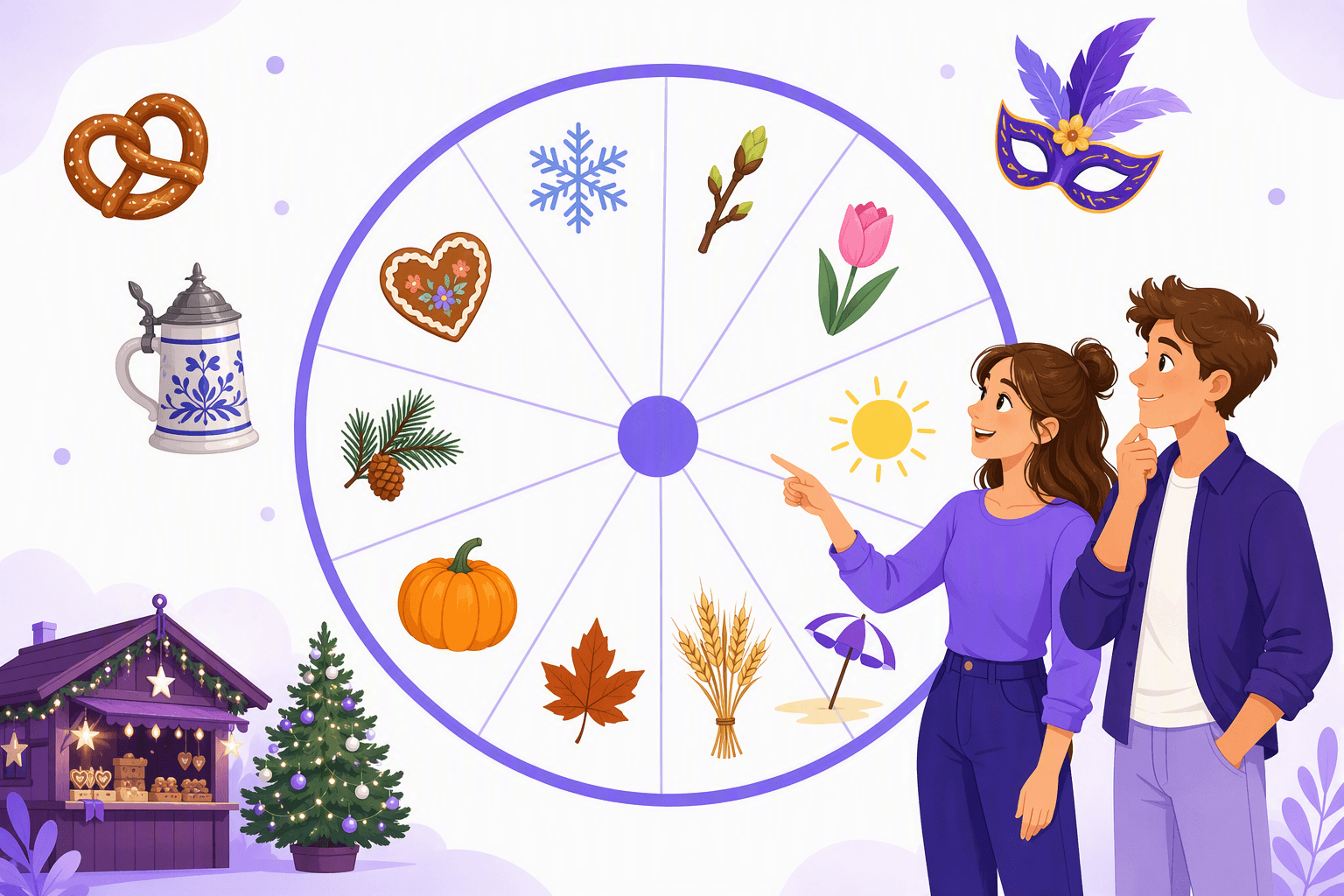
All 12 Months at a Glance
| English | German | Pronunciation | Note |
|---|---|---|---|
| January | Januar | YAH-noo-ar | Austria: Jänner |
| February | Februar | FAY-broo-ar | Austria: sometimes Feber |
| March | März | mehrts | Umlaut: ä |
| April | April | ah-PRIL | |
| May | Mai | my | |
| June | Juni | YOO-nee | |
| July | Juli | YOO-lee | |
| August | August | ow-GOOST | |
| September | September | zep-TEM-ber | |
| October | Oktober | ok-TOH-ber | |
| November | November | noh-VEM-ber | |
| December | Dezember | deh-TSEM-ber |
Notice the key spelling differences from English: Januar (no -y), Februar (no -y), März (with umlaut), Mai (not May), Juni/Juli (not June/July), Oktober (k not c), and Dezember (z not c). These small differences are the main challenge: the words are close enough to feel familiar, but different enough to trip you up in writing.
Etymology: Latin Roots With Germanic Character
Nearly all German month names trace directly to the Latin calendar introduced across medieval Europe. However, the way German adopted and adapted these names reveals the language's distinct phonological character.
Januar
From Latin Januarius, named after Janus, the Roman god of beginnings, doorways, and transitions. Janus had two faces, one looking forward and one looking back, making him the perfect patron for the month that bridges the old year and the new. German dropped the Latin ending to create Januar.
In Austrian German, the standard form is Jänner (YEN-ner), which derives from the same root through a Middle High German vowel shift. Jänner is the official term in Austrian government documents, media, and everyday speech.
Februar
From Latin Februarius, named after the Roman purification festival Februa, held in mid-February. The German pronunciation shifts the stress compared to English: FAY-broo-ar rather than FEB-roo-ary.
In Austria, the older form Feber (FAY-ber) occasionally appears, though it is less universally used than Jänner. The Duden dictionary recognizes both Februar and Feber as valid.
März
From Latin Martius, the month of Mars, the Roman god of war. März is the only German month with an umlaut (ä), which gives it the distinctive sound "mehrts." This umlaut evolved from the Middle High German Merze, which itself came from the Latin.
March was originally the first month of the Roman calendar. This is why September through December have number-based names that are "off by two": September means "seventh month," but it is the ninth.
💡 Pronouncing the Umlaut in März
The ä in März sounds like the English "e" in "bed" or "fair." It is NOT the same as the English "a" in "March." Say "mehrts" (rhymes with English "ferts") to get close. This is one of the most commonly mispronounced German month names by English speakers.
April
From Latin Aprilis, possibly derived from the Latin aperire (to open), referring to the opening of buds and flowers in spring. The German spelling is identical to English, but the pronunciation differs: ah-PRIL, with the stress on the second syllable and a short "a" sound.
The phrase Aprilwetter (April weather) is commonly used in German to describe unpredictable, rapidly changing weather: sunshine one moment, rain the next.
Mai
From Latin Maius, named after the Roman goddess Maia, associated with growth and fertility. German simplified the spelling to Mai, pronounced like the English word "my."
Mai is the shortest German month name at just three letters. The Maifeiertag (May Day, May 1st) is a public holiday across all German-speaking countries, celebrating workers' rights.
Juni
From Latin Junius, named after the Roman goddess Juno, protector of marriage and the Roman state. German replaced the English "-e" ending with "-i," giving Juni (YOO-nee).
Juli
From Latin Julius, named after Julius Caesar, who reformed the Roman calendar in 46 BC. Like Juni, German uses the "-i" ending: Juli (YOO-lee).
🌍 Juni vs. Juli: Avoiding Confusion
Because Juni and Juli sound very similar, especially over the phone, Germans often clarify by saying Juni, Juno or Juli, Julius to distinguish them. In military and official contexts, Julei (yoo-LY) is sometimes used as an alternative pronunciation for July to prevent misunderstandings.
August
From Latin Augustus, named after Emperor Augustus Caesar. The German pronunciation places stress on the second syllable: ow-GOOST, with the "au" diphthong sounding like "ow" in "ouch."
Note that August is also a traditional German first name, but when used as a name, the stress falls on the first syllable: OW-goost.
September
From Latin September ("seventh month" in the original Roman calendar). The German spelling is identical to English, but the initial "s" is pronounced as a "z" sound: zep-TEM-ber. This voiced "s" at the beginning of words is a signature feature of German pronunciation.
Oktober
From Latin October ("eighth month"). German replaces the English "c" with "k," reflecting the actual hard consonant sound. This is a consistent German spelling convention: Latin "c" before back vowels becomes "k" in German.
November
From Latin November ("ninth month"). Identical spelling in German and English. The German pronunciation voices the initial consonant group and stresses the second syllable: noh-VEM-ber.
Dezember
From Latin December ("tenth month"). German replaces the "c" with "z," reflecting the "ts" pronunciation that English achieves with "c" before "e." The result is Dezember (deh-TSEM-ber).
Grammar: How to Use Months in German
German has precise rules for using months in sentences. Getting these right is essential for sounding natural.
Always Capitalized
German capitalizes all nouns, so months are always written with a capital letter: Januar, Februar, März. This distinguishes German from Spanish (enero), French (janvier), and Italian (gennaio), where months are lowercase. English and German share this capitalization convention.
Gender: All Masculine
Every month in German is masculine (der). No exceptions:
der Januar, der Februar, der März, der April, der Mai, der Juni, der Juli, der August, der September, der Oktober, der November, der Dezember
"In January" = Im Januar
The preposition in combined with the dative article dem contracts to im for all months:
- Im Januar schneit es oft. (In January it often snows.)
- Wir heiraten im Juni. (We're getting married in June.)
- Im Oktober beginnt das Wintersemester. (In October the winter semester begins.)
| English | German | Pronunciation |
|---|---|---|
| In January | Im Januar | im YAH-noo-ar |
| Since March | Seit März | zyt mehrts |
| Until May | Bis Mai | bis my |
| From June to August | Von Juni bis August | fon YOO-nee bis ow-GOOST |
| At the beginning of April | Anfang April | AHN-fahng ah-PRIL |
| At the end of December | Ende Dezember | EN-duh deh-TSEM-ber |
| In the middle of September | Mitte September | MIT-tuh zep-TEM-ber |
Writing Dates
German uses the day-month-year format, the opposite of the American system:
- Full form: der 25. Dezember 2026 (December 25, 2026)
- Numeric: 25.12.2026
- In a sentence: Ich komme am 3. März. (I'm coming on March 3rd.)
The ordinal number is written with a period: 3. means "third," 25. means "twenty-fifth." This period functions like the English "-st," "-nd," "-rd," or "-th" suffix.
💡 Saying Dates Aloud
When speaking dates, use ordinal numbers: der dritte März (the third of March), der fünfundzwanzigste Dezember (the twenty-fifth of December). The preposition is am: am dritten März (on March 3rd), where the ordinal takes a dative -n ending.
Austrian and Swiss Variations
German-speaking countries share the same month names with two notable exceptions in Austrian German.
Jänner (Austrian January)
Austria officially uses Jänner (YEN-ner) instead of Januar. This is not slang or dialect; it is the standard written form in Austrian law, newspapers, and government documents. The Duden dictionary lists Jänner as Austrian standard German. If you see Jänner in a text, you can immediately identify an Austrian author.
Feber (Austrian February)
Feber (FAY-ber) is an Austrian variant of Februar, though it is less universally adopted than Jänner. Some Austrian institutions and publications use Feber, while others stick with Februar. The GfdS notes that Feber is gradually declining in formal use but remains common in spoken Austrian German.
Swiss German Particularities
Switzerland uses the same standard month names as Germany in written German. However, in spoken Swiss German (Schwyzerdütsch), dialect pronunciations differ considerably. The most notable difference is cultural rather than linguistic: Switzerland uses French month names in its French-speaking cantons and Italian month names in Ticino, reflecting the country's multilingual identity.
The German Cultural Calendar: Key Months and Events
Understanding which events anchor each month gives you cultural fluency beyond vocabulary.

Karneval Season (Februar to März)
Karneval (also called Fasching in southern Germany and Austria, or Fasnacht in Switzerland) peaks in February or early March. The main celebrations, including elaborate parades and costumes, run from Weiberfastnacht (Women's Carnival Thursday) through Aschermittwoch (Ash Wednesday). Cologne, Düsseldorf, and Mainz host Germany's largest Karnevalsumzüge (carnival parades).
Oktoberfest (September to Oktober)
Perhaps the most famous German cultural event worldwide, Oktoberfest actually begins in mid-September. The original 1810 celebration for Crown Prince Ludwig's wedding took place in October, but organizers gradually moved the start date earlier to take advantage of warmer weather. Today, the festival runs approximately 16-18 days, ending on the first Sunday of October. The event draws over six million visitors to Munich annually.
Adventszeit and Weihnachten (Dezember)
The Adventszeit (Advent season) begins four Sundays before Christmas and transforms German cities with Weihnachtsmärkte (Christmas markets). These markets, selling Glühwein (mulled wine), Lebkuchen (gingerbread), and handcrafted ornaments, are a defining feature of German December. The Adventskranz (Advent wreath) with four candles is found in virtually every German home.
Christmas itself is celebrated on Heiligabend (Christmas Eve, December 24th), when families exchange gifts. December 25th and 26th are both public holidays (erster and zweiter Weihnachtsfeiertag).
The Academic Year
The German academic calendar is structured around months rather than seasons. Universities operate on a Wintersemester (October to March) and a Sommersemester (April to September). Schools follow a different rhythm, with the school year starting in August or September depending on the Bundesland (federal state). The famous six-week Sommerferien (summer holidays) are staggered across states from late June through mid-September to prevent travel chaos.
Compound Words With Months
German's famous compound word tradition extends to months. These compounds appear frequently in news, weather reports, and daily conversation.
| English | German | Pronunciation |
|---|---|---|
| Summer month | Sommermonat | ZOM-mer-moh-naht |
| Winter month | Wintermonat | VIN-ter-moh-naht |
| Months of the year | Jahresmonat | YAH-res-moh-naht |
| Monthly | Monatlich | MOH-naht-likh |
| Monthly ticket | Monatskarte | MOH-nahts-kar-tuh |
| Month's salary | Monatsgehalt | MOH-nahts-geh-hahlt |
| Half a year / six months | Halbjahr | HAHLP-yar |
The word Monat (month) itself comes from the same Germanic root as Mond (moon), reflecting the ancient lunar calendar that measured time by moon cycles. According to the DWDS etymological database, both words trace back to the Proto-Germanic menon-, meaning "moon" and "month" simultaneously.
Practice With Real German Content
Months come up constantly in German conversations, from scheduling appointments (Können wir uns im März treffen?) to discussing holidays (Weihnachten ist im Dezember) to talking about the weather (Der Februar war dieses Jahr sehr kalt). Building fluency means hearing these words in natural context, not just memorizing a table.
German films, news broadcasts, and podcasts are filled with date references, event planning, and seasonal discussions. For movie recommendations across different genres and dialects, check out our guide to the best movies for learning German.
Wordy lets you practice German vocabulary in real context by watching German content with interactive subtitles. Tap any word, including month names, to see its meaning, pronunciation, gender, and case usage. Explore our blog for more German learning guides, or visit our German learning page to start building your vocabulary today.
Frequently Asked Questions
What are the 12 months of the year in German?
Are German months masculine, feminine, or neuter?
How do you say 'in January' in German?
What is the difference between 'Januar' and 'Jänner'?
Why does Oktoberfest start in September?
How do you write dates in German?
Sources & References
- Duden, Die deutsche Rechtschreibung, 28th edition (2024)
- Gesellschaft für deutsche Sprache (GfdS), Sprachliche Zweifelsfälle
- DWDS (Digitales Wörterbuch der deutschen Sprache), Etymological entries
- Ethnologue: Languages of the World, German language entry (2024)
- Institut für Deutsche Sprache (IDS), Mannheim, Grammatik in Fragen und Antworten
Start learning with Wordy
Watch real movie clips and build your vocabulary as you go. Free to download.


