Quick Answer
The core German family words are 'die Mutter' (mother), 'der Vater' (father), 'der Bruder' (brother), 'die Schwester' (sister), 'der Sohn' (son), and 'die Tochter' (daughter). German family vocabulary is built on compound word logic: 'Schwieger-' creates all in-law terms, 'Groß-' means grand-, and 'Ur-' means great-grand-. Every family noun has a fixed grammatical gender (der, die, das) that must be memorized.
Family vocabulary is one of the first things any German learner should master. Whether you are introducing relatives, filling out official forms, or simply following along with a German conversation at the dinner table, these words come up constantly. Whether you're looking up "german family words" for travel, study, or conversation, this guide covers everything you need.
With approximately 134 million speakers worldwide according to Ethnologue's 2024 data, German is the most widely spoken native language in the European Union. Family structures run deep in German-speaking culture, and the language reflects this with a systematic, compound-based vocabulary that lets you build dozens of relationship terms from a handful of core roots.
"German kinship terminology follows the Eskimo system identified by Murdock, distinguishing lineal relatives (parents, grandparents) from collateral ones (aunts, uncles, cousins), with separate terms for each relationship rather than merged categories." (G.P. Murdock, Social Structure, 1949)
This guide covers every family word you need: immediate family, extended relatives, in-laws, and the informal endearments that Germans actually use at home. Every term includes its grammatical gender, because in German, you cannot use a noun correctly without its article.
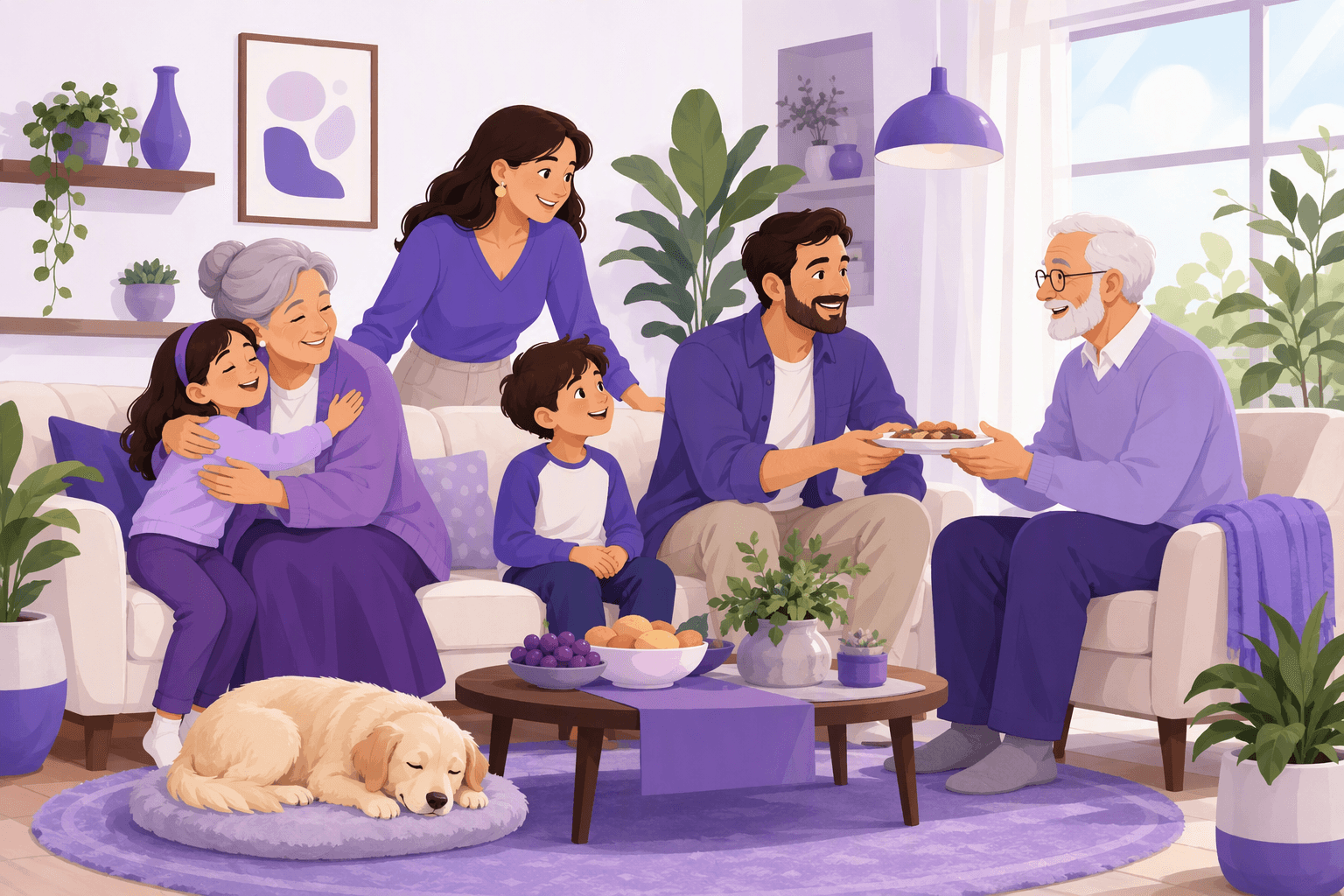
Immediate Family: Die Kernfamilie
The immediate family forms the foundation of German family vocabulary. These six words are among the most frequently used nouns in the entire language, appearing in everything from children's books to legal documents.
| English | German | Pronunciation | Note |
|---|---|---|---|
| Mother | die Mutter | dee MOO-ter | Feminine (die) |
| Father | der Vater | dehr FAH-ter | Masculine (der) |
| Brother | der Bruder | dehr BROO-der | Masculine (der), pl: Brüder |
| Sister | die Schwester | dee SHVES-ter | Feminine (die), pl: Schwestern |
| Son | der Sohn | dehr zohn | Masculine (der), pl: Söhne |
| Daughter | die Tochter | dee TOKH-ter | Feminine (die), pl: Töchter |
| Parents | die Eltern | dee EL-tern | Plural only (no singular) |
| Siblings | die Geschwister | dee geh-SHVIS-ter | Plural only (no singular) |
| Child | das Kind | dahs kint | Neuter (das), pl: Kinder |
Notice that German follows a logical gender pattern for immediate family: male relatives are masculine (der), female relatives are feminine (die). The exceptions are the collective terms, die Eltern (parents) and die Geschwister (siblings), which exist only in plural form with no usable singular.
die Geschwister
Geschwister deserves special attention because it has no true singular form. Unlike English, which has "sibling," German forces you to specify ein Bruder (a brother) or eine Schwester (a sister) when referring to just one. According to the Institut für Deutsche Sprache (IDS), attempts to create a singular Geschwister have never gained traction in standard German, though some dialects use das Geschwisterkind.
💡 Plurals Change the Vowel
Many German family nouns form their plural with an umlaut: Bruder → Brüder, Sohn → Söhne, Tochter → Töchter, Mutter → Mütter, Vater → Väter. This vowel shift (called Umlaut) is one of the most distinctive features of German plural formation and applies heavily to family vocabulary.
Extended Family: Die Verwandtschaft
German extended family terms follow clear patterns. The prefix Groß- (great/grand) extends generational reach, while standard terms cover aunts, uncles, and cousins.
| English | German | Pronunciation | Note |
|---|---|---|---|
| Grandmother | die Großmutter | dee GROHS-moo-ter | Feminine (die) |
| Grandfather | der Großvater | dehr GROHS-fah-ter | Masculine (der) |
| Grandparents | die Großeltern | dee GROHS-el-tern | Plural only |
| Uncle | der Onkel | dehr ONG-kel | Masculine (der) |
| Aunt | die Tante | dee TAHN-tuh | Feminine (die) |
| Cousin (male) | der Cousin | dehr koo-ZANG | Masculine, French pronunciation |
| Cousin (female) | die Cousine | dee koo-ZEE-nuh | Feminine, also: Kusine |
| Nephew | der Neffe | dehr NEF-fuh | Masculine (der) |
| Niece | die Nichte | dee NIKH-tuh | Feminine (die) |
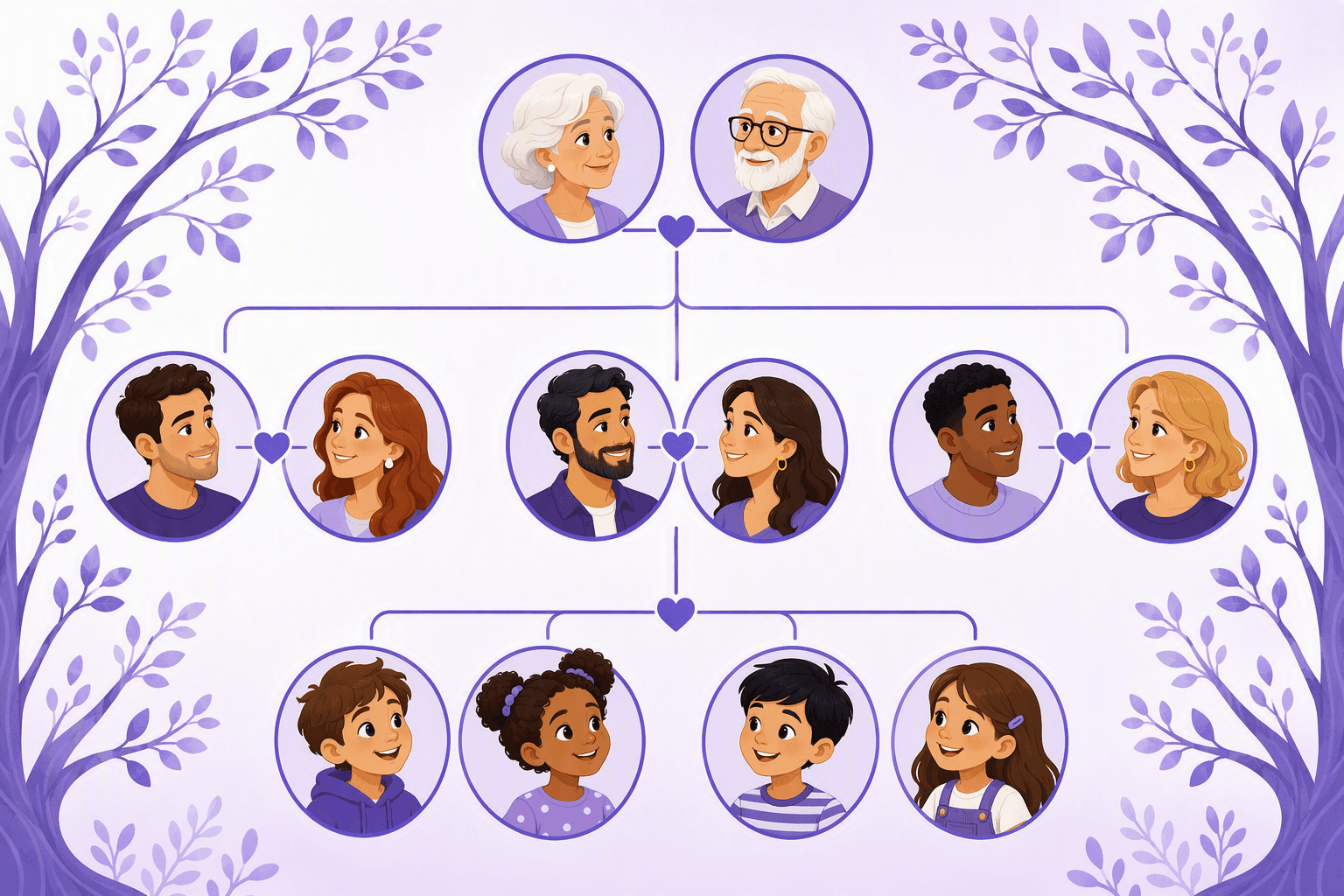
der Cousin / die Cousine
These words are borrowed directly from French and retain their French pronunciation: koo-ZANG and koo-ZEE-nuh. The alternative spellings Kusin and Kusine exist in Duden but are rarely used in practice. Unlike English, German distinguishes male and female cousins with separate words, which means you always know the gender of the person being discussed.
der Urgroßvater / die Urgroßmutter
To go back one more generation, add the prefix Ur- (meaning "original" or "primordial") to create great-grandparent terms: der Urgroßvater (great-grandfather), die Urgroßmutter (great-grandmother), die Urgroßeltern (great-grandparents). You can even stack it: der Ururgroßvater means great-great-grandfather, though this is rare outside genealogy.
🌍 Groß- vs. Ur- Prefix System
The compound logic is consistent: Groß- = grand (one generation back), Ur- = great-grand (two generations back). This same system works for grandchildren: das Enkelkind (grandchild), das Urenkelkind (great-grandchild). Once you learn the prefixes, you can construct any generational term on the fly.
In-Laws: Die Schwiegereltern
German handles in-law relationships with elegant simplicity: the prefix Schwieger- (from Middle High German swiger) attaches to any family member to create the in-law equivalent. No exceptions, no irregular forms.
| English | German | Pronunciation | Note |
|---|---|---|---|
| Mother-in-law | die Schwiegermutter | dee SHVEE-ger-moo-ter | Feminine (die) |
| Father-in-law | der Schwiegervater | dehr SHVEE-ger-fah-ter | Masculine (der) |
| In-laws (parents) | die Schwiegereltern | dee SHVEE-ger-el-tern | Plural only |
| Brother-in-law | der Schwager | dehr SHVAH-ger | Masculine (der) |
| Sister-in-law | die Schwägerin | dee SHVEH-geh-rin | Feminine (die) |
| Son-in-law | der Schwiegersohn | dehr SHVEE-ger-zohn | Masculine (der) |
| Daughter-in-law | die Schwiegertochter | dee SHVEE-ger-tokh-ter | Feminine (die) |
die Schwiegermutter
The Schwieger- prefix is one of the most productive compound elements in German family vocabulary. While Schwiegermutter, Schwiegervater, Schwiegersohn, and Schwiegertochter all follow the regular pattern, brother-in-law and sister-in-law take the shortened forms der Schwager and die Schwägerin instead of the theoretically possible Schwiegerbruder and Schwiegerschwester. According to Duden, Schwager and Schwägerin have been the standard forms since the 15th century.
The grammatical gender of every Schwieger- compound follows the base word: die Schwiegermutter is feminine because die Mutter is feminine, der Schwiegervater is masculine because der Vater is masculine. This consistency makes the system easy to learn.
"The German kinship system maintains a clear structural distinction between affinal (in-law) and consanguineal (blood) relatives through the systematic use of the Schwieger- prefix, a feature shared with other Germanic languages but absent from Romance language families." (Institut für Deutsche Sprache (IDS), Grammatik in Fragen und Antworten)
Informal Endearments: Kosenamen in der Familie
Germans rarely use the formal terms at home. In everyday speech, family members are addressed with shortened, affectionate forms that vary by region. These are the words you will actually hear in German households.
| English | German | Pronunciation | Note |
|---|---|---|---|
| Mom | Mama | MAH-mah | Universal across all regions |
| Mom (regional) | Mutti | MOO-tee | Eastern/central Germany |
| Dad | Papa | PAH-pah | Universal across all regions |
| Dad (regional) | Vati | FAH-tee | Eastern Germany, older usage |
| Grandma | Oma | OH-mah | Universally beloved |
| Grandpa | Opa | OH-pah | Universally beloved |
Oma
Oma and Opa are among the most universally recognized and emotionally resonant words in the German language. Unlike the formal Großmutter and Großvater, which appear mainly on official documents, Oma and Opa are what children say, and what adults continue to say well into old age. The Gesellschaft für deutsche Sprache (GfdS) notes that Oma consistently ranks among the most emotionally positive words in German language surveys.
These terms transcend regional boundaries entirely. Whether you are in Hamburg, Vienna, or Zurich, everyone understands and uses Oma and Opa.
Mama / Mutti
The divide between Mama and Mutti is one of the clearest regional markers in German family vocabulary. Mama (stress on the first syllable, MAH-mah) dominates in western and northern Germany and is the default across all German-speaking countries. Mutti carries a warmer, more intimate connotation and is more common in eastern Germany and parts of Austria. In Swiss German, the preferred form is Mami (MAH-mee).
🌍 Regional Variations Across German-Speaking Countries
Austria uses Mama and Papa as standard, but you may also hear the dialect forms die Muatter (mother) and der Voda (father) in rural areas. Swiss German has Mami and Papi as the dominant informal forms. These regional differences extend to grandparents too: some Austrian dialects use Omi and Opi alongside standard Oma and Opa.
Compound Family Words: The German System
One of German's greatest strengths is its ability to build new words through compounding. Family vocabulary showcases this perfectly. Understanding the core prefixes unlocks dozens of relationship terms without additional memorization.
| Prefix | Meaning | Example | Translation |
|---|---|---|---|
| Groß- | Grand- | Großmutter | Grandmother |
| Ur- | Great-grand- | Urgroßvater | Great-grandfather |
| Schwieger- | -in-law | Schwiegersohn | Son-in-law |
| Stief- | Step- | Stiefmutter | Stepmother |
| Halb- | Half- | Halbbruder | Half-brother |
| Pflege- | Foster- | Pflegemutter | Foster mother |
The prefix Stief- (step-) works identically to Schwieger-: attach it to any family member to create the step-relative. Die Stiefmutter (stepmother), der Stiefvater (stepfather), die Stiefschwester (stepsister), der Stiefbruder (stepbrother). The fairy-tale connotation of Stiefmutter is strong in German culture; the Brothers Grimm permanently associated the word with wickedness, and the compound die böse Stiefmutter (the evil stepmother) remains a fixed expression.
Similarly, Halb- (half-) creates half-sibling terms: der Halbbruder (half-brother), die Halbschwester (half-sister). And Pflege- (foster/care) generates foster-family terms: die Pflegemutter (foster mother), das Pflegekind (foster child).
Grammatical Gender Patterns
Every German noun has a grammatical gender, and family words follow a mostly logical pattern, with a few notable exceptions.
Masculine (der): Vater, Sohn, Bruder, Onkel, Neffe, Cousin, Schwager, Großvater, Schwiegervater
Feminine (die): Mutter, Tochter, Schwester, Tante, Nichte, Cousine, Schwägerin, Großmutter, Schwiegermutter
Neuter (das): Kind (child), Baby, Enkelkind (grandchild)
The pattern is clear: male family members take der, female family members take die, and children (when gender is unspecified) take das. This is one of the rare areas in German where grammatical gender aligns with natural gender almost perfectly. The main exception is das Mädchen (girl), neuter because of the diminutive suffix -chen, not because of any logic about the person.
💡 Always Learn the Article
German teachers universally advise learning the article together with the noun: not just Mutter, but die Mutter. For family words this may feel redundant since gender is predictable, but the habit pays off with every other noun category in German, where gender assignment is far less intuitive.
Family Words in Everyday Phrases
Family vocabulary extends far beyond naming relatives. German uses family words in common everyday expressions and idioms.
| German | English | Context |
|---|---|---|
| Ich habe zwei Geschwister. | I have two siblings. | Introducing your family |
| Meine Schwiegermutter kommt zu Besuch. | My mother-in-law is coming to visit. | Announcing a visit |
| Er ist Einzelkind. | He is an only child. | Describing family size |
| Sie erwartet ein Kind. | She is expecting a child. | Announcing a pregnancy |
| Das liegt in der Familie. | It runs in the family. | Idiomatic expression |
| Vater werden | To become a father | Life milestone |
The compound das Einzelkind (only child, literally "single-child") is used far more frequently in German than "only child" is in English. According to the Institut für Deutsche Sprache, approximately 26% of German families have only one child, making Einzelkind a common descriptor in everyday conversation.
Practice with Real German Content
Family conversations are central to German films, television, and literature. From the complex family dynamics in Das Leben der Anderen to the multigenerational stories in Dark, family vocabulary appears in virtually every German-language production. Check out our guide to the best movies for learning German for recommendations that will expose you to authentic family vocabulary in context.
Wordy lets you practice family words and thousands of other German terms through interactive subtitles while watching real content. Tap any word to see its meaning, pronunciation, and grammatical gender, exactly the information you need to master German vocabulary. Explore more German learning resources on our blog, or head to our German learning page to start practicing today.
Frequently Asked Questions
How do you say 'family' in German?
What does 'Geschwister' mean in German?
How does the 'Schwieger-' prefix work in German?
What is the difference between 'Mama' and 'Mutti' in German?
How do you say 'grandparents' in German?
Sources & References
- Duden, Deutsches Universalwörterbuch, 9th edition (2023)
- Institut für Deutsche Sprache (IDS), Mannheim, German reference corpus (DeReKo)
- Ethnologue: Languages of the World, German language entry (2024)
- Murdock, G.P., Social Structure (1949), kinship terminology classification
- Gesellschaft für deutsche Sprache (GfdS), Language trends and naming conventions
Start learning with Wordy
Watch real movie clips and build your vocabulary as you go. Free to download.


