Colors in German: 30+ Farben With Pronunciation, Grammar, and Cultural Meaning
Quick Answer
The basic colors in German are Rot (red), Blau (blue), Gelb (yellow), Grün (green), Orange (orange), Lila (purple), Weiß (white), Schwarz (black), Grau (gray), and Braun (brown). All are capitalized when used as nouns (das Rot) and lowercase as adjectives (der rote Ball). The main challenge is adjective declension. German colors change their endings based on gender, case, and article type.
The most essential colors in German are Rot (red), Blau (blue), Gelb (yellow), Grün (green), Weiß (white), and Schwarz (black). With these six words plus a handful of secondary colors, you can describe nearly everything you see in daily life across Germany, Austria, and Switzerland.
German is spoken by approximately 134 million people worldwide according to Ethnologue's 2024 data, making it the most widely spoken native language in the European Union. Colors are among the first vocabulary any learner needs, from describing clothes while shopping in Munich to understanding traffic signs on the Autobahn to discussing art at Berlin's countless galleries. And unlike many languages, German turns its colors into spectacular compound words like himmelblau (sky blue), schneeweiß (snow white), and pechschwarz (pitch black).
"Color terms in Germanic languages reveal deep cultural and environmental encoding. German's productive compounding system allows speakers to create precise, evocative color descriptions that other languages would need multiple words to express."
(Institut für Deutsche Sprache, Mannheim)
This guide covers 30+ German colors with pronunciation, the critical grammar of adjective declension, compound color words, cultural significance from Bauhaus to the flag, and the most colorful German idioms.
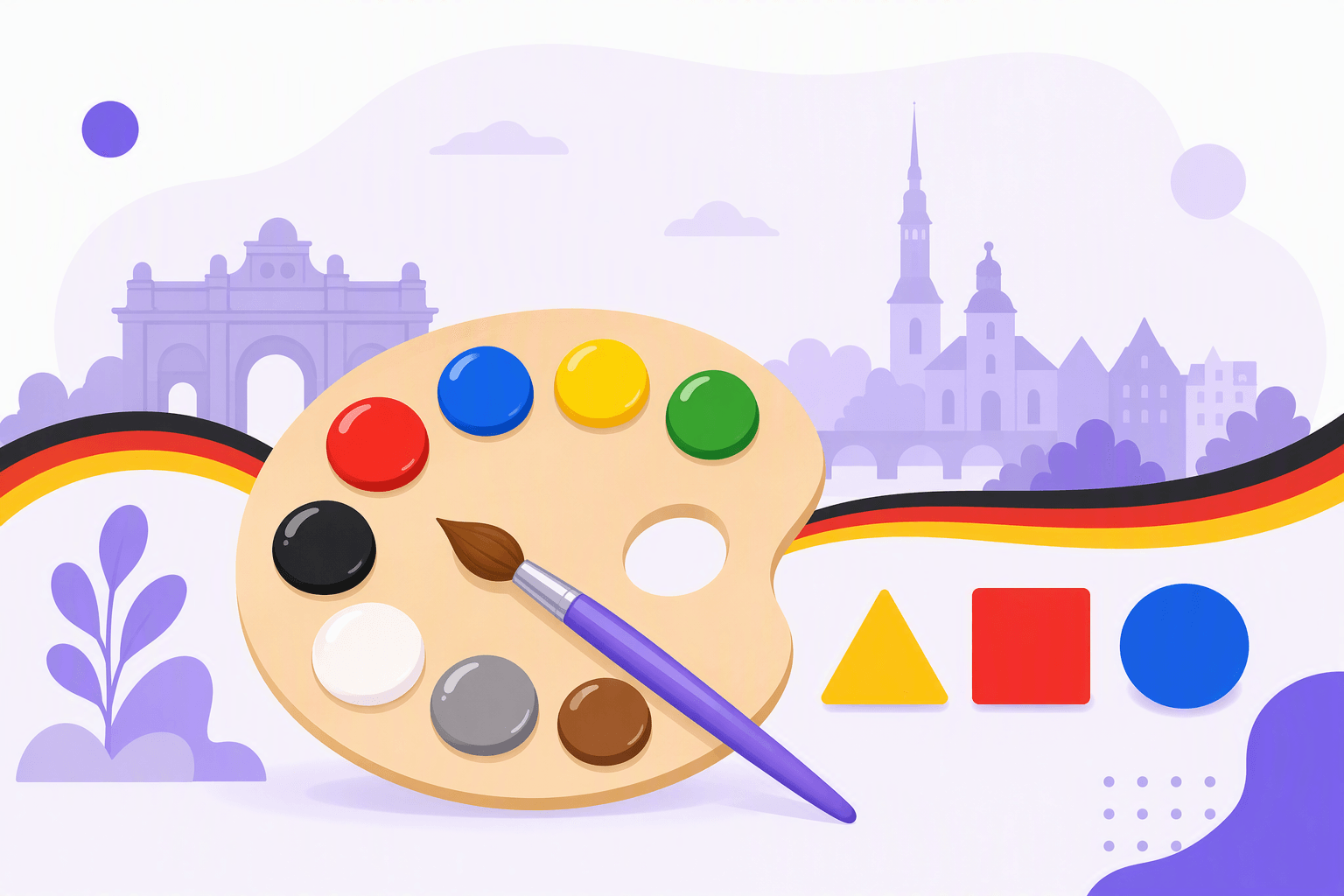
All Colors at a Glance
| English | German | Pronunciation |
|---|---|---|
| Red | Rot | roht |
| Blue | Blau | blau (rhymes with 'cow') |
| Yellow | Gelb | gelp |
| Green | Grün | grewn |
| Orange | Orange | oh-RAHN-zhuh |
| Purple | Lila | LEE-lah |
| Violet | Violett | vee-oh-LET |
| White | Weiß | vice |
| Black | Schwarz | shvarts |
| Gray | Grau | grau (rhymes with 'cow') |
| Brown | Braun | braun (rhymes with 'crown') |
| Pink | Rosa | ROH-zah |
| Turquoise | Türkis | tewr-KEES |
| Gold | Gold | golt |
| Silver | Silber | ZIL-ber |
A few pronunciation notes: the au diphthong in Blau, Grau, and Braun sounds like "ow" in English "cow." The ü in Grün and Türkis has no English equivalent: round your lips as if saying "oo" but try to say "ee." The ß in Weiß is the Eszett, representing a sharp "ss" sound.
Primary Colors: Rot, Blau, Gelb
The three primary colors are fundamental to both everyday conversation and Germany's rich artistic tradition.
Rot
Rot (roht) covers the full spectrum from scarlet to crimson. As a noun, it is neuter: das Rot. The word descends from Old High German rōt, sharing a root with English "red" through Proto-Germanic raudaz.
Red is deeply embedded in German culture. The Rotkäppchen (Little Red Riding Hood) fairy tale originates from the Brothers Grimm collection. Rotwein (red wine) is Germany's second most popular wine category after white. And the phrase den roten Faden verlieren (to lose the red thread) means to lose track of your argument, a metaphor borrowed from Greek mythology.
Blau
Blau (blau, rhymes with "cow") is one of the most culturally loaded colors in German. As a noun: das Blau. The word comes from Old High German blāo and is cognate with English "blue."
The artistic movement Der Blaue Reiter (The Blue Rider), founded in Munich in 1911 by Wassily Kandinsky and Franz Marc, made blue a symbol of spirituality and artistic freedom in German Expressionism. Kandinsky believed blue was the most spiritual color, representing depth and the infinite.
🌍 Der Blaue Reiter
Der Blaue Reiter was not just an art group. It was a philosophy. Kandinsky and Marc believed that colors had inherent spiritual qualities. Blue represented the celestial and transcendent, while yellow represented the earthly and aggressive. Their 1912 almanac became one of the most influential documents in modern art history. You can see the original works at the Lenbachhaus gallery in Munich.
Gelb
Gelb (gelp) means yellow. As a noun: das Gelb. The word derives from Old High German gelo, related to English "yellow" through the same Proto-Germanic root gelwaz.
In traffic contexts, Gelb is critical: German traffic lights use the standard red-yellow-green system, but Germans say die Ampel ist gelb (the traffic light is yellow), never "orange" or "amber" as in some English-speaking countries. The Gelbe Seiten (Yellow Pages) were a household staple before the digital age.
Secondary Colors: Grün, Orange, Lila
Grün
Grün (grewn) means green. As a noun: das Grün. The umlaut ü is essential; without it, Grun does not exist as a German word. Grün shares its Proto-Germanic root grōniz with English "green."
Germany's environmental movement gave Grün political significance. Die Grünen (The Greens) became a major political party in the 1980s, and the word grün now carries strong ecological connotations. The compound Grünfläche (green space) appears on city maps and urban planning documents throughout the country.
Orange
Orange (oh-RAHN-zhuh) keeps its French pronunciation in German; this is not anglicized. As a noun: das Orange. Because of its foreign origin, orange is one of the "undeclinable" color adjectives in strict grammar: ein orange Hemd (an orange shirt) without an adjective ending. However, in spoken German, many people add endings anyway: ein oranges Hemd. The Duden recognizes the colloquial declined forms.
Lila
Lila (LEE-lah) means purple or lilac. The word entered German through French from Arabic līlak (lilac flower). Like orange, lila traditionally resists declension: ein lila Kleid (a purple dress). The more formal and fully declinable alternative is violett (vee-oh-LET): ein violettes Kleid.
💡 Lila vs. Violett vs. Purpur
German has three words for the purple spectrum. Lila is the everyday word most Germans use, covering everything from lavender to deep purple. Violett is more formal and precise, closer to "violet." Purpur (POOR-poor) refers specifically to a deep reddish-purple and appears mostly in literary or historical contexts as the color of royal robes and cardinals' vestments.
Neutral Colors: Weiß, Schwarz, Grau, Braun
Weiß
Weiß (vice) means white. As a noun: das Weiß. The ß (Eszett) follows the long vowel ei and represents a voiceless "ss" sound. Note that Weiß with a capital W is the color, while weiß (lowercase) can also mean "knows" (from wissen), but context always makes the meaning clear.
The compound Weißwurst (white sausage) is a Bavarian breakfast staple, traditionally eaten before noon. Weißbier (wheat beer) is another famous Bavarian product. And Schneewittchen (literally "Snow White") is another Brothers Grimm contribution to German cultural vocabulary.
Schwarz
Schwarz (shvarts) means black. As a noun: das Schwarz. The consonant cluster schw- is distinctly German, so English speakers should practice the "shv" sound.
Schwarz appears in countless compounds: Schwarzbrot (dark rye bread, a German staple), Schwarzwald (Black Forest), Schwarzarbeit (illegal undeclared work, literally "black work"), and Schwarzfahrer (fare dodger on public transit, literally "black rider"). The Schwarzwald in southwestern Germany gave its name to the famous Schwarzwälder Kirschtorte (Black Forest cake).
Grau
Grau (rhymes with "cow") means gray. As a noun: das Grau. Germany's reputation for gray skies is linguistically encoded: Grauer Himmel (gray sky) is practically a weather forecast cliche from October through March, especially in northern Germany.
Braun
Braun (rhymes with "crown") means brown. As a noun: das Braun. The word is cognate with English "brown" through Proto-Germanic brūnaz.
Be aware that braun carries sensitive historical connotations in German. The term Braunhemden (brown shirts) refers to the SA paramilitary during the Nazi era, and braun is still sometimes used metaphorically to reference far-right ideology. In everyday contexts about actual colors, however, braun is perfectly neutral.
Additional Colors: Rosa, Türkis, Gold, Silber
Rosa
Rosa (ROH-zah) means pink. Like lila and orange, it is a foreign-origin color that traditionally does not decline: ein rosa Kleid (a pink dress). The colloquial declined form ein rosanes Kleid exists but is considered informal by the Duden.
Türkis
Türkis (tewr-KEES) means turquoise. The word comes from French turquoise (Turkish stone), referring to the gemstone's trade route through Turkey. Unlike rosa and lila, türkis can take standard adjective endings without sounding unusual: ein türkises Meer (a turquoise sea).
Gold and Silber
Gold (golt) and Silber (ZIL-ber) function as both nouns and color adjectives. As colors, the adjective forms golden (GOL-den) and silbern (ZIL-bern) are more common: ein goldener Ring (a golden ring), silbernes Haar (silver hair).
Gold holds special status in German national symbolism: the flag is officially Schwarz-Rot-Gold, not Schwarz-Rot-Gelb.
Grammar: Adjective Declension With Colors
This is the area where German colors challenge learners most. In English, "red" never changes form. In German, rot can become rote, roter, rotes, rotem, or roten depending on the grammatical context.
Predicative Use (No Ending)
When a color follows the verb sein (to be), it takes no ending:
- Der Himmel ist blau. (The sky is blue.)
- Die Blume ist rot. (The flower is red.)
- Das Auto ist grün. (The car is green.)
This is the simplest use, and the color stays in its base form.
Attributive Use (Endings Required)
When a color comes before a noun, it must take an adjective ending. The ending depends on three factors: the gender of the noun, the case (nominative, accusative, dative, genitive), and whether a definite article, indefinite article, or no article is used.
| English | German | Pronunciation | Note |
|---|---|---|---|
| The red ball (masc.) | Der rote Ball | dehr ROH-tuh bahl | Definite article + -e |
| A red ball (masc.) | Ein roter Ball | ayn ROH-ter bahl | Indefinite article + -er |
| The blue flower (fem.) | Die blaue Blume | dee BLAU-uh BLOO-muh | Definite article + -e |
| A blue flower (fem.) | Eine blaue Blume | AY-nuh BLAU-uh BLOO-muh | Indefinite article + -e |
| The green car (neut.) | Das grüne Auto | dahs GREW-nuh OW-toh | Definite article + -e |
| A green car (neut.) | Ein grünes Auto | ayn GREW-nes OW-toh | Indefinite article + -es |
| Red wine (no article) | Roter Wein | ROH-ter vyne | No article + -er |
💡 The Shortcut Rule
When no definite article is present, the adjective ending mirrors what the definite article would have been: der becomes -er, die becomes -e, das becomes -es. So: roter Wein (der Wein), rote Milch (die Milch), rotes Bier (das Bier). This "strong declension" pattern handles most no-article situations.
Compound Colors: German's Creative Genius
German's compound word system shines brightest with colors. Where English needs two words ("dark blue") or a hyphen ("sky-blue"), German fuses everything into a single, elegant compound.
Light and Dark
Add hell- (light) or dunkel- (dark) as a prefix:
| English | German | Pronunciation |
|---|---|---|
| Light blue | Hellblau | HEL-blau |
| Dark blue | Dunkelblau | DOON-kel-blau |
| Light green | Hellgrün | HEL-grewn |
| Dark green | Dunkelgrün | DOON-kel-grewn |
| Light red | Hellrot | HEL-roht |
| Dark red | Dunkelrot | DOON-kel-roht |
| Light gray | Hellgrau | HEL-grau |
| Dark brown | Dunkelbraun | DOON-kel-braun |
Poetic Compound Colors
These compounds use nouns to create vivid, imagery-rich color descriptions. They are used in literature, product descriptions, fashion, and everyday speech.
| English | German | Pronunciation | Note |
|---|---|---|---|
| Sky blue | Himmelblau | HIM-mel-blau | Himmel = sky/heaven |
| Fire red | Feuerrot | FOY-er-roht | Feuer = fire |
| Snow white | Schneeweiß | SHNAY-vice | Schnee = snow |
| Pitch black | Pechschwarz | PEKH-shvarts | Pech = pitch/tar |
| Blood red | Blutrot | BLOOT-roht | Blut = blood |
| Moss green | Moosgrün | MOHS-grewn | Moos = moss |
| Midnight blue | Nachtblau | NAKHT-blau | Nacht = night |
| Cherry red | Kirschrot | KIRSH-roht | Kirsche = cherry |
| Lemon yellow | Zitronengelb | tsee-TROH-nen-gelp | Zitrone = lemon |
| Wine red | Weinrot | VYNE-roht | Wein = wine |
These compounds are one of German's most expressive features. A single word like Himmelblau evokes the specific blue of a clear sky, warmer and lighter than Marineblau (navy blue), brighter than Dunkelblau (dark blue). This precision is part of why German has a reputation for exactness.
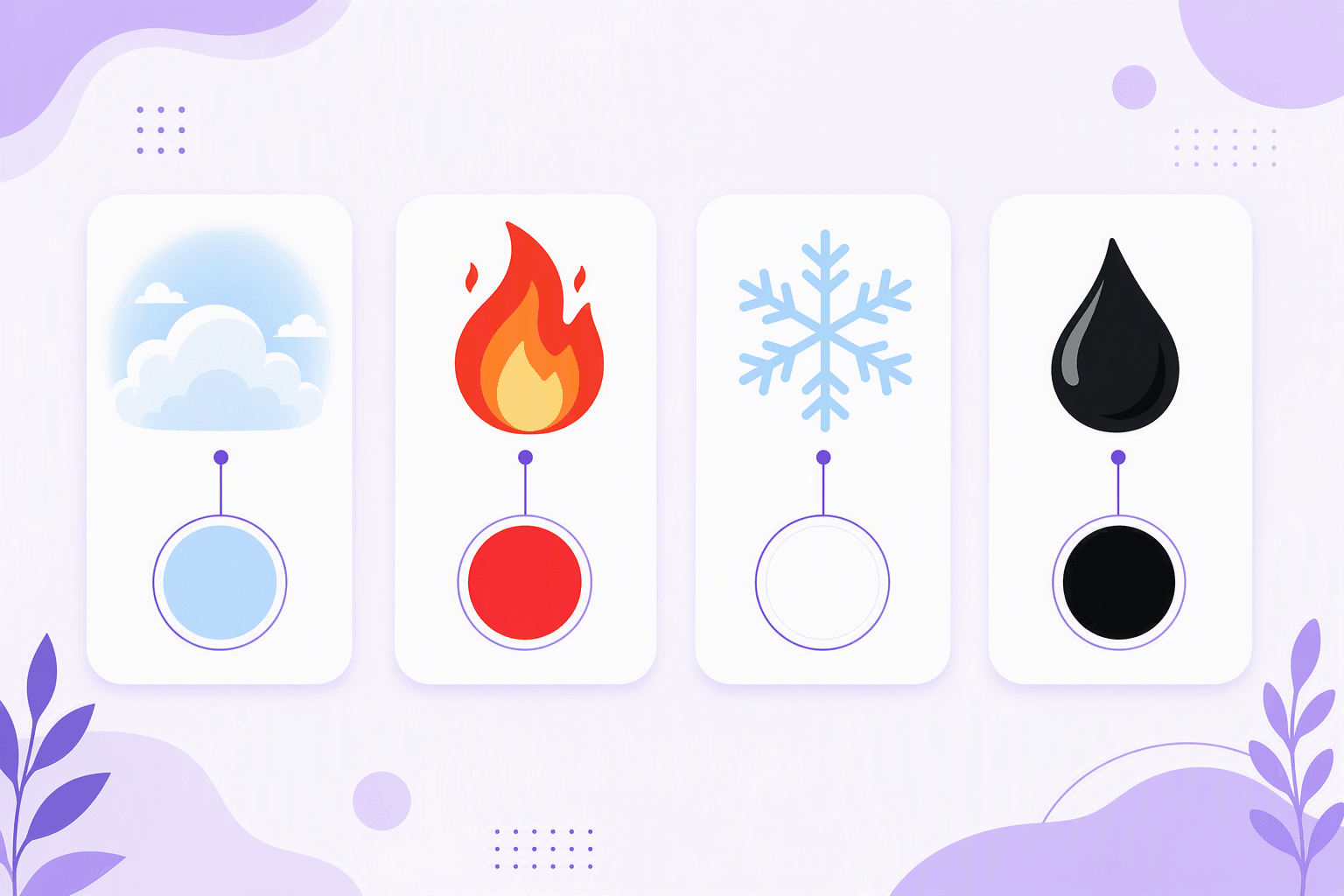
The German Flag: Schwarz-Rot-Gold
The German national flag's three horizontal stripes (Schwarz, Rot, and Gold) carry deep historical meaning. The combination is officially called Schwarz-Rot-Gold, and using Gold rather than Gelb is important. The flag represents the democratic tradition, not just a color scheme.
The colors trace to the Lützowsches Freikorps (Lützow Free Corps), volunteer soldiers who fought against Napoleon's occupation in 1813. Their uniforms were black with red facings and gold buttons, the only colors available for a volunteer force of mixed social backgrounds, since black fabric could be dyed from any civilian clothing. These colors became a symbol of German unity and democratic aspiration during the Vormärz period and the 1848 revolution.
🌍 Schwarz-Rot-Gold vs. Schwarz-Weiß-Rot
The color debate reflected political ideology for over a century. Schwarz-Rot-Gold represented democracy and unity (Weimar Republic, Federal Republic). Schwarz-Weiß-Rot (black-white-red) represented the Prussian-dominated German Empire. The current flag restored Schwarz-Rot-Gold after 1949, explicitly linking the new democracy to the 1848 tradition.
Color Idioms and Expressions
German has a rich set of color-based idioms. These expressions appear frequently in conversation and understanding them is a sign of advanced fluency.
| English | German | Pronunciation | Note |
|---|---|---|---|
| To skip work/play hooky | Blau machen | blau MAHKH-en | Lit: 'to make blue' |
| To be inexperienced | Grün hinter den Ohren sein | grewn HIN-ter den OH-ren zyne | Lit: 'green behind the ears' |
| To hit the bullseye | Ins Schwarze treffen | ins SHVAR-tsuh TREF-fen | Lit: 'to hit the black' |
| To be furious | Rot sehen | roht ZAY-en | Lit: 'to see red' |
| To get a black eye | Ein blaues Auge bekommen | ayn BLAU-es OW-guh beh-KOM-men | Blue = bruised in German |
| A trip into the countryside | Eine Fahrt ins Blaue | AY-nuh fahrt ins BLAU-uh | Lit: 'a trip into the blue' |
| To see the future bleakly | Schwarz sehen | shvarts ZAY-en | Lit: 'to see black' |
The origin of blau machen is debated among linguists. The DWDS etymological dictionary records the most widely accepted theory: it derives from the historical textile dyeing process. On Mondays, cloth soaked in indigo was left to oxidize and turn blue in the open air, giving dyers nothing to do. Hence "making blue" became synonymous with taking an unauthorized day off. This explanation was documented as early as the 17th century.
Grün hinter den Ohren parallels the English "wet behind the ears" but uses green instead. The image is of a newborn animal that still has a greenish tinge behind its ears from amniotic fluid. Both idioms mean "young and inexperienced," but the German version is far more common in daily speech.
"Color idioms in German reveal centuries of cultural history compressed into everyday phrases. The persistence of blau machen across five centuries of German demonstrates how deeply craft traditions shaped the language."
(Goethe-Institut, Redensarten und ihre Geschichte)
Bauhaus and German Color Theory
Germany's contribution to modern color theory is enormous. Johannes Itten, a Swiss-German teacher at the Bauhaus school in Weimar, developed his famous color wheel and color theory courses in the 1920s. His book Kunst der Farbe (The Art of Color, 1961) remains a foundational text in design education worldwide.
At the Bauhaus, colors were not merely decorative; they were structural. Kandinsky assigned colors to geometric shapes: yellow to the triangle, red to the square, blue to the circle. This systematic approach to color influenced architecture, industrial design, typography, and advertising across the 20th century.
The German Expressionists, particularly Der Blaue Reiter group in Munich and Die Brücke (The Bridge) in Dresden, used color as emotional language rather than representational description. Franz Marc painted horses in blue and yellow, believing each color carried spiritual meaning. Ernst Ludwig Kirchner used clashing greens and pinks to convey the anxiety of modern urban life. Understanding these associations adds a layer of cultural literacy when discussing art in German.
Practice With Real German Content
Colors appear everywhere in German daily life, from shopping for clothes (Haben Sie das in Rot?, "Do you have this in red?") to describing the weather (Der Himmel ist grau, "The sky is gray") to talking about sports teams (Die Mannschaft in den gelben Trikots, "The team in yellow jerseys"). Building natural fluency means encountering these words in context, not just studying tables.
German films are particularly rich in deliberate color usage. From the expressionist shadows of Fritz Lang to the saturated palettes of modern German cinema, color vocabulary enhances your viewing experience. Check out our guide to the best movies for learning German for recommendations across genres and difficulty levels.
Wordy lets you practice German vocabulary in real context by watching German content with interactive subtitles. When a color word appears in dialogue, you can tap it to see its meaning, pronunciation, gender, and declension pattern. Explore our blog for more German learning guides, or visit our German learning page to start building your vocabulary today.
Frequently Asked Questions
What are the basic colors in German?
How do you decline color adjectives in German?
How do you form compound colors in German?
What do the colors of the German flag mean?
What does 'blau machen' mean in German?
Why do some German colors not decline, like 'lila' and 'orange'?
Sources & References
- Duden, Die deutsche Rechtschreibung, 28th edition (2024)
- Goethe-Institut, German language and culture learning resources
- DWDS (Digitales Wörterbuch der deutschen Sprache), Etymological entries
- Institut für Deutsche Sprache (IDS), Mannheim, Deutsche Grammatik
- Ethnologue: Languages of the World, 27th edition (2024)
Start learning with Wordy
Watch real movie clips and build your vocabulary as you go. Free to download.


