Quick Answer
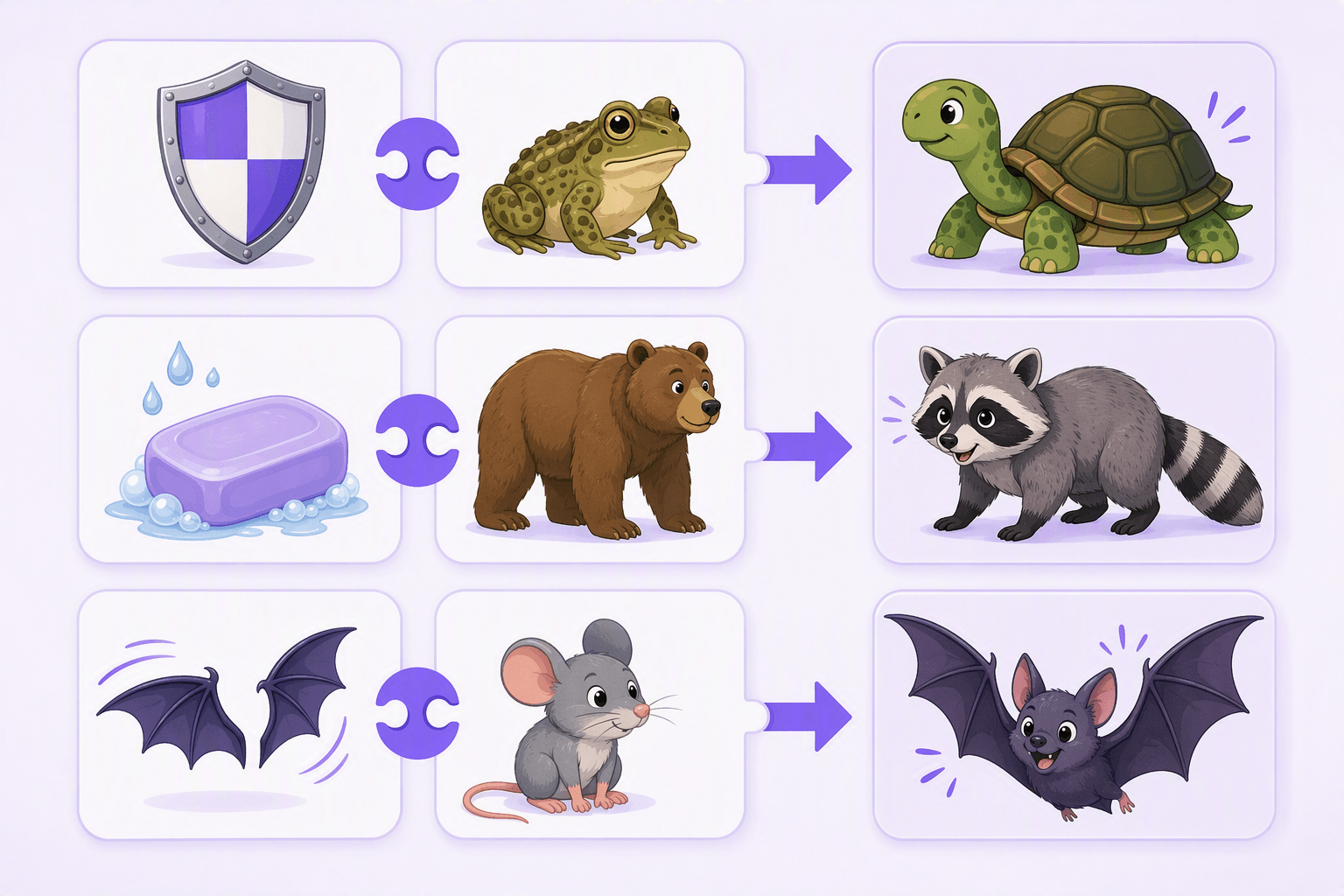
The most common animals in German are der Hund (dog), die Katze (cat), das Pferd (horse), der Vogel (bird), and der Fisch (fish). Every German animal noun has a grammatical gender you must memorize, there is no reliable rule. German also creates wonderfully descriptive compound animal names: Schildkröte (shield-toad = turtle), Faultier (lazy-animal = sloth), Waschbär (wash-bear = raccoon), and Stachelschwein (spike-pig = porcupine).
The most essential animal names in German are der Hund (dog), die Katze (cat), das Pferd (horse), der Vogel (bird), and der Fisch (fish). With these five words and a few dozen more, you can talk about pets, wildlife, and nature across Germany, Austria, and Switzerland. Whether you're looking up "animals in german" for travel, study, or conversation, this guide covers everything you need.
German is spoken by approximately 134 million people worldwide according to Ethnologue's 2024 data, making it the most spoken native language in the European Union. Animal vocabulary is fundamental for learners at every level, from understanding signs at the Berlin Zoo (the oldest zoo in Germany, founded in 1844) to reading children's stories by the Brothers Grimm, where animals play starring roles. What makes German animal vocabulary especially rewarding is the language's compound word system: a turtle is a Schildkröte (shield-toad), a sloth is a Faultier (lazy-animal), and a raccoon is a Waschbär (wash-bear). These transparent compounds make the words vivid and often easier to remember than their English equivalents.
"German's productive compound system is nowhere more playful than in its animal vocabulary. Words like Schildkröte, Stachelschwein, and Faultier reveal a language that names creatures by describing them, turning each noun into a miniature portrait."
(Institut für Deutsche Sprache, Mannheim)
This guide covers 50+ German animal names organized by category, with pronunciation, grammatical gender, the fascinating world of compound animal names, and animal idioms that Germans use every day.
Pets (Haustiere)
| English | German | Pronunciation | Note |
|---|---|---|---|
| Dog | der Hund | hoont | Masculine |
| Cat | die Katze | KAH-tsuh | Feminine |
| Bird | der Vogel | FOH-gel | Masculine |
| Fish | der Fisch | fish | Masculine |
| Rabbit | das Kaninchen | kah-NEEN-khen | Neuter |
| Turtle/Tortoise | die Schildkröte | SHILT-kruh-tuh | Feminine; lit. 'shield-toad' |
| Hamster | der Hamster | HAHM-ster | Masculine |
| Guinea pig | das Meerschweinchen | MEER-shvyne-khen | Neuter; lit. 'little sea pig' |
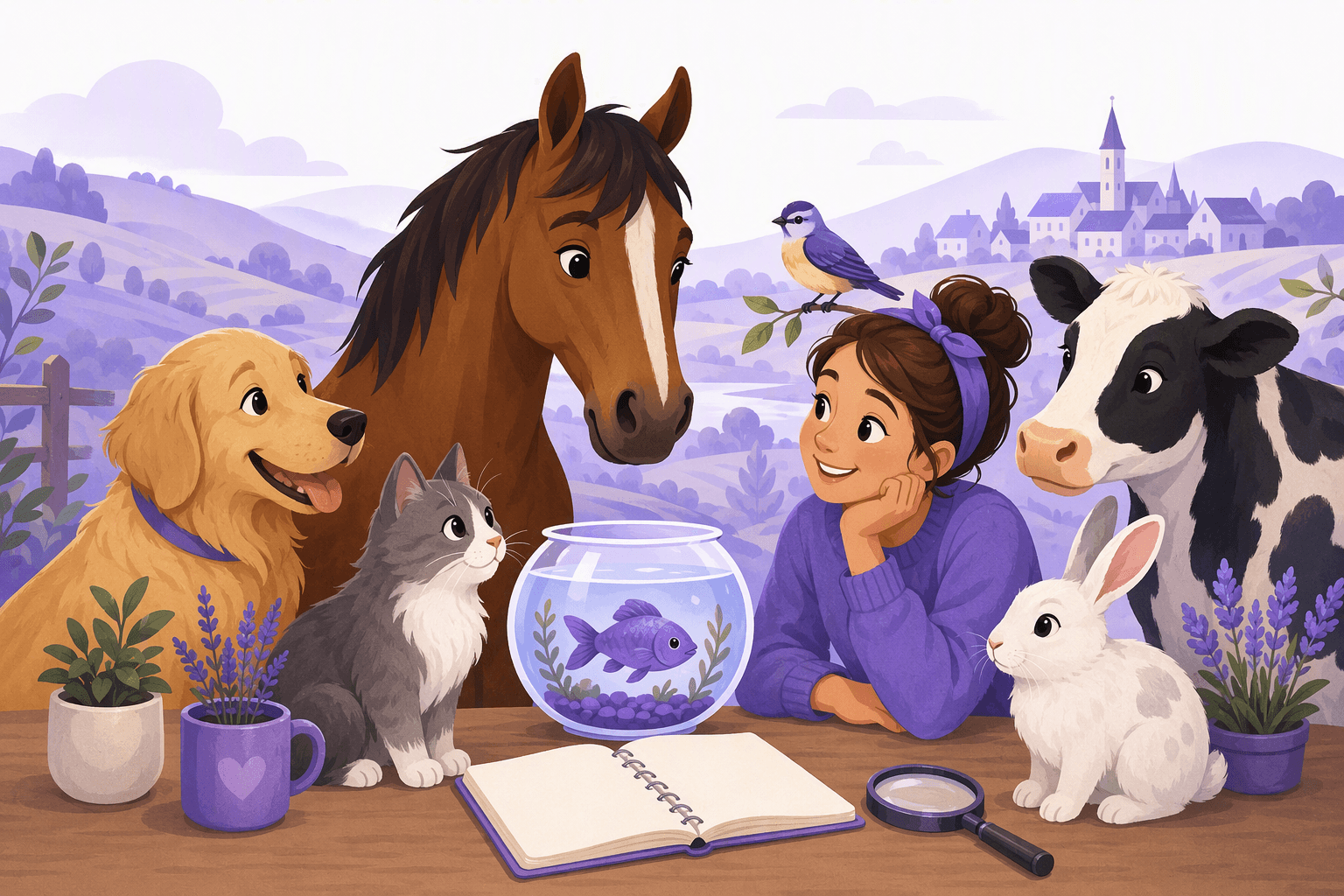
Germany is one of the most pet-friendly countries in Europe. According to the Industrieverband Heimtierbedarf, over 34 million pets live in German households, with cats (Katzen) outnumbering dogs (Hunde). The word Haustier (house-animal) is the general term for pet. Notice that Meerschweinchen (guinea pig) literally means "little sea pig," where Meer (sea) likely refers to the animal's overseas origin, and Schweinchen is the diminutive of Schwein (pig) because of their squealing sounds.
Farm Animals (Nutztiere)
| English | German | Pronunciation | Note |
|---|---|---|---|
| Cow | die Kuh | koo | Feminine |
| Horse | das Pferd | pfehrt | Neuter |
| Pig | das Schwein | shvyne | Neuter |
| Chicken | das Huhn | hoon | Neuter |
| Sheep | das Schaf | shahf | Neuter |
| Goat | die Ziege | TSEE-guh | Feminine |
| Donkey | der Esel | AY-zel | Masculine |
| Rooster | der Hahn | hahn | Masculine |
| Duck | die Ente | EN-tuh | Feminine |
Farm animals appear constantly in German culture and idiom. The Pferd initial consonant cluster pf- is one of German's trickiest sounds for English speakers: both lips press together for the "p" and immediately release into an "f." Practice by saying "cupful" and isolating the "pf" sound.
German distinguishes male and female farm animals with separate words: der Stier or der Bulle (bull) vs. die Kuh (cow), der Hahn (rooster) vs. die Henne (hen), der Eber (boar) vs. die Sau (sow). The generic animal names (das Huhn for chicken, das Schwein for pig) are typically neuter.
Wild Animals (Wildtiere)
| English | German | Pronunciation | Note |
|---|---|---|---|
| Lion | der Löwe | LUH-vuh | Masculine; weak noun |
| Tiger | der Tiger | TEE-ger | Masculine |
| Bear | der Bär | behr | Masculine; weak noun |
| Wolf | der Wolf | volf | Masculine |
| Fox | der Fuchs | fooks | Masculine |
| Deer | der Hirsch | hirsh | Masculine |
| Monkey/Ape | der Affe | AH-fuh | Masculine; weak noun |
| Elephant | der Elefant | eh-leh-FAHNT | Masculine; weak noun |
| Wild boar | das Wildschwein | VILT-shvyne | Neuter; lit. 'wild pig' |
Several of these wild animals hold special significance in German-speaking lands. The Bär (bear) is the symbol of Berlin. The city's name may derive from the Slavic word for swamp, but Berliners adopted the bear as their heraldic animal centuries ago. You will find bear statues, bear logos, and the Berliner Bär everywhere in the capital.
The Wolf has returned to Germany after being hunted to extinction in the 19th century. Since 2000, wolf packs have reestablished themselves, particularly in Saxony and Brandenburg, sparking intense public debate. The Rothirsch (red deer, literally "red stag") is Germany's largest native land mammal, and Wildschweine (wild boars) are so common in Berlin's suburbs that they regularly make the evening news.
🌍 Weak Nouns (schwache Nomen)
Several animal nouns are "weak nouns", they add -n or -en in every case except nominative singular. Der Löwe becomes den Löwen (accusative), dem Löwen (dative), des Löwen (genitive). The same applies to der Bär, der Affe, der Hase (hare), and der Elefant. Forgetting the -n ending is one of the most common mistakes German learners make, so always memorize which animal nouns are weak.
Sea Animals (Meerestiere)
| English | German | Pronunciation | Note |
|---|---|---|---|
| Whale | der Wal | vahl | Masculine |
| Dolphin | der Delfin | del-FEEN | Masculine |
| Shark | der Hai | hy | Masculine |
| Octopus | die Krake | KRAH-kuh | Feminine |
| Crab | die Krabbe | KRAH-buh | Feminine |
| Jellyfish | die Qualle | KVAH-luh | Feminine; Qu = 'kv' |
| Seal | der Seehund | ZAY-hoont | Masculine; lit. 'sea-dog' |
| Squid | der Tintenfisch | TIN-ten-fish | Masculine; lit. 'ink-fish' |
Compound names shine in this category. Seehund (seal) literally translates to "sea-dog," and once you see a seal's whiskered face, the name makes perfect sense. Tintenfisch (squid) is an "ink-fish," named for the dark ink these animals squirt. Qualle (jellyfish) features the distinctly German Qu combination, which is always pronounced "kv" rather than "kw" as in English.
Germany's North Sea and Baltic Sea coasts are home to Seehunde (harbor seals), Kegelrobben (grey seals), and Schweinswale (harbour porpoises, literally "pig-whales"). The Wadden Sea, a UNESCO World Heritage Site shared with the Netherlands and Denmark, is one of Europe's most important marine habitats.
Birds (Vögel)
| English | German | Pronunciation | Note |
|---|---|---|---|
| Eagle | der Adler | AHD-ler | Masculine |
| Owl | die Eule | OY-luh | Feminine |
| Parrot | der Papagei | pah-pah-GY | Masculine |
| Pigeon/Dove | die Taube | TAU-buh | Feminine |
| Penguin | der Pinguin | PING-goo-een | Masculine |
| Flamingo | der Flamingo | flah-MING-oh | Masculine |
| Stork | der Storch | shtorkh | Masculine |
| Crow | die Krähe | KREH-uh | Feminine |
The Adler (eagle) holds extraordinary cultural significance in the German-speaking world. The Bundesadler (federal eagle) has been Germany's official national emblem since the founding of the Federal Republic in 1949, continuing a tradition that stretches back to the Holy Roman Empire. You will see the eagle on German euro coins, government buildings, the Bundestag chamber, and official documents. The German national football team wears the eagle on their crest.
The Storch (stork) is another culturally beloved bird. White storks nest on rooftops across rural Germany, and according to German folklore, the stork delivers babies, a belief so widespread that Klapperstorch (clattering stork) became a standard euphemism for explaining where babies come from.
Insects and Small Creatures (Insekten und Kleintiere)
| English | German | Pronunciation | Note |
|---|---|---|---|
| Butterfly | der Schmetterling | SHMET-ter-ling | Masculine |
| Bee | die Biene | BEE-nuh | Feminine |
| Ant | die Ameise | ah-MY-zuh | Feminine |
| Spider | die Spinne | SHPIN-nuh | Feminine |
| Fly | die Fliege | FLEE-guh | Feminine |
| Mosquito | die Mücke | MEW-kuh | Feminine |
| Ladybug | der Marienkäfer | mah-REE-en-keh-fer | Masculine; lit. 'Mary's beetle' |
| Snail | die Schnecke | SHNEH-kuh | Feminine |
Schmetterling (butterfly) is one of the most beautiful-sounding words in German. Its origin is debated, but the Duden connects it to the dialectal word Schmetten (cream), possibly because butterflies were believed to steal cream, or because of the butter-yellow color of common species. The English "butterfly" has a similar folk-etymology connection to butter.
Marienkäfer (ladybug) literally translates to "Mary's beetle," named after the Virgin Mary. The insect's red color was associated with Mary's cloak in medieval Christianity. This religious naming convention exists across many European languages. The French call it coccinelle but also bête à bon Dieu (God's creature).
Notice that most insects and small creatures in German are feminine (die Biene, die Ameise, die Spinne, die Fliege, die Mücke, die Schnecke). This is one of the few loosely predictable gender patterns in German animal vocabulary.
Compound Animal Names: German's Word Playground
German's compound word system is at its most creative and entertaining with animal names. Where English borrows from Latin or Greek, German builds descriptive names from everyday words. Here are the best examples:
| English | German | Pronunciation | Note |
|---|---|---|---|
| Turtle/Tortoise | Schildkröte | SHILT-kruh-tuh | Schild (shield) + Kröte (toad) |
| Slug | Nacktschnecke | NAHKT-shneh-kuh | nackt (naked) + Schnecke (snail) |
| Porcupine | Stachelschwein | SHTAH-khel-shvyne | Stachel (spike) + Schwein (pig) |
| Sloth | Faultier | FAUL-teer | faul (lazy) + Tier (animal) |
| Raccoon | Waschbär | VASH-behr | waschen (to wash) + Bär (bear) |
| Squid | Tintenfisch | TIN-ten-fish | Tinte (ink) + Fisch (fish) |
| Seal | Seehund | ZAY-hoont | See (sea) + Hund (dog) |
| Bat | Fledermaus | FLAY-der-maus | flattern (to flutter) + Maus (mouse) |
| Armadillo | Gürteltier | GEWR-tel-teer | Gürtel (belt) + Tier (animal) |
| Skunk | Stinktier | SHTINK-teer | stinken (to stink) + Tier (animal) |
| Platypus | Schnabeltier | SHNAH-bel-teer | Schnabel (beak) + Tier (animal) |
| Hippopotamus | Nilpferd | NEEL-pfehrt | Nil (Nile) + Pferd (horse) |
These compounds are not just charming; they are genuinely useful for memorization. When you know that Schild means "shield" and Kröte means "toad," Schildkröte becomes unforgettable. The same logic applies across the board: a Faultier is literally a "lazy animal," which is exactly what a sloth is. A Stinktier is a "stink animal," and you will never confuse it with anything else.
The Waschbär (raccoon) is worth special mention because raccoons have become a genuine ecological issue in Germany. Originally introduced from North America in 1934, their population has exploded to over one million, according to the IUCN. They are now Germany's most successful invasive mammal, and the word Waschbär appears frequently in news reports about wildlife management.
🌍 Why German Compounds Work
According to David Crystal in The Cambridge Encyclopedia of Language, German's compounding system is among the most productive in any world language. The rules are simple: the last element determines gender and grammatical behavior, while earlier elements modify the meaning. So Schildkröte is feminine (die) because Kröte is feminine, regardless of what Schild would be on its own. This principle applies to all compound animal names.
Grammatical Gender: The Essential Challenge
⚠️ You Must Memorize the Article
Every German noun has a grammatical gender (masculine der, feminine die, or neuter das), and there is no reliable rule for predicting animal gender. Der Hund (dog) is masculine, die Katze (cat) is feminine, and das Pferd (horse) is neuter. Even similar animals can have different genders: der Hai (shark) is masculine but die Qualle (jellyfish) is feminine. Always learn the article together with the noun: never just "Hund," always "der Hund."
A few loose patterns can help, though they have exceptions:
- -ling endings tend to be masculine: der Schmetterling (butterfly), der Sperling (sparrow)
- -e endings are often feminine: die Katze, die Schlange (snake), die Biene, die Ameise, but not always: der Hase (hare), der Löwe (lion), der Affe (monkey) are masculine weak nouns
- -chen and -lein diminutives are always neuter: das Kaninchen (rabbit), das Kätzchen (kitten), das Hündchen (little dog), even when the base word has a different gender
The Goethe-Institut recommends learning each noun as a unit with its article from the very start. Flashcard systems that display "Hund" without "der" are actively harmful to your German development.
Animal Idioms (Tierische Redewendungen)
German speakers use animal idioms constantly in everyday conversation. Understanding these expressions is a strong marker of intermediate-to-advanced proficiency.
| English | German | Pronunciation | Note |
|---|---|---|---|
| That's the crux of the matter | Da liegt der Hund begraben | dah leekt dehr hoont beh-GRAH-ben | Lit: 'There lies the buried dog' |
| To be lucky | Schwein haben | shvyne HAH-ben | Lit: 'To have pig' |
| To have a hangover | Einen Kater haben | AY-nen KAH-ter HAH-ben | Lit: 'To have a tomcat' |
| The middle of nowhere | Wo sich Fuchs und Hase gute Nacht sagen | voh zikh fooks oont HAH-zuh GOO-tuh nakht ZAH-gen | Lit: 'Where fox and hare say goodnight' |
| It's a great party | Da steppt der Bär | dah shtept dehr behr | Lit: 'The bear dances there' |
| To kill two birds with one stone | Zwei Fliegen mit einer Klappe schlagen | tsvy FLEE-gen mit AY-ner KLAH-puh SHLAH-gen | Lit: 'Hit two flies with one swat' |
Schwein haben (to be lucky) is one of the most common German idioms. Its origin dates to medieval tournaments, where the worst-performing competitor received a pig as a consolation prize, so "having pig" originally meant winning without deserving it, which softened over centuries into simply meaning "to be lucky."
Einen Kater haben (to have a hangover) likely comes from the word Katarrh (catarrh, nasal inflammation), which was humorously corrupted into Kater (tomcat) in 19th-century student slang. The connection between a miserable tomcat and a miserable morning-after stuck, and now Kater is the standard colloquial word for hangover across all German-speaking countries.
Practice With Real German Content
Animal vocabulary appears throughout German culture, from the Brothers Grimm fairy tales (Die Bremer Stadtmusikanten, where a donkey, dog, cat, and rooster form a band) to modern wildlife documentaries on public television. The Berlin Zoo and the Tierpark are among the world's largest, and visiting them with German audio guides is an excellent way to practice.
German nature documentaries are particularly rich in animal vocabulary. Check out our guide to the best movies for learning German for film and TV recommendations that will expose you to natural German in context, including nature programming.
Wordy lets you practice German vocabulary while watching authentic German content with interactive subtitles. Tap any animal name in dialogue to see its meaning, pronunciation, grammatical gender, and plural form. Explore our blog for more German vocabulary guides, or visit our German learning page to start building your Wortschatz (vocabulary) today.
Frequently Asked Questions
What are the most common animal names in German?
How do German compound animal names work?
Do German animal nouns have grammatical gender?
What is Germany's national animal?
What German idioms use animal names?
How do you form the plural of German animal nouns?
Sources & References
- Duden, Die deutsche Rechtschreibung, 28th edition (2024)
- Goethe-Institut, German language and culture learning resources
- Crystal, D., The Cambridge Encyclopedia of Language (Cambridge University Press)
- IUCN Red List of Threatened Species, European fauna assessments
- Institut für Deutsche Sprache (IDS), Mannheim, Wortbildung im Deutschen
Start learning with Wordy
Watch real movie clips and build your vocabulary as you go. Free to download.


