Quick Answer
The most common French term of endearment is 'Mon amour' (mohn ah-MOOR), meaning 'my love.' It works for romantic partners and sometimes children. But what makes French pet names fascinating is how many draw from unexpected sources, food ('Mon chou,' my cabbage), animals ('Ma puce,' my flea), and baby talk ('Doudou,' cuddly thing). These quirky endearments are used daily by millions of French speakers and reveal a playful side of the language of love.
The Short Answer
The most common French term of endearment is Mon amour (mohn ah-MOOR), meaning "my love." It is the standard, everyday pet name between French couples. But what makes French distinctive is how creative and unexpected its terms of endearment are: the French call their loved ones "my cabbage" (mon chou), "my flea" (ma puce), and "my rabbit" (mon lapin), and mean it with complete sincerity.
French is spoken by approximately 321 million people across 29 countries, according to the Organisation internationale de la Francophonie (OIF). Its reputation as the language of love extends well beyond Je t'aime into a rich ecosystem of pet names that range from the classically romantic to the charmingly bizarre. These endearments reveal a playful, intimate side of French culture that formal grammar textbooks rarely capture.
"French terms of endearment draw from a remarkably eclectic range of sources: precious objects, food, animals, even insects. This reflects not randomness but a deep cultural association between smallness, sweetness, and affection."
(Claude Duneton, La Puce à l'oreille, Éditions Stock, 1990)
This guide covers 16 French terms of endearment organized by category: classic romantic, food and nature, playful and quirky, and family-oriented. Each one includes pronunciation, an example sentence, and cultural context so you know exactly when and how to use it.

Quick Reference: French Terms of Endearment at a Glance
| English | French | Pronunciation | Formality |
|---|---|---|---|
| My love | Mon amour | mohn ah-MOOR | casual |
| My heart | Mon cœur | mohn KUHR | casual |
| My darling (to a man) | Mon chéri | mohn shay-REE | casual |
| My darling (to a woman) | Ma chérie | mah shay-REE | casual |
| My treasure | Mon trésor | mohn tray-ZOR | casual |
| My cabbage / Sweetie | Mon chou | mohn SHOO | casual |
| Baby chick | Poussin | poo-SAH̃ | casual |
| Cuddly one / Snuggly | Doudou | doo-DOO | casual |
| My flea (cute) | Ma puce | mah PEWSS | casual |
| My doe / My dear | Ma biche | mah BEESH | casual |
| My rabbit | Mon lapin | mohn lah-PAH̃ | casual |
| Baby / Babe | Bébé | bay-BAY | casual |
| My beautiful (to a woman) | Ma belle | mah BEL | casual |
| My angel | Mon ange | mohn AHNZH | casual |
| My star | Mon étoile | mohn ay-TWAHL | casual |
| My little wolf | Mon loup | mohn LOO | casual |
Classic Romantic
These are the timeless French terms of endearment, the ones that have earned the language its reputation as the world's most romantic. According to the Académie française, several of these expressions have been in continuous use since the 16th century.
Mon amour
/mohn ah-MOOR/
Literal meaning: My love
“Bonne nuit, mon amour. À demain.”
Good night, my love. See you tomorrow.
The single most common French term of endearment. Used daily between couples. Note that 'mon' (masculine article) is used regardless of partner's gender because 'amour' is grammatically masculine. Also used by parents with young children.
Mon amour is the foundation of French romantic vocabulary. It is the pet name you will hear most often between French couples: at breakfast, in text messages, at the end of phone calls. Unlike the English "my love," which can sound formal or old-fashioned, mon amour remains effortlessly natural in modern French.
A grammatical note: amour is masculine, so you always say mon amour regardless of whether you are addressing a man or a woman. The mon refers to the gender of the noun, not the person.
Mon cœur
/mohn KUHR/
Literal meaning: My heart
“Viens ici, mon cœur. J'ai quelque chose à te dire.”
Come here, my heart. I have something to tell you.
Among the most intimate French endearments. The 'œ' in cœur is a distinctly French vowel, round your lips as if saying 'oh' but produce an 'uh' sound. Used between couples and by parents with children. Carries deep tenderness.
Mon cœur is one of the most tender expressions in French. The pronunciation requires mastering the œ ligature: position your lips as for "oh" but produce an "uh" sound. This vowel does not exist in English, which is part of why the phrase sounds so distinctly French.
Parents also use mon cœur with children, giving it a dual association with both romantic and familial love. Between couples, it signals deep emotional intimacy.
Mon chéri / Ma chérie
/mohn shay-REE / mah shay-REE/
Literal meaning: My dear / My darling
“Ma chérie, tu veux qu'on aille dîner dehors ce soir ?”
My darling, do you want to go out for dinner tonight?
One of the most internationally recognized French expressions. Gendered: 'mon chéri' for a man, 'ma chérie' for a woman. From the verb 'chérir' (to cherish). Used between couples, and by grandparents with grandchildren. Has entered English as a loanword.
Chéri(e) comes from the verb chérir (to cherish) and has become perhaps the most internationally recognized French term of endearment. It crossed into English decades ago, though English speakers often mispronounce it as "SHEH-ree" instead of the correct "shay-REE" with stress on the final syllable.
Between couples, it is warm and everyday. Grandparents also use mon chéri / ma chérie with grandchildren, giving it a cross-generational warmth.
Mon trésor
/mohn tray-ZOR/
Literal meaning: My treasure
“Tu es mon trésor, tu le sais ?”
You're my treasure, you know that?
Expresses that someone is precious and irreplaceable. Especially popular from parents to children, a mother calling her child 'mon trésor' is a classic French image. Between couples, it conveys deep appreciation. The 's' in 'trésor' is voiced as a 'z' sound.
Mon trésor carries a particular weight of preciousness; it implies that someone is rare, valuable, and carefully guarded. It is especially beloved between parents and young children. The image of a French mother calling her child mon trésor is one of the most iconic in the language.
Between romantic partners, it conveys appreciation that goes beyond surface attraction into something deeper and more lasting.
Food and Nature
French terms of endearment draw heavily from food and the natural world. These expressions sound quirky in English translation but are completely normal, even standard, in everyday French life.
Mon chou
/mohn SHOO/
Literal meaning: My cabbage / My cream puff
“Alors, mon chou, tu as passé une bonne journée ?”
So, sweetie, did you have a good day?
One of French's most famous quirky endearments. Despite the literal 'cabbage' translation, it likely derives from 'chou à la crème' (cream puff), something small, round, and sweet. Used between couples and from parents to children. The feminine form 'ma choute' and diminutive 'mon chouchou' are also common.
Mon chou is the pet name that makes every French learner do a double take. Yes, it technically translates to "my cabbage." But as linguist Claude Duneton explains in La Puce à l'oreille, the term almost certainly derives from chou à la crème (cream puff), something small, round, and sweet, rather than from the raw vegetable.
The diminutive mon chouchou (my little cabbage/darling) is even more popular and has entered everyday French as a general term for "favorite" or "pet." A teacher's chouchou is the teacher's pet.
🌍 French Food Endearments
Food-based pet names are a cornerstone of French affectionate language. Beyond mon chou, you will encounter ma crevette (my shrimp), mon canard (my duck), ma cocotte (my hen/casserole), and mon sucre d'orge (my barley sugar). These terms reflect how deeply intertwined food culture and emotional expression are in French life.
Ma puce
/mah PEWSS/
Literal meaning: My flea
“Allez, ma puce, c'est l'heure de dormir.”
Come on, sweetie, it's time to sleep.
Calling someone 'my flea' is genuinely affectionate in French. The logic: fleas are tiny, and in French, tiny equals adorable. Dating back to at least the 17th century, this endearment is used between couples and especially from parents to young children. One of the most beloved 'quirky' French pet names.
Ma puce (my flea) is one of French's most charmingly illogical endearments. The connection between fleas and affection lies in the French association between smallness and dearness: something tiny is something precious. The Académie française traces this usage to at least the 17th century.
It is especially popular between parents and young children. A mother tucking her daughter into bed and saying Bonne nuit, ma puce (Good night, my flea) is a perfectly tender, normal French scene.
Mon lapin
/mohn lah-PAH̃/
Literal meaning: My rabbit
“Mon lapin, tu as oublié tes clés sur la table.”
Bunny, you forgot your keys on the table.
Rabbits are associated with cuteness and softness in French culture. 'Mon lapin' is used between couples and with children. The feminine form 'ma lapine' exists but is less common: 'mon lapin' works for everyone. The diminutive 'mon petit lapin' (my little rabbit) adds extra tenderness.
Rabbits symbolize cuteness, softness, and warmth in French culture, making mon lapin a natural term of endearment. It works for both men and women. While ma lapine (my doe rabbit) exists, mon lapin is the standard form regardless of gender.
The extended form mon petit lapin (my little rabbit) is especially popular with children, and you will hear it frequently in French family settings.
Poussin
/poo-SAH̃/
Literal meaning: Baby chick
“Mon poussin, viens manger, c'est prêt !”
My little chick, come eat, it's ready!
An endearment inspired by the baby chick, small, fluffy, and endearing. Used mostly from parents to young children, and occasionally between couples. The nasal vowel in the final syllable is distinctly French. Less common than 'mon chou' or 'ma puce' but widely understood.
Poussin evokes the image of a baby chick: small, fluffy, and irresistibly cute. It is used primarily by parents with young children, though some couples adopt it as well. The nasal vowel in the final syllable (-SAH̃) is a characteristically French sound that English speakers need to practice: let air pass through both your mouth and nose simultaneously.
Playful and Intimate
These terms of endearment carry a more intimate, playful energy. They are the pet names that emerge in the private language between couples.
Doudou
/doo-DOO/
Literal meaning: Cuddly thing / Comfort object
“Tu viens, doudou ? Le film va commencer.”
Are you coming, snuggly? The movie is about to start.
In French, a 'doudou' is a child's comfort object, a stuffed animal or blanket they carry everywhere. As a pet name, it implies that the person is your source of comfort and security. Popular between couples, especially in France and the French Caribbean. In the Antilles and Réunion, it is one of the most common pet names.
Doudou has a fascinating dual meaning. For French children, a doudou is their comfort object, the stuffed animal or blanket they cannot sleep without. When used between adults, it transfers that meaning: you are my source of comfort, my security, my soft place to land.
The term is especially popular in the French Caribbean. In Guadeloupe, Martinique, and Réunion, doudou is one of the most common pet names, heard as frequently as mon amour is in Metropolitan France. The famous Antillean song Adieu Madras, adieu foulard, adieu doudou cemented its place in francophone culture.
Ma biche
/mah BEESH/
Literal meaning: My doe / My deer
“Ma biche, j'ai réservé une table pour ce soir.”
My darling, I booked a table for tonight.
Comparing a woman to a doe, graceful, gentle, and beautiful. Used primarily by men addressing women. Has a slightly vintage, classic French elegance. The masculine equivalent 'mon bichon' exists but is rare. You may also hear the variant 'ma bichette' (my little doe).
Ma biche draws on the image of a doe: graceful, gentle, and beautiful. It carries a slightly vintage elegance that evokes classic French cinema. The variant ma bichette (my little doe) adds a diminutive softness. While somewhat old-fashioned compared to mon amour or mon cœur, it remains in active use and is immediately understood by all French speakers.
Mon loup
/mohn LOO/
Literal meaning: My wolf
“Mon loup, tu rentres tard ce soir ?”
My wolf, are you coming home late tonight?
A pet name typically used by women addressing men, playing on the wolf's association with strength and protectiveness. The diminutive 'mon loulou' is more common in everyday speech and works for both genders. 'Loulou' has become one of France's most popular casual pet names.
Mon loup taps into the wolf's associations with strength, protectiveness, and a hint of wildness. It is typically used by women addressing men. But the real star here is the diminutive form mon loulou, which has become one of the most popular casual pet names in modern France, used for partners, children, and even pets.
Loulou has evolved so far from its wolf origins that most French speakers no longer think of the animal connection. It simply means "darling" or "sweetie" in everyday usage.
Bébé
/bay-BAY/
Literal meaning: Baby
“Bébé, tu peux m'envoyer l'adresse ?”
Babe, can you send me the address?
The French equivalent of English 'baby' or 'babe' as a pet name. Increasingly common among younger French couples, partly influenced by American pop culture and music. Used in text messages and casual speech. Less traditional than 'mon amour' but rapidly growing in popularity.
Bébé as a romantic pet name has surged in popularity among younger French speakers, partly influenced by American pop culture and R&B music. It functions exactly like English "babe": casual, modern, and used constantly in text messages and everyday speech.
Older generations of French speakers tend to prefer the classic endearments (mon amour, mon cœur), but among millennials and Gen Z, bébé has become a standard pet name.
Tender and Elevated
These expressions carry a gentler, more poetic quality. They are the terms you reach for in quiet, sincere moments.
Ma belle
/mah BEL/
Literal meaning: My beautiful
“Bonjour, ma belle. Tu as bien dormi ?”
Good morning, beautiful. Did you sleep well?
A warm, appreciative pet name for women. Used between couples and also between close female friends. Less formal than 'ma chérie' and more common in casual daily speech. The Beatles' 'Michelle, ma belle' introduced this expression to the English-speaking world.
Ma belle is warm, simple, and effortlessly charming. The Beatles brought it to global attention with "Michelle, ma belle," but in France it has always been an everyday expression. It works between romantic partners and also between close female friends. Two women greeting each other with Salut, ma belle! is entirely normal.
The masculine equivalent mon beau (my handsome) exists but is less common as a standalone pet name.
Mon ange
/mohn AHNZH/
Literal meaning: My angel
“Mon ange, ne t'inquiète pas, tout ira bien.”
My angel, don't worry, everything will be fine.
A tender endearment used between couples and especially from parents to children. 'Ange' is masculine in French, so it is always 'mon ange' regardless of the person's gender. Carries associations of purity, goodness, and preciousness.
Mon ange carries associations of purity, goodness, and being precious beyond measure. It is particularly popular from parents to children, but between couples it conveys a sincere tenderness. Like mon amour, the article stays mon (masculine) regardless of the addressee's gender because ange is a masculine noun.
Mon étoile
/mohn ay-TWAHL/
Literal meaning: My star
“Tu es mon étoile, tu brilles même dans mes jours les plus sombres.”
You are my star, you shine even on my darkest days.
A poetic endearment that compares the loved one to a star. Less common than 'mon amour' or 'mon cœur' but carries a beautiful imagery. Used between couples and from parents to children. The feminine noun 'étoile' takes 'mon' in this possessive construction.
Mon étoile is one of French's more poetic endearments. It is less common in everyday conversation than the top-tier pet names but carries a luminous beauty when used. The metaphor of someone as your guiding star resonates across French literature and song.
A grammatical note: despite étoile being feminine, mon is used here because French uses mon (not ma) before feminine nouns starting with a vowel sound, to avoid the awkward hiatus of ma étoile.
Regional Preferences: France vs. Québec vs. Francophone Africa
While the core endearments are shared across the francophone world, each region has developed its own favorites.
| Region | Top Pet Names | Cultural Notes |
|---|---|---|
| France | Mon amour, mon cœur, mon chou | Classic and diverse; food and animal names thrive |
| Québec | Mon amour, ma blonde, mon chum | Distinct partner terms; English influence |
| French Caribbean | Doudou, mon amour, ti chou | Doudou dominates; Creole influence |
| Francophone Africa | Mon cœur, chéri(e), bébé | French endearments mixed with local languages |
| Belgium | Mon chou, mon amour, ma biche | Similar to France; Flemish influence in some areas |
In Québec, ma blonde (my girlfriend, regardless of hair color) and mon chum (my boyfriend) are uniquely Québécois terms that Metropolitan French speakers find bewildering. In the French Caribbean, doudou holds a cultural importance that extends far beyond a simple pet name; it is woven into music, poetry, and Creole identity.
"The terms of endearment that a society uses most frequently are a direct window into its emotional culture. French, with its blend of the poetic and the playful, creates an endearment vocabulary unlike any other."
(Geneviève-Dominique de Salins, Politesse, savoir-vivre et relations sociales, 2002)
How to Use French Terms of Endearment Naturally
Understanding the social rules around pet names is essential. French culture has clear expectations about when these expressions are appropriate.
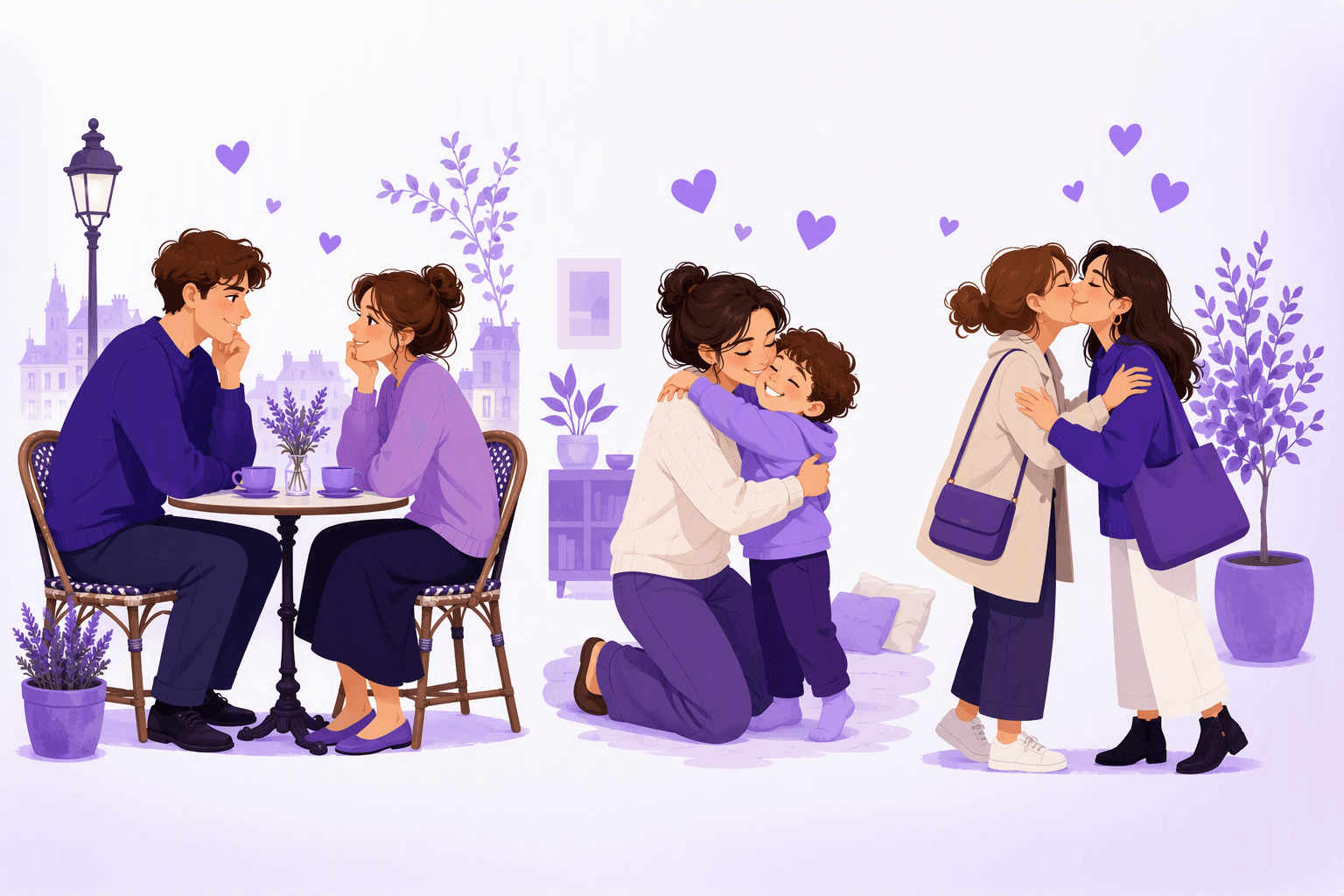
Timing and Relationship Stage
| Relationship Stage | Appropriate Terms | Avoid |
|---|---|---|
| Early dating | Mon cœur, ma belle/mon beau | Doudou, mon chou (too intimate) |
| New couple (1-3 months) | Mon amour, mon chéri/ma chérie | Ma puce, mon loup (very familiar) |
| Established couple | Any term from this guide | None, the full range is available |
| Parents to children | Mon trésor, ma puce, mon ange | Bébé (as romantic pet name) |
| Close female friends | Ma belle, ma chérie | Mon amour (romantic), doudou |
Gender and Grammar
French endearments follow strict grammatical gender rules:
- Mon + masculine noun → mon amour, mon cœur, mon ange, mon trésor, mon chou
- Ma + feminine noun → ma chérie, ma puce, ma belle, ma biche
- Mon before vowel sounds → mon étoile, mon ange (even though the nouns are feminine, mon replaces ma before vowels)
The gender-neutral terms (mon amour, mon cœur, mon ange, bébé) are safe defaults in any situation.
💡 Start With the Big Three
If you are learning French endearments for the first time, start with mon amour, mon cœur, and mon chéri/ma chérie. These three are universally understood, never inappropriate between couples, and will immediately make your French sound warmer and more natural. Branch into the quirky animal and food terms once you are comfortable.
Practice With Real French Content
Reading about terms of endearment gives you the vocabulary, but hearing them in authentic conversation, with real intonation, emotion, and context, is what makes them natural. French cinema is the perfect resource. Films like Amélie are filled with Parisian charm and playful endearments, while series like Dix pour cent (Call My Agent!) showcase how modern French professionals and couples use pet names in daily life.
Wordy lets you watch French films and shows with interactive subtitles. When you hear mon cœur whispered in a scene or ma puce called down a hallway, you can tap the phrase to see its meaning, pronunciation, and cultural context instantly. Instead of memorizing a list, you absorb these expressions from real emotional moments with authentic French delivery.
For more French content, explore our blog for guides including the best movies to learn French. You can also visit our French learning page to start practicing with real French dialogue today.
Frequently Asked Questions
What is the most common French term of endearment?
Why do the French call each other 'mon chou' (my cabbage)?
What does 'ma puce' mean and why is it a term of endearment?
What is the difference between 'mon chéri' and 'ma chérie'?
Do French terms of endearment differ between France and Québec?
Can you use French terms of endearment with friends?
Sources & References
- Académie française, Dictionnaire de l'Académie française, 9th edition
- Organisation internationale de la Francophonie (OIF), La langue française dans le monde, 2022 report
- Duneton, C. (1990). 'La Puce à l'oreille: Anthologie des expressions populaires avec leur origine.' Éditions Stock.
- Ethnologue: Languages of the World, French language entry (2024)
- Salins, G.-D. de (2002). 'Politesse, savoir-vivre et relations sociales.' Didier, Paris.
Start learning with Wordy
Watch real movie clips and build your vocabulary as you go. Free to download.


