Quick Answer
The most essential French slang falls into two systems: argot (traditional street slang like 'fric' for money and 'bouffe' for food) and verlan (syllable-reversal slang like 'meuf' from 'femme' and 'ouf' from 'fou'). Together they form the backbone of everyday informal French, spoken by millions across France and the Francophonie.
The Short Answer
French slang revolves around two systems: argot (traditional street vocabulary) and verlan (syllable-reversal slang). Words like kiffer (to love), meuf (woman), and ouf (crazy) are used daily by millions of French speakers, especially younger generations. Understanding these expressions is essential for following French movies, music, and real conversation.
French is spoken by approximately 321 million people worldwide across 29 countries, according to the Organisation internationale de la Francophonie (OIF). While textbooks teach standard French, the language spoken on the streets of Paris, Lyon, and Marseille is layered with slang that evolved from centuries of working-class culture, immigration, and youth creativity.
"Slang is not a corruption of language, it is language at its most creative. French argot and verlan represent living proof that speakers are constantly reinventing their tools of expression."
(Connie Eble, Slang and Sociability, University of North Carolina Press)
This guide covers 20+ essential French slang words organized by category: verlan expressions, classic argot, Arabic-origin slang, and everyday casual terms. Each entry includes pronunciation, cultural context, and real usage so you sound natural rather than like a textbook.

Quick Reference: French Slang at a Glance
| English | French | Pronunciation | Formality |
|---|---|---|---|
| Crazy / Insane | Ouf | OOF | slang |
| Woman / Girl | Meuf | MUHF | slang |
| Guy / Dude | Mec | MEHK | slang |
| Sketchy / Weird | Chelou | sheh-LOO | slang |
| Annoying / Heavy | Relou | reh-LOO | slang |
| Cop / Police | Keuf | KUHF | slang |
| To love / To enjoy | Kiffer | kee-FAY | slang |
| Money / Cash | Fric | FREEK | casual |
| Car | Bagnole | bah-NYOL | casual |
| Food / Grub | Bouffe | BOOF | casual |
| Tired / Fed up | Crevé(e) | kreh-VAY | casual |
| Lucky | Veinard(e) | veh-NAHR | casual |
| Buddy / Pal | Pote | POHT | casual |
| Thing / Stuff | Truc | TROOK | casual |
| Party | Teuf | TUHF | slang |
| Weird / Bizarre | Zarbi | zar-BEE | slang |
| Cool / Great | Chanmé | shahn-MAY | slang |
| To work | Bosser | boh-SAY | casual |
| To eat | Bouffer | boo-FAY | casual |
| Hometown / Village | Bled | BLEHD | slang |
Understanding Verlan: France's Syllable-Reversal Slang
Before diving into individual words, it helps to understand verlan, the slang system that makes French uniquely creative. The word verlan is itself verlan for l'envers (reverse, backward). The technique works by flipping syllables: femme becomes meuf, louche becomes chelou, fou becomes ouf.
Verlan emerged in the banlieues (working-class suburbs) of Paris in the mid-20th century and went mainstream by the 1990s through French hip-hop and cinema. According to the Centre National de Ressources Textuelles et Lexicales (CNRTL), some verlan terms have become so common that speakers no longer recognize them as reversed words.
Research from Le Petit Robert's 2025 edition notes that verlan terms now appear in formal dictionaries, reflecting their full integration into modern French. Here are the most important ones.
Ouf
/OOF/
Literal meaning: Verlan of 'fou' (crazy)
“C'est ouf comme il a changé !”
It's crazy how much he's changed!
Ubiquitous among young French speakers. Used to express amazement, disbelief, or intensity. Can be positive ('C'est ouf ce film!', That movie is insane!) or neutral.
Ouf is probably the single most-used verlan word in contemporary French. The reversal of fou (crazy), it has almost entirely replaced its source word in casual speech among speakers under 40. You will hear it constantly in French films, on social media, and in everyday conversation.
Meuf
/MUHF/
Literal meaning: Verlan of 'femme' (woman)
“T'as vu cette meuf ? Elle est trop stylée.”
Did you see that girl? She's so stylish.
The standard casual word for 'woman' or 'girl' in youth French. Not inherently disrespectful but context matters, tone determines whether it's neutral or objectifying.
Meuf perfectly illustrates how productive verlan is. Femme (fam) gets reversed to meuf. It is now the default informal word for "woman" or "girl" among young French speakers, much like "girl" in casual English. Its masculine counterpart is mec (guy).
Chelou
/sheh-LOO/
Literal meaning: Verlan of 'louche' (sketchy)
“Ce quartier est chelou la nuit.”
This neighborhood is sketchy at night.
Describes anything suspicious, weird, or off-putting. Very common in everyday speech. Has largely replaced 'louche' in casual registers among younger speakers.
When something feels off, chelou is the word. It conveys the same unease as "sketchy" or "shady" in English. A person, a situation, a neighborhood: anything can be chelou.
Relou
/reh-LOO/
Literal meaning: Verlan of 'lourd' (heavy)
“Arrête, t'es trop relou !”
Stop it, you're so annoying!
Used to describe someone or something tiresome, clingy, or obnoxious. One of the most common verlan adjectives. 'Lourd' in standard French means 'heavy' but in slang already meant 'annoying' before the verlan flip.
Relou is what you call someone who does not take a hint, tells the same joke three times, or keeps texting after you have said goodnight. The word captures a specific kind of persistent annoyance that English struggles to express in one word.
Keuf
/KUHF/
Literal meaning: Verlan of 'flic' (cop)
“Attention, y'a des keufs au coin de la rue.”
Watch out, there are cops at the corner.
Informal word for police. 'Flic' itself was already slang for police officer, so 'keuf' is verlan of a slang word, showing how layered French informal language can be.
Here is where verlan gets wonderfully recursive. Flic is already argot for "police officer." Then verlan flips flic into keuf. Slang of slang, a perfect example of how these two systems feed into each other.
🌍 Double Verlan: When Slang Gets Flipped Again
Some verlan words have been re-reversed because they became too mainstream. Meuf became feumeu, and arabe → beur (verlan) → rebeu (re-verlanized). This cycle shows that slang's core purpose is marking in-group identity; once outsiders adopt it, the group creates new forms.
Teuf
/TUHF/
Literal meaning: Verlan of 'fête' (party)
“On fait une teuf samedi, tu viens ?”
We're throwing a party Saturday, you coming?
The standard youth word for 'party.' Originally associated with rave culture in the 1990s, now used for any party or gathering among young French speakers.
Teuf comes from reversing fête (party/celebration). It entered mainstream slang through the French rave and electronic music scene of the 1990s and has stayed ever since.
Zarbi
/zar-BEE/
Literal meaning: Verlan of 'bizarre' (bizarre)
“Il est zarbi, ce type.”
That guy is weird.
Less negative than 'chelou', more 'odd' or 'quirky' than 'suspicious.' Used to describe eccentric behavior or unusual situations without necessarily implying danger.
While chelou carries a hint of suspicion, zarbi is more playful. The person who wears mismatched socks on purpose, the teacher who brings their parrot to class: they are zarbi, not chelou.
Chanmé
/shahn-MAY/
Literal meaning: Verlan of 'méchant' (mean/wicked)
“Ce concert était chanmé !”
That concert was amazing!
Similar to English 'wicked' or 'sick', a negative word flipped to mean something extremely positive. Common in Parisian youth slang and French hip-hop culture.
Just like English turned "wicked" and "sick" into compliments, French took méchant (mean) and reversed it into chanmé to mean "incredible" or "awesome." This semantic flip is a hallmark of youth slang across languages.
Classic Argot: Traditional French Street Slang
Argot predates verlan by centuries. Originally the coded language of criminals, thieves, and the Parisian underclass, it gradually seeped into mainstream French. Today, many argot words are so integrated that speakers do not realize they were once considered vulgar or criminal. Le Petit Robert traces some of these terms back to the 17th century.
Fric
/FREEK/
Literal meaning: Money / Cash
“J'ai plus de fric, faut que j'aille à la banque.”
I'm out of cash, I need to go to the bank.
The most common informal word for money in French. Other slang synonyms include 'thune' (also very common), 'blé' (wheat → money), and 'oseille' (sorrel → money). French has an unusually rich vocabulary for money in slang.
French has a remarkable number of slang words for money: fric, thune, blé, oseille, pognon, flouze. But fric is the most universally understood. It works across all age groups and regions of France.
Bagnole
/bah-NYOL/
Literal meaning: Car
“Sa bagnole est tombée en panne sur l'autoroute.”
His car broke down on the highway.
The standard casual word for 'car' (voiture). So common that many French speakers don't consider it slang anymore. Originally meant a horse-drawn cart, then evolved to mean any vehicle.
Bagnole is one of those argot words that has been so thoroughly adopted that it barely registers as slang. Your grandmother would use it. Your boss might too. It sits comfortably between formal voiture and more colorful terms like caisse (crate) or tire (puller).
Bouffe
/BOOF/
Literal meaning: Food / Grub
“On se fait une bouffe ce soir ?”
Shall we do dinner tonight?
Casual word for food or a meal. 'Se faire une bouffe' (to do a meal together) is an extremely common way to suggest getting together for dinner. The verb 'bouffer' means 'to eat' in casual French.
In a country where food is practically sacred, it makes sense that the casual word for eating is everywhere. Bouffe as a noun means "food" or "a meal." The verb bouffer means "to eat" and carries a slightly more enthusiastic connotation than the standard manger.
Bosser
/boh-SAY/
Literal meaning: To work
“J'ai bossé toute la nuit pour finir ce projet.”
I worked all night to finish this project.
The everyday casual replacement for 'travailler' (to work). Implies working hard or grinding. Very common in all informal contexts, you'll hear it in offices, schools, and homes across France.
Bosser has almost entirely replaced travailler in casual speech. It carries a slightly more effortful tone: you do not just work, you grind. The related noun boulot (job/work) is equally essential. C'est le boulot (that's work for you) is something you will hear French people say with a characteristically Gallic shrug.
Pote
/POHT/
Literal meaning: Buddy / Pal
“C'est mon meilleur pote depuis le lycée.”
He's been my best buddy since high school.
The casual word for 'friend' or 'buddy.' Warmer than 'ami' (friend) in everyday speech. 'Mon pote' is equivalent to 'my mate' in British English or 'my buddy' in American English.
While ami is the textbook word for "friend," pote is what you actually hear in daily life. It conveys a warmth and casualness that ami sometimes lacks. C'est mon pote (he's my buddy) implies genuine closeness.
Truc
/TROOK/
Literal meaning: Thing / Stuff / Whatchamacallit
“C'est quoi ce truc ? Passe-moi le truc, là.”
What's this thing? Pass me the thing, over there.
Possibly the most-used filler word in casual French. Equivalent to 'thing,' 'stuff,' 'thingy.' French speakers use it dozens of times a day when they can't think of or don't bother with the specific word.
Truc is the Swiss Army knife of French casual vocabulary. Cannot remember the name of something? Truc. Need to refer vaguely to an idea? Truc. Its close cousin machin serves the same purpose, and some speakers alternate between them in the same sentence.
Arabic-Origin Slang: Immigration's Linguistic Legacy
Decades of North African immigration have enriched French slang with Arabic-origin words. These terms, once confined to immigrant communities, are now used by French speakers of all backgrounds, a reflection of France's multicultural reality. According to Ethnologue's 2024 data, Arabic is the most widely spoken non-European language in France, with an estimated 3-4 million speakers.
Kiffer
/kee-FAY/
Literal meaning: To love / To enjoy (from Arabic 'kif,' pleasure)
“Je kiffe trop cette chanson !”
I love this song so much!
One of the most successful Arabic borrowings in French. Originally from Maghrebi Arabic 'kif' (pleasure/enjoyment). Now completely mainstream, used by French speakers of all backgrounds and ages under 50.
Kiffer is the star example of Arabic influence on French slang. From Maghrebi Arabic kif (pleasure), it has become the go-to casual verb for expressing strong enthusiasm. Je kiffe is more intense than j'aime (I like) but more casual than j'adore (I adore). You will hear it in French music constantly.
🌍 Arabic Influence on French Slang
Beyond kiffer, French has absorbed dozens of Arabic-origin slang words: bled (hometown), clebs (dog), flouze (money), toubib (doctor), kif-kif (same thing), and seum (anger/frustration). This linguistic borrowing reflects over a century of cultural exchange between France and North Africa.
Bled
/BLEHD/
Literal meaning: Hometown / Village (from Arabic 'bled,' country)
“Cet été, je retourne au bled voir ma famille.”
This summer, I'm going back to the homeland to see my family.
Originally used by North African immigrants to refer to their home country or village. Now used more broadly by all French speakers to mean any small, remote town, sometimes affectionately, sometimes dismissively.
Bled has two distinct uses. For speakers of North African heritage, it affectionately refers to their ancestral homeland. For other French speakers, it often means a small, boring, middle-of-nowhere town. On habite dans un bled paumé (We live in a town in the middle of nowhere) captures the second meaning.
Seum
/SUHM/
Literal meaning: Anger / Frustration (from Arabic 'sem,' venom)
“J'ai le seum, j'ai raté mon train.”
I'm so frustrated, I missed my train.
Expresses a specific kind of bitter frustration, you had something within reach and lost it. Became massively popular after France's 2018 World Cup victory when losing teams' fans said 'on a le seum.' Now mainstream among under-30s.
Avoir le seum (to have the seum) expresses a very specific emotion: bitter frustration at something that was nearly within reach. It went from banlieue slang to national vocabulary during the 2018 FIFA World Cup and has stayed ever since.
Everyday Casual Expressions
These expressions are not strictly argot or verlan but are essential to sounding natural in informal French.
Crevé(e)
/kreh-VAY/
Literal meaning: Burst / Punctured (literally)
“Je suis crevée, j'ai couru dix kilomètres.”
I'm exhausted, I ran ten kilometers.
The standard casual way to say 'exhausted.' Literally means 'burst' (like a tire). More dramatic than 'fatigué(e)' (tired). Universally understood and used across France.
When fatigué (tired) does not cut it, crevé steps in. The image is vivid: you are so exhausted you have burst like a flat tire. It is dramatic in a way that perfectly suits the French tendency toward expressive language.
Veinard(e)
/veh-NAHR / veh-NAHRD/
Literal meaning: Lucky person (from 'veine,' luck/vein)
“T'as eu des places pour le concert ? Veinard !”
You got concert tickets? Lucky you!
Casual way to call someone lucky. Comes from 'veine' which means both 'vein' and 'luck' in French. The connection between veins and luck is unique to French, possibly related to the idea of good fortune flowing through one's blood.
The connection between veine (vein) and luck is a quirk of French that has no equivalent in English. When you call someone veinard, you are saying luck runs through their veins.
Nickel
/nee-KEHL/
Literal meaning: Nickel (the metal, shiny, perfect)
“T'es prêt ?, Ouais, nickel !”
You ready?, Yeah, perfect!
Means 'perfect,' 'spotless,' or 'all good.' Comes from the shiny quality of the metal nickel. 'C'est nickel' (it's perfect) is heard constantly in everyday French conversation.
Nickel fills the gap of a casual "perfect" in French. The apartment is clean? Nickel. The plan works out? Nickel. Everything is settled? Nickel. It is one of those words you will hear ten times a day in France.
Parisian vs. Banlieue vs. Regional Slang
French slang is not monolithic. Where and who you are shapes which words you use.
| Context | Characteristics | Example |
|---|---|---|
| Parisian (intra-muros) | Classic argot + some verlan, more polished | C'est sympa (That's nice) |
| Banlieue (suburbs) | Heavy verlan, Arabic borrowings, hip-hop influence | C'est chanmé (That's amazing) |
| Southern France | Occitan-influenced expressions, distinct accent | Peuchère ! (Oh dear!, Marseille) |
| Quebec (Canada) | Joual system, English borrowings, old Norman French | C'est malade ! (That's crazy!) |
| Belgium | Belgian French expressions | Ça fait ça (That's how it is) |
| Switzerland | Swiss French particularities | Septante (70, vs. France's soixante-dix) |
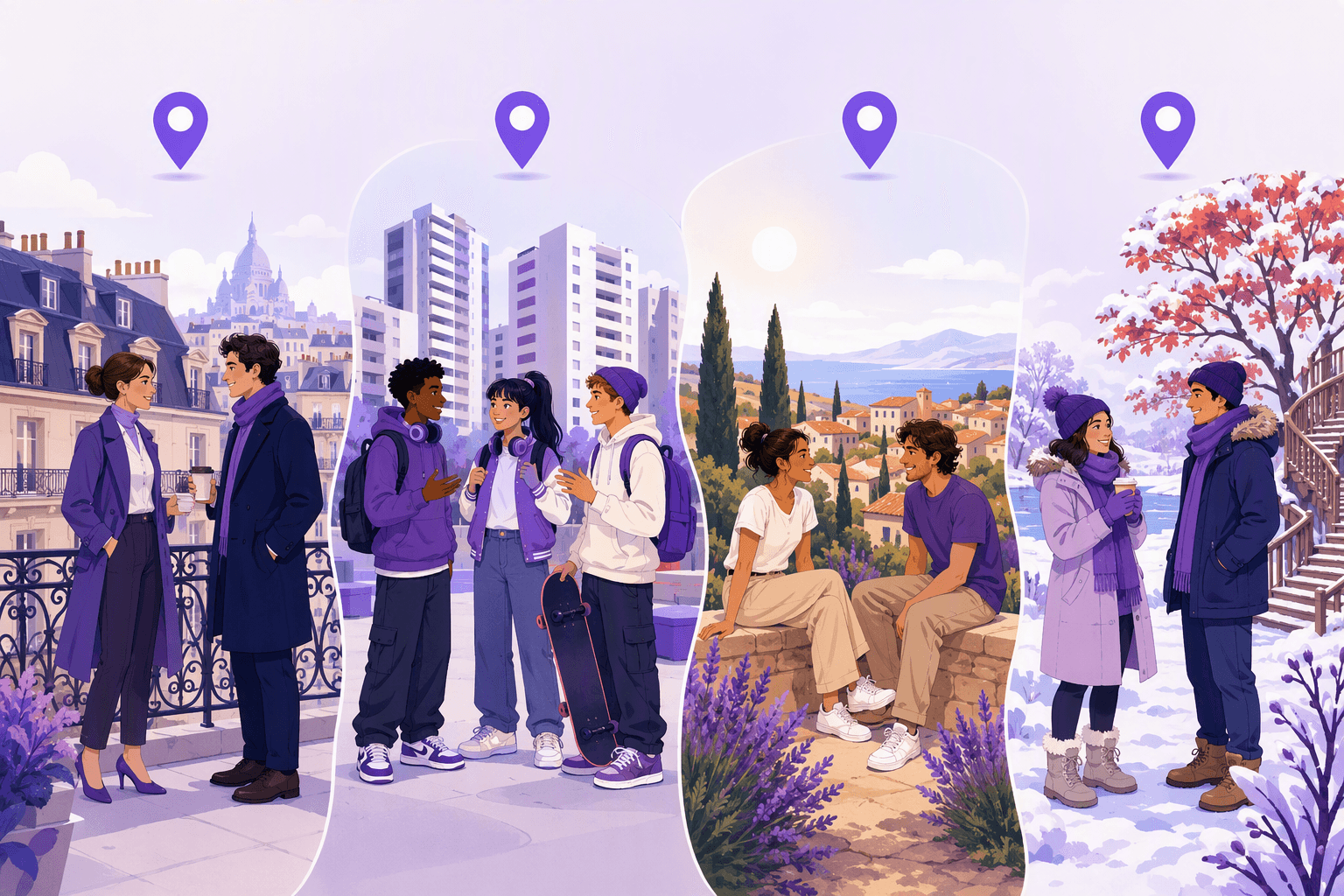
The biggest divide is between metropolitan France and Quebec. A Parisian saying C'est ouf ! and a Montrealer saying C'est malade ! mean the same thing, but neither expression would sound natural in the other's city. Quebec's joual draws from centuries-old Norman French and English loanwords, creating a slang system entirely independent of argot and verlan.
⚠️ Register Awareness Is Critical in French
French culture has a strong sense of linguistic register. Using heavy slang (verlan, Arabic borrowings) in formal settings (job interviews, meeting a partner's parents, professional emails) can create a strongly negative impression. Standard French (français soutenu) and slang (français familier) are treated as almost separate languages. Master both, but know when to deploy each one.
How to Respond to French Slang
When someone uses slang with you, it signals they consider you an insider. Here are natural responses.
| They Say | Meaning | You Respond |
|---|---|---|
| C'est ouf ! | That's crazy! | Grave ! (Totally!) / Trop ouf ! (So crazy!) |
| T'es relou | You're annoying | Mais non ! (No I'm not!) / Arrête (Stop it) |
| Je kiffe | I love it | Moi aussi je kiffe (I love it too) |
| J'ai le seum | I'm so frustrated | C'est normal (Makes sense) / Pas de chance (Bad luck) |
| C'est chelou | That's sketchy | Carrément (Totally) / Ouais, bizarre (Yeah, weird) |
| Nickel ! | Perfect! | Nickel (Perfect) / Top ! (Great!) |
Practice With Real French Content
The best way to absorb French slang is through immersion. French cinema is rich with informal language. Films like La Haine (1995) pioneered banlieue slang on screen, while series like Lupin and Emily in Paris show different registers of contemporary French.
Wordy lets you watch French movies and shows with interactive subtitles. When a character drops a verlan word or an argot expression, you can tap it to see its meaning, etymology, and register level in real time. Instead of memorizing slang from a list, you pick it up naturally from authentic conversations.
For more French content, explore our blog for guides on everything from how to say hello in French to the best movies to learn French. And visit our French learning page to start practicing today.
Frequently Asked Questions
What is verlan in French?
What is the difference between argot and verlan?
Is French slang the same in France and Quebec?
Is it appropriate to use French slang with strangers?
What French slang words come from Arabic?
Sources & References
- Le Petit Robert, Dictionnaire de la langue française, 2025 edition
- Centre National de Ressources Textuelles et Lexicales (CNRTL), Étymologie et histoire des mots français
- Eble, C., Slang and Sociability: In-Group Language Among College Students (University of North Carolina Press)
- Ethnologue: Languages of the World, 27th edition (2024), French language entry
- Organisation internationale de la Francophonie (OIF), La langue française dans le monde, 2022
Start learning with Wordy
Watch real movie clips and build your vocabulary as you go. Free to download.


