Quick Answer
The best movies and TV shows to learn Russian are Cheburashka and Moscow Does Not Believe in Tears for beginners, Better Than Us and The Irony of Fate for intermediate learners, and Stalker and The Master and Margarita for advanced students. Russian is spoken by approximately 255 million people and is classified by the FSI as a Category IV language, requiring around 1,100 hours to reach proficiency.
Russian cinema does not get the global attention it deserves. Soviet-era classics, gritty 90s films, and a growing wave of modern streaming shows make it one of the most interesting film cultures to explore, and one of the best ways to train your ear for a language that intimidates a lot of learners. Russian is spoken by approximately 255 million people worldwide (Ethnologue, 2024), making it the eighth most spoken language globally. The FSI classifies it as a Category IV language, requiring around 1,100 hours to reach proficiency. The Cyrillic alphabet looks scary for about three days. After that, it clicks. The real challenge with Russian is the grammar: six cases, verb aspect pairs, and a flexible word order that lets speakers rearrange sentences for emphasis. As linguist Stephen Krashen argues in his Input Hypothesis, comprehensible input from authentic media is one of the most effective ways to internalize grammar naturally. This list covers 60 years of Russian film and television. Start with the ones that match your level and work your way up.
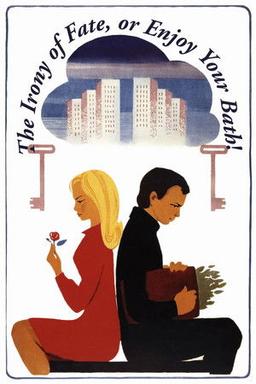
The Irony of Fate (Ironiya Sudby)
Every Russian family watches this on New Year's Eve. It is the Russian equivalent of watching "It's a Wonderful Life." The dialogue is built around a simple comedy of errors: a man gets drunk, flies to the wrong city, and ends up in a stranger's apartment. The humor relies on everyday vocabulary, and the characters speak standard, clear Moscow Russian at a moderate pace.
Learning tip: The film has several songs with lyrics that are well-known across Russia. Look up the lyrics and follow along. Russian poetry and song lyrics are a surprisingly effective way to internalize grammar patterns.
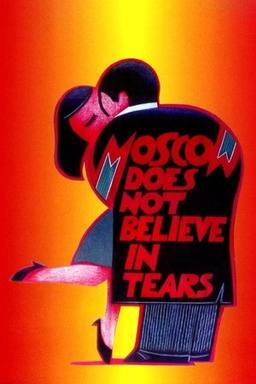
Moscow Does Not Believe in Tears (Moskva Slezam ne Verit)
An Oscar-winning film that follows three women over 20 years in Moscow. The dialogue is conversational, covering friendship, work, love, and raising kids. The language is standard and the emotional range gives you vocabulary for situations that matter in real life. Because it spans decades, you also hear subtle shifts in how Russian was spoken from the 1950s to the 1970s.
Learning tip: Focus on the domestic scenes first. The vocabulary is practical: cooking, arguing, apologizing, making plans. These are the phrases you will use most in real conversation.
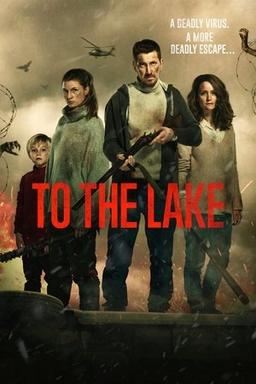
To the Lake (Epidemiya)
A pandemic thriller where a group of people flee Moscow for a remote lake. The tension keeps you watching, and the dialogue is modern, colloquial Russian. Characters argue, negotiate, and make decisions under pressure, so you hear how Russian sounds when emotions are high. The vocabulary covers survival, family conflict, and moral dilemmas.
Learning tip: The arguments between characters are great for learning how Russians express disagreement. Notice how intonation shifts when someone is angry versus sarcastic versus pleading. Russian intonation carries a lot of emotional weight.
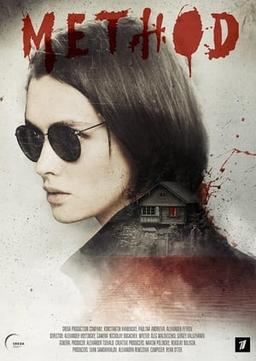
The Method (Metod)
A dark crime drama about a detective with unconventional methods. The dialogue is tense and clipped, with lots of interrogation scenes where characters speak directly and with purpose. This is great for learning how to ask questions, give commands, and construct shorter sentences in Russian. The modern slang mixed with police jargon expands your vocabulary quickly.
Learning tip: Interrogation scenes force characters to speak in complete, deliberate sentences. Use those scenes for dictation practice: pause, write what you heard, then check. The structure of the questions follows patterns you will use constantly.

Better Than Us (Luchshe, chem lyudi)
A Russian sci-fi series about a humanoid robot in near-future Moscow. The premise is unusual for Russian TV, and the dialogue blends everyday family conversation with tech vocabulary and philosophical discussions about humanity. It was one of the first Russian series to get wide international distribution through Netflix, so the production quality is high and the speech is clear.
Learning tip: The family scenes use casual, domestic Russian while the corporate scenes switch to formal register. Track which verb forms change between settings. The contrast helps you feel the difference between "ty" (informal you) and "vy" (formal you) in context.

Leviathan (Leviafan)
Andrey Zvyagintsev's film about a man fighting a corrupt mayor in a small coastal town. The Russian is raw and naturalistic. Characters drink, swear, argue, and speak in the kind of unpolished everyday language that textbooks never teach you. The setting outside Moscow means you hear provincial speech patterns that differ from the standard dialect.
Learning tip: This film is heavy and slow-paced, which actually helps for language learning. The silences between dialogue give your brain time to process what was just said. Do not rush through it.
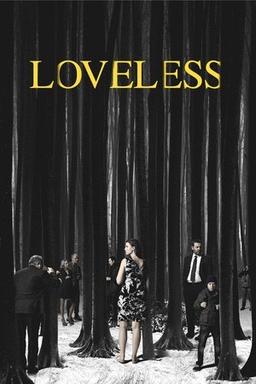
Loveless (Nelyubov)
Another Zvyagintsev film, this time about a divorcing couple whose son goes missing. The dialogue is emotionally intense and full of conflict. You hear how Russians argue in intimate settings: the accusations, the deflections, the silences. The vocabulary is emotional and relational, covering territory that most language courses skip entirely.
Learning tip: Watch the argument scenes multiple times. Russian arguments have a rhythm and structure that differs from English. The word order shifts for emphasis, and the intonation patterns are worth studying closely.
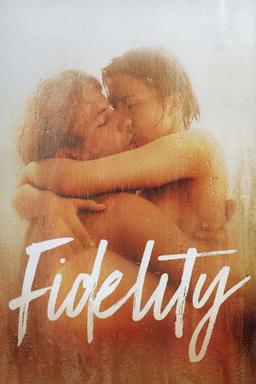
Fidelity (Vernost)
A drama about a woman questioning her marriage. The Russian is quiet, internal, and reflective. Long stretches feature realistic domestic conversation: plans for the evening, discussions about relationships, small talk with friends. It is the opposite of dramatic movie dialogue, which makes it closer to how Russian actually sounds in private moments.
Learning tip: The main character often speaks in short, clipped sentences when she is emotionally guarded. Notice how sentence length in Russian correlates with emotional openness, just like in English.
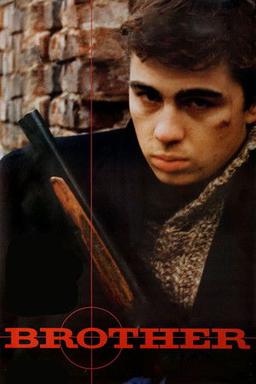
Brother (Brat)
A cult classic from the chaotic 1990s about a young man who becomes a hitman in St. Petersburg. The dialogue is drenched in 90s slang, criminal jargon, and street Russian. It is not polite or standard, but it is culturally essential. Russians quote this film constantly. Understanding the references helps you understand Russian pop culture.
Learning tip: Danila Bagrov's speech is deliberately simple and direct, almost deadpan. The people around him speak more colorfully. Start by following his lines, then branch out to the supporting characters once you are comfortable.
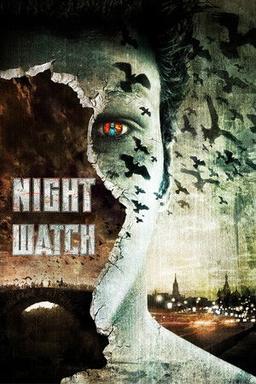
Night Watch (Nochnoy Dozor)
A fantasy action film based on Sergei Lukyanenko's novel. The dialogue mixes modern colloquial Russian with fantasy terminology and dramatic monologues about light and darkness. It is fast-paced and the vocabulary is unusual, but it is one of the most fun Russian films to watch repeatedly. Each rewatch reveals words and phrases you missed before.
Learning tip: Read a plot summary in English first so you are not lost in the mythology. Then watch in Russian with Russian subtitles. The Cyrillic subtitles help you connect spoken words to their written forms, which is crucial for building reading skills alongside listening.
Tips for Learning Russian from Movies and TV
Learn Cyrillic before you press play. It takes about a week of daily practice. Some letters look like English letters but sound completely different ("P" is "R," "H" is "N"), so get those sorted first or you will confuse yourself constantly.
Focus on verb pairs early. Russian verbs come in perfective and imperfective pairs, and movies show you the difference in action. "He was reading" versus "he read (and finished)" is a distinction Russian makes every single time.
Do not memorize case tables. Instead, watch how prepositions and endings work in real sentences. Your brain absorbs patterns from repeated exposure faster than from charts. Save the tables for reference, not for memorization.
Start with Soviet classics. The speech in films from the 1970s and 1980s tends to be clearer and more standard than modern Russian, which is full of slang and borrowed English words. Build your foundation on the clean stuff first.
Use Wordy to break down clips word by word. Russian word boundaries are hard to hear at first because the language links words together in speech. Seeing each word isolated helps you start to hear where one ends and the next begins.
Frequently Asked Questions
Is Russian too hard to learn from movies?
Do I need to learn Cyrillic before watching Russian movies?
What is the best Russian movie for absolute beginners?
Should I watch Soviet-era films or modern Russian shows?
Sources & References
- Foreign Service Institute (FSI). "Language Difficulty Rankings." U.S. Department of State.
- Ethnologue (2024). "Russian Language Profile." SIL International.
- Krashen, S. (1985). "The Input Hypothesis: Issues and Implications." Longman.
Start learning with Wordy
Watch real movie clips and build your vocabulary as you go. Free to download.


