Months of the Year in Spanish: Complete Guide With Origins and Cultural Traditions
Quick Answer
The 12 months in Spanish are enero, febrero, marzo, abril, mayo, junio, julio, agosto, septiembre, octubre, noviembre, and diciembre. All are masculine, never capitalized, and used with the preposition 'en' (en enero = in January) or 'de' for specific dates (el 5 de marzo = March 5th).
The 12 months of the year in Spanish closely mirror their English counterparts, making them among the easiest vocabulary for English speakers to learn. Every Spanish month name shares a Latin root with its English equivalent, so recognition is nearly instant.
Spanish is spoken by approximately 559 million people across 21 countries, according to Ethnologue's 2024 data. From scheduling meetings in Madrid to planning vacations in Buenos Aires, month names are essential calendar vocabulary you will use daily. What makes them interesting is not just the words themselves, but the grammar rules, cultural traditions, and seasonal differences that vary across the vast Spanish-speaking world.
"The Roman calendar's legacy is nowhere more visible than in the month names of Romance languages, where the original Latin designations have survived virtually unchanged for over two millennia." (David Crystal, The Cambridge Encyclopedia of Language)
This guide covers all 12 months with pronunciation, their Latin origins, essential grammar rules, and the major holidays and cultural traditions associated with each.

All 12 Months at a Glance
| English | Spanish | Pronunciation | Note |
|---|---|---|---|
| January | enero | eh-NEH-roh | From Latin Ianuarius (Janus) |
| February | febrero | feh-BREH-roh | From Latin Februarius (purification) |
| March | marzo | MAR-soh | From Latin Martius (Mars) |
| April | abril | ah-BREEL | From Latin Aprilis (opening/spring) |
| May | mayo | MAH-yoh | From Latin Maius (Maia) |
| June | junio | HOO-nee-oh | From Latin Iunius (Juno) |
| July | julio | HOO-lee-oh | From Latin Iulius (Julius Caesar) |
| August | agosto | ah-GOHS-toh | From Latin Augustus (Augustus Caesar) |
| September | septiembre | sehp-tee-EHM-breh | From Latin septem (seven) |
| October | octubre | ohk-TOO-breh | From Latin octo (eight) |
| November | noviembre | noh-bee-EHM-breh | From Latin novem (nine) |
| December | diciembre | dee-see-EHM-breh | From Latin decem (ten) |
💡 Pronunciation Pattern
Notice that the last four months (septiembre, octubre, noviembre, diciembre) all share the -bre ending, pronounced "breh." This makes them easy to group together when memorizing. The "J" in junio and julio is pronounced like a strong English "H."
Latin Origins: Why Each Month Has Its Name
Every Spanish month name is a direct inheritance from the Roman calendar. Understanding these origins makes the vocabulary memorable and reveals fascinating historical connections.
Enero
Enero comes from the Latin Ianuarius, named after Janus, the two-faced Roman god of doorways, beginnings, and transitions. Janus looked simultaneously toward the past and the future, making him the perfect deity for the first month of the year. The English word "January" shares this same root.
Febrero
Febrero derives from Februarius, which comes from the Latin februum meaning "purification." The Romans held the purification festival Februa during this month to cleanse and prepare for the coming spring. It has always been the shortest month, with 28 days (29 in leap years, or años bisiestos in Spanish).
Marzo
Marzo comes from Martius, named after Mars, the Roman god of war. In the original Roman calendar, March was actually the first month of the year, which is why September through December have numerical names that are "off by two." Mars was also an agricultural deity, and March marked the beginning of the farming and military campaign season.
Abril
Abril derives from Aprilis, likely connected to the Latin verb aperire ("to open"), referring to the opening of flower buds in spring. Some scholars link it instead to the Greek goddess Aphrodite. Either way, the month carries associations with renewal and growth across the Spanish-speaking world.
Mayo
Mayo comes from Maius, named after Maia, the Roman goddess of growth and fertility. In many Latin American countries, May is associated with mothers. El Día de las Madres is celebrated on May 10th in Mexico, making mayo one of the most culturally significant months.
Junio
Junio derives from Iunius, named after Juno, the Roman goddess of marriage and queen of the gods. This association with marriage persists today, and June remains one of the most popular months for weddings across Spain and Latin America.
Julio
Julio comes from Iulius, renamed in honor of Julius Caesar in 44 BC. Before that, this month was called Quintilis (the fifth month in the old Roman calendar). Julio is also a common Spanish first name, making it the only month that doubles as a popular given name.
Agosto
Agosto derives from Augustus, renamed after Emperor Augustus Caesar in 8 BC. Like July, it was originally a numbered month called Sextilis (sixth). Augustus allegedly added an extra day to "his" month so it would have as many days as Julius Caesar's July.
🌍 Agosto and Vacation Culture
In Spain, agosto is synonymous with vacation. The phrase hacer el agosto (literally "to do August") means "to make a killing" or "to profit," referring to the harvest season. Major cities like Madrid and Barcelona empty out as residents head to the coast. Many small businesses close entirely for the month.
Septiembre
Septiembre comes from the Latin septem meaning "seven." It was the seventh month in the original Roman calendar that began in March. When January and February were added to the beginning of the calendar, September kept its name despite becoming the ninth month.
Octubre
Octubre derives from octo ("eight"), following the same pattern. In the modern calendar it is the tenth month, but the Latin root stubbornly preserves its original position. The same mismatch exists in English, French, Italian, and every Romance language.
Noviembre
Noviembre comes from novem ("nine"). The original ninth month became our eleventh. In many Spanish-speaking countries, November is associated with remembrance. El Día de los Muertos (Day of the Dead) is celebrated on November 1st and 2nd, particularly in Mexico and Central America.
Diciembre
Diciembre derives from decem ("ten"), the original tenth month that became the twelfth. Despite two thousand years of calendar reform, no one ever bothered to rename these last four months to match their actual positions.
Grammar Rules: How to Use Months in Spanish
Spanish handles months differently from English in several key ways. Getting these rules right will immediately make your Spanish sound more natural.
No Capitalization
The Real Academia Española (RAE) and Fundéu RAE both confirm that months are common nouns in Spanish. They are never capitalized unless they begin a sentence.
- Mi cumpleaños es en marzo. (My birthday is in March.)
- Enero es el mes más frío. (January is the coldest month. Capitalized only because it starts the sentence.)
This rule also applies to days of the week and language names. If you are used to English conventions, this is one of the most common mistakes to watch for in written Spanish.
Gender: All Months Are Masculine
Every month in Spanish is masculine. When a month appears with an article or adjective, use masculine forms.
- el próximo enero (next January)
- un febrero muy lluvioso (a very rainy February)
- todo agosto (all of August)
Prepositions With Months
The preposition en is used to say "in" a particular month, with no article needed.
| English | Spanish | Pronunciation |
|---|---|---|
| in January | en enero | en eh-NEH-roh |
| in March | en marzo | en MAR-soh |
| in July | en julio | en HOO-lee-oh |
| in December | en diciembre | en dee-see-EHM-breh |
| from May to August | de mayo a agosto | deh MAH-yoh ah ah-GOHS-toh |
| until November | hasta noviembre | AHS-tah noh-bee-EHM-breh |
Saying Dates
Spanish dates follow the format: el + cardinal number + de + month. The key exception is the first of the month, which uses the ordinal primero.
| English | Spanish | Pronunciation | Note |
|---|---|---|---|
| January 1st | el primero de enero | el pree-MEH-roh deh eh-NEH-roh | Ordinal for the 1st only |
| February 14th | el catorce de febrero | el kah-TOR-seh deh feh-BREH-roh | |
| May 5th | el cinco de mayo | el SEEN-koh deh MAH-yoh | |
| October 12th | el doce de octubre | el DOH-seh deh ohk-TOO-breh | |
| December 25th | el veinticinco de diciembre | el bayn-tee-SEEN-koh deh dee-see-EHM-breh |
💡 Date Format in Writing
In Spanish-speaking countries, dates are written in day/month/year order: 25/12/2026 means December 25, 2026 (not the American month/day/year). In formal writing, the format is 25 de diciembre de 2026. This is consistent with most of the world outside the United States.
Seasons and the Hemisphere Question
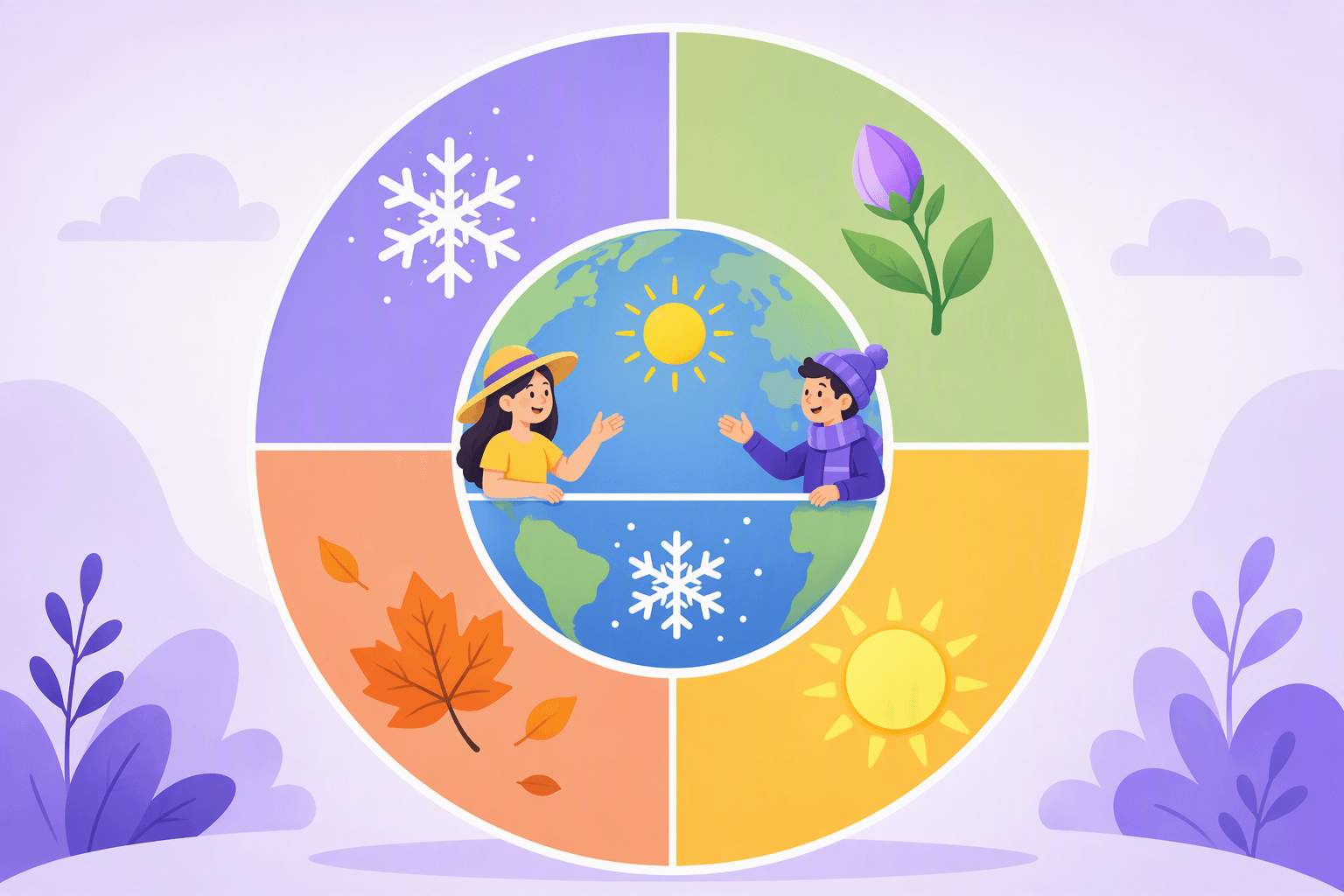
One detail that catches many learners off guard is that the seasons are reversed in Spanish-speaking countries south of the equator. Argentina, Chile, Uruguay, Paraguay, and parts of Bolivia, Peru, Ecuador, and Colombia experience opposite seasons from Spain and Mexico.
| English | Spanish | Pronunciation | Note |
|---|---|---|---|
| Spring (Northern) | primavera (marzo-mayo) | pree-mah-BEH-rah | Spain, Mexico, Central America |
| Summer (Northern) | verano (junio-agosto) | beh-RAH-noh | Spain, Mexico, Central America |
| Fall (Northern) | otoño (septiembre-noviembre) | oh-TOH-nyoh | Spain, Mexico, Central America |
| Winter (Northern) | invierno (diciembre-febrero) | een-bee-EHR-noh | Spain, Mexico, Central America |
| Summer (Southern) | verano (diciembre-febrero) | beh-RAH-noh | Argentina, Chile, Uruguay |
| Winter (Southern) | invierno (junio-agosto) | een-bee-EHR-noh | Argentina, Chile, Uruguay |
This means that when a speaker from Buenos Aires says en verano (in summer), they mean December through February, the exact opposite of a speaker from Madrid. Christmas in Argentina is a warm, outdoor affair with barbecues (asados), while in Spain it is bundled up and cold. Context always matters when discussing seasons in Spanish.
🌍 Tropical Countries Have Different Seasons
In countries near the equator like Colombia, Ecuador, and parts of Central America, the traditional four-season model does not apply. Instead, people refer to temporada seca (dry season) and temporada de lluvias (rainy season). When someone in Bogotá says invierno, they often mean the rainy season, not cold weather.
Key Holidays and Cultural Dates by Month
Understanding which months carry special cultural weight helps you connect with Spanish speakers on a deeper level. Here are the most significant dates across the Spanish-speaking world.
Enero: Día de los Reyes Magos (January 6th, Three Kings' Day) is the traditional gift-giving holiday in Spain and much of Latin America, often more important than Christmas Day itself. Children receive presents from the Reyes Magos (Wise Kings) rather than Santa Claus.
Febrero: Carnaval falls in February or early March depending on the year. The celebrations in Cádiz (Spain), Barranquilla (Colombia), and Oruro (Bolivia) are among the most spectacular in the world. February 14th is el Día de San Valentín, widely celebrated across the Spanish-speaking world.
Marzo/Abril: Semana Santa (Holy Week) moves between March and April. Seville's Semana Santa processions are UNESCO-recognized, drawing over a million visitors annually. In Guatemala, elaborate alfombras (sawdust carpets) cover entire streets.
Mayo: Día de las Madres on May 10th in Mexico is one of the highest-revenue days for restaurants and florists in the entire country. In Spain, el Día de la Madre falls on the first Sunday of May.
Septiembre: Mexico celebrates el Día de la Independencia on September 16th with the Grito de Dolores ceremony. Several Central American countries also celebrate independence in September.
Noviembre: El Día de los Muertos (November 1st-2nd) is one of Mexico's most iconic cultural traditions. Families build ofrendas (altars) and visit cemeteries to honor deceased loved ones with food, flowers, and music. UNESCO recognized it as Intangible Cultural Heritage in 2008.
Diciembre: Navidad (December 25th) and Nochebuena (Christmas Eve, December 24th) anchor the holiday season. In Spain, the celebration extends to January 6th. Nochevieja (New Year's Eve) features the tradition of eating twelve grapes at midnight, one for each chime of the clock, for good luck in the coming year.
Useful Month-Related Phrases
| English | Spanish | Pronunciation |
|---|---|---|
| What month is it? | ¿En qué mes estamos? | en keh mehs ehs-TAH-mohs |
| What is today's date? | ¿Qué fecha es hoy? | keh FEH-chah ehs oy |
| My birthday is in April. | Mi cumpleaños es en abril. | mee koom-pleh-AH-nyohs ehs en ah-BREEL |
| Last month | el mes pasado | el mehs pah-SAH-doh |
| Next month | el mes que viene | el mehs keh bee-EH-neh |
| Every month | todos los meses | TOH-dohs lohs MEH-sehs |
| Month by month | mes a mes | mehs ah mehs |
| Bimonthly | bimensual | bee-men-SWAHL |
Practice With Real Spanish Content
Memorizing a list of months is a solid start, but hearing them used naturally in conversation is what makes them stick. Spanish-language films and series are full of date references, scheduling conversations, and seasonal vocabulary. Check out our guide to the best movies for learning Spanish for recommendations across different dialects and difficulty levels.
Wordy lets you practice Spanish vocabulary in real context by watching movies and shows with interactive subtitles. When a month or date appears in dialogue, you can tap on it to see the translation, pronunciation, and grammatical details in real time. This contextual approach is far more effective than drilling isolated vocabulary lists.
For more Spanish learning resources, explore our blog or visit our Spanish learning page to start practicing today.
Frequently Asked Questions
What are the 12 months of the year in Spanish?
Why are months not capitalized in Spanish?
How do you say a date in Spanish?
Are the months masculine or feminine in Spanish?
How do you say 'in January' in Spanish?
Are Spanish month names the same in Spain and Latin America?
Sources & References
- Instituto Cervantes, El español en el mundo, 2024 annual report
- Fundéu RAE, Recomendaciones sobre la escritura de fechas y meses
- Ethnologue: Languages of the World, 27th edition (2024)
- Crystal, D., The Cambridge Encyclopedia of Language (Cambridge University Press)
- Comrie, B. (ed.), The World's Major Languages (Routledge)
Start learning with Wordy
Watch real movie clips and build your vocabulary as you go. Free to download.


