Colors in Spanish: 25+ Essential Colors With Grammar Rules and Cultural Meanings
Quick Answer
The basic colors in Spanish are rojo (red), azul (blue), amarillo (yellow), verde (green), naranja (orange), morado (purple), blanco (white), negro (black), gris (gray), marrón (brown), and rosa (pink). Most colors agree in gender and number with the noun they modify (rojo/roja, blancos/blancas), but colors derived from nouns (rosa, naranja, violeta) are invariable.
Colors are among the first vocabulary any language learner needs. In Spanish, knowing your colors goes far beyond describing objects. Colors carry rich cultural weight, appear in dozens of everyday idioms, and follow grammar rules that trip up even intermediate learners.
With approximately 559 million speakers across 21 countries according to Ethnologue's 2024 data, Spanish is the world's second most spoken language by native speakers. Whether you are shopping for una camisa azul in Barcelona, describing el cielo rojo of a Mexican sunset, or understanding why someone se puso verde in a conversation, color vocabulary is essential from day one.
"Color terminology reveals deep patterns in how languages carve up the perceptual spectrum. Spanish, like most major world languages, has fully developed basic color terms that map closely to universal cognitive categories identified in cross-linguistic research." (David Crystal, The Cambridge Encyclopedia of Language)
This guide covers all the essential colors in Spanish with pronunciation, grammar rules, shades, idiomatic expressions, and the regional differences you need to know.
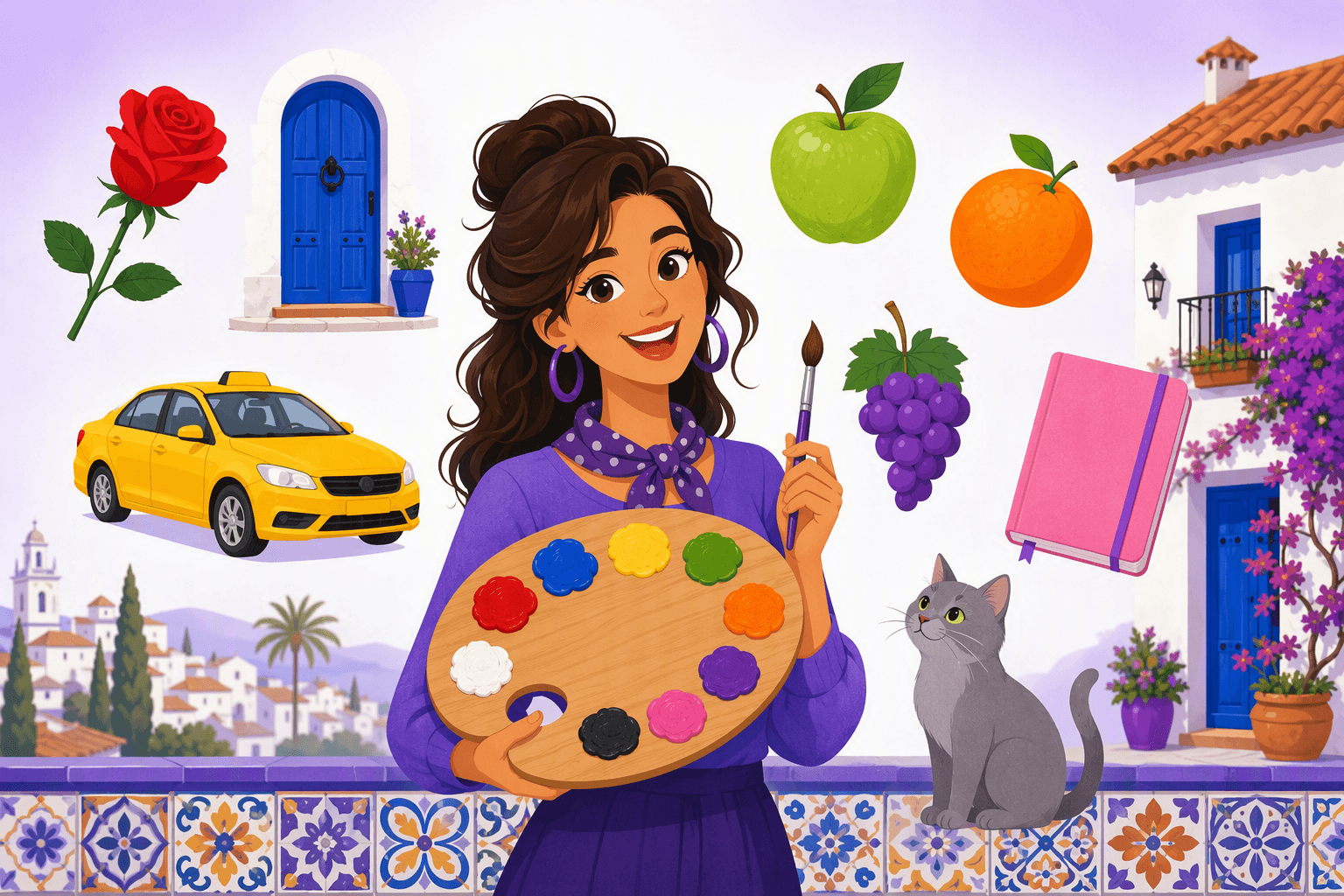
All Essential Colors at a Glance
| English | Spanish | Pronunciation | Note |
|---|---|---|---|
| Red | Rojo | RROH-hoh | Fem: roja, Pl: rojos/rojas |
| Blue | Azul | ah-SOOL | Invariable in gender |
| Yellow | Amarillo | ah-mah-REE-yoh | Fem: amarilla |
| Green | Verde | BEHR-deh | Invariable in gender |
| Orange | Naranja | nah-RAHN-hah | Invariable (from noun) |
| Purple | Morado | moh-RAH-doh | Fem: morada |
| Pink | Rosa | RROH-sah | Invariable (from noun) |
| White | Blanco | BLAHN-koh | Fem: blanca |
| Black | Negro | NEH-groh | Fem: negra |
| Gray | Gris | grees | Invariable in gender |
| Brown | Marrón | mah-RROHN | Also: café, castaño |
| Sky blue | Celeste | seh-LEHS-teh | Invariable in gender |
| Gold | Dorado | doh-RAH-doh | Fem: dorada |
| Silver | Plateado | plah-teh-AH-doh | Fem: plateada |
| Violet | Violeta | bee-oh-LEH-tah | Invariable (from noun) |
💡 Quick Gender Rule
Colors ending in -o change to -a for feminine nouns (rojo → roja). Colors ending in -e or a consonant (verde, azul, gris) stay the same for both genders. Colors borrowed from nouns (rosa, naranja, violeta) never change at all. All colors add -s or -es for plural.
Primary Colors
The three primary colors form the foundation of Spanish color vocabulary. These appear constantly in everyday conversation.
Rojo
Rojo is one of the most culturally loaded colors in Spanish. It follows standard -o/-a adjective agreement: el vestido rojo (the red dress, masculine), la rosa roja (the red rose, feminine). The plural forms are rojos and rojas.
Red is deeply tied to Spanish identity. The muleta (cape) used in bullfighting is famously red, and the color dominates the flags of numerous Spanish-speaking countries. The idiomatic expression ponerse rojo means "to turn red" or "to blush," and you will hear it constantly in everyday conversation. Al rojo vivo (at red hot) means something is at its peak intensity, often used for heated debates or breaking news.
Azul
Azul is invariable in gender. It stays azul whether describing a masculine or feminine noun: el cielo azul (the blue sky), la puerta azul (the blue door). The plural is azules.
The word has a fascinating etymology. Unlike most Spanish color terms derived from Latin, azul comes from the Arabic lazaward, reflecting the Moorish influence on the Iberian Peninsula during 800 years of coexistence. One of the most beloved Spanish idioms uses this color: príncipe azul (blue prince) means "Prince Charming." If someone says they are waiting for their príncipe azul, they are waiting for their ideal romantic partner.
Amarillo
Amarillo follows the standard -o/-a pattern: el taxi amarillo (the yellow taxi), la flor amarilla (the yellow flower). Plurals are amarillos and amarillas.
In some Latin American countries, yellow carries specific cultural associations. In Colombia and other Andean nations, wearing yellow underwear on New Year's Eve is believed to bring good luck and prosperity in the coming year. The expression prensa amarilla (yellow press) refers to sensationalist tabloid journalism, just as "yellow journalism" does in English.
Secondary Colors
Verde
Verde ends in -e, making it invariable in gender: el pasto verde (the green grass), la manzana verde (the green apple). The plural is verdes.
Spanish has a remarkable number of idioms involving green. Estar verde means "to be inexperienced" or "green," exactly like the English equivalent. But viejo verde (green old man) describes an older man who makes inappropriate advances toward younger people, and chiste verde (green joke) means a dirty or off-color joke. The expression poner verde a alguien means to badmouth someone harshly. According to Fundéu RAE, these figurative uses of verde date back to medieval Spanish literature.
Naranja
Naranja is invariable because it derives from the noun naranja (orange fruit). It never changes regardless of the noun's gender or number: el gato naranja (the orange cat), las flores naranja (the orange flowers; note: not naranjas when used as a color).
The word naranja itself traveled a remarkable linguistic path. It entered Spanish from the Arabic nāranj, which came from the Persian nārang, ultimately from the Sanskrit nāranga. The fruit arrived in Europe through Moorish trade routes, and the color was named after the fruit, not the other way around. Before the orange fruit became widespread in Europe, there was no common word for this color in any European language.
Morado
Morado is the everyday word for purple in Spanish, following standard -o/-a agreement: el vestido morado (the purple dress), la tinta morada (the purple ink). It comes from mora (mulberry), reflecting how the color was originally associated with the dark berry.
The expression pasarlas moradas means "to have a really tough time" or "to go through hardship." Púrpura, the more formal and literary alternative, refers specifically to the deep reddish-purple historically associated with royalty and the Catholic Church. Violeta is a separate color (a lighter, bluer shade) and it is invariable because it derives from the flower name.
Neutral Colors
Blanco
Blanco follows standard agreement: el papel blanco (the white paper), la pared blanca (the white wall). Plurals are blancos and blancas.
En blanco is one of the most useful color expressions in Spanish. It means "blank": una hoja en blanco (a blank page), me quedé en blanco (my mind went blank). Dar en el blanco means "to hit the mark" or "to be spot on." The expression pasar la noche en blanco means to have a sleepless night, a phrase that dates back centuries in Spanish literature.
Negro
Negro follows the -o/-a pattern: el café negro (black coffee), la noche negra (the dark night). Plurals are negros and negras.
Black appears in numerous expressions. Mercado negro (black market), humor negro (dark humor), and oveja negra (black sheep) mirror their English counterparts. More uniquely Spanish is verlo todo negro (to see everything black), meaning to be pessimistic. Pasarlas negras is synonymous with pasarlas moradas, meaning to go through a very difficult time. In many Latin American countries, negro and negra are also used as affectionate terms of endearment between partners, regardless of skin color.
Gris
Gris is invariable in gender: el día gris (the gray day), la zona gris (the gray area). The plural is grises.
Like in English, gray carries connotations of dullness and ambiguity. Una zona gris (a gray area) describes something uncertain or morally ambiguous. Un día gris describes a dreary, overcast day, or metaphorically, a depressing one.
Marrón
Marrón is invariable in gender: el oso marrón (the brown bear), la mesa marrón (the brown table). The plural is marrones. However, brown is the color with the most regional variation in the entire Spanish language.
In Mexico and Central America, café is the preferred word for brown (from the color of coffee). In Spain, marrón dominates for objects, while castaño is specifically used for hair and eye color: pelo castaño (brown hair), ojos castaños (brown eyes). The RAE recognizes all three as valid, but knowing which one to use in each country marks you as a culturally aware speaker.
Additional Colors
Rosa
Rosa is invariable because it comes from the noun rosa (rose). It stays rosa regardless of gender or number: el cuaderno rosa (the pink notebook), las paredes rosa (the pink walls).
The expression verlo todo de color de rosa (to see everything in pink) means to be overly optimistic, the equivalent of "looking through rose-colored glasses." In some Latin American countries, rosado is used as an alternative that does follow standard agreement rules: una camisa rosada.
Celeste
Celeste means sky blue or light blue, derived from cielo (sky). It is invariable in gender: el auto celeste, la camisa celeste. This color has particular significance in Argentina and Uruguay, where it describes the distinctive light blue of their national flags. The Argentine flag's celeste y blanco (sky blue and white) is a source of deep national pride, and the term is used far more frequently there than in Spain, where azul claro (light blue) is more common.
Dorado
Dorado (golden) comes from oro (gold) and follows standard -o/-a agreement: el anillo dorado (the golden ring), la era dorada (the golden age). La edad dorada and el siglo de oro (the Golden Age/Century) refer to Spain's cultural peak in the 16th and 17th centuries, when Cervantes, Lope de Vega, and Velázquez produced their masterworks.
Plateado
Plateado (silver) comes from plata (silver) and follows standard -o/-a agreement: el reloj plateado (the silver watch), la luna plateada (the silver moon). In many Latin American countries, plata is also a common slang word for money, making plateado carry subtle associations with wealth.
Grammar Rules: Color Agreement in Detail
Color adjective agreement is one of the trickiest grammar points for Spanish learners. The rules fall into three clear categories.
Category 1: Standard Agreement (Most Colors)
Colors ending in -o have four forms: masculine singular, feminine singular, masculine plural, and feminine plural.
| English | Spanish | Pronunciation |
|---|---|---|
| the red car | el coche rojo | el KOH-cheh RROH-hoh |
| the red house | la casa roja | lah KAH-sah RROH-hah |
| the white shirts | las camisas blancas | lahs kah-MEE-sahs BLAHN-kahs |
| the yellow flowers | las flores amarillas | lahs FLOH-rehs ah-mah-REE-yahs |
This category includes rojo, blanco, negro, amarillo, morado, dorado, and plateado.
Category 2: Gender-Invariable, Number-Variable
Colors ending in -e or a consonant do not change for gender but do add -s or -es for plural.
| English | Spanish | Pronunciation |
|---|---|---|
| the green table (masc) | el mantel verde | el mahn-TEL BEHR-deh |
| the green leaf (fem) | la hoja verde | lah OH-hah BEHR-deh |
| the blue eyes | los ojos azules | lohs OH-hohs ah-SOO-lehs |
| the gray walls | las paredes grises | lahs pah-REH-dehs GREE-sehs |
This category includes verde, azul, gris, marrón, and celeste.
Category 3: Fully Invariable (Noun-Derived Colors)
Colors that derive from nouns never change, not for gender, not for number. According to Butt & Benjamin's A New Reference Grammar of Modern Spanish, this is because they function as shortened forms of de color + noun.
| English | Spanish | Pronunciation |
|---|---|---|
| the pink shoes | los zapatos rosa | lohs sah-PAH-tohs RROH-sah |
| the orange curtains | las cortinas naranja | lahs kohr-TEE-nahs nah-RAHN-hah |
| the violet dress | el vestido violeta | el behs-TEE-doh bee-oh-LEH-tah |
⚠️ Common Mistake With Invariable Colors
Even advanced speakers sometimes incorrectly pluralize noun-derived colors. It is los zapatos rosa (not rosas when meaning color) and las paredes naranja (not naranjas when meaning color). If you say naranjas, it sounds like the shoes or walls are literal oranges. However, the RAE notes that rosas and naranjas as color adjectives are increasingly accepted in informal speech.
Shades and Modifiers
Spanish uses a simple system of modifiers placed after the color to describe shades and intensities. These modifiers are invariable; they never change form.
| English | Spanish | Pronunciation |
|---|---|---|
| Light blue | azul claro | ah-SOOL KLAH-roh |
| Dark blue | azul oscuro | ah-SOOL ohs-KOO-roh |
| Bright/intense red | rojo fuerte | RROH-hoh FWEHR-teh |
| Pale green | verde pálido | BEHR-deh PAH-lee-doh |
| Light yellow | amarillo claro | ah-mah-REE-yoh KLAH-roh |
| Dark gray | gris oscuro | grees ohs-KOO-roh |
| Navy blue | azul marino | ah-SOOL mah-REE-noh |
| Wine red | rojo vino | RROH-hoh BEE-noh |

When a color-plus-modifier combination modifies a noun, the entire phrase is typically treated as invariable: una camisa azul oscuro (a dark blue shirt), unos pantalones verde claro (light green pants). This rule simplifies things considerably, so you do not need to worry about agreement when using shade modifiers.
Color Idioms and Expressions
Spanish is exceptionally rich in color-based idioms. These expressions appear constantly in everyday conversation, film dialogue, and literature.
| English | Spanish | Pronunciation |
|---|---|---|
| To blush / turn red | ponerse rojo/a | poh-NEHR-seh RROH-hoh |
| Prince Charming | príncipe azul | PREEN-see-peh ah-SOOL |
| To be inexperienced | estar verde | ehs-TAR BEHR-deh |
| To see everything positively | verlo todo de color de rosa | BEHR-loh TOH-doh deh koh-LOR deh RROH-sah |
| My mind went blank | me quedé en blanco | meh keh-DEH en BLAHN-koh |
| To have a hard time | pasarlas moradas | pah-SAR-lahs moh-RAH-dahs |
| To be pessimistic | verlo todo negro | BEHR-loh TOH-doh NEH-groh |
| A dirty joke | un chiste verde | oon CHEES-teh BEHR-deh |
| To badmouth someone | poner verde a alguien | poh-NEHR BEHR-deh ah AHL-gee-en |
| To hit the mark | dar en el blanco | dar en el BLAHN-koh |
Notice how verde alone carries at least three different figurative meanings (inexperienced, dirty/risqué, and harshly critical), depending on the construction. This density of idiomatic meaning makes color vocabulary far more important than a simple vocabulary list might suggest.
Regional Differences
Color vocabulary varies noticeably across the Spanish-speaking world. These differences are among the most practical regional variations a learner can know.
Brown: As mentioned earlier, marrón is standard in Spain, café dominates in Mexico and Central America, and castaño is reserved for hair and eyes across most regions. In Argentina, marrón is used but bordó (burgundy/maroon) fills a gap that other countries cover with granate or burdeos.
Light blue: Spain uses azul claro, while Argentina and Uruguay strongly prefer celeste. This is not just a vocabulary preference; celeste carries national identity for Argentines and Uruguayans, tied directly to their flags and sports teams.
Pink: Rosa is universal, but rosado is more common in several Latin American countries including Colombia, Venezuela, and Peru. Rosado has the advantage of following standard adjective agreement: una pared rosada.
Purple: Spain tends toward morado, while many Latin American countries use violeta or lila more freely. Púrpura is formal and literary everywhere.
Blonde/Fair: For hair color, Spain uses rubio/rubia, but in many Latin American countries, güero/güera (Mexico) or mono/mona (Colombia) are the colloquial equivalents, though these describe the person rather than the color itself.
🌍 Colors in National Flags
Color vocabulary gains real-world importance when discussing national symbols. The Mexican flag's verde, blanco y rojo (green, white, and red) symbolize hope, unity, and the blood of national heroes. Argentina's celeste y blanco represents the sky and clouds. Colombia's amarillo, azul y rojo stands for gold, the seas, and blood spilled for independence. Knowing these colors and their symbolism is an easy way to connect with native speakers from these countries.
Practice With Real Spanish Content
Color vocabulary appears everywhere in authentic Spanish, from describing characters in movies (la mujer del vestido rojo) to weather reports (un cielo gris) to food (arroz negro, chocolate blanco). The best way to internalize both the vocabulary and the grammar rules is through exposure to real context.
Spanish-language films and series offer excellent opportunities to hear colors used naturally. Pay attention to how characters describe clothing, settings, and emotions using color terms and idioms. Check out our guide to the best movies for learning Spanish for recommendations across different dialects.
Wordy lets you practice color vocabulary in real context by watching Spanish content with interactive subtitles. When a color word appears in dialogue, you can tap it to see the translation, pronunciation, and grammatical details in real time. Explore our blog for more Spanish learning guides, or visit our Spanish learning page to start practicing today.
Frequently Asked Questions
What are the basic colors in Spanish?
Do colors change gender in Spanish?
What is the difference between morado and púrpura in Spanish?
How do you say light blue and dark blue in Spanish?
Why is brown said differently across Spanish-speaking countries?
Where do colors go in a Spanish sentence?
Sources & References
- Real Academia Española (RAE), Diccionario de la lengua española, 23rd edition
- Fundéu RAE, Spanish language usage guide
- Ethnologue: Languages of the World, 27th edition (2024)
- Crystal, D., The Cambridge Encyclopedia of Language (Cambridge University Press)
- Butt, J. & Benjamin, C. (2019). A New Reference Grammar of Modern Spanish, 6th edition. Routledge.
Start learning with Wordy
Watch real movie clips and build your vocabulary as you go. Free to download.


