Quick Answer
Korean months use Sino-Korean numbers plus 월 (wol, meaning 'month'): 일월 (January), 이월 (February), 삼월 (March), 사월 (April), 오월 (May), 유월 (June), 칠월 (July), 팔월 (August), 구월 (September), 시월 (October), 십일월 (November), 십이월 (December). Watch out for June (유월, NOT 육월) and October (시월, NOT 십월), these irregular pronunciations are the most common mistake learners make.
Korean months follow one of the simplest systems in any language. Each month is formed by combining a Sino-Korean number (일, 이, 삼...) with the word 월 (wol), meaning "month." There are no unique month names to memorize. If you know your Korean numbers, you already know most of the months. Whether you're looking up "months in korean" for travel, study, or conversation, this guide covers everything you need.
With approximately 82 million speakers worldwide according to Ethnologue's 2024 data, Korean has become one of the most studied languages globally, driven by the explosive popularity of K-pop, K-dramas, and Korean cinema. Knowing the months is essential for everything from booking travel to understanding Korean holidays to following along when your favorite idol announces a comeback date.
"The Korean month-naming system, inherited from classical Chinese, demonstrates remarkable efficiency. By combining ordinal numerals with a single morpheme for 'month,' the system eliminates the need for twelve unique lexical items, a stark contrast to the etymologically opaque month names in European languages." (Bernard Comrie, The World's Major Languages, Routledge; Ho-min Sohn, The Korean Language, Cambridge University Press)
This guide covers all 12 months with Hangul, pronunciation (including the two critical irregular forms), grammar patterns, the lunar calendar, and the cultural significance of each month in Korean life.
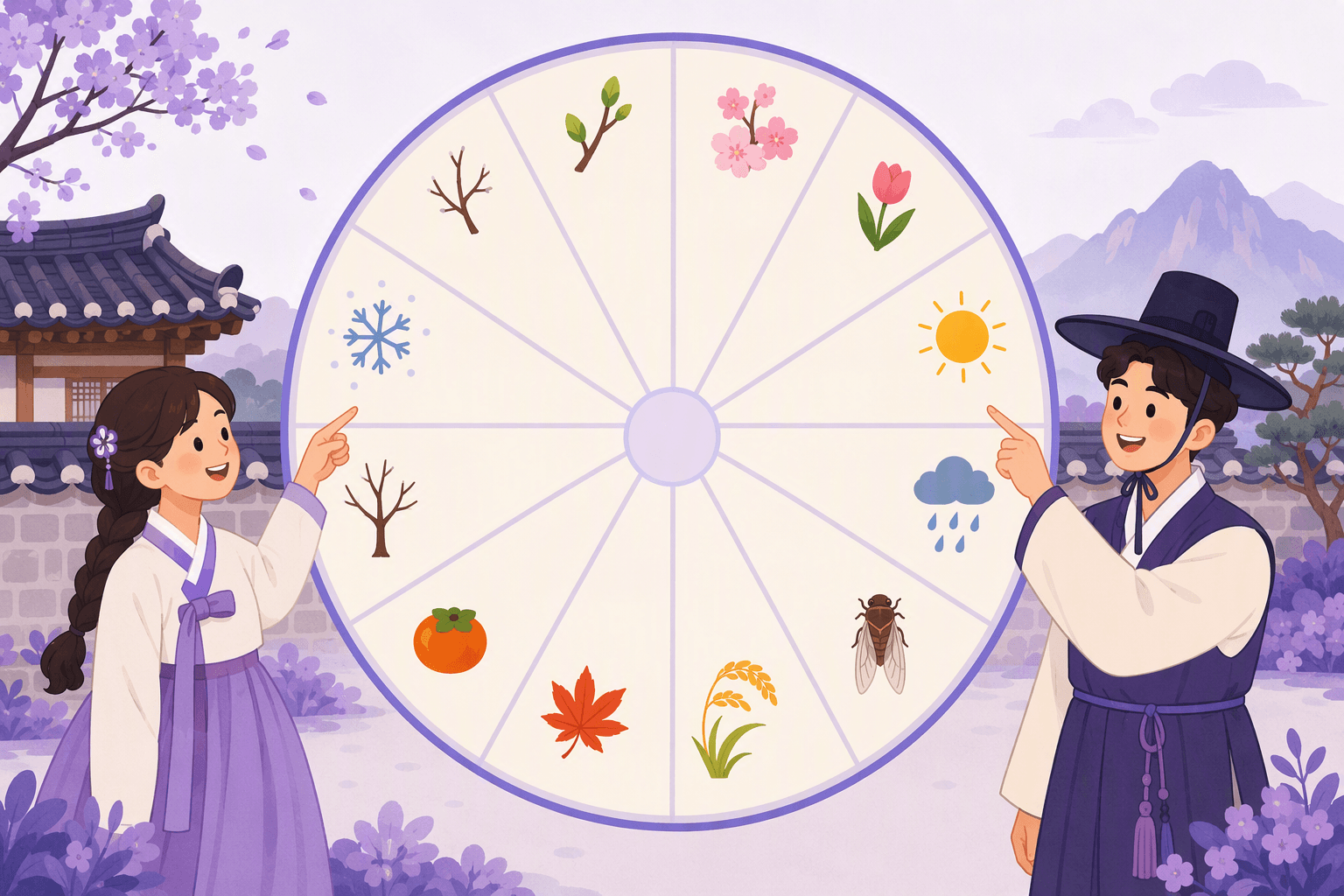
All 12 Months at a Glance
| English | Korean | Pronunciation | Note |
|---|---|---|---|
| January | 1월 (일월) | il-wol | Sino-Korean 일 = 1 |
| February | 2월 (이월) | i-wol | Sino-Korean 이 = 2 |
| March | 3월 (삼월) | sam-wol | Sino-Korean 삼 = 3 |
| April | 4월 (사월) | sa-wol | Sino-Korean 사 = 4 |
| May | 5월 (오월) | o-wol | Sino-Korean 오 = 5 |
| June | 6월 (유월) | yu-wol | IRREGULAR: 유월, not 육월 |
| July | 7월 (칠월) | chil-wol | Sino-Korean 칠 = 7 |
| August | 8월 (팔월) | pal-wol | Sino-Korean 팔 = 8 |
| September | 9월 (구월) | gu-wol | Sino-Korean 구 = 9 |
| October | 10월 (시월) | si-wol | IRREGULAR: 시월, not 십월 |
| November | 11월 (십일월) | sib-il-wol | Sino-Korean 십일 = 11 |
| December | 12월 (십이월) | sib-i-wol | Sino-Korean 십이 = 12 |
The system is beautifully regular, with exactly two exceptions. June is 유월 (yu-wol), not 육월, and October is 시월 (si-wol), not 십월. These two irregular pronunciations are the single most common mistake Korean learners make with months, so commit them to memory early.
The Sino-Korean Number System for Months
Korean months use Sino-Korean numbers (한자어 수사 hanja-eo susa), which are Korean pronunciations of Chinese number characters. These are the same numbers used for dates, money, phone numbers, and addresses.
일월 (il-wol)
일 (il) is the Sino-Korean reading of 一, meaning "one." January is literally "month one." The character 일 appears throughout Korean: 일요일 (il-yo-il, Sunday), 일본 (il-bon, Japan), and 일등 (il-deung, first place).
이월 (i-wol)
이 (i) comes from 二, meaning "two." February, the shortest month, has particular significance in the Korean school system. The Korean academic year ends in February, making it a time of graduation ceremonies (졸업식 jol-eop-sik) across the country.
삼월 (sam-wol)
삼 (sam) derives from 三, meaning "three." March marks the beginning of the Korean school year and the start of spring. The national holiday 삼일절 (Sam-il-jeol, March 1st Movement Day) commemorates the 1919 independence movement against Japanese colonial rule.
사월 (sa-wol)
사 (sa) is from 四, meaning "four." April brings cherry blossom season (벚꽃 beot-kkot) to Korea. Koreans flock to famous viewing spots like Yeouido in Seoul and Jinhae in the south for 벚꽃축제 (beot-kkot-chuk-je, cherry blossom festivals).
오월 (o-wol)
오 (o) comes from 五, meaning "five." May is one of Korea's most holiday-packed months: 어린이날 (eo-rin-i-nal, Children's Day) on May 5th, 어버이날 (eo-beo-i-nal, Parents' Day) on May 8th, and 스승의 날 (seu-seung-ui nal, Teachers' Day) on May 15th.
🌍 가정의 달 (ga-jeong-ui dal): Family Month
May is known as 가정의 달 (ga-jeong-ui dal, "Family Month") in South Korea. With Children's Day, Parents' Day, and Teachers' Day all falling within the same month, May is dedicated to honoring family bonds and the people who shape your life. Gifts, flowers, and family outings define the month, and restaurants and shops run special family-themed promotions.
The Two Irregular Months: June and October
This is the section that will save you from the most common pronunciation mistake in Korean months. Two months have irregular pronunciations that deviate from the standard number + 월 pattern.
유월 (yu-wol)
June should logically be 육월 (yug-wol), since six is 육 (yuk). But the final consonant ㄱ (k) of 육 is dropped before 월 for easier pronunciation. The result is 유월 (yu-wol). This is not optional or dialectal; 유월 is the only correct standard pronunciation, as codified by NIKL (the National Institute of Korean Language).
시월 (si-wol)
October should logically be 십월 (sip-wol), since ten is 십 (sip). But the final consonant ㅂ (p) of 십 is dropped before 월, producing 시월 (si-wol). Again, this is the mandatory standard form. You will hear native speakers say 시월 every single time.
⚠️ The #1 Learner Mistake
Saying 육월 instead of 유월 and 십월 instead of 시월 immediately marks you as a beginner. These pronunciation changes exist because Korean phonology avoids certain consonant clusters at syllable boundaries. The NIKL explicitly lists 유월 and 시월 as the standard pronunciations in the Standard Korean Language Dictionary. Memorize these two exceptions and you will sound significantly more natural.
Note that November (십일월 sib-il-wol) and December (십이월 sib-i-wol) are regular because the consonant ㅂ of 십 is followed by a vowel (이, 일), not by 월 directly. The problematic cluster only occurs when ㅂ or ㄱ sits right before the ㅇ of 월.
Grammar: Using Months in Sentences
Saying "In [Month]" With the 에 (e) Particle
To express "in" a particular month, add the time particle 에 (e) after the month name.
- 삼월에 한국에 갈 거예요. (Sam-wol-e han-gug-e gal geo-ye-yo.) = I'm going to Korea in March.
- 유월에 결혼해요. (Yu-wol-e gyeol-hon-hae-yo.) = I'm getting married in June.
In casual speech, the 에 particle is often dropped:
- 시월 여행 가자! (Si-wol yeo-haeng ga-ja!) = Let's travel in October!

Korean Date Format: Year-Month-Day
Korean dates follow the order year, month, day, the same as Japanese and Chinese and the opposite of American English.
| English | Korean | Pronunciation |
|---|---|---|
| March 1, 2026 | 2026년 3월 1일 | i-cheon-i-sib-yuk-nyeon sam-wol il-il |
| June 25 | 6월 25일 | yu-wol i-sib-o-il |
| October 3 | 10월 3일 | si-wol sam-il |
| December 25 | 12월 25일 | sib-i-wol i-sib-o-il |
The structure is: year + 년 (nyeon) + month + 월 (wol) + day + 일 (il). In written Korean, Arabic numerals are standard in everyday contexts (3월 15일), while Hangul numerals (삼월 십오일) appear in formal or literary writing.
Asking "What Month?"
- 지금 몇 월이에요? (Ji-geum myeot wol-i-e-yo?) = What month is it now?
- 생일이 몇 월이에요? (Saeng-il-i myeot wol-i-e-yo?) = What month is your birthday?
Counting Months as Duration: 개월 (gae-wol)
There is a critical distinction between naming a calendar month and expressing a duration of months. Calendar months use Sino-Korean numbers + 월. But to say "for X months" (a duration), you use native Korean numbers + 개월 (gae-wol).
| English | Korean | Pronunciation | Note |
|---|---|---|---|
| 1 month | 한 개월 | han gae-wol | Native Korean 한 = 1 |
| 2 months | 두 개월 | du gae-wol | Native Korean 두 = 2 |
| 3 months | 세 개월 | se gae-wol | Native Korean 세 = 3 |
| 6 months | 여섯 개월 | yeo-seot gae-wol | Native Korean 여섯 = 6 |
| 12 months | 열두 개월 | yeol-du gae-wol | Native Korean 열두 = 12 |
💡 개월 vs. 달
In everyday conversation, many Koreans use 달 (dal) instead of 개월 for counting months: 세 달 (se dal) = three months. 달 is the native Korean word for "month" (and also "moon"), while 개월 is the Sino-Korean counter. Both are correct, but 개월 is more common in formal or written contexts (contracts, medical forms, military service documents), while 달 dominates casual speech.
The Korean Cultural Calendar: Key Months
Korean life follows a rich cycle of holidays and cultural events tied to specific months. Understanding these gives you real-world context for when and how months come up in conversation.
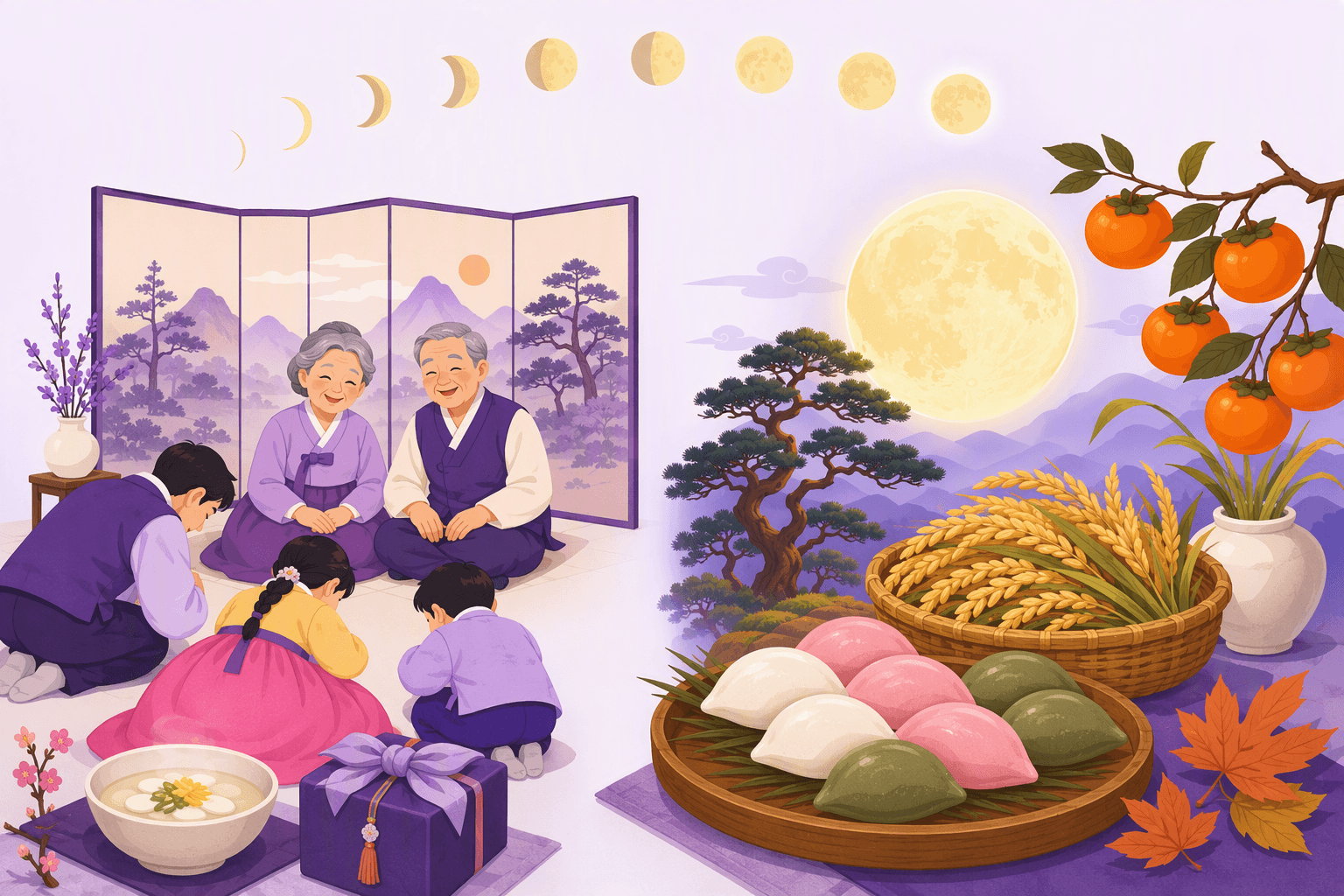
일월 / 이월: Seollal (설날)
설날 (Seol-lal, Lunar New Year) is Korea's most important family holiday. Because it follows the lunar calendar, the Gregorian date changes every year, typically falling in January or February. Families gather for ancestral rites (차례 cha-rye), eat 떡국 (tteok-guk, rice cake soup, and eating it symbolically adds one year to your age), and play traditional games like 윷놀이 (yut-nol-i). The holiday lasts three days (the day before, the day of, and the day after the lunar new year).
삼월: Independence Movement Day (삼일절)
삼일절 (Sam-il-jeol) on March 1st commemorates the 1919 nationwide peaceful protests against Japanese colonial occupation. It is a national public holiday. The name literally means "March 1st Day," one of the clearest examples of months appearing in Korean cultural vocabulary.
팔월 / 구월: Chuseok (추석)
추석 (Chu-seok, Korean Thanksgiving) falls on the 15th day of the 8th lunar month, which typically corresponds to September or early October on the Gregorian calendar. It is a three-day holiday centered on harvest celebration, ancestral rites, and family reunions. Koreans eat 송편 (song-pyeon, half-moon rice cakes) and travel to their hometowns, creating some of the most intense traffic congestion of the year. According to the Academy of Korean Studies, Chuseok traditions date back over a thousand years to the Silla Dynasty.
팔월: Liberation Day (광복절)
광복절 (Gwang-bok-jeol) on August 15th celebrates Korea's liberation from Japanese colonial rule in 1945. The name means "Restoration of Light Day." It is one of Korea's most solemn national holidays, marked by ceremonies, flag displays, and historical commemorations.
🌍 The Lunar Calendar Today
Despite officially using the Gregorian calendar, many Koreans still know their lunar birthday (음력 생일 eum-nyeok saeng-il). Some older Koreans celebrate their birthday according to the lunar calendar rather than the solar one, meaning the Gregorian date shifts each year. When someone tells you their birthday month, it is worth asking: 양력이에요, 음력이에요? (Yang-nyeok-i-e-yo, eum-nyeok-i-e-yo? = Is that solar or lunar?).
Military Service and Birth Months
For Korean men, birth month has a practical significance that does not exist in most other countries. South Korea requires mandatory military service (병역 의무 byeong-yeok ui-mu) of approximately 18 months for all able-bodied men. The timing of enlistment, which many men choose strategically around university semesters, means that birth month and age calculations play a direct role in life planning.
Korea's age system also connects to months. Until 2023, Korea used a unique age-counting system where everyone was 1 at birth and gained a year every January 1st, regardless of actual birth month. This meant someone born in December was considered 2 years old just days after birth. In June 2023, South Korea officially adopted the international age system, but the traditional counting (만 나이 man na-i vs. 한국 나이 han-guk na-i) still surfaces in casual conversation, especially among older generations.
Useful Month Phrases
| English | Korean | Pronunciation |
|---|---|---|
| What month is it? | 지금 몇 월이에요? | ji-geum myeot wol-i-e-yo |
| My birthday is in May. | 제 생일은 오월이에요. | je saeng-il-eun o-wol-i-e-yo |
| From March to June | 삼월부터 유월까지 | sam-wol-bu-teo yu-wol-kka-ji |
| Last month | 지난달 | ji-nan-dal |
| Next month | 다음 달 | da-eum dal |
| This month | 이번 달 | i-beon dal |
| Every month | 매달 / 매월 | mae-dal / mae-wol |
Notice that "last month," "next month," and "this month" use the native Korean word 달 (dal) rather than the Sino-Korean 월 (wol). The words 지난 (ji-nan, last/past), 다음 (da-eum, next), and 이번 (i-beon, this time) are the same modifiers used with days of the week: 지난 월요일 (last Monday), 다음 화요일 (next Tuesday).
Practice With Real Korean Content
Months come up constantly in Korean conversation, from making plans (삼월에 만나요, "Let's meet in March") to discussing holidays (추석이 구월이에요, "Chuseok is in September") to watching news about seasonal events. The best way to internalize them is through repeated exposure in natural Korean dialogue.
Korean dramas and variety shows are filled with date references, birthday celebrations, and holiday episodes that reinforce month vocabulary in context. Check out our guide to the best Korean dramas for learning Korean for recommendations that combine entertainment with language learning.
Wordy lets you practice months and dates in real context by watching Korean content with interactive subtitles. When a month name appears in dialogue, you can tap it to see the Hangul, romanization, and meaning instantly. Explore our blog for more Korean learning guides, or visit our Korean learning page to start practicing today.
Frequently Asked Questions
What are the 12 months of the year in Korean?
Why is June 유월 and not 육월 in Korean?
How do you say a full date in Korean?
Does South Korea use the lunar or solar calendar?
How do you say 'for 3 months' in Korean?
Sources & References
- National Institute of Korean Language (국립국어원, NIKL), Standard Korean Language Dictionary, pronunciation rules
- Academy of Korean Studies (한국학중앙연구원), Encyclopedia of Korean Culture
- Ethnologue: Languages of the World, 27th edition (2024), Korean language entry
- Comrie, B. (ed.), The World's Major Languages, 3rd edition (Routledge)
- King Sejong Institute Foundation, Korean Language Education Standards
Start learning with Wordy
Watch real movie clips and build your vocabulary as you go. Free to download.


