Quick Answer
Korean family vocabulary (가족, gajok) is one of the most intricate kinship systems in any major language. Unlike English, Korean sibling terms change based on the speaker's gender: a woman calls her older brother 오빠 (oppa), while a man calls his older brother 형 (hyeong). Korean also distinguishes paternal and maternal relatives with separate words, reflecting centuries of Confucian family hierarchy.
Family is at the heart of Korean culture, and the Korean language reflects this with one of the most detailed kinship vocabulary systems in the world. Where English uses a single word like "uncle," Korean has distinct terms depending on whether the uncle is your father's older brother, father's younger brother, or mother's brother.
Korean is spoken by approximately 81 million people worldwide according to Ethnologue's 2024 data, and family vocabulary ranks among the first things every learner needs. Whether you are watching a K-drama, meeting your partner's parents, or simply introducing your family members, these words come up constantly.
"Korean kinship terminology is among the most elaborated in any language, encoding not only generation and lineage but also the speaker's gender, relative age, and the paternal-maternal distinction, features that reflect the deep Confucian roots of Korean social organization."
(Academy of Korean Studies, Encyclopedia of Korean Culture)
This guide covers 25+ essential Korean family words organized by category: immediate family, extended family, in-laws, and the cultural systems that tie them all together.
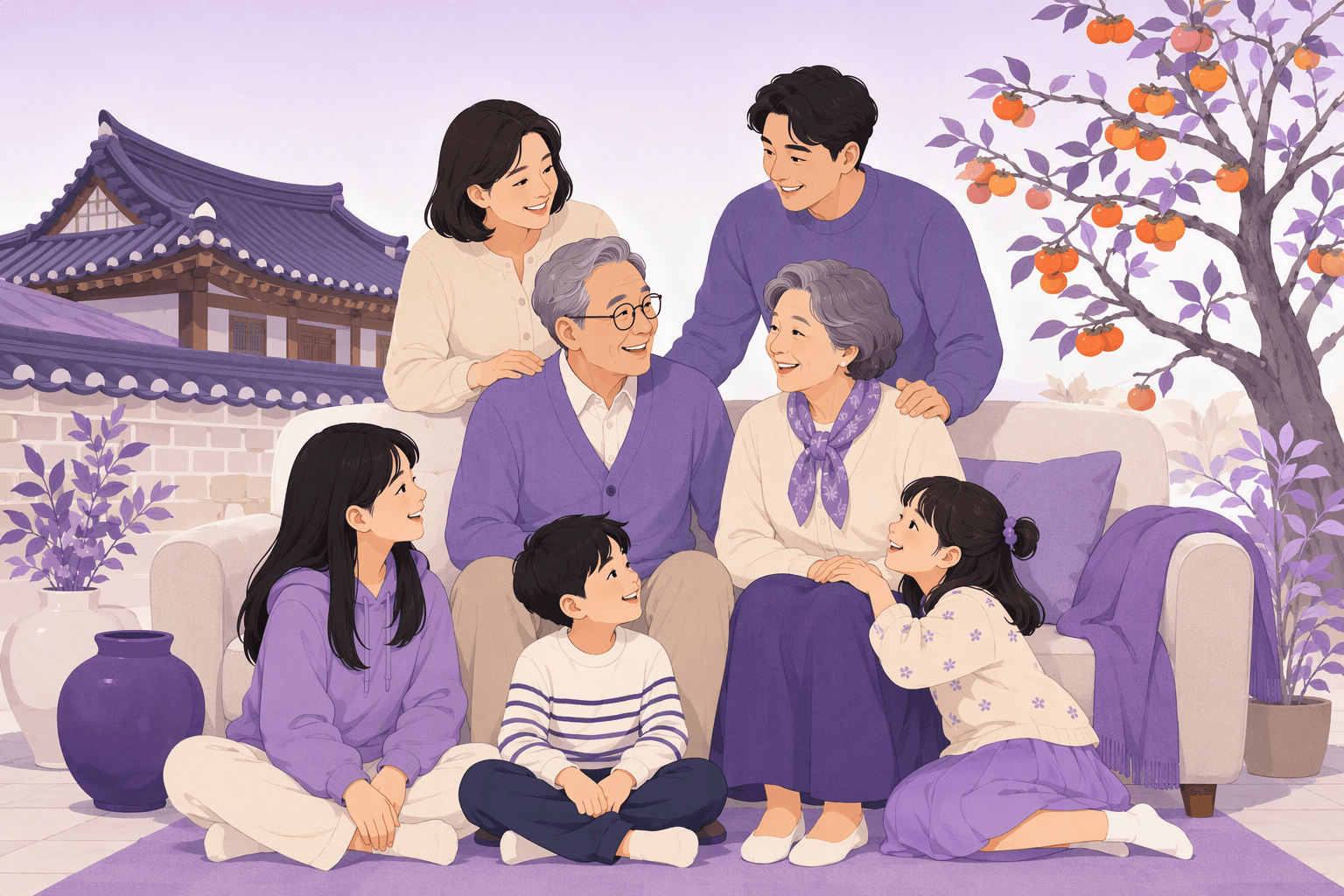
Complete Family Vocabulary Reference
| English | Korean | Pronunciation |
|---|---|---|
| Family | 가족 | ga-JOK |
| Parents | 부모님 | bu-MO-nim |
| Mother (formal) | 어머니 | eo-MEO-ni |
| Mom (informal) | 엄마 | EOM-ma |
| Father (formal) | 아버지 | a-BEO-ji |
| Dad (informal) | 아빠 | AP-pa |
| Older brother (female speaker) | 오빠 | OP-pa |
| Older brother (male speaker) | 형 | hyeong |
| Older sister (female speaker) | 언니 | EON-ni |
| Older sister (male speaker) | 누나 | NU-na |
| Younger sibling | 동생 | dong-SAENG |
| Son | 아들 | a-DEUL |
| Daughter | 딸 | ttal |
| Grandfather (paternal) | 할아버지 | hal-a-BEO-ji |
| Grandmother (paternal) | 할머니 | hal-MEO-ni |
| Grandfather (maternal) | 외할아버지 | oe-hal-a-BEO-ji |
| Grandmother (maternal) | 외할머니 | oe-hal-MEO-ni |
| Uncle (father's brother) | 삼촌 | sam-CHON |
| Aunt (father's sister) | 고모 | GO-mo |
| Aunt (mother's sister) | 이모 | I-mo |
| Uncle (mother's brother) | 외삼촌 | oe-sam-CHON |
| Cousin | 사촌 | sa-CHON |
| Mother-in-law (husband's) | 시어머니 | shi-eo-MEO-ni |
| Father-in-law (wife's) | 장인 | JANG-in |
| Sister-in-law (older brother's wife) | 형수 | HYEONG-su |
Immediate Family: 가족의 핵심
The immediate family unit in Korean carries both formal and informal registers. Most terms come in pairs: a respectful form used in polite speech and a casual form used at home.
어머니 / 엄마
어머니 (eomeoni) is the formal word for "mother," used when speaking respectfully (to elders, in public, or about someone else's mother). 엄마 (eomma) is the warm, intimate form used at home by children of all ages. Even adult Koreans call their own mother 엄마 in private. According to NIKL's Standard Korean Dictionary, 어머니 carries the politeness marker inherent in formal Korean speech, while 엄마 is classified as a familiar-register term.
💡 When to Use Which Form
Use 어머니 when: speaking formally, referring to someone else's mother, or in public settings. Use 엄마 when: talking to your own mother at home, or in casual conversation with close friends. Getting this distinction right signals cultural awareness to native speakers.
아버지 / 아빠
The same formal-informal split applies to "father." 아버지 (abeoji) is respectful and used in polite contexts. 아빠 (appa) is the affectionate, casual form, equivalent to "dad." In traditional Korean families, children may use 아버지 even at home as a sign of respect, though modern families increasingly default to 아빠.
오빠 / 형
Here is where Korean family vocabulary becomes truly unique. The word for "older brother" changes depending on who is speaking. A woman calls her older brother 오빠 (oppa). A man calls his older brother 형 (hyeong). There is no single Korean word for "older brother" because the speaker's gender is always encoded.
🌍 오빠 Beyond Family
In modern Korean culture, 오빠 has expanded far beyond its family meaning. Girlfriends often call their boyfriends 오빠 as a term of affection. Female K-pop fans call male idols 오빠. This usage is so widespread that it has become one of the most recognized Korean words globally. However, in family contexts, it retains its literal meaning of "older brother (said by a female)."
언니 / 누나
The same gender-based split applies to "older sister." A woman calls her older sister 언니 (eonni). A man calls his older sister 누나 (nuna). Like 오빠, 언니 is also used outside the family, and younger women call older female friends, colleagues, or mentors 언니 as a sign of closeness and respect.
동생
Unlike older siblings, the word for "younger sibling" does not change based on the speaker's gender. 동생 (dongsaeng) works universally. To specify, you can say 남동생 (nam-dongsaeng, younger brother) or 여동생 (yeo-dongsaeng, younger sister), where 남 means "male" and 여 means "female."
아들
아들 (adeul) means "son." In Korean families, the eldest son (장남, jangnam) traditionally carries significant responsibility, including caring for aging parents. While modern Korean society is evolving, this cultural expectation still influences family dynamics.
딸
딸 (ttal) means "daughter." The eldest daughter is 장녀 (jangnyeo). Note the double consonant at the beginning of 딸. This tensed sound is a common challenge for Korean learners. Press your tongue firmly and release with a sharp, crisp "tt" sound.
Extended Family: 친척
Korean extended family terms reveal the language's deep paternal-maternal distinction. The prefix 외 (oe, meaning "outer" or "maternal side") marks maternal relatives, while paternal relatives use the unmarked, default terms.
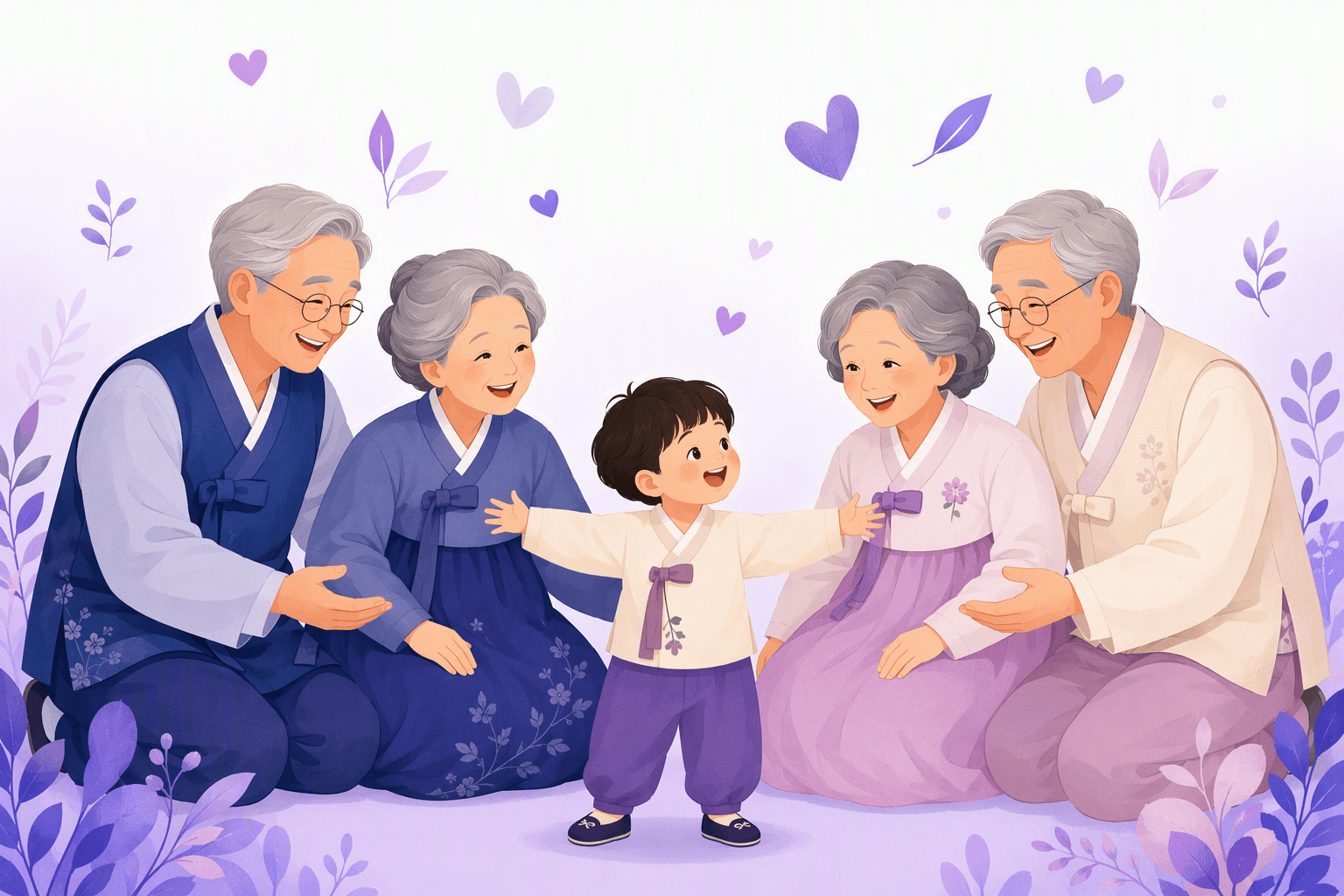
할아버지 / 할머니
할아버지 (harabeoji) means "grandfather" and 할머니 (halmeoni) means "grandmother," but specifically on your father's side. These are the default, unmarked terms because Korean's Confucian-influenced kinship system treats the paternal line as primary.
For maternal grandparents, add the prefix 외: 외할아버지 (oe-harabeoji) and 외할머니 (oe-halmeoni). This paternal-maternal split is not optional, and using the wrong term would confuse any Korean listener.
"The Korean kinship system belongs to the bifurcate collateral type, one of only six fundamental kinship structures identified cross-culturally, where distinct terms exist for virtually every collateral relative position."
(George P. Murdock, Social Structure, 1949)
삼촌
삼촌 (samchon) means "uncle," specifically your father's brother. But Korean goes even further. Your father's older brother is 큰아버지 (keunabeoji, literally "big father"), while your father's younger brother is 작은아버지 (jageun-abeoji, literally "small father") or simply 삼촌. Your mother's brother is 외삼촌 (oe-samchon).
이모 / 고모
Korean has separate words for paternal and maternal aunts. 고모 (gomo) is your father's sister. 이모 (imo) is your mother's sister. These are never interchangeable. 이모 is also commonly used as a friendly term for middle-aged women in casual settings, such as calling a restaurant owner 이모.
사촌
사촌 (sachon) means "cousin." The word itself reveals the 촌수 counting system: 사 means "four," and 촌 means "step" or "degree." Your cousin is four kinship steps away from you (up to your parent, up to grandparent, down to aunt/uncle, down to cousin). Second cousins are 육촌 (yukchon, six steps). This numerical precision is unique to Korean kinship vocabulary.
In-Laws: 시댁 and 처가
Korean in-law vocabulary is extensive because marriage traditionally meant joining an entirely new family hierarchy. The terms differ depending on whether you are the husband or the wife.
시어머니
시어머니 (si-eomeoni) is "mother-in-law" from the wife's perspective, specifically your husband's mother. The prefix 시 marks the husband's family side. Your husband's father is 시아버지 (si-abeoji). The entire husband's family household is called 시댁 (sidaek).
🌍 The 시댁 Relationship in K-Dramas
The relationship between a wife and her 시어머니 (mother-in-law) is one of the most explored themes in Korean dramas. Traditional expectations placed enormous pressure on the new bride to earn her mother-in-law's approval. While modern Korean families are far more relaxed, this dynamic remains a rich source of K-drama conflict and comedy.
장인
장인 (jangin) is "father-in-law" from the husband's perspective, meaning your wife's father. Your wife's mother is 장모님 (jangmonim). The wife's family side is called 처가 (cheoga).
형수
형수 (hyeongsu) is "sister-in-law," specifically your older brother's wife (used by a male speaker). Korean has distinct terms for nearly every in-law relationship: 제수 (jesu, younger brother's wife), 매형 (maehyeong, older sister's husband), 매제 (maeje, younger sister's husband), and more.
The 촌수 System: Counting Kinship Distance
One of the most distinctive features of Korean family vocabulary is 촌수 (chonsu), a numerical system for measuring how closely two people are related. Every family relationship in Korean can be expressed as a number of 촌 (steps).
| Relationship | 촌수 | Example |
|---|---|---|
| Parent / Child | 1촌 | 아버지 is 1촌 |
| Sibling | 2촌 | 형 is 2촌 |
| Uncle / Aunt | 3촌 | 삼촌 is 3촌 |
| Cousin | 4촌 (사촌) | Cousin is 4촌 |
| Parent's cousin | 5촌 | , |
| Second cousin | 6촌 (육촌) | , |
| Third cousin | 8촌 (팔촌) | , |
Koreans commonly use 촌수 in everyday conversation. Saying "그 사람은 팔촌이야" (that person is 8촌) means "that person is a third cousin." The system extends theoretically to any distance, and many Korean families maintain awareness of relatives up to 8촌 or even beyond. According to the Academy of Korean Studies, this precise kinship counting reflects the Confucian value of understanding one's exact place within the family hierarchy.
💡 Korean Marriage Law and 촌수
Korean law historically prohibited marriage between people within 8촌 of the same clan (same surname and ancestral origin). This was reformed in 2005, and now only marriages within 6촌 of the same lineage are restricted. The 촌수 system thus has real legal significance, not just cultural.
Confucian Roots: Why Korean Family Terms Are So Specific
Korean family vocabulary is inseparable from 유교 (yugyo, Confucianism), which shaped Korean society for over 600 years during the Joseon Dynasty (1392-1897). Three Confucian principles directly explain why the kinship system works the way it does:
1. 효 (hyo), Filial Piety: Respect for parents and ancestors is the highest virtue. This is why Korean has formal and informal registers for "mother" and "father"; the language itself enforces respect.
2. 장유유서 (jang-yu-yu-seo), Age Hierarchy: Older people deserve deference from younger people. This is why Korean distinguishes older and younger siblings with completely different words, and why 오빠, 형, 언니, and 누나 are never interchangeable.
3. 내외 (nae-oe), Inner vs. Outer: The paternal line is "inner" (primary) and the maternal line is "outer" (secondary). This is why paternal grandparents use the default terms (할아버지, 할머니) while maternal grandparents require the 외 prefix.
Understanding these principles transforms Korean family vocabulary from a list of words to memorize into a logical system that reflects deep cultural values.
Practice with Korean Media
Korean family vocabulary appears in virtually every K-drama, variety show, and film. Family dynamics drive the plot of most Korean storytelling, making media immersion one of the fastest ways to internalize these terms.
Pay attention to how characters switch between 어머니 and 엄마, or how a female character calls her older male friend 오빠. These shifts in register communicate volumes about relationships, emotions, and social dynamics. Check out our guide to the best movies for learning Korean for recommendations across genres.
Wordy helps you practice Korean family vocabulary in real context by watching Korean content with interactive subtitles. When a family term appears in dialogue, you can tap it to see the Hangul, romanization, and usage notes. Explore our blog for more Korean learning guides, or visit our Korean learning page to start building your vocabulary today.
Frequently Asked Questions
Why do Korean sibling terms change based on the speaker's gender?
What is the difference between 어머니 and 엄마 in Korean?
What does 촌수 (chonsu) mean in Korean family terms?
How do you say 'family' in Korean?
Why does Korean have different words for paternal and maternal grandparents?
Sources & References
- National Institute of Korean Language (국립국어원, NIKL), Standard Korean Dictionary (표준국어대사전)
- Academy of Korean Studies (한국학중앙연구원), Encyclopedia of Korean Culture
- Ethnologue: Languages of the World, 27th edition (2024), Korean language entry
- Murdock, G.P., Social Structure (1949, Free Press), kinship terminology typology
Start learning with Wordy
Watch real movie clips and build your vocabulary as you go. Free to download.


