Quick Answer
The most essential Korean emotion words are 행복하다 (haengbokhada, happy), 슬프다 (seulpeuda, sad), 화나다 (hwanada, angry), 무섭다 (museopda, scared), and 놀라다 (nollada, surprised). Korean also has uniquely untranslatable emotional concepts: 정 (jeong, deep bond), 한 (han, collective grief), and 눈치 (nunchi, reading the room) that are central to Korean culture and relationships.
Korean is a language where emotions run deep, both in everyday vocabulary and in cultural concepts that have no direct translation in any other language. With approximately 77 million speakers worldwide according to Ethnologue's 2024 data, Korean has gained extraordinary global visibility through the Korean Wave (한류, hallyu). K-dramas, K-pop, and Korean cinema have introduced millions of international viewers to emotional expressions like 화이팅 (hwaiting, fighting/you can do it) and cultural concepts like 정 (jeong, deep bond).
What makes Korean emotion vocabulary distinctive is its structure. Unlike English, where "happy" and "sad" are simple adjectives, Korean emotions are descriptive verbs (형용사, hyeongyongsa). You do not say "I am sad" but rather 슬프다 (seulpeuda, "to be sad"), and this verb must be conjugated for formality level, tense, and social context. This grammatical structure means that every emotional expression in Korean simultaneously encodes how you feel and your relationship to the person you are speaking to.
"Korean possesses a remarkably rich vocabulary of interpersonal emotions (concepts like 정, 한, and 눈치) that reflect a cultural emphasis on social harmony and relational awareness with no precise equivalents in Indo-European languages."
(Anna Wierzbicka, Emotions Across Languages and Cultures, Cambridge University Press, 1999)
This guide covers 40+ Korean emotion words organized by category, with special attention to the uniquely Korean emotional concepts that K-drama fans and language learners encounter constantly.
Essential Korean Emotions
These are the core emotion words that correspond to Paul Ekman's research on universal human emotions. Every Korean learner needs these as a foundation.
| English | Korean | Pronunciation | Note |
|---|---|---|---|
| Happy | 행복하다 (haengbokhada) | heng-BOK-ha-da | General happiness, life satisfaction |
| Sad | 슬프다 (seulpeuda) | seul-PEU-da | General sadness, sorrow |
| Angry | 화나다 (hwanada) | hwa-NA-da | Literally 'fire rises' |
| Scared / Afraid | 무섭다 (museopda) | mu-SEOP-da | Fear, feeling frightened |
| Surprised | 놀라다 (nollada) | nol-LA-da | Shock or surprise |
| Disgusted | 역겹다 (yeokgyeopda) | yeok-GYEOP-da | Strong physical or moral disgust |
| Joyful | 기쁘다 (gippeuda) | gi-PPEU-da | Joy from a specific event |
| Worried | 걱정되다 (geokjeongdoeda) | geok-jeong-DOE-da | Concern, anxiety about something |
💡 행복하다 vs. 기쁘다: Two Kinds of Happy
Korean distinguishes between 행복하다 (haengbokhada), which describes a general, lasting state of happiness or life satisfaction, and 기쁘다 (gippeuda), which describes joy triggered by a specific event or moment. Passing an exam makes you 기쁘다. Being content with your life makes you 행복하다. Using the wrong one is not a grammar error, but Koreans will notice the nuance difference.
Positive Emotions
Beyond basic happiness, Korean has a rich vocabulary for positive emotional states that appear constantly in K-dramas, songs, and daily conversation.
| English | Korean | Pronunciation | Note |
|---|---|---|---|
| Excited | 신나다 (sinnada) | sin-NA-da | Energetic excitement, pumped up |
| Grateful | 감사하다 (gamsahada) | gam-SA-ha-da | Formal gratitude (Sino-Korean) |
| Thankful | 고맙다 (gomapda) | go-MAP-da | Warm, personal gratitude (native Korean) |
| Proud | 자랑스럽다 (jarangseureopda) | ja-rang-SEU-reop-da | Pride in someone or something |
| Comfortable | 편안하다 (pyeonanhada) | pyeon-AN-ha-da | At ease, relaxed |
| Satisfied | 만족하다 (manjokhada) | man-JOK-ha-da | Contentment, satisfaction |
| Hopeful | 희망적이다 (huimangjeogida) | hui-mang-JEO-gi-da | Feeling hopeful about the future |
| Touched / Moved | 감동하다 (gamdonghada) | gam-DONG-ha-da | Emotionally moved, deeply touched |
| Relieved | 안심하다 (ansimhada) | an-SIM-ha-da | Relief, peace of mind |
| In love | 사랑에 빠지다 (sarange ppajida) | sa-rang-e PPA-ji-da | Literally 'fall into love' |
The word 감동하다 (gamdonghada, to be deeply moved) is one of the most commonly used positive emotion words in Korean media culture. When Koreans say 감동이에요 (gamdonieyo), they mean something has touched their heart profoundly: a scene in a movie, a kind gesture, or an unexpected gift. K-drama reviews and fan reactions use this word constantly, making it essential vocabulary for anyone engaging with Korean content.
Negative Emotions
Korean negative emotion vocabulary is particularly nuanced, with several words describing internal states that English can only approximate with lengthy explanations.
| English | Korean | Pronunciation | Note |
|---|---|---|---|
| Anxious | 불안하다 (buranhada) | bur-AN-ha-da | Uneasy, anxious, insecure |
| Frustrated (suffocated) | 답답하다 (dapdaphada) | dap-DA-pa-da | Stifled, no way out; uniquely Korean |
| Jealous | 질투하다 (jiltuhada) | jil-TU-ha-da | Jealousy or envy |
| Lonely | 외롭다 (oiropda) | oe-ROP-da | Deep loneliness, isolation |
| Embarrassed | 부끄럽다 (bukkeureopda) | buk-KREU-reop-da | Shame, embarrassment, shyness |
| Annoyed | 짜증나다 (jjajeungnada) | jja-jeung-NA-da | Irritated, annoyed |
| Hurt (emotionally) | 상처받다 (sangcheobatda) | sang-cheo-BAT-da | Literally 'receive a wound' |
| Regretful | 후회하다 (huhoehada) | hu-HOE-ha-da | Regretting a past action |
| Resentful | 억울하다 (eogulhada) | eo-GUL-ha-da | Unfairly wronged, unjust treatment |
| Exhausted (mentally) | 지치다 (jichida) | ji-CHI-da | Mentally drained, worn out |
Two words in this list deserve special attention. 답답하다 (dapdaphada) describes a feeling of suffocation or frustration when a situation is stagnant, someone does not understand you, or there is no clear way forward. It is the feeling of being stuck in traffic, watching someone make a preventable mistake, or dealing with bureaucracy. K-drama viewers hear this word constantly, and characters say 답답해! (dapdaphae!) when they are exasperated.
억울하다 (eogulhada) describes the specific feeling of being wrongly accused or unfairly treated. It is not just anger; it is the anguish of injustice. This emotion appears so frequently in Korean dramas and legal proceedings that the King Sejong Institute Foundation includes it in intermediate-level cultural vocabulary.
Uniquely Korean Emotional Concepts
These are the emotion words that make Korean truly distinctive. They represent cultural concepts so deeply embedded in Korean society that they resist direct translation into any other language. Understanding these words is essential to understanding Korean people and culture.
| English | Korean | Pronunciation | Note |
|---|---|---|---|
| Deep bond / affection | 정 (jeong) | jeong | Untranslatable: deep attachment formed over time |
| Collective grief / resentment | 한 (han) | han | Historical sorrow woven into Korean identity |
| Reading the room | 눈치 (nunchi) | nun-chi | Social-emotional intelligence, 'eye-measure' |
| Heart-fluttering anticipation | 설레다 (seolleda) | seol-LE-da | Butterflies, romantic excitement |
| Bittersweet regret | 아쉽다 (aswipda) | a-SWIP-da | Wistful feeling when something good ends |
| Heart-fluttering (slang) | 심쿵 (simkung) | sim-KUNG | Heart attack from cuteness; K-drama slang |
| Mental breakdown (slang) | 멘붕 (menbung) | men-BUNG | From 멘탈붕괴, internet slang for shock |
| Cringe / secondhand embarrassment | 오글거리다 (ogeulgeorida) | o-geul-GEO-ri-da | Physical cringe reaction |
🌍 정 (Jeong) and 한 (Han): The Two Pillars of Korean Emotion
정 (jeong) and 한 (han) are often described as the two foundational emotional concepts of Korean culture. 정 represents the warm side: the deep bonds that form between people who share experiences over time. Koreans say 정이 많다 (jeongi manta, "has much jeong") to describe a warm, generous person. 한 represents the sorrowful side: a collective feeling of historical grief, resentment, and unresolved pain that has been passed down through generations of foreign invasion, colonial rule, and national division. According to the Academy of Korean Studies, 한 is considered the emotional foundation of Korean traditional arts, including pansori (판소리) opera, where performers channel centuries of 한 into their singing. Together, these two concepts create a Korean emotional landscape that prizes both deep connection and the resilience born from shared suffering.
Key Concepts Explained
설레다
설레다 (seolleda) describes the fluttery, excited anticipation you feel before something wonderful happens: the butterflies before a first date, the excitement the night before a trip, or the nervous thrill when your crush sends a message. K-drama characters use 설레다 constantly during romantic scenes. The noun form 설렘 (seollem) appears in song titles and drama dialogue. There is no single English word that captures exactly this blend of nervous excitement and happy anticipation.
아쉽다
아쉽다 (aswipda) is the bittersweet feeling of regret when something good comes to an end, or when you miss out on something by just a little. It is not devastating sadness; it is the wistful pang when a vacation ends, when you almost caught the train, or when a good meal is finished. Koreans use 아쉽다 far more frequently than English speakers use "regretful" or "wistful," because the concept covers a broader range of everyday moments.
눈치
눈치 (nunchi) literally means "eye-measure" and refers to the ability to gauge the emotional temperature of a situation and act accordingly. A 2019 study by Euny Hong popularized the concept internationally, describing it as Korea's secret to happiness and success. In Korean society, having good 눈치 (눈치가 빠르다, nunchiga ppareuda, "fast nunchi") is considered essential to social functioning. Having poor 눈치 (눈치가 없다, nunchiga eopda, "no nunchi") is a serious social criticism. In K-dramas, comedic characters often have bad 눈치, creating awkward situations that drive the plot.
Grammar: How Korean Emotion Verbs Work
Korean emotions are not adjectives but descriptive verbs (형용사, hyeongyongsa). This means they conjugate for formality, tense, and sentence position, just like action verbs. The National Institute of Korean Language classifies three major formality levels that apply to all emotion vocabulary.
Formality levels with 기쁘다 (gippeuda, joyful):
| Level | Form | Usage |
|---|---|---|
| Casual (반말) | 기뻐 (gippeo) | Between close friends, to younger people |
| Polite (존댓말) | 기뻐요 (gippeoyo) | Standard daily conversation |
| Formal (격식체) | 기쁩니다 (gippeumnida) | News, speeches, business |
Common patterns for expressing emotions:
- 저는 행복해요 (jeoneun haengbokhaeyo) = "I am happy" (polite)
- 기분이 어때요? (gibuni eottaeyo?) = "How do you feel?" (polite)
- 슬퍼하지 마세요 (seulpeohaji maseyo) = "Don't be sad" (polite)
- 화나면 말해 (hwynamyeon malhae) = "Tell me if you're angry" (casual)
The -하다 distinction:
Many Korean emotion words end in -하다 (hada, "to do"). These are technically verbs formed by combining a Sino-Korean noun with 하다: 행복 (haengbok, happiness) + 하다 = 행복하다 (to be happy). Native Korean emotion words like 슬프다, 기쁘다, and 무섭다 do not follow this pattern and are inherently descriptive verbs with their own conjugation rules.
⚠️ 감정 vs. 기분: Emotion vs. Mood
Korean distinguishes between 감정 (gamjeong, emotion/feeling) and 기분 (gibun, mood/state of mind). 감정 refers to deeper emotional states, while 기분 describes your current mood or how something makes you feel in the moment. When asking "How do you feel?" in Korean, 기분이 어때요? (gibuni eottaeyo?) asks about current mood. 감정이 어때요? would sound clinical, as if asking about emotions in a therapeutic context.
Emotions in K-Drama and Korean Pop Culture
Korean entertainment is saturated with emotional vocabulary, and recognizing these words transforms your viewing experience. K-dramas are built around emotional intensity, and the entire genre structure revolves around characters navigating complex feelings, from the heart-fluttering 설렘 (seollem) of early romance to the devastating 이별 (ibyeol, separation) that typically arrives around episode 12.
Modern Korean internet culture has created a wave of emotion-related slang. 심쿵 (simkung, "heart-thump") describes the chest-tightening feeling when you see something adorable or romantic. 멘붕 (menbung), short for 멘탈붕괴 (mental bungoe, "mental collapse"), describes being so shocked that your brain shuts down. 오글거리다 (ogeulgeorida) is the physical cringing sensation when witnessing something embarrassingly cheesy, and K-drama fans use it for overly romantic scenes that are simultaneously irresistible and cringeworthy.
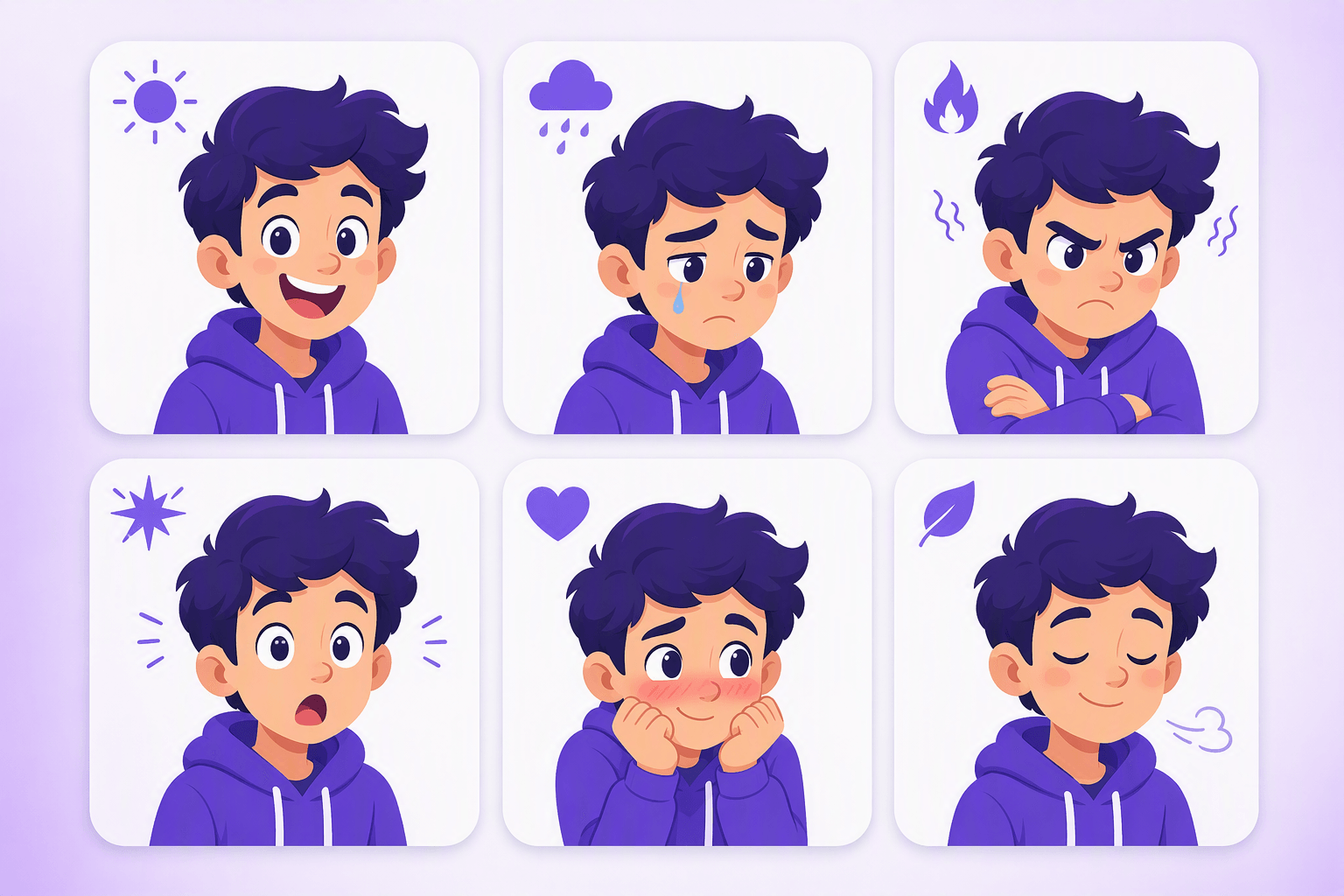
The expression 눈물 바다 (nunmul bada, "sea of tears") describes crying intensely, which K-drama fans experience regularly. And 가슴이 아프다 (gaseumi apeuda, "my chest hurts") is the go-to expression for emotional pain: heartbreak, empathy for someone suffering, or the ache of missing someone.
For immersive practice hearing these emotion words in natural Korean dialogue, check out the best Korean dramas to learn Korean. Watching emotionally rich K-dramas with Wordy lets you tap any emotion word in the subtitles to see its Hangul, pronunciation, meaning, and conjugation form in real time.
Build Your Korean Emotion Vocabulary
Emotion vocabulary is where language learning becomes truly personal. Once you move beyond 행복하다 and 슬프다 into words like 설레다, 답답하다, and 정, you start thinking in Korean emotional categories that do not exist in English. This cognitive shift (what linguists call emotional acculturation) is what separates someone who knows Korean words from someone who understands Korean culture.
The best way to absorb Korean emotion vocabulary is through the emotional context of stories. K-dramas deliver emotion words embedded in scenes that make them unforgettable. You will never forget what 답답해 means after watching a character scream it in frustration.
Explore our blog for more Korean vocabulary guides, or visit our Korean learning page to start encountering emotion vocabulary in authentic Korean content today.
Frequently Asked Questions
What are the basic emotions in Korean?
What is 정 (jeong) in Korean?
What does 한 (han) mean in Korean culture?
What is 눈치 (nunchi) and why is it important?
How do Korean emotion words differ from English?
How do I express my feelings in Korean?
Sources & References
- National Institute of Korean Language (국립국어원, NIKL), Standard Korean Dictionary (표준국어대사전)
- Ekman, P. (1992), An Argument for Basic Emotions, Cognition and Emotion, 6(3-4)
- Wierzbicka, A. (1999), Emotions Across Languages and Cultures (Cambridge University Press)
- King Sejong Institute Foundation, Korean Language Education Standards (2024)
- Academy of Korean Studies (한국학중앙연구원), Encyclopedia of Korean Culture
Start learning with Wordy
Watch real movie clips and build your vocabulary as you go. Free to download.


