Korean Colors: 20+ Essential Color Words With Hangul, Pronunciation, and the ㅎ Irregular System
Quick Answer
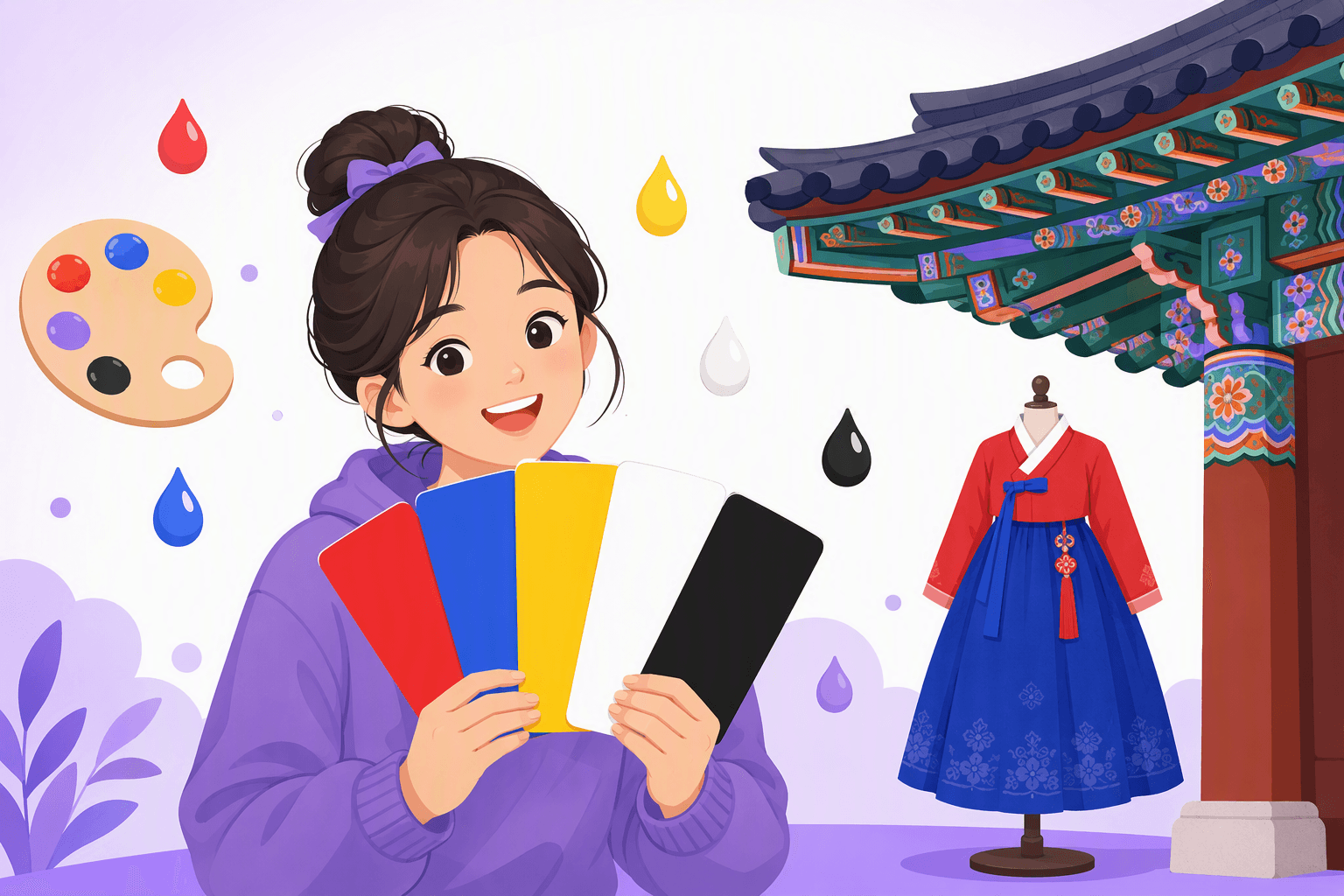
The basic colors in Korean are 빨간색 (ppalgan-saek, red), 파란색 (paran-saek, blue), 노란색 (noran-saek, yellow), 하얀색 (hayan-saek, white), and 까만색 (kkaman-saek, black). Korean has a unique dual system: native color adjectives (빨갛다, 파랗다) that follow ㅎ irregular conjugation, and Sino-Korean color nouns formed by adding 색 (saek, color) to the adjective stem.
Korean has one of the most linguistically interesting color systems of any major world language. Instead of simple adjectives like English's "red" or "blue," Korean uses a dual system: native color adjectives that follow special irregular conjugation rules, and Sino-Korean color nouns built with the suffix 색 (saek, color).
With approximately 82 million speakers worldwide according to Ethnologue's 2024 data, Korean is increasingly studied globally, and the King Sejong Institute Foundation reports over 16 million active Korean language learners. Whether you are describing a 빨간 드레스 (ppalgan deureseu, red dress) in a K-drama discussion, shopping for clothes in Seoul, or understanding traditional 한복 (hanbok) color symbolism, mastering Korean colors is essential.
"The Korean color adjective system, with its ㅎ irregular conjugation pattern, represents one of the language's most distinctive morphological features, a feature that has no parallel in the major European languages learners typically compare it to."
(Ho-Min Sohn, The Korean Language, Cambridge University Press, 2019)
This guide covers 20+ colors with Hangul, pronunciation, the ㅎ irregular conjugation system, grammar patterns, and the deep cultural significance of color in Korean tradition.
Quick Reference: Essential Korean Colors
These are the colors you will encounter most frequently in daily Korean. The table includes the noun form (with 색) and romanized pronunciation.
| English | Korean | Pronunciation | Note |
|---|---|---|---|
| Red | 빨간색 | ppalgan-saek | From 빨갛다 (ppalgata) |
| Blue | 파란색 | paran-saek | From 파랗다 (parata) |
| Yellow | 노란색 | noran-saek | From 노랗다 (norata) |
| White | 하얀색 | hayan-saek | From 하얗다 (hayata) |
| Black | 까만색 | kkaman-saek | From 까맣다 (kkamata) |
| Green | 초록색 | chorok-saek | Sino-Korean 초록 (grass-green) |
| Orange | 주황색 | juhwang-saek | Sino-Korean 주황 (vermilion-yellow) |
| Pink | 분홍색 | bunhong-saek | Sino-Korean 분홍 (powder-red) |
| Purple | 보라색 | bora-saek | Native Korean 보라 |
| Gray | 회색 | hoe-saek | Sino-Korean 회 (ash) |
| Brown | 갈색 | gal-saek | Sino-Korean 갈 (brown/kudzu) |
| Gold | 금색 | geum-saek | Sino-Korean 금 (gold/metal) |
| Silver | 은색 | eun-saek | Sino-Korean 은 (silver) |
💡 색 vs. 색깔: Two Words for 'Color'
Korean has two words for "color" itself: 색 (saek) and 색깔 (saekkkari). Both are correct. 색 is used in formal and compound forms (빨간색, what Sino-Korean color nouns use). 색깔 is slightly more colloquial and common in everyday speech: 무슨 색깔 좋아해요? (museun saekkkari joahaeyo?, what color do you like?). In practice, they are interchangeable.
The Five Basic Color Adjectives: ㅎ Irregulars
Korean's five basic colors are not nouns but descriptive adjectives (형용사, hyeongyongsa). This is one of the most distinctive features of the Korean color system. These five adjectives all end in ㅎ and follow the ㅎ irregular conjugation pattern, which the National Institute of Korean Language classifies as one of Korean's core irregular verb patterns.
| English | Korean | Pronunciation | Note |
|---|---|---|---|
| To be red | 빨갛다 | ppal-ga-ta | ㅎ irregular |
| To be blue | 파랗다 | pa-ra-ta | ㅎ irregular |
| To be yellow | 노랗다 | no-ra-ta | ㅎ irregular |
| To be white | 하얗다 | ha-ya-ta | ㅎ irregular |
| To be black | 까맣다 | kka-ma-ta | ㅎ irregular |
These are the only five colors in Korean that have dedicated native adjective forms. All other colors (green, purple, orange, pink, brown, gray) exist only as nouns. They borrow from Sino-Korean roots or foreign loanwords and cannot directly modify nouns the way these five can.
How ㅎ Irregular Conjugation Works
The ㅎ at the end of the adjective stem behaves differently depending on what follows it. This is one of the trickier grammar points in Korean, but once you learn the pattern for one color, it applies to all five.
Before a vowel ending, ㅎ drops and the vowel changes:
- 빨갛다 → 빨개요 (ppalgaeyo) = "It's red" (polite)
- 파랗다 → 파래요 (paraeyo) = "It's blue"
- 노랗다 → 노래요 (noraeyo) = "It's yellow"
- 하얗다 → 하얘요 (hayaeyo) = "It's white"
- 까맣다 → 까매요 (kkamaeyo) = "It's black"
Before ㄴ (noun-modifying form), ㅎ drops and ㄴ attaches to the stem:
- 빨갛다 → 빨간 (ppalgan) = "red" + noun
- 파랗다 → 파란 (paran) = "blue" + noun
- 노랗다 → 노란 (noran) = "yellow" + noun
- 하얗다 → 하얀 (hayan) = "white" + noun
- 까맣다 → 까만 (kkaman) = "black" + noun
This noun-modifying form is what you use most often: 빨간 차 (ppalgan cha, red car), 파란 하늘 (paran haneul, blue sky), 하얀 눈 (hayan nun, white snow).
⚠️ Common Mistake: Using the Dictionary Form Directly
You cannot place the dictionary form directly before a noun. 빨갛다 차 is incorrect. You must conjugate to the modifier form: 빨간 차. This trips up many learners because in English, "red" works as both an adjective and a descriptor without changing form. In Korean, the adjective must transform.
Before -ㅂ니다 (formal polite), ㅎ combines to create a new sound:
- 빨갛다 → 빨갛습니다 (ppalgaseumnida) = formal "It's red"
- 파랗다 → 파랗습니다 (paraseumnida) = formal "It's blue"
The formal conjugation preserves the ㅎ because it precedes a consonant (ㅅ). This distinction between vowel-following and consonant-following behavior is the core of the ㅎ irregular pattern.
Forming Color Nouns With 색
To turn any color adjective into a standalone color noun, take the modifier form and add 색 (saek, color):
- 빨간 + 색 = 빨간색 (red color)
- 파란 + 색 = 파란색 (blue color)
- 노란 + 색 = 노란색 (yellow color)
- 하얀 + 색 = 하얀색 (white color)
- 까만 + 색 = 까만색 (black color)
This 색 form is what you use when naming the color itself rather than describing a noun. For example: 빨간색이 좋아요 (ppalgan-saegi joayo, I like the color red) versus 빨간 사과 (ppalgan sagwa, a red apple).
For colors that do not have a native adjective form, the 색 noun is the only option:
| English | Korean | Pronunciation | Note |
|---|---|---|---|
| Green | 초록색 | chorok-saek | 초록 = grass-green |
| Orange | 주황색 | juhwang-saek | 주황 = vermilion-yellow |
| Pink | 분홍색 | bunhong-saek | 분홍 = powder-red |
| Purple | 보라색 | bora-saek | 보라 = native Korean root |
| Gray | 회색 | hoe-saek | 회 = ash |
| Brown | 갈색 | gal-saek | 갈 = kudzu/brown |
| Navy | 남색 | nam-saek | 남 = indigo |
| Sky blue | 하늘색 | haneul-saek | 하늘 = sky (native Korean) |
| Beige | 베이지색 | beiji-saek | Loanword from English |
💡 Using Sino-Korean Colors Before Nouns
Since Sino-Korean colors like 초록 and 보라 are nouns, not adjectives, they cannot directly modify another noun the way 빨간 can. You need to add 색 and the possessive-like construction: 초록색 셔츠 (chorok-saek syeocheu, green-color shirt) or 보라색 꽃 (bora-saek kkot, purple-color flower). Think of it as saying "green-colored shirt" rather than "green shirt."
Alternate and Intensified Color Forms
Korean has a second set of basic color adjectives with slightly different nuances. These "light" or "soft" versions use different vowels:
| English | Korean | Pronunciation | Note |
|---|---|---|---|
| Red (vivid) | 빨갛다 | ppalgata | Strong, saturated red |
| Red (soft) | 발갛다 | balgata | Softer, lighter red |
| Blue (vivid) | 파랗다 | parata | Strong, vivid blue |
| Blue (soft) | 퍼렇다 | peoreota | Duller, muted blue |
| Yellow (vivid) | 노랗다 | norata | Bright, clear yellow |
| Yellow (soft) | 누렇다 | nureota | Yellowish, faded |
| White (vivid) | 하얗다 | hayata | Bright, pure white |
| White (soft) | 허옇다 | heoyeota | Whitish, pale |
| Black (vivid) | 까맣다 | kkamata | Deep, jet black |
| Black (soft) | 거멓다 | geomeota | Darkish, dusky |
The tense consonant versions (빨갛다, 까맣다) convey vivid, saturated colors, while the plain consonant versions (발갛다, 거멓다) suggest softer, more muted tones. This vowel-alternation system is a unique feature of Korean that allows speakers to express fine color gradations without separate words. You will encounter both forms in literature and K-dramas, though the vivid forms are far more common in everyday speech.
오방색: Korea's Five Traditional Colors
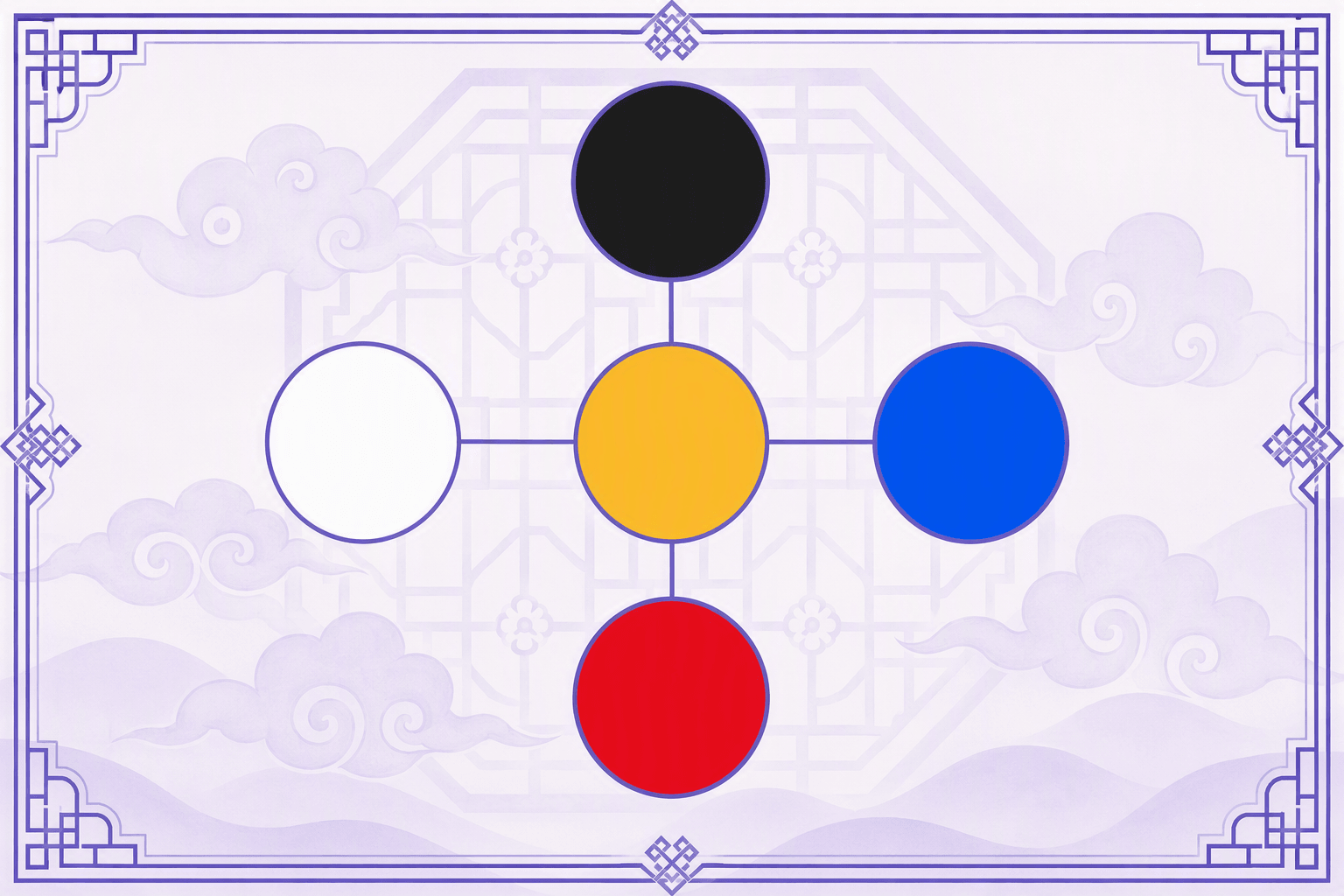
The 오방색 (obangsaek, five directional colors) system is one of the most culturally significant aspects of Korean color use. Rooted in the yin-yang and five elements theory (음양오행, eumyang ohaeng), these five colors have governed Korean aesthetics, architecture, clothing, and ceremony for over a thousand years.
According to the Academy of Korean Studies, the five directional colors are:
| Color | Korean | Direction | Element | Symbolism |
|---|---|---|---|---|
| Blue | 파랑 (parang) | East (동) | Wood (목) | Hope, creativity, spring |
| Red | 빨강 (ppalkang) | South (남) | Fire (화) | Passion, protection from evil |
| Yellow | 노랑 (norang) | Center (중) | Earth (토) | Authority, prosperity |
| White | 하양 (hayang) | West (서) | Metal (금) | Purity, mourning, autumn |
| Black | 검정 (geomjeong) | North (북) | Water (수) | Wisdom, formality, creation |
These colors appear everywhere in Korean traditional culture. The Korean flag (태극기, taegeukgi) uses 빨강 and 파랑 in the central taegeuk symbol representing cosmic balance, with 검정 trigrams (괘, gwae) in the four corners. Traditional 한복 (hanbok) uses 오방색 combinations to indicate the wearer's age, marital status, and social position.
🌍 오방색 in Hanbok and Architecture
In traditional Korean weddings, the bride wears a 원삼 (wonsam) featuring all five 오방색 colors, symbolizing cosmic harmony. Korean palace architecture (visible at 경복궁 (Gyeongbokgung) and 창덕궁 (Changdeokgung)) uses the five colors in its painted eave decorations called 단청 (dancheong). Each color is placed according to its directional meaning: blue on eastern walls, red on southern gates. This system remains active in modern Korean design, from temple restorations to contemporary fashion.
Color Symbolism in Modern Korea
Beyond the traditional 오방색 system, colors carry specific modern connotations in Korean culture that differ from Western associations.
빨강 (Red): Red represents passion and is believed to ward off evil spirits. Red bean porridge (팥죽, patjuk) is eaten on the winter solstice specifically for its protective symbolism. However, writing someone's name in red ink is a serious taboo because it traditionally signifies death. Never write a Korean person's name in red.
하양 (White): Koreans historically called themselves the 백의민족 (baeguiminjok, "white-clothed people") because commoners wore white hanbok for centuries. White symbolizes purity and mourning. It is the color worn at Korean funerals, unlike the Western association of black with mourning.
검정 (Black): In modern Korean culture, black signifies luxury, formality, and sophistication. The 블랙카드 (beullaek kadeu, "black card") is a status symbol representing the highest tier credit cards. Black school uniforms represent discipline and seriousness.
금색 (Gold): The expression 금수저 (geumsujeo, "golden spoon") describes someone born into wealth, part of the viral "spoon class theory" (수저 계급론) that became a major cultural discussion point in Korea. Its opposite, 흙수저 (heuksujeo, "dirt spoon"), describes someone born into poverty.
"Color in Korean culture is never merely aesthetic; it is a semiotic system encoding philosophical, spiritual, and social meaning that has remained remarkably consistent from the Three Kingdoms period to the modern era."
(Academy of Korean Studies, Encyclopedia of Korean Culture)
Useful Color Phrases
Knowing individual color words is essential, but you also need the grammar patterns to use them in conversation.
Asking about color:
- 무슨 색이에요? (museun saegieyo?) = "What color is it?" (polite)
- 무슨 색 좋아해요? (museun saek joahaeyo?) = "What color do you like?"
- 이거 빨간색이에요 (igeo ppalgan-saegieyo) = "This is red"
Describing color:
- 하늘이 파래요 (haneuri paraeyo) = "The sky is blue"
- 빨간 옷을 입었어요 (ppalgan oseul ibeosseoyo) = "I wore red clothes"
- 초록색 우산 있어요? (chorok-saek usan isseoyo?) = "Do you have a green umbrella?"
Preferences:
- 검정색으로 주세요 (geomjeong-saeg-euro juseyo) = "Please give me the black one"
- 파란색이 더 예뻐요 (paran-saegi deo yeppeoyo) = "Blue is prettier"
💡 Shopping for Clothes: Color + (으)로 주세요
When shopping in Korea, the pattern color + (으)로 주세요 (euro juseyo, "please give me in...") is indispensable. The particle (으)로 indicates selection or means: 빨간색으로 주세요 (in red, please), 하얀색으로 주세요 (in white, please). This single pattern handles most color-related shopping interactions.
Colors in K-Drama and K-Pop Culture
Korean popular culture makes heavy use of color symbolism, and recognizing these patterns enriches your viewing experience. In K-dramas, costume designers deliberately use color to signal character traits: a character wearing 하얀색 (white) is typically pure-hearted or naive, while 까만색 (black) signals power, mystery, or moral ambiguity.
K-pop groups frequently build their visual identities around specific colors. Fan groups adopt official colors, and 방탄소년단 (BTS) fans carry 보라색 (purple) lights, connecting to the phrase "보라해" (borahae, "I purple you"), a term coined by member V that has become a global expression of enduring love.
The color 빨간색 (red) appears in countless K-pop titles and concepts, from Red Velvet's name itself to the aggressive energy of "red" comeback concepts. Understanding these color associations helps you decode the visual language of Korean entertainment.
For immersive practice recognizing colors in natural Korean dialogue, check out the best Korean dramas to learn Korean. Watching with Wordy lets you tap any color word in the subtitles to see its Hangul, pronunciation, and meaning in real time.
Practice Colors With Real Korean Content
Color vocabulary appears constantly in Korean daily life, from shopping and fashion discussions to describing food, weather, and emotions. The phrase 하늘이 파래요 (the sky is blue) is one of the first complete sentences many Korean learners master, and from there, colors branch into grammar (ㅎ irregulars), culture (오방색), and modern slang (보라해).
Wordy lets you encounter color words in authentic Korean content with interactive subtitles. Instead of memorizing isolated vocabulary from flashcards, you absorb 빨간, 파란, and 까만 in the contexts native speakers actually use them, describing outfits in dramas, discussing food in variety shows, or narrating scenes in films.
Explore our blog for more Korean vocabulary guides, or visit our Korean learning page to start building your color vocabulary through real content today.
Frequently Asked Questions
What are the basic colors in Korean?
What is the difference between 빨갛다 and 빨간색?
What are ㅎ irregular adjectives in Korean?
What is 오방색 (obangsaek)?
How do you say 'What color is it?' in Korean?
Are there colors that exist in Korean but not in English?
Sources & References
- National Institute of Korean Language (국립국어원, NIKL), Standard Korean Dictionary (표준국어대사전)
- Academy of Korean Studies (한국학중앙연구원), Encyclopedia of Korean Culture
- Ethnologue: Languages of the World, 27th edition (2024), Korean language entry
- Sohn, H. (2019). The Korean Language, 2nd edition. Cambridge University Press.
- King Sejong Institute Foundation, Korean Language Education Standards (2024)
Start learning with Wordy
Watch real movie clips and build your vocabulary as you go. Free to download.


