Korean Body Parts: 35+ Essential Words With Hangul, Pronunciation, and Medical Phrases
Quick Answer
The most important Korean body parts to learn first are '머리' (meori, head), '팔' (pal, arm), '다리' (dari, leg), and '심장' (simjang, heart). Korean body vocabulary is split between native Korean words used in everyday speech and Sino-Korean medical terms used in healthcare settings.
Why Learn Body Parts in Korean?
Knowing body parts in Korean is essential for medical situations, understanding everyday idioms, and navigating the Korean Wave (한류) content that has captivated global audiences. According to Ethnologue's 2024 data, approximately 82 million people speak Korean worldwide, and the King Sejong Institute Foundation reports that Korean language learners have surpassed 16 million globally.
Korean body vocabulary has a distinctive feature: it operates on two layers. Native Korean words (순우리말, sunurimal) dominate everyday conversation: 머리 (meori, head), 손 (son, hand), 배 (bae, belly). Sino-Korean words (한자어, hanja-eo), derived from Chinese characters, appear in medical and formal contexts: 두통 (dutong, headache), 복통 (boktong, stomachache). Understanding both layers is critical for real-world fluency. Whether you're looking up "korean body parts" for travel, study, or conversation, this guide covers everything you need.
"The dual vocabulary system of Korean (native words for daily use, Sino-Korean terms for technical and medical discourse) creates a layered lexicon that learners must navigate with awareness of register and context."
(Ho-Min Sohn, The Korean Language, Cambridge University Press, 2019)
This guide covers 35+ body parts organized by region, with Hangul, romanized pronunciation, medical phrases, and the idioms Korean speakers use daily. For interactive practice with Korean content, visit our Korean learning page.
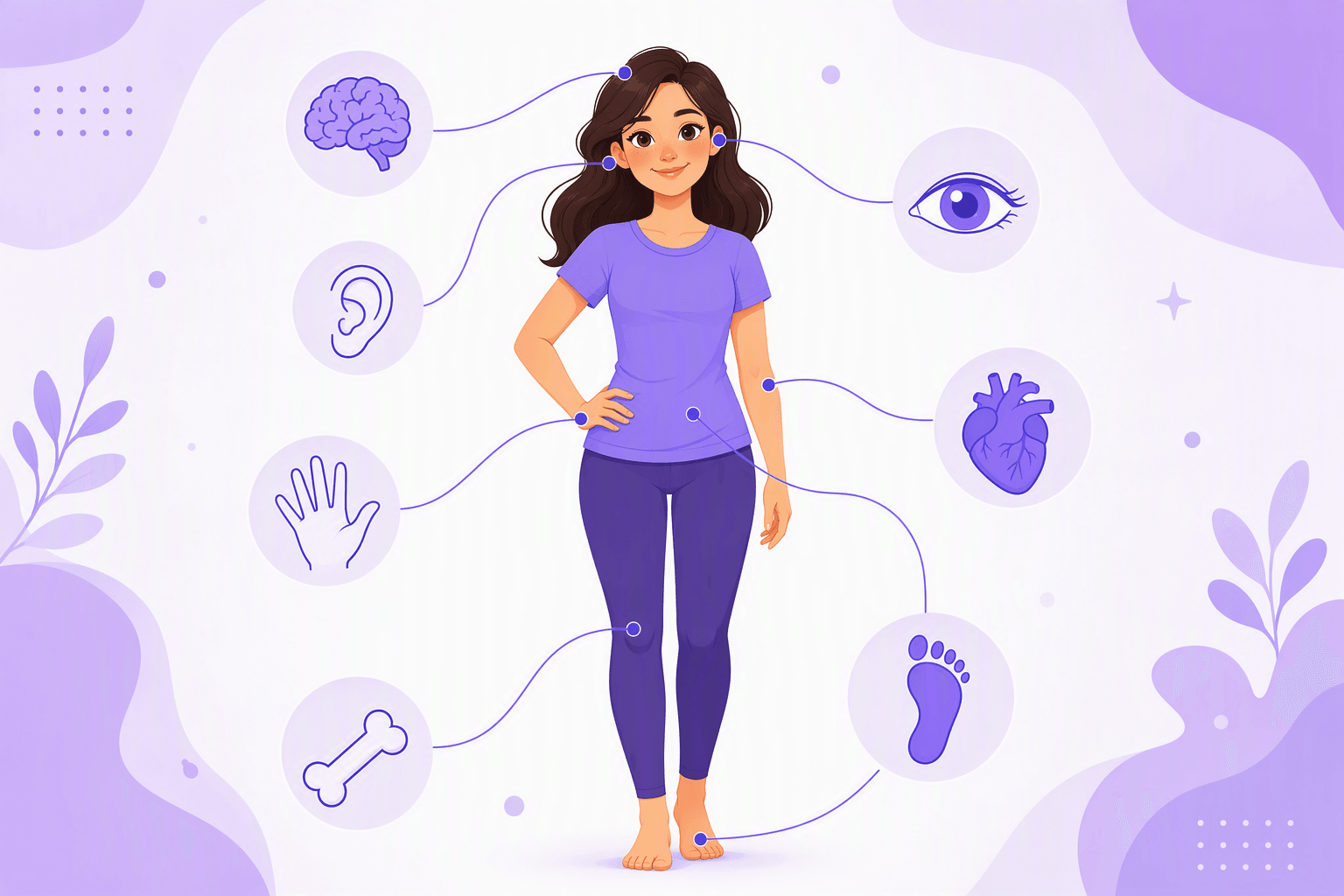
Head and Face
The head and face contain the most frequently used body vocabulary in Korean. These words appear constantly in K-dramas, songs, and everyday conversation, especially in the many idioms built around 눈 (eye), 입 (mouth), and 코 (nose).
| English | Korean | Pronunciation | Note |
|---|---|---|---|
| Head | 머리 | meori | Also means 'hair' and 'mind' |
| Face | 얼굴 | eolgul | 얼굴이 작다 = small face (compliment!) |
| Eye | 눈 | nun | Also means 'snow' |
| Ear | 귀 | gwi | |
| Nose | 코 | ko | Very common in idioms |
| Mouth | 입 | ip | 입맛 (immak) = appetite |
| Tongue | 혀 | hyeo | |
| Tooth | 이 | i | 치아 (chia) in formal/medical use |
| Lip | 입술 | ipsul | Compound: 입 (mouth) + 술 (edge) |
| Chin | 턱 | teok | |
| Forehead | 이마 | ima | |
| Cheek | 볼 | bol | Also 뺨 (ppyam) |
| Eyebrow | 눈썹 | nunssop | Compound: 눈 (eye) + 썹 (fringe) |
| Hair | 머리카락 | meorikarak | 머리 alone can mean hair too |
💡 머리: Head, Hair, and Mind All in One
The word 머리 (meori) does triple duty in Korean, meaning "head," "hair," and "mind/brain" depending on context. 머리가 아파요 means "my head hurts." 머리를 자르다 means "to cut hair." 머리가 좋다 means "to be smart" (good head/mind). The longer form 머리카락 (meorikarak) specifically means individual strands of hair.
Key Medical Phrases for Head and Face
Korean medical phrases use the verb 아프다 (apeuda, to be painful/sick) as the primary way to express pain:
- 머리가 아파요 (meori-ga apayo) = "My head hurts"
- 눈이 아파요 (nuni apayo) = "My eyes hurt"
- 이가 아파요 (iga apayo) = "My tooth hurts"
- 코피가 나요 (kopiga nayo) = "My nose is bleeding" (lit. "nose-blood comes out")
The basic pattern is: body part + 이/가 (subject particle) + 아파요 (hurts). Use 이 after consonant-ending nouns (눈이) and 가 after vowel-ending nouns (머리가). For formal situations at a hospital, switch to the formal ending: 머리가 아픕니다 (meori-ga apeumnida).
Upper Body and Torso
Upper body vocabulary is essential for medical descriptions and daily conversation. The word 배 (bae, belly/stomach) is one of the most commonly heard body words in Korean daily life.
| English | Korean | Pronunciation | Note |
|---|---|---|---|
| Neck | 목 | mok | Also means 'throat' and 'voice' |
| Shoulder | 어깨 | eokkae | 어깨가 넓다 = broad-shouldered |
| Chest | 가슴 | gaseum | Also means 'heart/feelings' |
| Back | 등 | deung | |
| Stomach | 배 | bae | Also means 'pear' and 'boat' |
| Waist | 허리 | heori | 허리가 아프다 = very common |
| Hip | 엉덩이 | eongdeongi | |
| Rib | 갈비뼈 | galbippyeo | 갈비 also = short ribs (food!) |
🌍 배 (Bae): Belly, Pear, and Boat
The syllable 배 has three common meanings in Korean, distinguished entirely by context: belly/stomach (배), pear (배, the fruit), and boat (배, the vessel). All three are native Korean words that happen to share the same pronunciation. Korean speakers have no trouble distinguishing them in conversation, but learners should be aware of the triple meaning. The phrase 배가 아파요 always means "my stomach hurts" in a medical context.
Medical Phrases for the Upper Body
- 등이 아파요 (deungi apayo) = "My back hurts"
- 배가 아파요 (bae-ga apayo) = "My stomach hurts"
- 가슴이 아파요 (gaseumi apayo) = "My chest hurts" (seek immediate help; this can also mean emotional heartache)
- 속이 메스꺼워요 (sogi meseukkeowoyo) = "I feel nauseous"
- 허리가 아파요 (heori-ga apayo) = "My lower back/waist hurts"
⚠️ 가슴이 아파요: Physical Pain or Heartbreak?
The phrase 가슴이 아파요 (gaseumi apayo) can mean either "my chest hurts" (physical pain) or "my heart aches" (emotional pain). In medical settings, be specific: add 여기 (yeogi, here) while pointing, or use the medical term 흉통이 있어요 (hyungtong-i isseoyo, I have chest pain) to make it clear you mean physical symptoms.
Arms and Hands
Korean arm and hand vocabulary is concise and practical. The word 손 (son, hand) is one of Korean's most productive words for idiom formation, appearing in dozens of fixed expressions.
| English | Korean | Pronunciation | Note |
|---|---|---|---|
| Arm | 팔 | pal | |
| Elbow | 팔꿈치 | palkkumchi | Compound: 팔 (arm) + 꿈치 |
| Wrist | 손목 | sonmok | Lit. 'hand-neck' |
| Hand | 손 | son | Extremely productive in idioms |
| Finger | 손가락 | songarak | Lit. 'hand-branch' |
| Thumb | 엄지손가락 | eomji-songarak | 엄지 = thumb base |
| Nail | 손톱 | sontop | Lit. 'hand-cover' |
💡 Korean Body Part Compound Logic
Korean builds body part compounds in intuitive ways. The wrist is 손목 (sonmok, "hand-neck," where the hand meets the arm), the ankle is 발목 (balmok, "foot-neck," where the foot meets the leg), and the elbow is 팔꿈치 (palkkumchi, from 팔 "arm" + a suffix). Fingernails are 손톱 (sontop, "hand-cover") and toenails are 발톱 (baltop, "foot-cover"). This consistent logic makes compound vocabulary easier to remember.
Body Part Idioms: Arms and Hands
Korean hand idioms are colorful and widely used in daily conversation:
- 손이 크다 (soni keuda, hands are big) = to be generous, especially with food portions
- 손이 빠르다 (soni ppareuda, hands are fast) = to work quickly and efficiently
- 손을 씻다 (soneul ssitda, to wash hands) = to cut ties with something, to walk away
- 팔을 걷다 (pareul geodda, to roll up sleeves/arms) = to get ready to work hard
- 손에 땀을 쥐다 (sone ttameul jwida, to grasp sweat in the hand) = to be on the edge of your seat, tense with anticipation
- 손가락질하다 (songarakjilhada, to do finger-pointing) = to point fingers, to blame
Lower Body and Legs
Korean lower body vocabulary clearly distinguishes between 다리 (dari, leg) and 발 (bal, foot). The word 발 forms many useful compounds, paralleling how 손 works for the upper body.
| English | Korean | Pronunciation | Note |
|---|---|---|---|
| Leg | 다리 | dari | Also means 'bridge' |
| Thigh | 허벅지 | heobokji | |
| Knee | 무릎 | mureup | 무릎을 꿇다 = to kneel |
| Shin | 정강이 | jeonggangi | |
| Calf | 종아리 | jongari | |
| Ankle | 발목 | balmok | Lit. 'foot-neck' |
| Foot | 발 | bal | Parallels 손 in compounds |
| Toe | 발가락 | balgarak | Lit. 'foot-branch' |
| Heel | 발뒤꿈치 | baldwikkumchi |
Lower Body Idioms
- 발이 넓다 (bari neolda, feet are wide) = to be well-connected, to know many people
- 다리를 놓다 (darireul nota, to lay a bridge/leg) = to act as a go-between, to connect people
- 발을 끊다 (bareul kkeunta, to cut off the foot) = to stop visiting a place, to cut ties
- 발등에 불이 떨어지다 (baldeunge buri tteoreojida, fire falls on top of the foot) = to be in an urgent, desperate situation
- 무릎을 치다 (mureupeul chida, to slap the knee) = to have an "aha" moment
🌍 다리 (Dari): Legs and Bridges
The word 다리 means both "leg" and "bridge" in Korean. Context always clarifies: 다리가 아파요 means "my leg hurts," while 다리를 건너다 means "to cross a bridge." This double meaning creates playful wordplay in Korean humor. The compound 다리를 놓다 (to lay a bridge/leg) uses the bridge meaning metaphorically, connecting two people as a go-between.
Internal Organs
Internal organ vocabulary in Korean uses a mix of native Korean and Sino-Korean terms. Medical settings predominantly use Sino-Korean vocabulary, while everyday conversation favors native Korean words.
| English | Korean | Pronunciation | Note |
|---|---|---|---|
| Heart | 심장 | simjang | Sino-Korean; 마음 (maeum) = emotional heart |
| Brain | 뇌 | noe | Sino-Korean; 머리 used casually |
| Lung | 폐 | pye | Sino-Korean; 허파 (heopa) = native word |
| Liver | 간 | gan | 간이 크다 = to be bold/brave |
| Kidney | 신장 | sinjang | Also 콩팥 (kongpat, native) |
| Bone | 뼈 | ppyeo | Native Korean; tense consonant ㅃ |
| Blood | 피 | pi | Native Korean |
| Skin | 피부 | pibu | Sino-Korean; 살 (sal) = flesh |
| Muscle | 근육 | geunyuk | Sino-Korean |
Essential Medical Phrases With Organs
- 심장이 빨리 뛰어요 (simjangi ppalli ttwiyeoyo) = "My heart is beating fast"
- 뼈가 부러졌어요 (ppyeoga bureojyeosseoyo) = "I broke a bone"
- 피부가 가려워요 (pibuga garyeowoyo) = "My skin is itchy"
- 피가 나요 (piga nayo) = "I'm bleeding"
💡 심장 vs. 마음: The Physical and Emotional Heart
Korean clearly separates the physical heart from the emotional heart. 심장 (simjang) is the organ, so use this for medical situations. 마음 (maeum) is the emotional center: feelings, intentions, and the soul. "My heart is racing" (physical) is 심장이 빨리 뛰어요. "My heart aches" (emotional) is 마음이 아파요. Mixing these up in a medical setting could cause confusion.
The 아프다 (Apeuda) Pattern: Expressing Pain in Korean
The core pattern for describing pain in Korean uses the descriptive verb 아프다 (apeuda, to be painful):
| English | Korean | Romanization | Formality |
|---|---|---|---|
| My head hurts | 머리가 아파요 | meori-ga apayo | Polite |
| My stomach hurts | 배가 아파요 | bae-ga apayo | Polite |
| Does your back hurt? | 등이 아파요? | deungi apayo? | Polite |
| My legs hurt | 다리가 아파요 | dari-ga apayo | Polite |
| I have a headache | 두통이 있어요 | dutong-i isseoyo | Polite (medical) |

For casual speech among friends, drop the -요: 머리 아파 (meori apa). For formal/hospital settings, use -ㅂ니다: 머리가 아픕니다 (meori-ga apeumnida). The Sino-Korean compound pattern for named ailments uses the body part's Sino-Korean reading + 통 (tong, pain): 두통 (headache), 복통 (stomachache), 요통 (back pain).
Body Part Idioms Native Speakers Actually Use
Korean conversation is full of body-part idioms. The National Institute of the Korean Language has documented hundreds of these expressions, many of which you will encounter in Korean dramas and films:
- 눈이 높다 (nuni nopda, eyes are high) = to have high standards (often said about someone picky in dating or shopping)
- 입이 가볍다 (ibi gabyeopda, mouth is light) = to be a blabbermouth, to not keep secrets
- 귀가 얇다 (gwiga yalpda, ears are thin) = to be easily swayed by others' opinions
- 코가 높다 (koga nopda, nose is high) = to be arrogant, stuck up
- 간이 크다 (gani keuda, liver is big) = to be very bold or daring
- 배가 아프다 (bae-ga apeuda, belly hurts) = to be jealous of others' success (beyond literal meaning)
- 눈에 넣어도 아프지 않다 (nune neoheodo apeuji anta, would not hurt even if put in the eye) = to adore someone, usually said about one's child
"Korean idiomatic expressions using body-part nouns constitute the single largest category of fixed expressions in the language, with over 600 entries documented in the Standard Korean Dictionary."
(National Institute of the Korean Language, 표준국어대사전)
🌍 눈에 넣어도 아프지 않다: Korean Parental Love
The expression 눈에 넣어도 아프지 않다 (nune neoheodo apeuji anta, "would not hurt even if put in the eye") is one of the most beautiful Korean idioms. It describes how precious someone is to you, so beloved that even putting them in your eye would not cause pain. It is most commonly used by parents about their children, and you will hear it frequently in Korean family dramas.
Practice Body Parts With Real Korean Content
Learning vocabulary from structured lists is an excellent foundation, but absorbing these words in natural Korean conversation is what drives lasting fluency. Korean dramas (K-dramas), variety shows, and films are packed with body-part vocabulary, from medical dramas like Hospital Playlist to romantic comedies to action thrillers.
Wordy lets you watch Korean content with interactive subtitles. Tap any body-part word to see its Hangul, pronunciation, and meaning in context. Instead of just memorizing from flashcards, you encounter 머리, 손, and 다리 naturally, the way native speakers use them.
Explore our blog for more Korean guides, or check out the best movies to learn Korean for viewing recommendations that bring this vocabulary to life.
Frequently Asked Questions
What are the most common body parts in Korean?
How do you say 'my head hurts' in Korean?
What is the difference between native Korean and Sino-Korean body part words?
How do you describe symptoms to a Korean doctor?
What are some Korean idioms that use body parts?
Do Korean body parts change form depending on formality?
Sources & References
- National Institute of the Korean Language, Standard Korean Dictionary (표준국어대사전)
- King Sejong Institute Foundation, Korean Language Education Standards (2024)
- Ethnologue: Languages of the World, Korean language entry (2024)
- Sohn, H. (2019). The Korean Language, 2nd edition. Cambridge University Press.
- World Health Organization, Multilingual Health Phrase Guide (2023)
Start learning with Wordy
Watch real movie clips and build your vocabulary as you go. Free to download.


