Quick Answer
The most common animals in Korean include 개 (gae, dog), 고양이 (goyangi, cat), 호랑이 (horangi, tiger), 곰 (gom, bear), 고래 (gorae, whale), and 나비 (nabi, butterfly). Korean uses the counter 마리 (mari) for all animals regardless of size, and animals carry deep cultural significance. The 호랑이 (tiger) is Korea's national symbol, appearing in the founding myth of Dangun.
Animals are among the first vocabulary any language learner encounters, and Korean animal words reveal fascinating layers of culture, mythology, and linguistic structure. The word for animal itself, 동물 (dongmul), literally means "moving thing," a straightforward Sino-Korean compound that reflects how Korean builds vocabulary from Chinese character roots.
With approximately 77 million native speakers according to Ethnologue's 2024 data, Korean is one of the most studied languages worldwide. The King Sejong Institute Foundation reports over 16 million active learners globally, many drawn in by K-dramas and K-pop where animal vocabulary appears constantly, from pet nicknames to zodiac discussions to the tiger symbolism woven through Korean storytelling.
"Korean's animal vocabulary is a window into the peninsula's cultural history. The tiger, bear, magpie, and dragon are not merely zoological terms but carry centuries of mythological, philosophical, and symbolic weight that shapes everyday language use."
(Academy of Korean Studies, Encyclopedia of Korean Culture)
This guide covers 50+ animal names organized by category, with Hangul, romanized pronunciation, cultural notes, onomatopoeia, and the essential 마리 (mari) counter system.
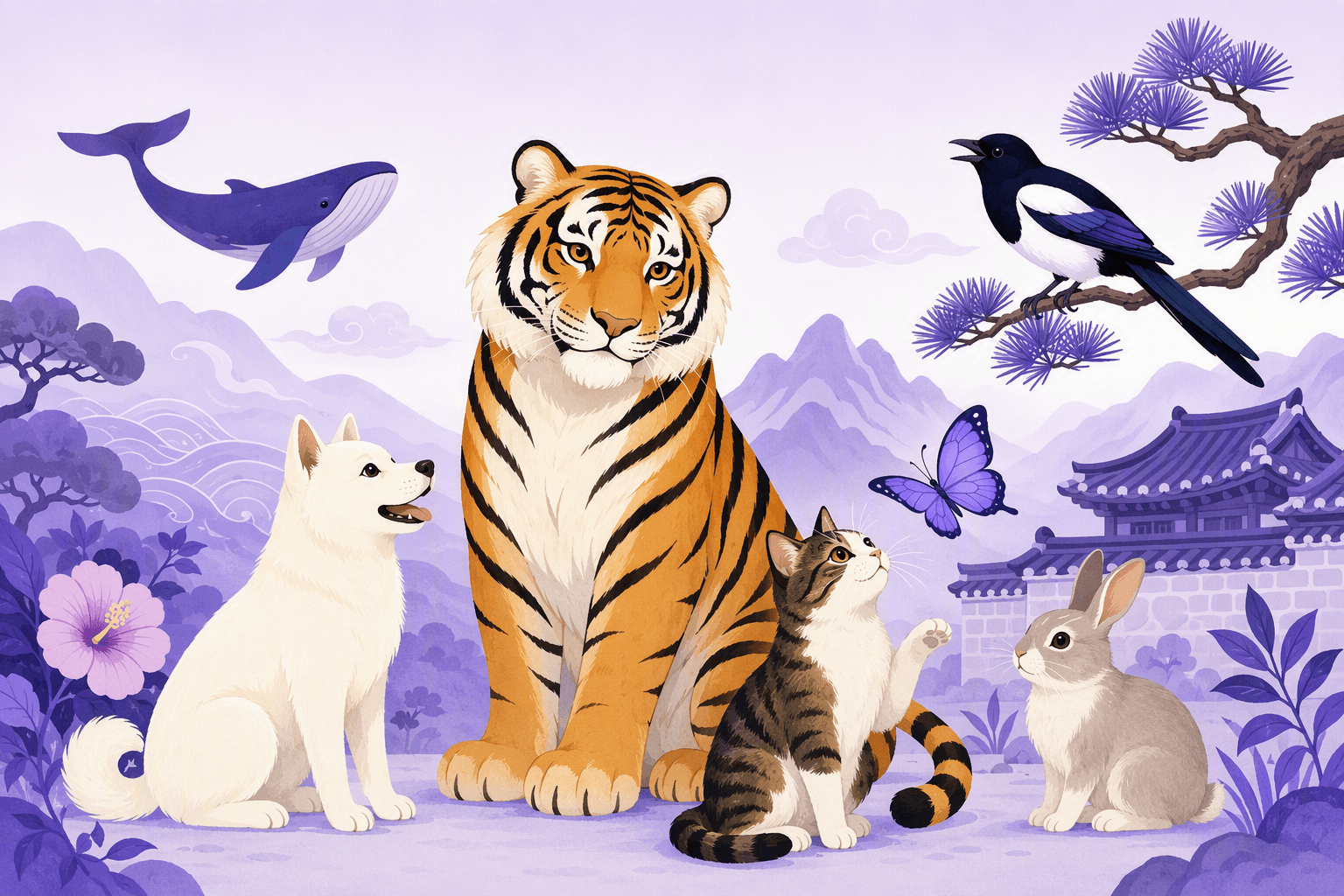
Pets and Domestic Animals
Pet culture has exploded in South Korea over the past decade. The term 반려동물 (ballyeo dongmul, "companion animal") has largely replaced the older 애완동물 (aewan dongmul, "pet animal") in official and media usage, reflecting a cultural shift toward viewing pets as family members rather than possessions.
| English | Korean | Pronunciation | Note |
|---|---|---|---|
| Dog | 개 (gae) | geh | Also 강아지 (gangaji) for puppy; 진돗개 (Jindo dog) is Korea's national breed |
| Cat | 고양이 (goyangi) | go-yang-ee | 길고양이 (gilgoyangi) = stray cat; 야옹이 (yaongi) = cute/informal |
| Bird | 새 (sae) | seh | General term; specific birds have their own names |
| Fish | 물고기 (mulgogi) | mul-go-gi | Literally 'water meat'; 생선 (saengseon) = fish as food |
| Rabbit | 토끼 (tokki) | tok-ki | Appears in the Korean moon legend (달토끼, dal tokki) |
| Turtle | 거북이 (geobuki) | geo-bu-ki | Symbol of longevity; 거북선 (geobukseon) = famous turtle ship |
| Hamster | 햄스터 (haemseuteo) | haem-seu-teo | Loanword from English; very popular pet in Korea |
| Parrot | 앵무새 (aengmusae) | aeng-mu-seh | 앵무 = parrot + 새 = bird |
🌍 진돗개, Korea's Legendary Dog Breed
The 진돗개 (jindotgae) from Jindo Island is designated Korean Natural Monument No. 53 and is protected by law. These dogs are famous for extraordinary loyalty. The most celebrated story involves a Jindo named 백구 (Baekgu) who was sold to a new owner 300 kilometers away but escaped and walked back to her original home. 백구's story became a children's book and animated film, cementing the Jindo as a symbol of Korean faithfulness.
Farm Animals
Korea's agricultural history stretches back thousands of years, and farm animal vocabulary reflects the peninsula's traditional rural economy. Several of these words appear in proverbs, idioms, and the Korean zodiac (띠, tti).
| English | Korean | Pronunciation | Note |
|---|---|---|---|
| Cow / Ox | 소 (so) | so | Zodiac animal (소띠); 한우 (hanu) = Korean beef cattle |
| Horse | 말 (mal) | mal | Zodiac animal (말띠); 제주마 (jejuma) = Jeju pony, a native breed |
| Pig | 돼지 (dwaeji) | dweh-ji | Zodiac animal (돼지띠); symbol of wealth and fortune |
| Chicken | 닭 (dak) | dak | Zodiac animal (닭띠); 삼계탕 (samgyetang) = chicken ginseng soup |
| Sheep | 양 (yang) | yang | Zodiac animal (양띠); less common in Korean agriculture |
| Goat | 염소 (yeomso) | yeom-so | 산양 (sanyang) = wild mountain goat; 염소수염 = goatee |
| Duck | 오리 (ori) | o-ri | 오리고기 (origogi) = duck meat, a Korean delicacy |
| Rooster | 수탉 (sutak) | su-tak | 수 = male prefix; 암탉 (amtak) = hen |
💡 Animal Onomatopoeia in Korean
Korean animal sounds are strikingly different from English. Dogs say 멍멍 (meongmeong), cats say 야옹 (yaong), cows say 음매 (eummae), pigs say 꿀꿀 (kkulkkul), roosters say 꼬끼오 (kkokkio), and chicks say 삐약삐약 (ppiyakppiyak). Learning these is essential because Korean children's songs and everyday speech use them constantly, and they appear frequently in K-dramas for humor and warmth.
Wild Animals
Korea's mountainous terrain (over 70% of the peninsula is mountainous) supports diverse wildlife. The 호랑이 (tiger) and 곰 (bear) hold special status in Korean mythology, both appearing in the nation's founding legend.
| English | Korean | Pronunciation | Note |
|---|---|---|---|
| Tiger | 호랑이 (horangi) | ho-rang-ee | Korea's national symbol; appears in the Dangun founding myth |
| Bear | 곰 (gom) | gom | In the Dangun myth, a bear became the first Korean woman (웅녀, Ungnyeo) |
| Lion | 사자 (saja) | sa-ja | Not native to Korea; 사자성어 (sajaseongeo) = four-character idiom |
| Wolf | 늑대 (neukdae) | neuk-dae | Rare on the peninsula today; used in expressions like 늑대 소년 (wolf boy) |
| Fox | 여우 (yeou) | yeo-u | 구미호 (gumiho) = nine-tailed fox, a major figure in Korean folklore |
| Deer | 사슴 (saseum) | sa-seum | 사슴벌레 (saseumbeolle) = stag beetle; symbol of grace |
| Monkey | 원숭이 (wonsungi) | won-sung-ee | Zodiac animal (원숭이띠); not native to the Korean peninsula |
| Elephant | 코끼리 (kokkiri) | ko-kki-ri | From 코 (ko, nose) + 끼리; literally refers to the trunk |
| Snake | 뱀 (baem) | baem | Zodiac animal (뱀띠); 구렁이 (gureongi) = large snake |
| Rat / Mouse | 쥐 (jwi) | jwi | Zodiac animal (쥐띠); first animal of the zodiac cycle |
| Dragon | 용 (yong) | yong | Zodiac animal (용띠); symbol of imperial power and water |
🌍 호랑이, The Tiger in Korean Culture
The tiger is Korea's most culturally significant animal. In the founding myth of Dangun (단군 신화), a tiger and a bear both entered a cave to become human, but only the bear succeeded because the tiger lacked patience. Despite this, the tiger became Korea's national symbol, representing courage and strength. The 1988 Seoul Olympics mascot was 호돌이 (Hodori), a tiger, and the Korean proverb "호랑이도 제 말 하면 온다" (horangido je mal hamyeon onda, "speak of the tiger and it arrives") is the exact equivalent of "speak of the devil." Korean folk paintings called 민화 (minhwa) frequently depict tigers, often humorously alongside magpies.
Sea Animals
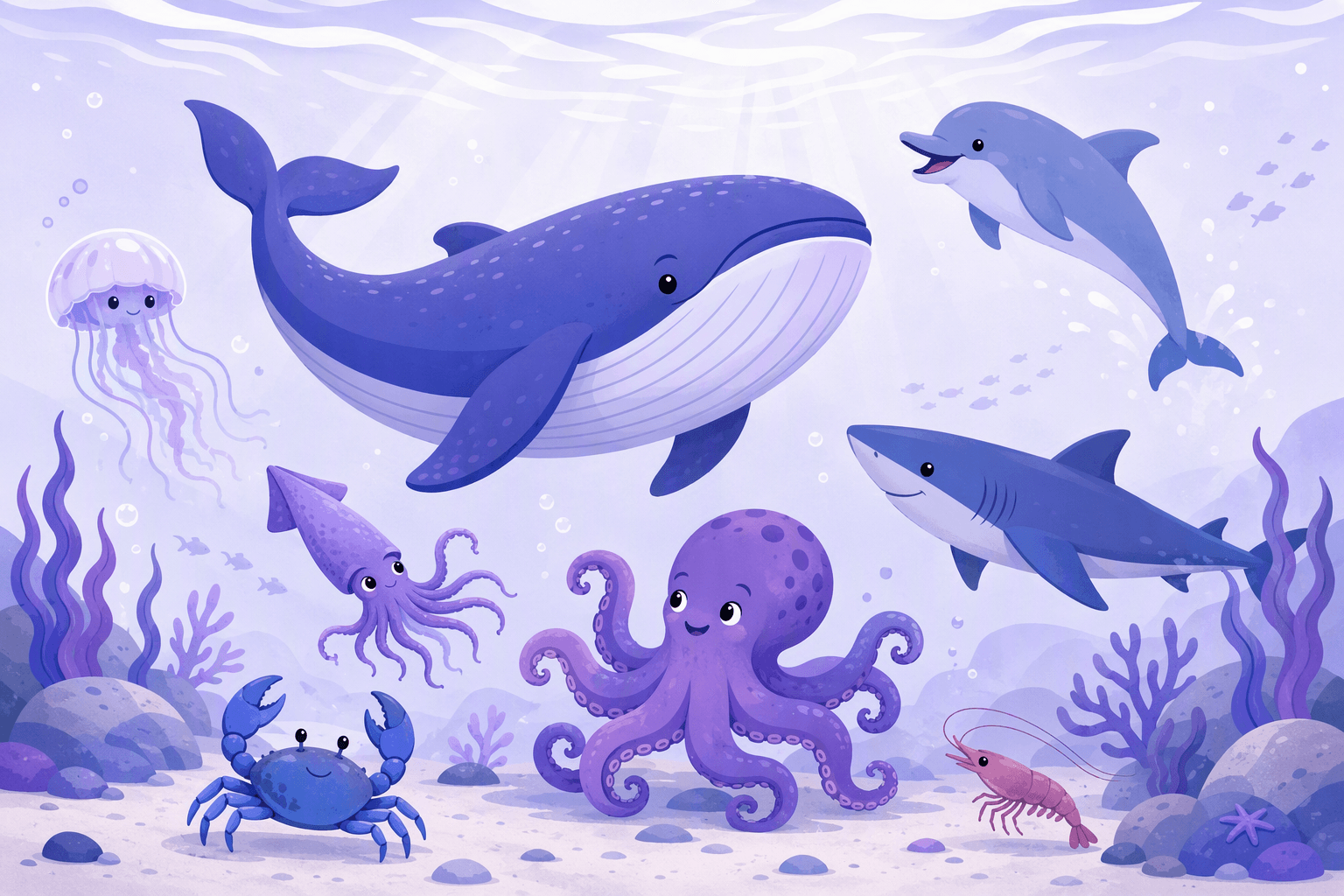
The Korean peninsula is surrounded by sea on three sides, and seafood is central to Korean cuisine and culture. Many sea animal names double as food vocabulary, an important distinction that Korean marks lexically.
| English | Korean | Pronunciation | Note |
|---|---|---|---|
| Whale | 고래 (gorae) | go-reh | 울산 (Ulsan) has Korea's famous whale museum and festival |
| Dolphin | 돌고래 (dolgorae) | dol-go-reh | 돌 (dol, stone/turning) + 고래 (gorae, whale) |
| Shark | 상어 (sangeo) | sang-eo | 아기상어 (agi sangeo, Baby Shark) = the viral Korean children's song |
| Octopus | 문어 (muneo) | mu-neo | 산낙지 (sannakji) = live octopus, a famous Korean dish |
| Crab | 게 (ge) | geh | 꽃게 (kkotkke) = blue crab; 간장게장 (ganjang gejang) = soy-marinated crab |
| Jellyfish | 해파리 (haepari) | hae-pa-ri | 해 (hae, sea) + 파리 (pari, fly) |
| Squid | 오징어 (ojingeo) | o-jing-eo | 오징어 게임 (Ojingeo Geim) = Squid Game, the global Netflix hit |
| Shrimp | 새우 (saeu) | seh-u | 새우깡 (saeukkan) = Korea's iconic shrimp-flavored snack |
Birds
Korea sits along the East Asian-Australasian Flyway, one of the world's major migratory bird routes, making it home to hundreds of bird species. The IUCN notes several species unique to or concentrated in the Korean peninsula.
| English | Korean | Pronunciation | Note |
|---|---|---|---|
| Eagle | 독수리 (doksuri) | dok-su-ri | 대머리독수리 (daemeoridoksuri) = bald eagle equivalent |
| Owl | 부엉이 (bueongi) | bu-eong-ee | 올빼미 (olppaemi) = another owl variety; symbol of wisdom |
| Magpie | 까치 (kkachi) | kka-chi | Korea's national bird; symbol of good news and luck |
| Pigeon / Dove | 비둘기 (bidulgi) | bi-dul-gi | 평화의 비둘기 (pyeonghwaui bidulgi) = dove of peace |
| Penguin | 펭귄 (penggwin) | peng-gwin | Loanword from English; popular character in Korean media |
| Crane | 학 (hak) | hak | 두루미 (durumi) = red-crowned crane; symbol of longevity |
| Crow | 까마귀 (kkamagwi) | kka-ma-gwi | Considered a bad omen in Korean folklore |
| Sparrow | 참새 (chamsae) | cham-seh | 참 (cham, true/real) + 새 (sae, bird) |
The 까치 (kkachi, magpie) deserves special attention. According to the Academy of Korean Studies, magpies have been considered messengers of good fortune in Korea for centuries. The famous folk tale 견우직녀 (Gyeonu Jingnyeo, the Korean version of the Cowherd and Weaver Girl legend) features magpies forming a bridge across the Milky Way. When a magpie calls in the morning, Koreans traditionally say it signals a welcome guest will arrive that day.
Insects and Small Creatures
Korean has rich vocabulary for insects and small creatures, many of which appear in children's songs, seasonal expressions, and cultural references.
| English | Korean | Pronunciation | Note |
|---|---|---|---|
| Butterfly | 나비 (nabi) | na-bi | 나비효과 (nabi hyogwa) = butterfly effect; common girl's name element |
| Bee | 벌 (beol) | beol | 꿀벌 (kkulbeol) = honeybee; 벌꿀 (beolkkul) = honey |
| Ant | 개미 (gaemi) | gae-mi | 개미처럼 일하다 (gaemicheoreom ilhada) = work like an ant |
| Spider | 거미 (geomi) | geo-mi | 거미줄 (geomijul) = spider web; 거미남/거미녀 = slang for clingy person |
| Fly | 파리 (pari) | pa-ri | Also the Korean pronunciation of Paris (context-dependent) |
| Mosquito | 모기 (mogi) | mo-gi | 모기장 (mogijang) = mosquito net; summer vocabulary essential |
| Dragonfly | 잠자리 (jamjari) | jam-ja-ri | Also means 'sleeping place/bed'; context determines meaning |
| Cicada | 매미 (maemi) | mae-mi | Symbol of summer in Korea; their buzzing defines Korean summers |
The Korean Zodiac: 12 Animals
The Korean zodiac (띠, tti) follows the same 12-animal cycle found across East Asia but uses native Korean animal names. Asking "무슨 띠예요?" (museun ttiyeyo?, what's your zodiac sign?) is a common and culturally natural way to learn someone's age in Korean society, where age and hierarchy significantly shape social interactions.
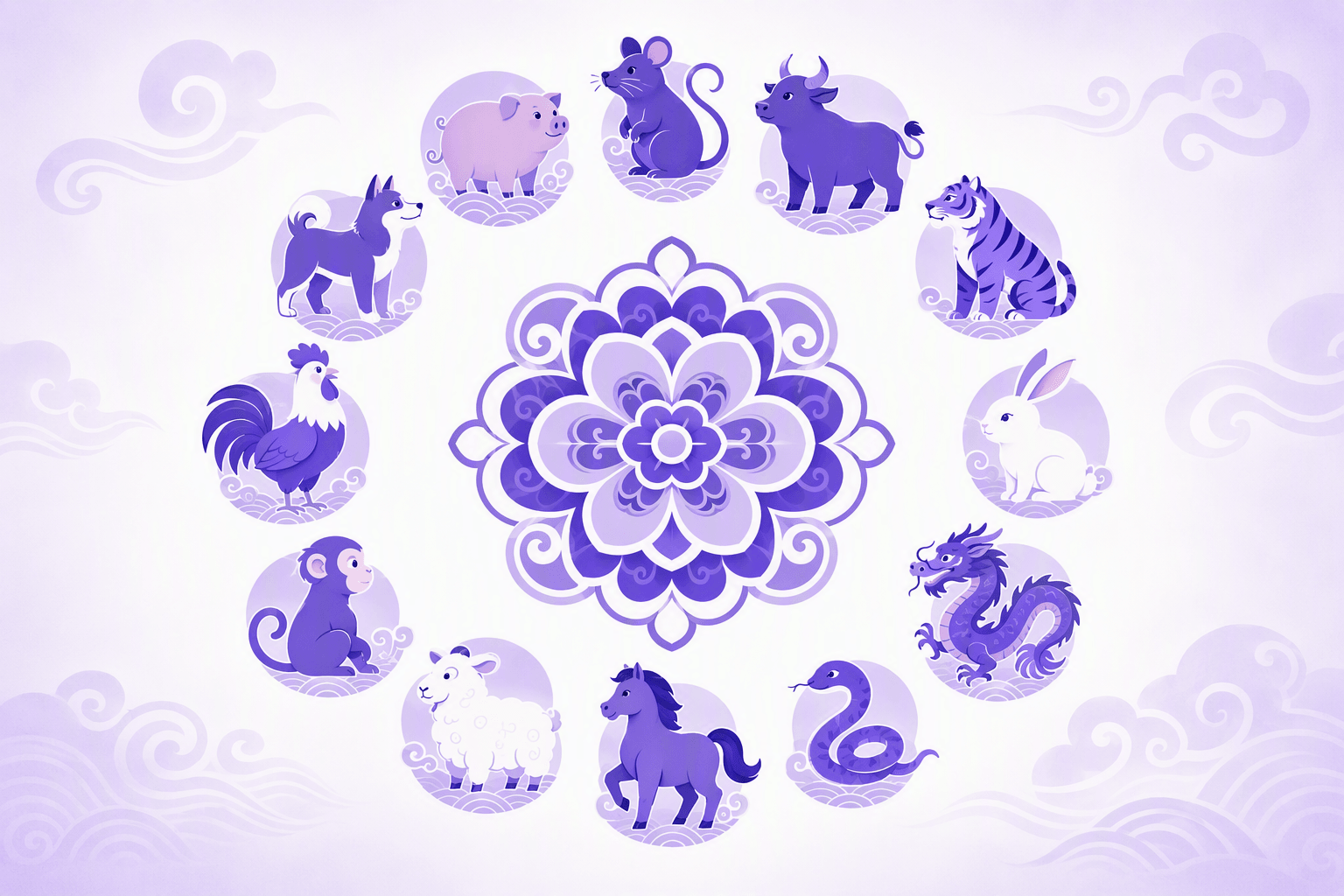
| Zodiac Year | Korean | Pronunciation | English |
|---|---|---|---|
| 자 | 쥐띠 | jwi-tti | Rat |
| 축 | 소띠 | so-tti | Ox |
| 인 | 호랑이띠 | horangi-tti | Tiger |
| 묘 | 토끼띠 | tokki-tti | Rabbit |
| 진 | 용띠 | yong-tti | Dragon |
| 사 | 뱀띠 | baem-tti | Snake |
| 오 | 말띠 | mal-tti | Horse |
| 미 | 양띠 | yang-tti | Sheep |
| 신 | 원숭이띠 | wonsungi-tti | Monkey |
| 유 | 닭띠 | dak-tti | Rooster |
| 술 | 개띠 | gae-tti | Dog |
| 해 | 돼지띠 | dwaeji-tti | Pig |
In Korean culture, 돼지 (pig) is not an insult; it symbolizes wealth, fortune, and abundance. Dreaming of a pig is considered extremely lucky, and piggy banks (돼지 저금통, dwaeji jeogeumtong) are as culturally embedded in Korea as they are in the West. The 용 (dragon) year is considered the most auspicious, and birth rates in Korea historically spike during dragon years.
Counting Animals: The 마리 Counter
Korean uses a specific counter word for animals: 마리 (mari). This single counter applies to every animal regardless of size, from mosquitoes to whales. You must use native Korean numbers (하나, 둘, 셋), not Sino-Korean numbers (일, 이, 삼), with this counter.
| Count | Korean | Pronunciation | Example |
|---|---|---|---|
| 1 animal | 한 마리 | han mari | 고양이 한 마리 (one cat) |
| 2 animals | 두 마리 | du mari | 개 두 마리 (two dogs) |
| 3 animals | 세 마리 | se mari | 새 세 마리 (three birds) |
| 4 animals | 네 마리 | ne mari | 물고기 네 마리 (four fish) |
| 5 animals | 다섯 마리 | daseot mari | 토끼 다섯 마리 (five rabbits) |
The pattern is: noun + native Korean number + 마리. For example, 호랑이 두 마리가 있어요 (horangi du mariga isseoyo, there are two tigers). This counter is one of many in Korean: 명 (myeong) is used for people, 개 (gae) for general objects, and 권 (gwon) for books. If you have already studied Korean numbers, adding 마리 to your toolkit is straightforward.
💡 마리 Works for ALL Animals
Unlike Japanese, which uses different counters for small animals (匹, hiki) versus large animals (頭, tou) versus birds (羽, wa), Korean uses 마리 universally. One ant? 한 마리. One elephant? 한 마리. One eagle? 한 마리. This simplicity is a welcome relief for learners coming from Japanese or Chinese, where animal counters are notoriously complicated.
Korean Animal Proverbs
Animals feature prominently in Korean proverbs (속담, sokdam), and learning these expressions gives you insight into Korean values and humor.
-
호랑이도 제 말 하면 온다 (horangido je mal hamyeon onda): "Even the tiger comes when you speak of it." The Korean equivalent of "speak of the devil." Used when someone you were just discussing unexpectedly appears.
-
개천에서 용 난다 (gaecheoneseo yong nanda): "A dragon rises from a ditch." Describes someone who achieves greatness despite humble origins. One of the most beloved Korean proverbs, frequently cited in discussions of social mobility.
-
원숭이도 나무에서 떨어진다 (wonsungido namuaeseo tteoreojinda): "Even a monkey falls from a tree." Nobody is perfect; even experts make mistakes.
-
꿩 대신 닭 (kkwong daesin dak): "A chicken instead of a pheasant." When you cannot get what you want, a substitute will do. Similar to "beggars can't be choosers."
-
고래 싸움에 새우 등 터진다 (gorae ssaume saeu deung teojinda): "In a whale fight, the shrimp's back bursts." When powerful entities clash, the small and powerless suffer. This proverb is frequently used in Korean political and economic commentary.
Animals in Korean Media and Entertainment
Korean dramas, films, and music are filled with animal references, and recognizing these words enriches your viewing experience. The global phenomenon 오징어 게임 (Ojingeo Geim, Squid Game) put 오징어 directly into the international vocabulary. The viral children's song 아기상어 (Agi Sangeo, Baby Shark) by Korean company Pinkfong became the most-viewed YouTube video of all time, introducing millions to basic Korean animal words.
In K-dramas, characters are frequently compared to animals: someone with fox-like cunning is called 여우 같은 (yeou gateun, fox-like), while a loyal and straightforward person might be described as 개 같은 (gae gateun), though this expression can also be used as an insult depending on context and tone. The 구미호 (gumiho, nine-tailed fox) from Korean folklore has inspired dozens of dramas and films, including the popular series "내 여자친구는 구미호" (My Girlfriend is a Gumiho).
For immersive practice hearing animal vocabulary in natural Korean, check out the best Korean dramas to learn Korean. Watching with Wordy lets you tap any word in the subtitles to see its Hangul, pronunciation, and meaning instantly.
Build Your Korean Animal Vocabulary
Animal vocabulary connects to nearly every aspect of Korean language and culture, from zodiac conversations and proverbs to food ordering and K-drama comprehension. The words in this guide appear in everyday Korean speech far more often than you might expect, because animals are embedded in idioms, expressions, and cultural references that native speakers use daily.
Start with the pets and farm animals, which appear most frequently in conversation, then expand to wildlife and sea creatures as you encounter them in Korean media. The cultural notes (the tiger in folklore, the magpie as a good omen, the pig as a symbol of wealth) are just as important as the vocabulary itself, because they help you understand why Koreans react to animal references the way they do.
Explore more vocabulary guides on our blog, or visit our Korean learning page to practice animal words through authentic Korean content with interactive subtitles.
Frequently Asked Questions
How do you say 'animal' in Korean?
What counter do you use for animals in Korean?
What is Korea's national animal?
How do Korean animal sounds differ from English?
What is the Jindo dog and why is it famous in Korea?
What animals appear in the Korean zodiac?
Sources & References
- National Institute of Korean Language (국립국어원, NIKL), Standard Korean Dictionary (표준국어대사전)
- King Sejong Institute Foundation, Korean Language Education Standards (2024)
- Crystal, D. The Cambridge Encyclopedia of Language (Cambridge University Press)
- IUCN Red List of Threatened Species, Korean Peninsula fauna assessment
- Academy of Korean Studies (한국학중앙연구원), Encyclopedia of Korean Culture
Start learning with Wordy
Watch real movie clips and build your vocabulary as you go. Free to download.


