Japanese Family Words: The Complete Guide to 家族 Vocabulary With Uchi-Soto Distinction
Quick Answer
Japanese has TWO complete sets of family vocabulary. When talking about YOUR family, you use humble terms: 母 (haha, mother), 父 (chichi, father), 兄 (ani, older brother). When talking about SOMEONE ELSE'S family, you switch to honorific terms: お母さん (okaasan), お父さん (otousan), お兄さん (oniisan). This uchi-soto (inside-outside) distinction is fundamental to Japanese politeness and unique among major world languages.
Japanese family vocabulary is unlike anything in European languages. Where English has one word for "mother," Japanese has two entirely separate systems: one for talking about your own family to outsiders, and another for referring to someone else's family. This uchi-soto (inside-outside) distinction is not optional politeness; it is a core grammatical feature that every speaker must master. Whether you're looking up "japanese family words" for travel, study, or conversation, this guide covers everything you need.
With approximately 125 million native speakers according to Ethnologue's 2024 data, Japanese is the world's ninth most spoken language. The Japan Foundation reports that 3.8 million people study Japanese worldwide, and family vocabulary consistently ranks among the most essential word sets in beginner curricula, precisely because getting it wrong signals a fundamental misunderstanding of Japanese social structure.
"Japanese kinship terminology exemplifies what anthropologist G.P. Murdock classified as a 'bifurcate collateral' system, distinguishing not only between the speaker's own family and others' families, but also between older and younger siblings, a level of specificity rare among the world's major languages."
(G.P. Murdock, Social Structure, Free Press, 1949)
This guide covers 25+ family terms organized by the uchi-soto system, with kanji, hiragana, pronunciation, and the cultural logic behind each distinction. For interactive practice with authentic Japanese content, visit our Japanese learning page.
The Uchi-Soto System: Why Japanese Has Two Sets of Family Words
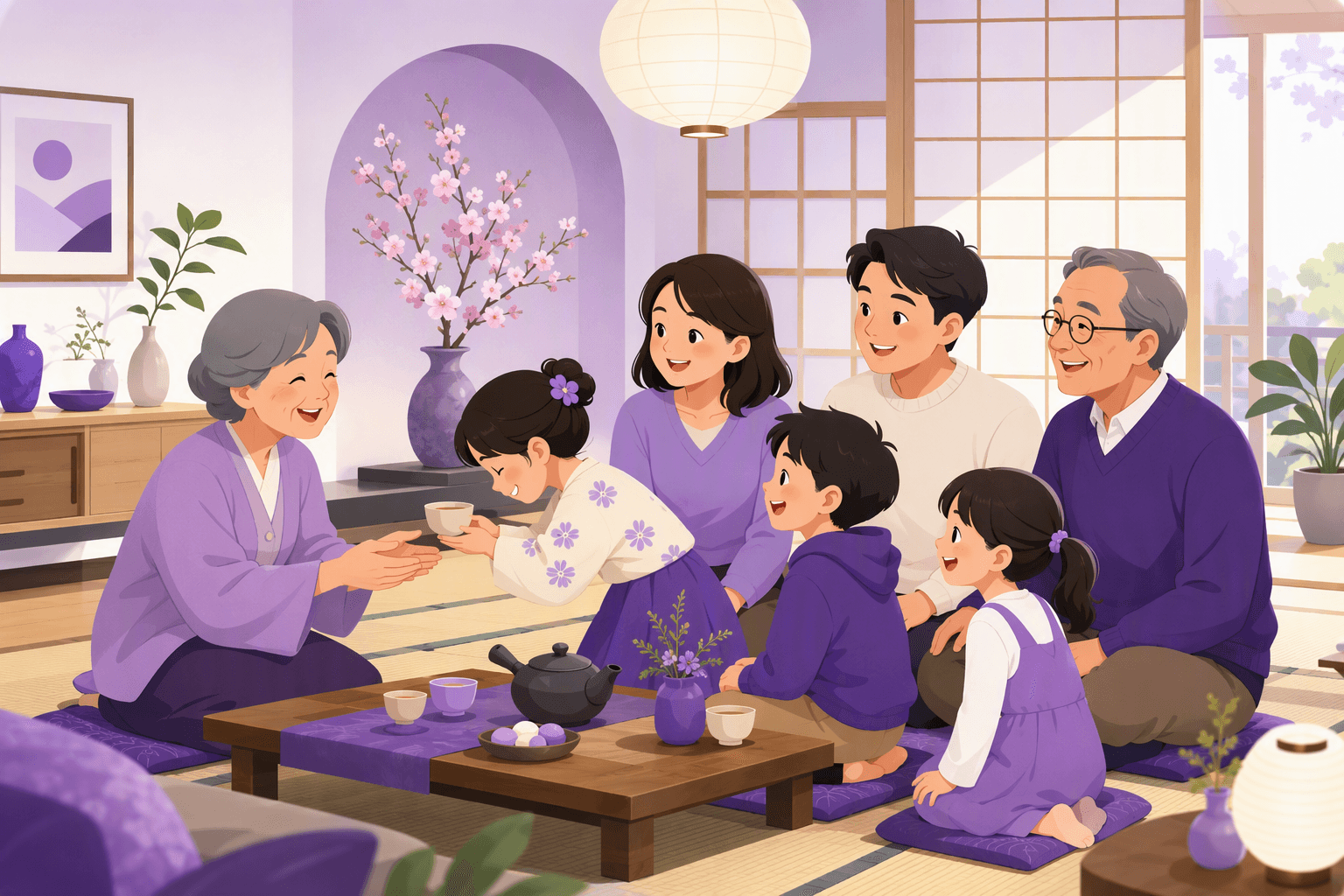
Before learning individual words, you need to understand the principle that governs all of them. Japanese society operates on the concept of uchi (内, inside) and soto (外, outside). Your family is your "inside" group. Everyone else is "outside."
When speaking to someone outside your family about your own relatives, you use humble terms, plain, unadorned words that deliberately lower your family's status. When referring to someone else's family members, you use honorific terms, polite forms with the お prefix or さん suffix that elevate them.
This is not a matter of being "casual versus formal." A CEO talking to a colleague about his own mother will say 母 (haha), the humble form. The same CEO referring to the colleague's mother will say お母さん (okaasan), the honorific form. Mixing these up is one of the most noticeable mistakes a Japanese learner can make.
⚠️ The Most Common Mistake
Never use お母さん (okaasan) when telling someone about YOUR mother. Saying 「お母さんは元気です」 (okaasan wa genki desu) to your boss means you are either talking about HIS mother or making a serious social error. The correct form is 「母は元気です」 (haha wa genki desu). This rule applies to all family terms.
Quick Reference: All Family Terms at a Glance
| English | Japanese | Pronunciation | Note |
|---|---|---|---|
| Family | 家族 / かぞく | kazoku | ご家族 (gokazoku) for others' |
| Father (own) | 父 / ちち | chichi | Humble, about YOUR father |
| Father (others') | お父さん / おとうさん | otousan | Honorific, others' father |
| Mother (own) | 母 / はは | haha | Humble, about YOUR mother |
| Mother (others') | お母さん / おかあさん | okaasan | Honorific, others' mother |
| Older brother (own) | 兄 / あに | ani | Humble form |
| Older brother (others') | お兄さん / おにいさん | oniisan | Honorific form |
| Older sister (own) | 姉 / あね | ane | Humble form |
| Older sister (others') | お姉さん / おねえさん | oneesan | Honorific form |
| Younger brother (own) | 弟 / おとうと | otouto | Humble form |
| Younger brother (others') | 弟さん / おとうとさん | otoutosan | Honorific form |
| Younger sister (own) | 妹 / いもうと | imouto | Humble form |
| Younger sister (others') | 妹さん / いもうとさん | imoutosan | Honorific form |
| Husband (own) | 夫 / おっと | otto | Humble; also 主人 (shujin) |
| Husband (others') | ご主人 / ごしゅじん | goshujin | Honorific; also 旦那さん |
| Wife (own) | 妻 / つま | tsuma | Humble; also 家内 (kanai) |
| Wife (others') | 奥さん / おくさん | okusan | Honorific form |
| Grandfather (own) | 祖父 / そふ | sofu | Humble form |
| Grandfather (others') | おじいさん | ojiisan | Honorific form |
| Grandmother (own) | 祖母 / そぼ | sobo | Humble form |
| Grandmother (others') | おばあさん | obaasan | Honorific form |
| Uncle (parent's older bro) | 伯父 / おじ | oji | 伯 = elder; おじさん polite |
| Uncle (parent's younger bro) | 叔父 / おじ | oji | 叔 = younger; same reading |
| Aunt (parent's older sis) | 伯母 / おば | oba | 伯 = elder; おばさん polite |
| Aunt (parent's younger sis) | 叔母 / おば | oba | 叔 = younger; same reading |
| Cousin | 従兄弟 / いとこ | itoko | Kanji varies by gender/age |
Your Own Family: Humble Terms (内 Uchi)
These are the words you use when describing your family to anyone outside the family unit: colleagues, teachers, strangers, or anyone who is not part of your household.
父 (ちち)
Father, pronunciation: chichi (CHEE-chee). This is the humble term for your own father. Use it when speaking to anyone outside your family. Example: 「父は東京で働いています」(chichi wa Toukyou de hataraite imasu, "My father works in Tokyo"). The kanji 父 also appears in 父親 (chichioya), a slightly more formal synonym meaning "father (as parent)."
母 (はは)
Mother, pronunciation: haha (HAH-hah). The humble term for your own mother. Example: 「母は料理が上手です」(haha wa ryouri ga jouzu desu, "My mother is good at cooking"). The kanji 母 forms compounds like 母国 (bokoku, homeland, literally "mother country") and 母語 (bogo, mother tongue).
兄 (あに)
Older brother, pronunciation: ani (AH-nee). Used only for a brother who is older than you. Example: 「兄は大阪に住んでいます」(ani wa Oosaka ni sunde imasu, "My older brother lives in Osaka"). There is no generic word for "brother" in Japanese; you must always specify older or younger.
姉 (あね)
Older sister, pronunciation: ane (AH-neh). Used only for a sister older than you. Example: 「姉は医者です」(ane wa isha desu, "My older sister is a doctor"). Like 兄, this term is exclusively for the elder sibling.
弟 (おとうと)
Younger brother, pronunciation: otouto (oh-TOH-toh). Example: 「弟はまだ高校生です」(otouto wa mada koukousei desu, "My younger brother is still in high school").
妹 (いもうと)
Younger sister, pronunciation: imouto (ee-MOH-toh). Example: 「妹は来年大学に入ります」(imouto wa rainen daigaku ni hairimasu, "My younger sister enters university next year").
🌍 Older vs. Younger: Why It Matters
Japanese requires you to specify whether a sibling is older or younger because age hierarchy is built into the language. An older sibling (兄/姉) holds a higher social position than a younger one (弟/妹), and this is reflected in everyday address. Children typically call their older siblings お兄ちゃん (oniichan) or お姉ちゃん (oneechan), while older siblings call younger ones by name. This hierarchy extends to all Japanese social interactions, not just family.
Someone Else's Family: Honorific Terms (外 Soto)
When referring to another person's family members, switch to these polite forms. The お prefix and さん suffix signal respect.
お父さん (おとうさん)
Father (someone else's), pronunciation: otousan (oh-TOH-san). Use when asking about or referring to someone else's father. Example: 「お父さんはお元気ですか?」(otousan wa ogenki desu ka?, "Is your father well?"). This is also the term children use to address their own father directly.
お母さん (おかあさん)
Mother (someone else's), pronunciation: okaasan (oh-KAH-san). Example: 「お母さんによろしくお伝えください」(okaasan ni yoroshiku otsutae kudasai, "Please give my regards to your mother"). Children also use this to address their own mother at home.
お兄さん (おにいさん)
Older brother (someone else's), pronunciation: oniisan (oh-NEE-san). Example: 「お兄さんは何をされていますか?」(oniisan wa nani wo sarete imasu ka?, "What does your older brother do?"). Also used to address unfamiliar young men in casual contexts.
お姉さん (おねえさん)
Older sister (someone else's), pronunciation: oneesan (oh-NEH-san). Example: 「お姉さんは結婚されていますか?」(oneesan wa kekkon sarete imasu ka?, "Is your older sister married?"). Like お兄さん, it can also be used to address young women you don't know well.
💡 Address vs. Reference: The Double Function
The honorific family terms serve two purposes. First, they refer to SOMEONE ELSE'S family members. Second, they are how you ADDRESS your own family members directly at home. A child calls out 「お母さん!」(okaasan!) to get their mother's attention. But when that same child tells a teacher about their mother, they switch to 「母が...」(haha ga...). The humble forms are NEVER used as forms of address.
Extended Family
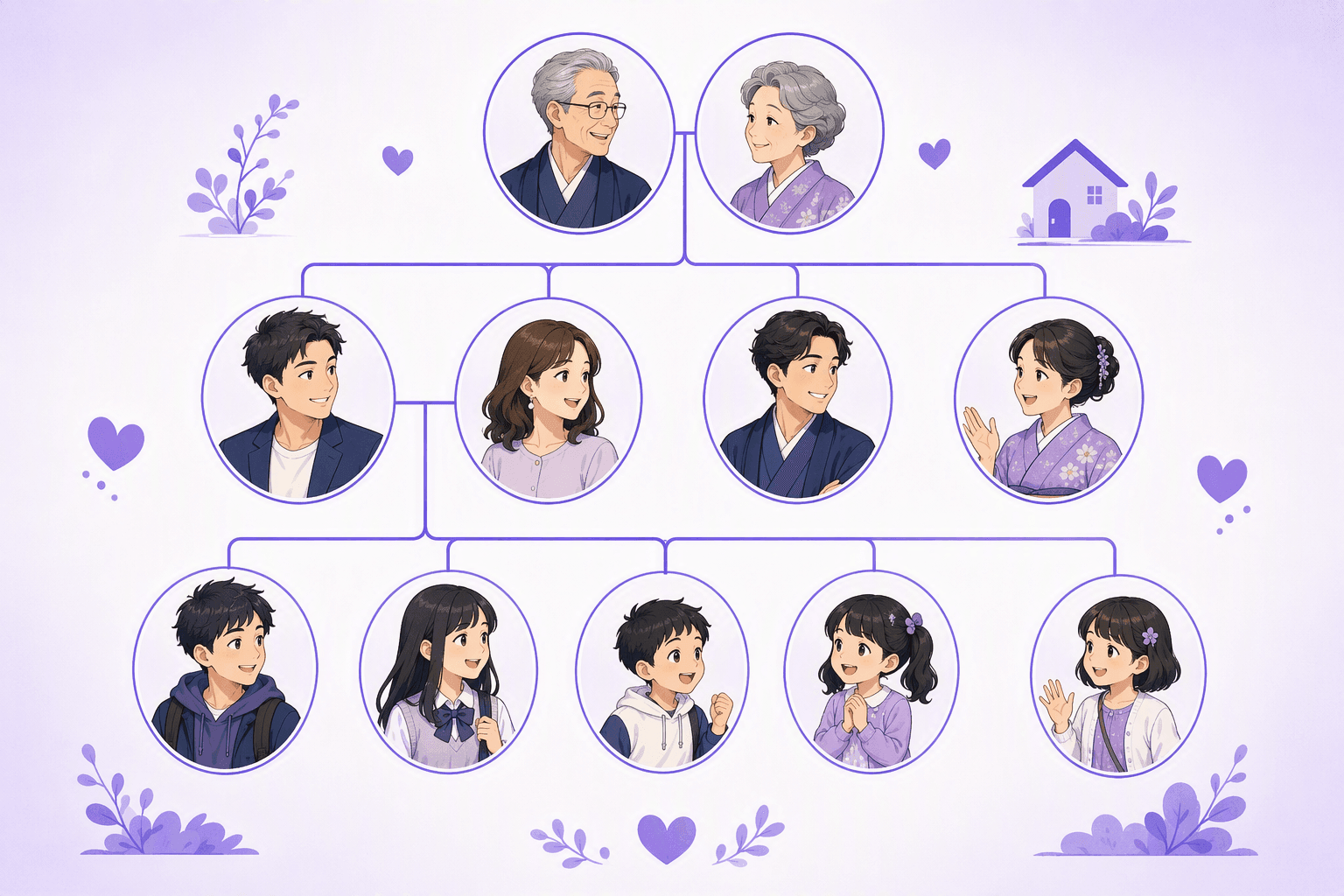
Japanese extended family vocabulary follows the same uchi-soto logic, with additional distinctions based on whether a relative is older or younger than your parent.
祖父 (そふ) / おじいさん
Grandfather, humble: sofu (SOH-foo), honorific: ojiisan (oh-JEE-san). The humble form 祖父 is used when telling others about your grandfather. Children address their grandfather as おじいちゃん (ojiichan), the affectionate form. The kanji 祖 means "ancestor" and appears in 祖先 (sosen, ancestors) and 祖国 (sokoku, fatherland).
祖母 (そぼ) / おばあさん
Grandmother, humble: sobo (SOH-boh), honorific: obaasan (oh-BAH-san). Example: 「祖母は九十歳です」(sobo wa kyuujussai desu, "My grandmother is 90 years old"). The affectionate form is おばあちゃん (obaachan).
伯父・叔父 (おじ) / おじさん
Uncle: Japanese distinguishes between a parent's older sibling (伯父, using the kanji 伯 for "elder") and a parent's younger sibling (叔父, using 叔 for "junior"). Both are pronounced oji, but the kanji carry important genealogical information. The polite form for either is おじさん (ojisan). Be careful with vowel length: おじさん (ojisan, uncle) versus おじいさん (ojiisan, grandfather); one extra い changes the generation entirely.
伯母・叔母 (おば) / おばさん
Aunt: the same elder/younger distinction applies. 伯母 (oba) for a parent's older sister, 叔母 (oba) for a parent's younger sister. Polite form: おばさん (obasan). Again, watch the vowel: おばさん (obasan, aunt) versus おばあさん (obaasan, grandmother).
従兄弟 (いとこ)
Cousin, pronunciation: itoko (ee-TOH-koh). The kanji for cousin actually changes based on the cousin's gender and relative age: 従兄 (older male cousin), 従弟 (younger male cousin), 従姉 (older female cousin), 従妹 (younger female cousin). In practice, most people write いとこ in hiragana and let context handle the details.
🌍 おじさん and おばさん Beyond Family
The words おじさん (ojisan) and おばさん (obasan) are used far beyond family contexts. Japanese people commonly address middle-aged men as おじさん and middle-aged women as おばさん, even with no family relationship. This can be a sensitive topic; being called おばさん for the first time is a cultural milestone (not always a welcome one) that signals you have crossed from "young" to "middle-aged" in society's eyes.
Modern and Casual Family Terms
Contemporary Japanese families, especially younger generations, increasingly use borrowed and informal terms alongside the traditional system.
| English | Japanese | Pronunciation | Note |
|---|---|---|---|
| Dad (casual) | パパ | papa | From English; young children |
| Mom (casual) | ママ | mama | From English; young children |
| Dad (informal) | お父ちゃん / おとうちゃん | otouchan | Affectionate; rural/older usage |
| Mom (informal) | お母ちゃん / おかあちゃん | okaachan | Affectionate; rural/older usage |
| Big bro (casual) | お兄ちゃん / おにいちゃん | oniichan | Affectionate; used by children |
| Big sis (casual) | お姉ちゃん / おねえちゃん | oneechan | Affectionate; used by children |
| Grandpa (casual) | おじいちゃん | ojiichan | Affectionate diminutive |
| Grandma (casual) | おばあちゃん | obaachan | Affectionate diminutive |
The Agency for Cultural Affairs' 2024 National Language Survey found that パパ (papa) and ママ (mama) usage has increased significantly among families with children under ten. However, most Japanese adults transition to お父さん/お母さん by their teenage years, and the humble 父/母 system remains firmly in place for all formal and business communication.
"The coexistence of traditional keigo-based kinship terms with modern casual forms like パパ and ママ reflects a broader shift in Japanese family structure, but the uchi-soto distinction in reference terms shows no sign of weakening."
(Agency for Cultural Affairs (文化庁), National Language Survey Report, 2024)
The 家 (Ie) System: Historical Context
Japanese family vocabulary is rooted in the 家 (ie, household) system, a legal and social structure that dominated Japan from the Meiji era (1868) until its formal abolition in 1947. Under the ie system, the family was a patrilineal unit headed by the eldest male. The household, not the individual, was the basic unit of society.
This history explains several features of modern family vocabulary. The word 家内 (kanai, literally "inside the house") was the standard humble term for "my wife," reflecting the expectation that women managed the domestic sphere. While 家内 is still understood, many younger Japanese prefer 妻 (tsuma, wife) as a more neutral term. Similarly, 主人 (shujin, literally "master") for "my husband" is increasingly replaced by 夫 (otto) among younger speakers who find the hierarchical connotation outdated.
The traditional ie system also explains why Japanese distinguishes 伯父 (uncle older than your parent) from 叔父 (uncle younger than your parent). In the ie system, birth order determined inheritance and household authority, making this distinction legally and socially critical.
🌍 Changing Terms for Spouses
The shift away from 主人 (shujin, "master") and 家内 (kanai, "inside the house") reflects changing gender dynamics in Japan. A 2023 NHK survey found that speakers under 40 increasingly prefer 夫 (otto, husband) and 妻 (tsuma, wife) as gender-neutral alternatives. In casual speech, 旦那 (danna, hubby) and 嫁 (yome, wife, originally "bride") are also common, though both carry traditional connotations.
Sibling Terms: The Age Hierarchy
One of the most distinctive features of Japanese family vocabulary is the absolute requirement to distinguish between older and younger siblings. This table summarizes the complete sibling system.
| Relationship | Humble (Own) | Honorific (Others') | Casual/Address |
|---|---|---|---|
| Older brother | 兄 (ani) | お兄さん (oniisan) | お兄ちゃん (oniichan) |
| Younger brother | 弟 (otouto) | 弟さん (otoutosan) | Name + くん (kun) |
| Older sister | 姉 (ane) | お姉さん (oneesan) | お姉ちゃん (oneechan) |
| Younger sister | 妹 (imouto) | 妹さん (imoutosan) | Name + ちゃん (chan) |
| Siblings (general) | 兄弟 (kyoudai) | ご兄弟 (gokyoudai) | N/A |
Notice that younger siblings are addressed by name, not by title. An older sister calls her younger brother たろう (Tarou), while the younger brother calls her お姉ちゃん (oneechan). This asymmetry reinforces the age hierarchy: older siblings have titles, younger siblings have names.
The collective word 兄弟 (kyoudai, siblings) literally means "older brother + younger brother." For sisters, 姉妹 (shimai, "older sister + younger sister") exists but is less commonly used. In practice, 兄弟 covers all sibling combinations regardless of gender, similar to how English "brothers" can informally mean "siblings."
Practice Family Words With Real Japanese Content
Family scenes appear in virtually every Japanese drama, anime, and film. Dinner table conversations, family arguments, meeting the parents: these scenarios provide natural repetition of uchi-soto family vocabulary in authentic emotional contexts. You will quickly notice how characters switch between 母 and お母さん depending on who they are talking to.
Japanese movies and anime are especially valuable for hearing the casual forms (パパ, ママ, お兄ちゃん) that textbooks often underemphasize. Check out our guide to the best anime and movies for learning Japanese for recommendations that feature rich family dialogue.
Wordy lets you watch Japanese content with interactive subtitles. Tap any family term to see its kanji, reading, and whether it is the humble or honorific form. Instead of memorizing from lists alone, you absorb the uchi-soto system naturally by watching how native speakers actually use it. Explore our blog for more Japanese guides, or visit our Japanese learning page to start practicing today.
Frequently Asked Questions
Why does Japanese have two words for 'mother'?
How do you say 'family' in Japanese?
What is the difference between 兄 and 弟 in Japanese?
Do Japanese people use パパ and ママ?
How do you say 'uncle' in Japanese?
Sources & References
- Agency for Cultural Affairs (文化庁), National Language Survey on Politeness and Kinship Terms (2024)
- The Japan Foundation (国際交流基金), Survey Report on Japanese-Language Education Abroad (2024)
- Ethnologue: Languages of the World, Japanese language entry, 27th edition (2024)
- Murdock, G.P. Social Structure (Free Press, 1949), kinship terminology classification
Start learning with Wordy
Watch real movie clips and build your vocabulary as you go. Free to download.


