Quick Answer
The most common animals in Japanese are 犬 (inu, dog), 猫 (neko, cat), 鳥 (tori, bird), 魚 (sakana, fish), 牛 (ushi, cow), 馬 (uma, horse), and 虎 (tora, tiger). Japanese uses kanji characters for native and traditional animals (犬 literally depicts a dog) while foreign or exotic animals like ライオン (raion, lion) and ペンギン (pengin, penguin) are written in katakana. The general word for animal is 動物 (doubutsu), literally meaning 'moving thing.'
The most essential animals in Japanese are 犬 (inu, dog), 猫 (neko, cat), 鳥 (tori, bird), 魚 (sakana, fish), 牛 (ushi, cow), and 虎 (tora, tiger). Japanese animal vocabulary reveals a fascinating divide: animals native to Japan and East Asia are written in kanji characters with embedded meaning, while exotic species borrowed from Western languages appear in katakana.
Japanese is spoken by approximately 125 million native speakers according to Ethnologue's 2024 data. The language's three-script writing system (hiragana, katakana, and kanji) creates a uniquely layered vocabulary for the natural world. The character 犬 visually evolved from a pictograph of a dog, while 鳥 traces back to an ancient drawing of a bird with a long tail. Learning animal kanji is one of the most rewarding entry points into the Japanese writing system because many characters retain visual connections to the creatures they represent.
"The pictographic origins of animal kanji offer learners a window into how the earliest writing systems encoded the natural world. Characters like 魚 (fish), 馬 (horse), and 鳥 (bird) have traceable visual histories spanning three thousand years of evolution from oracle bone inscriptions to modern forms."
(David Crystal, The Cambridge Encyclopedia of Language, Cambridge University Press)
This guide covers 50+ animal names organized by category, with kanji, kana readings, pronunciation, and the cultural stories behind Japan's relationship with its fauna. For interactive practice with real Japanese content, visit our Japanese learning page.
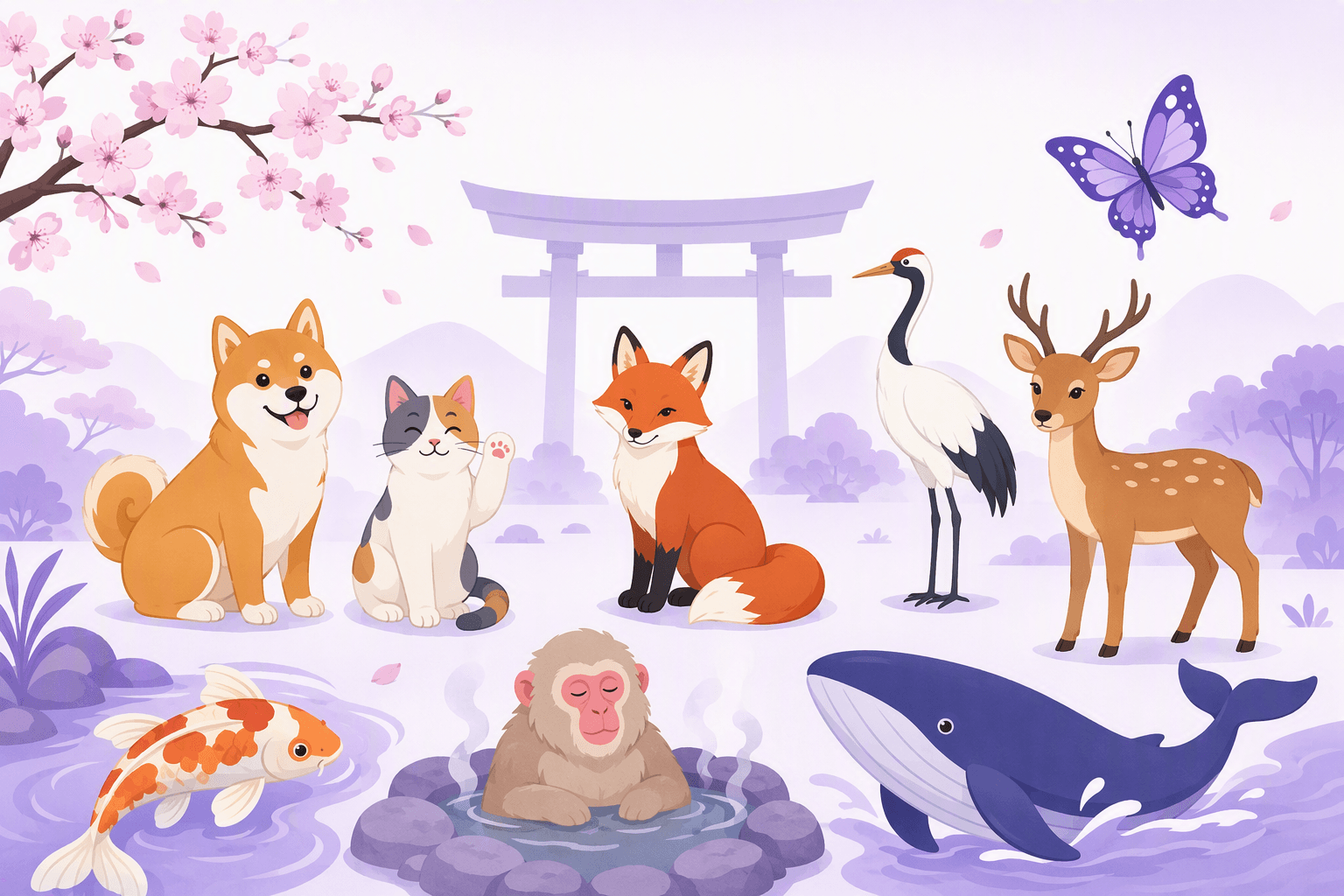
Quick Reference: Essential Japanese Animals
| English | Japanese | Pronunciation | Note |
|---|---|---|---|
| Animal | 動物 (どうぶつ) | doh-BOO-tsoo | General term. Lit. 'moving thing' |
| Dog | 犬 (いぬ) | ee-NOO | Also read けん (ken) in compounds |
| Cat | 猫 (ねこ) | NEH-koh | 招き猫 (maneki-neko) = beckoning cat |
| Bird | 鳥 (とり) | TOH-ree | Also means chicken (food) |
| Fish | 魚 (さかな) | sah-KAH-nah | Also read うお (uo) in compounds |
| Horse | 馬 (うま) | OO-mah | Also read ば (ba) in compounds |
| Cow / Bull | 牛 (うし) | OO-shee | Also read ぎゅう (gyuu) in compounds |
| Monkey | 猿 (さる) | SAH-roo | Three wise monkeys of Nikko |
| Tiger | 虎 (とら) | TOH-rah | Symbol of courage and strength |
| Bear | 熊 (くま) | KOO-mah | Hokkaido's ヒグマ (higuma) is famous |
| Whale | 鯨 (くじら) | koo-JEE-rah | Fish radical 魚 + capital 京 |
| Fox | 狐 (きつね) | kee-TSOO-neh | Inari shrine messenger |
| Lion | ライオン | RAH-ee-ohn | Katakana (from English 'lion') |
| Penguin | ペンギン | PEN-geen | Katakana (from English 'penguin') |
💡 Kanji vs. Katakana: Native vs. Foreign Animals
There is a reliable pattern in Japanese animal vocabulary. Animals that have been part of Japanese life for centuries are written in kanji: 犬 (dog), 猫 (cat), 鯨 (whale), 鹿 (deer). Animals that arrived through Western contact or have no historical presence in Japan use katakana loanwords: ライオン (lion), ペンギン (penguin), ゴリラ (gorilla), キリン (giraffe). Some animals exist in both forms: 河馬 (hippopotamus) has kanji, but カバ (kaba) in katakana is the standard modern form. Recognizing this pattern immediately tells you whether an animal has deep roots in Japanese culture.
Pets and Domestic Animals
Japan has one of the world's highest rates of pet ownership. According to the Japan Pet Food Association's 2024 survey, there are approximately 9 million pet dogs and 8.9 million pet cats in the country, numbers that rival the under-15 human population. Pet vocabulary is among the first animal words Japanese children learn.
犬 (いぬ)
| English | Japanese | Pronunciation | Note |
|---|---|---|---|
| Dog | 犬 (いぬ) | ee-NOO | One of the simplest kanji; also read けん (ken) in compounds |
| Cat | 猫 (ねこ) | NEH-koh | 猫舌 (nekojita, 'cat tongue') = can't eat hot food |
| Bird | 鳥 (とり) | TOH-ree | Counter: 羽 (wa). 小鳥 (kotori) = small bird |
| Fish | 魚 (さかな) | sah-KAH-nah | 金魚 (kingyo) = goldfish (lit. 'gold fish') |
| Rabbit | うさぎ / 兎 | oo-SAH-gee | Usually written in hiragana. Counted with 羽 (wa) |
| Turtle / Tortoise | 亀 (かめ) | KAH-meh | Symbol of longevity. 万年 (10,000 years) |
犬 (inu) is one of the first kanji most learners encounter. It appears in the famous compound 忠犬 (chuuken, loyal dog), as in 忠犬ハチ公 (Chuuken Hachiko), the Akita dog who waited at Shibuya Station for his deceased owner for nearly ten years. The sound a dog makes in Japanese is ワンワン (wan wan), quite different from English "woof" or "bark."
猫 (neko) has become globally famous through Japanese pop culture. The 招き猫 (maneki-neko, beckoning cat) figurine is believed to bring good fortune to businesses. 猫舌 (nekojita, literally "cat tongue") describes someone who cannot eat hot food, a uniquely Japanese expression with no English equivalent.
Rabbits (うさぎ) have a curious grammatical quirk: they are counted with the bird counter 羽 (wa) rather than the small-animal counter 匹 (hiki). The widely accepted explanation is that Buddhist monks, forbidden from eating four-legged animals, classified rabbits as birds based on their long ears resembling wings. This counting tradition persists in modern Japanese.
Farm Animals
Japanese farm animal vocabulary consists almost entirely of kanji words, reflecting the deep agricultural roots of Japanese civilization. The Japan Foundation notes that these words appear in JLPT N5-N4 level materials, making them essential early vocabulary.
牛 (うし)
| English | Japanese | Pronunciation | Note |
|---|---|---|---|
| Cow / Bull | 牛 (うし) | OO-shee | Also ぎゅう (gyuu). 牛乳 (gyuunyuu) = milk |
| Horse | 馬 (うま) | OO-mah | Also ば (ba). 馬鹿 (baka) = fool (lit. 'horse-deer') |
| Pig | 豚 (ぶた) | BOO-tah | 豚肉 (butaniku) = pork. 豚カツ (tonkatsu) |
| Chicken | 鶏 (にわとり) | nee-wah-TOH-ree | Lit. 'garden bird.' 鶏肉 (toriniku) = chicken meat |
| Sheep | 羊 (ひつじ) | hee-TSOO-jee | Zodiac animal. 羊毛 (youmou) = wool |
| Goat | 山羊 (やぎ) | YAH-gee | Lit. 'mountain sheep' |
牛 (ushi) is central to modern Japanese food culture. The compound 和牛 (wagyuu, literally "Japanese cow") has become internationally famous. The character appears in dozens of daily compounds: 牛乳 (gyuunyuu, milk), 牛肉 (gyuuniku, beef), 牛丼 (gyuudon, beef bowl). A cow's sound in Japanese is モーモー (moo moo), one of the few animal sounds that closely matches English.
The compound 馬鹿 (baka, fool or idiot) is one of Japanese's most common insults and literally combines 馬 (horse) and 鹿 (deer). Several folk etymologies explain this pairing, but the most accepted theory traces it to a Chinese historical anecdote about a corrupt official who pointed at a deer and called it a horse to test the loyalty of courtiers.
Wild Animals
Japan's mountainous terrain and island geography support a diverse range of wildlife. According to IUCN Red List data, Japan is home to over 90,000 documented animal species, including iconic creatures like the Japanese macaque (ニホンザル), the Asiatic black bear (ツキノワグマ), and the Iriomote cat (イリオモテヤマネコ), one of the world's rarest felines.
ライオン
| English | Japanese | Pronunciation | Note |
|---|---|---|---|
| Lion | ライオン | RAH-ee-ohn | Katakana. From English 'lion' |
| Tiger | 虎 (とら) | TOH-rah | Zodiac animal. Symbol of bravery |
| Bear | 熊 (くま) | KOO-mah | 熊本 (Kumamoto) = 'bear origin' prefecture |
| Wolf | 狼 (おおかみ) | oh-OH-kah-mee | Extinct in Japan since 1905. Lit. 'great god' |
| Fox | 狐 (きつね) | kee-TSOO-neh | Inari shrine messenger. Shapeshifter in folklore |
| Deer | 鹿 (しか) | SHEE-kah | Sacred in Nara. Over 1,200 roam freely |
| Monkey | 猿 (さる) | SAH-roo | Three wise monkeys: 見ざる聞かざる言わざる |
狐 (kitsune, fox) holds a unique place in Japanese mythology. In Shinto tradition, foxes are the messengers of Inari, the deity of rice, fertility, and prosperity. Stone fox statues guard the entrances to thousands of Inari shrines across Japan, with Kyoto's Fushimi Inari Taisha being the most famous. In folklore, kitsune are supernatural tricksters that can shapeshift into human form, a motif that appears constantly in anime and manga.
猿 (saru, monkey) is inseparable from Japanese culture. The three wise monkeys at Nikko's Toshogu Shrine (見ざる (mizaru, see no evil), 聞かざる (kikazaru, hear no evil), 言わざる (iwazaru, speak no evil)) are a wordplay on ざる (zaru, "not doing") and 猿 (saru, monkey). The Japanese macaque (ニホンザル, nihonzaru) is the world's northernmost-living non-human primate, famously bathing in hot springs in Nagano.
狼 (ookami, wolf) literally means "great god" (大神), reflecting the animal's sacred status in pre-modern Japan. Wolves were revered as protectors of crops who kept deer and boar populations in check. The Japanese wolf (ニホンオオカミ) was declared extinct in 1905, making it a poignant word to know.
Sea Creatures
As an island nation with over 29,000 kilometers of coastline, Japan has an extraordinarily rich vocabulary for marine life. Many sea creature kanji contain the 魚 (fish) radical on the left side, making them visually identifiable as aquatic animals.
鯨 (くじら)
| English | Japanese | Pronunciation | Note |
|---|---|---|---|
| Whale | 鯨 (くじら) | koo-JEE-rah | 魚 radical + 京. Counted with 頭 (tou) |
| Dolphin | イルカ | ee-ROO-kah | Usually katakana. Kanji 海豚 = 'sea pig' |
| Shark | サメ / 鮫 | SAH-meh | Both katakana and kanji used |
| Octopus | タコ / 蛸 | TAH-koh | Iconic in Japanese cuisine. たこ焼き (takoyaki) |
| Crab | カニ / 蟹 | KAH-nee | 北海道 (Hokkaido) famous for crab |
| Jellyfish | クラゲ / 水母 | koo-RAH-geh | Kanji 水母 = 'water mother' |
鯨 (kujira, whale) is written with the fish radical 魚 on the left, reflecting the pre-scientific classification of whales as fish. The right side is 京 (capital), possibly referencing the animal's enormous size (京 also means "ten quadrillion" in the Japanese numeral system). イルカ (iruka, dolphin) has an equally fascinating kanji form: 海豚, literally "sea pig."
タコ (tako, octopus) is deeply embedded in Japanese food culture. たこ焼き (takoyaki, octopus balls) originated in Osaka in the 1930s and is now one of Japan's most iconic street foods. The octopus itself has been a staple of Japanese cuisine and art for centuries, appearing in Hokusai's famous woodblock prints.
Birds
Japanese has a dedicated counter for birds: 羽 (wa), literally meaning "feather." This counter is one of the first Japanese learners encounter when studying the counter system, and it applies to all birds regardless of size.
鷹 (たか)
| English | Japanese | Pronunciation | Note |
|---|---|---|---|
| Hawk / Falcon | 鷹 (たか) | TAH-kah | Proverb: 能ある鷹は爪を隠す (skilled hawks hide claws) |
| Owl | フクロウ / 梟 | foo-KOO-roh | Lucky symbol. 不苦労 (no hardship) wordplay |
| Parrot | オウム / 鸚鵡 | OH-oo-moo | Kanji extremely complex; katakana standard |
| Pigeon / Dove | 鳩 (はと) | HAH-toh | Peace symbol. Common in parks |
| Penguin | ペンギン | PEN-geen | Katakana only. No kanji form in common use |
フクロウ (fukurou, owl) is considered a lucky bird in Japan through an elaborate wordplay. The syllables can be reinterpreted as 不苦労 (fu-ku-rou, "no hardship") or 福来郎 (fuku-rou, "fortune-coming gentleman"). Owl figurines and charms are popular souvenirs, and owl cafes (フクロウカフェ) became a tourist attraction in Tokyo and Osaka. The kanji 梟 exists but is rarely used; katakana フクロウ dominates in modern writing.
鳩 (hato, pigeon/dove) is one of the most commonly seen birds in urban Japan. The character appears in the name of the famous Kamakura temple 鳩サブレ (Hato Sable) cookie, a beloved Kanagawa souvenir since 1894.
Insects
Japanese has a rich insect vocabulary because 虫 (mushi, insect/bug) has traditionally been a broad category in Japanese culture. Listening to insects, particularly the singing of autumn crickets, is considered an aesthetic pleasure in Japan, a practice that has been documented since the Heian period (794-1185).
蝶 (ちょう)
| English | Japanese | Pronunciation | Note |
|---|---|---|---|
| Butterfly | 蝶 (ちょう) | CHOH | 蝶々 (chouchou) = butterfly (reduplicated) |
| Bee | 蜂 (はち) | HAH-chee | 蜜蜂 (mitsubachi) = honeybee |
| Ant | 蟻 (あり) | AH-ree | Common kanji despite complexity |
| Spider | 蜘蛛 (くも) | KOO-moh | Morning spider = lucky; night spider = unlucky |
| Fly | 蝿 / ハエ (はえ) | HAH-eh | Both kanji and katakana used |
| Mosquito | 蚊 (か) | KAH | Single-syllable word. 蚊取り線香 = mosquito coil |
Notice that all insect kanji share the 虫 (mushi) radical, just as sea creatures share the 魚 (fish) radical. This consistency makes insect kanji recognizable even when the full character is complex. 蚊 (ka, mosquito) is notable for being one of the shortest words in Japanese (just a single mora) and its kanji cleverly combines 虫 (insect) with 文 (a phonetic element).
蜘蛛 (kumo, spider) has an interesting superstition attached to it: seeing a spider in the morning (朝蜘蛛, asa-kumo) is considered good luck, while seeing one at night (夜蜘蛛, yoru-kumo) is bad luck. This belief appears in Japanese literature dating back centuries.
Animal Counters: 匹, 頭, and 羽
One of the trickiest aspects of Japanese animal vocabulary is the counter system. Unlike English, where you simply say "three dogs," Japanese requires a specific counter word that changes based on the animal's size.
| Counter | Reading | Used For | Example |
|---|---|---|---|
| 匹 (ひき) | hiki | Small animals: cats, dogs, fish, insects | 三匹の猫 (sanbiki no neko) = 3 cats |
| 頭 (とう) | tou | Large animals: horses, cows, elephants | 二頭の馬 (nitou no uma) = 2 horses |
| 羽 (わ) | wa | Birds (and rabbits) | 五羽の鳥 (gowa no tori) = 5 birds |
The boundary between 匹 and 頭 is roughly the size of a person: animals you can hold use 匹, animals larger than you use 頭. However, this is not absolute. Butterflies and insects always use 匹 regardless of size, and rabbits use 羽 due to the historical Buddhist classification mentioned earlier.
⚠️ Sound Changes With Counters
The counter 匹 (hiki) undergoes consonant changes depending on the number before it: 一匹 (ippiki), 二匹 (nihiki), 三匹 (sanbiki), 四匹 (yonhiki), 五匹 (gohiki), 六匹 (roppiki), 七匹 (nanahiki), 八匹 (happiki), 九匹 (kyuuhiki), 十匹 (juppiki). These sound changes (連濁, rendaku) are one of the areas where even advanced learners make mistakes. Listen for these patterns in natural Japanese speech.
The Japanese Zodiac (干支)
🌍 干支 (Eto): The 12 Zodiac Animals
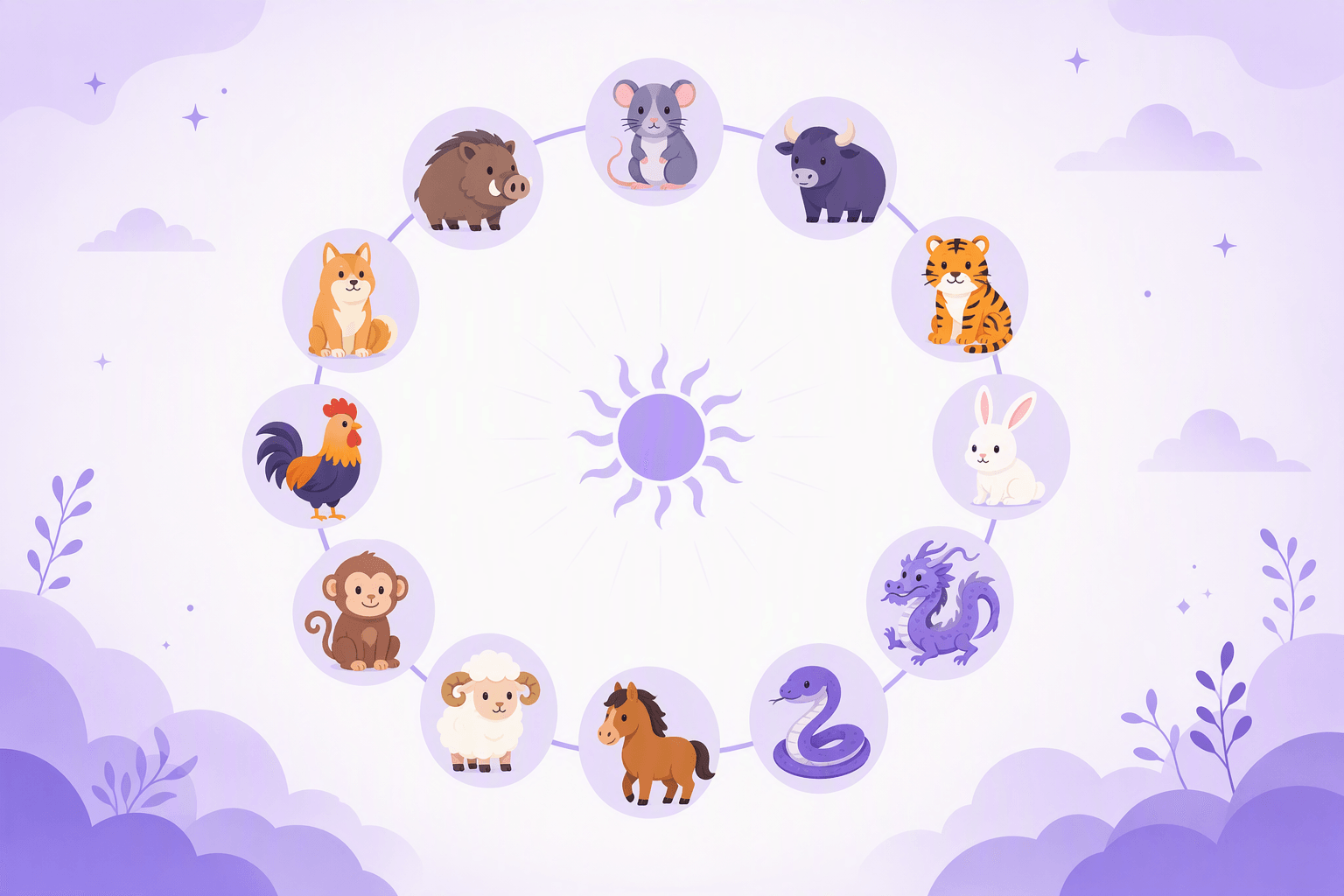
The Japanese zodiac (干支, eto) follows a 12-year cycle, with each year represented by an animal. Japanese people commonly ask 何年?(nani-doshi?, "what year [animal]?") as an indirect way to ask someone's age. The 12 animals are: 子 (ne, rat), 丑 (ushi, ox), 寅 (tora, tiger), 卯 (u, rabbit), 辰 (tatsu, dragon), 巳 (mi, snake), 午 (uma, horse), 未 (hitsuji, sheep), 申 (saru, monkey), 酉 (tori, rooster), 戌 (inu, dog), and 亥 (i, boar). Note that the zodiac uses special kanji readings different from the everyday animal words; 子 usually means "child," but in the zodiac it represents the rat. 2026 is the year of the 午 (horse).
The Japanese zodiac differs from the Chinese version in one notable way: the final animal is 猪 (inoshishi, wild boar) rather than a pig. Wild boar have a long history in Japan as both a food source and a cultural symbol of reckless courage. The expression 猪突猛進 (chototsu moushin, "boar charge") describes someone who rushes forward without thinking.
Japanese Animal Onomatopoeia
Japanese is famously rich in onomatopoeia (擬声語, giseigo), and animal sounds are among the first words children learn. These sounds differ dramatically from their English equivalents:
| Animal | Japanese Sound | Romaji | English Equivalent |
|---|---|---|---|
| Dog | ワンワン | wan wan | woof woof |
| Cat | ニャー / ニャンニャン | nyaa / nyan nyan | meow |
| Cow | モーモー | moo moo | moo |
| Pig | ブーブー | buu buu | oink oink |
| Rooster | コケコッコー | kokekokkou | cock-a-doodle-doo |
| Frog | ケロケロ | kero kero | ribbit |
| Crow | カーカー | kaa kaa | caw caw |
| Cricket | リーンリーン | riin riin | chirp chirp |
These onomatopoeia appear constantly in manga, anime, and everyday conversation. A Japanese parent might call a dog ワンワン (wan wan) or a cat ニャンニャン (nyan nyan) when speaking to young children, similar to how English speakers say "doggy" or "kitty." The Agency for Cultural Affairs' National Language Survey confirms that onomatopoeia remains one of the most productive word-formation categories in modern Japanese.
Practice Japanese Animal Vocabulary With Real Content
Vocabulary tables build your foundation, but hearing animal words in authentic Japanese dialogue is what makes them permanent. Japanese anime and film are full of animal references, from the spirit animals in Studio Ghibli films to the animal companions in shonen manga to nature documentaries narrated in Japanese.
Wordy lets you watch Japanese content with interactive subtitles. When 犬, 猫, or any animal word appears in dialogue, tap it to see the kanji, reading, and meaning in real context. You absorb vocabulary naturally as native speakers actually use it, rather than drilling isolated flashcards.
Browse our blog for more Japanese vocabulary guides, or check out the best movies to learn Japanese for viewing recommendations that bring these animal words to life in authentic storytelling.
Frequently Asked Questions
What is the Japanese word for animal?
Why are some Japanese animal names in kanji and others in katakana?
How do you count animals in Japanese?
What are the 12 animals of the Japanese zodiac?
What are common Japanese animal onomatopoeia?
Which animals are considered lucky or unlucky in Japan?
Sources & References
- Agency for Cultural Affairs (文化庁), National Language Survey, 2024
- Japan Foundation (国際交流基金), Survey of Japanese-Language Education Abroad, 2024
- Crystal, D., The Cambridge Encyclopedia of Language, 4th edition (Cambridge University Press)
- IUCN Red List of Threatened Species, Japanese Fauna Assessment, 2024
- Kenkyusha, New Japanese-English Dictionary, 6th edition
Start learning with Wordy
Watch real movie clips and build your vocabulary as you go. Free to download.


