Quick Answer
The most common way to ask 'what is your name' in Korean is '이름이 뭐예요?' (Ireumi mwoyeyo?), which is the standard polite form. For formal situations, use '성함이 어떻게 되세요?' (Seonghami eotteoke doeseyo?), which uses the honorific word for 'name.' The casual form among close friends is '이름이 뭐야?' (Ireumi mwoya?). Choosing the right version depends on the listener's age and your social relationship.
The Short Answer
The most common way to ask "what is your name" in Korean is 이름이 뭐예요? (Ireumi mwoyeyo?). This polite form works in most everyday situations, including meeting new acquaintances, social gatherings, and casual first encounters. For formal settings, switch to 성함이 어떻게 되세요? (Seonghami eotteoke doeseyo?), which uses the honorific word for "name."
Korean is spoken by over 80 million people worldwide, according to Ethnologue's 2024 data. What makes asking someone's name in Korean uniquely complex is the language's two entirely different words for "name": 이름 (ireum) for everyday use and 성함 (seongham) for honorific contexts. Choosing the wrong one signals either disrespect or awkward over-formality, both of which Koreans notice immediately. Whether you're looking up "what is your name in korean" for travel, study, or conversation, this guide covers everything you need.
"Korean honorifics are not mere stylistic choices. They are grammatically obligatory markers of social relationship, and the lexical distinction between plain and honorific nouns, such as 이름 versus 성함, is central to that system."
(Ho-min Sohn, The Korean Language, Cambridge University Press)
This guide covers 12+ ways to ask and answer "what is your name" in Korean across all three major speech levels, plus the cultural context behind Korean names, from surname-first ordering to hanja meanings and the generational name tradition.

Quick Reference: Korean "What Is Your Name" Phrases
| English | Korean | Pronunciation | Formality |
|---|---|---|---|
| What is your name? (polite) | 이름이 뭐예요? | I-reu-mi mwo-ye-yo? | polite |
| What is your name? (honorific) | 성함이 어떻게 되세요? | Seong-ha-mi eo-tteo-ke doe-se-yo? | formal |
| What is your name? (very formal) | 성함이 어떻게 되십니까? | Seong-ha-mi eo-tteo-ke doe-sim-ni-kka? | very formal |
| What is your name? (casual) | 이름이 뭐야? | I-reu-mi mwo-ya? | casual |
| What's your name? (casual) | 너 이름이 뭐야? | Neo i-reu-mi mwo-ya? | casual |
| My name is... (polite) | 제 이름은 ...이에요/예요 | Je i-reu-meun ...-i-e-yo/ye-yo | polite |
| I am... (formal) | 저는 ...입니다 | Jeo-neun ...-im-ni-da | formal |
| I am... (casual) | 나는 ...이야/야 | Na-neun ...-i-ya/ya | casual |
| May I ask your name? | 이름이 어떻게 되세요? | I-reu-mi eo-tteo-ke doe-se-yo? | polite |
| Please tell me your name | 성함을 알려주세요 | Seong-ha-meul al-lyeo-ju-se-yo | formal |
| What should I call you? | 뭐라고 불러드릴까요? | Mwo-ra-go bul-leo-deu-ril-kka-yo? | polite |
| How old are you? (follow-up) | 몇 살이에요? | Myeot sa-ri-e-yo? | polite |
이름 vs. 성함: Two Words for "Name"
Before learning individual phrases, you need to understand why Korean has two separate nouns for "name." This distinction does not exist in English, but it is fundamental to Korean communication.
| Word | Hangul | Type | When to Use |
|---|---|---|---|
| 이름 (ireum) | 이름 | Standard | With peers, younger people, in casual/polite speech |
| 성함 (seongham) | 성함 | Honorific | With elders, superiors, in formal/very formal speech |
According to the National Institute of Korean Language (국립국어원), Korean has an entire layer of honorific vocabulary where everyday nouns are replaced by elevated forms when referring to someone of higher status. 이름 becomes 성함 the same way 나이 (nai, "age") becomes 연세 (yeonse) and 집 (jip, "house") becomes 댁 (daek).
Using 이름 when asking an elderly person their name is a noticeable social error. Conversely, using 성함 to ask a child or a close friend their name would sound absurdly stiff. Brown and Levinson's Politeness: Some Universals in Language Usage (1987) identifies this kind of lexical honorific system as one of the most elaborate politeness mechanisms found in any language.
💡 Default to 성함 When Unsure
If you cannot judge the other person's age or status (for example, in a phone call or online interaction), default to 성함이 어떻게 되세요? It is never offensive to be too polite. The other person may tell you to speak casually (편하게 말하세요, pyeonhage malhaseyo), at which point you can switch.

Polite Forms (존댓말)
These are the versions you will use most in daily life. They strike the right balance between respect and warmth for the majority of first encounters.
이름이 뭐예요?
/I-reu-mi mwo-ye-yo?/
Literal meaning: Name (subject) what is?
“안녕하세요! 이름이 뭐예요?”
Hello! What is your name?
The standard polite way to ask someone's name. Appropriate for people roughly your age, peers in social settings, and everyday encounters. Often followed immediately by an age question to determine speech levels.
This is the phrase to reach for in most everyday situations, whether meeting a new classmate, a friend's friend at a gathering, or a fellow traveler. The structure is straightforward: 이름 (name) + 이 (subject particle) + 뭐예요 (what is it?). The polite -예요 ending keeps it respectful without formality.
In practice, this question rarely comes alone. Korean introductions follow a natural sequence: greeting, name exchange, and then the age question. A typical exchange might sound like: "안녕하세요, 이름이 뭐예요?" followed by "몇 살이에요?" or "몇 년생이에요?" (What year were you born?). This age question is not rude; it is the essential second step that determines how both speakers will talk to each other going forward.
성함이 어떻게 되세요?
/Seong-ha-mi eo-tteo-ke doe-se-yo?/
Literal meaning: Honorable name, how does it become?
“실례지만, 성함이 어떻게 되세요?”
Excuse me, but what is your name?
The honorific way to ask someone's name. Uses 성함 (honorific 'name') instead of 이름 (standard 'name'). Essential for addressing elders, clients, officials, or anyone deserving heightened respect. Commonly heard at hospitals, banks, and government offices.
This phrase layers two levels of politeness. First, 성함 replaces the standard 이름. Second, the verb phrase 어떻게 되세요 (how does it become) is an indirect construction that avoids directly asking "what is," resulting in a softer, more deferential approach. You will hear this phrase constantly in Korean service industries: receptionists, bank tellers, hospital staff, and hotel clerks all use it.
The phrasing 어떻게 되세요 deserves special attention. Literally "how does it become?", this construction is Korean's go-to indirect question form for polite inquiries. You will encounter it beyond names: 전화번호가 어떻게 되세요? (What is your phone number?), 생년월일이 어떻게 되세요? (What is your date of birth?). Master this pattern and you unlock polite questions for any topic.
🌍 Korean Service Culture
In Korea, customer service interactions default to the highest speech levels. Even if you look young, a bank teller will ask 성함이 어떻게 되세요?, not because they think you are older, but because service contexts demand maximum politeness. This is why 성함 is often the first honorific noun that Korean learners encounter in real life.
Formal Form (격식체)
Reserved for the most formal contexts: corporate meetings, government proceedings, military settings, and public speeches.
성함이 어떻게 되십니까?
/Seong-ha-mi eo-tteo-ke doe-sim-ni-kka?/
Literal meaning: Honorable name, how does it become? (formal)
“처음 뵙겠습니다. 성함이 어떻게 되십니까?”
I am meeting you for the first time. What is your name?
The most formal version. The -십니까 ending is the formal interrogative, used in business meetings, official events, military contexts, and broadcast interviews. Rarely heard in casual daily life.
The -십니까 ending is the formal interrogative form, placing this phrase at the top of the formality scale. You will hear it in corporate boardrooms, official government interactions, and television interviews. In everyday life, 성함이 어떻게 되세요? covers virtually all situations where honorific vocabulary is needed, so reserve this form for when the stakes are highest.
Note the pronunciation: 되십니까 sounds like "doe-shim-ni-kka" with the ㅂ nasalizing before ㄴ. This phonological shift is standard in Korean and happens automatically in natural speech.
Casual Forms (반말)
Use these only with people who are confirmed to be your age or younger, and only in informal settings. Using casual speech to ask an older person's name is one of the fastest ways to cause offense in Korean.
이름이 뭐야?
/I-reu-mi mwo-ya?/
Literal meaning: Name what is?
“안녕! 이름이 뭐야?”
Hey! What's your name?
Casual form used between confirmed peers of the same age. Common among university students after establishing they share the same birth year (동갑). The -야 ending replaces -예요, dropping all politeness markers.
The structure is identical to the polite form except for the ending: 뭐야 replaces 뭐예요. This single syllable change (dropping the -요 politeness particle) shifts the entire social register. Korean university students use this version constantly after the critical age-confirmation exchange. Once two students discover they are 동갑 (donggap, same birth year), switching to casual speech is expected and even welcomed.
너 이름이 뭐야?
/Neo i-reu-mi mwo-ya?/
Literal meaning: You, name what is?
“야, 너 이름이 뭐야? 처음 보는 얼굴인데.”
Hey, what's your name? I haven't seen your face before.
Adding the casual pronoun 너 (neo, 'you') makes it more direct and personal. Only appropriate between close peers or when speaking to someone clearly younger. Children also use this form with each other.
Adding 너 (neo, "you") makes the question more pointed and direct. You will often hear this among children on playgrounds and teenagers meeting in casual group settings. Among adults, this level of directness is reserved for people who are already confirmed as same-age peers or when speaking to someone noticeably younger.
How to Respond: Giving Your Name
Knowing how to answer is just as important as knowing how to ask. Korean has distinct response patterns for each speech level.
제 이름은 ...이에요/예요
/Je i-reu-meun ...-i-e-yo/ye-yo/
Literal meaning: My name (topic) is...
“제 이름은 수진이에요.”
My name is Sujin.
The standard polite self-introduction. 제 (je) is the humble 'my.' Use 이에요 after consonant-ending names and 예요 after vowel-ending names. This particle distinction (이에요 vs 예요) is one of the first grammar points Korean learners must master.
The choice between 이에요 and 예요 depends on the final sound of the name: 수진이에요 (Sujin, which ends in consonant ㄴ, uses 이에요) versus 유나예요 (Yuna, which ends in a vowel, uses 예요). This consonant/vowel distinction applies to all Korean copula constructions, not just names.
저는 ...입니다
/Jeo-neun ...-im-ni-da/
Literal meaning: As for me, I am...
“저는 김민수입니다. 만나서 반갑습니다.”
I am Kim Minsu. Nice to meet you.
The formal self-introduction. Uses 저 (humble 'I') and the formal copula -입니다. Standard in business, interviews, and public introductions. The name typically includes both surname and given name.
In formal introductions, Koreans almost always give their full name, surname first and given name second. 저는 김민수입니다 means "I am Kim Minsu," with 김 as the surname and 민수 as the given name. This surname-first order is standard across all Korean-speaking contexts.
Response Summary Table
| Situation | They Ask | You Respond |
|---|---|---|
| Polite | 이름이 뭐예요? | 제 이름은 [name]이에요/예요 |
| Formal | 성함이 어떻게 되세요? | 저는 [name]입니다 |
| Very formal | 성함이 어떻게 되십니까? | 저는 [name]입니다 |
| Casual | 이름이 뭐야? | 나는 [name]이야/야 or 내 이름은 [name]이야/야 |
💡 Pronouncing Foreign Names in Korean
If your name is not Korean, Koreans will try to transliterate it into Hangul. "Sarah" becomes 사라 (Sa-ra), "Michael" becomes 마이클 (Ma-i-keul), "David" becomes 데이비드 (De-i-bi-deu). You can pre-learn the Korean spelling of your name to make introductions smoother. For long names, consider offering a shorter form that maps cleanly to Korean syllables.
Korean Naming Culture
Understanding Korean names gives you a deeper appreciation for why the name question carries so much cultural weight.
Surname-First Order
Korean names follow the pattern: surname (성, seong) + given name (이름, ireum). A name like 김수진 (Kim Sujin) breaks down as 김 (Kim, surname) + 수진 (Sujin, given name). According to the Academy of Korean Studies (한국학중앙연구원), approximately 300 Korean surnames account for about 95% of the entire population.
| Rank | Surname | Hangul | Approximate Population |
|---|---|---|---|
| 1 | Kim | 김 | ~10.6 million (21.5%) |
| 2 | Lee | 이 | ~7.3 million (14.7%) |
| 3 | Park | 박 | ~4.2 million (8.4%) |
| 4 | Choi | 최 | ~2.3 million (4.7%) |
| 5 | Jung/Jeong | 정 | ~2.1 million (4.3%) |
This means you will encounter these five surnames in over half of all Korean introductions. When two Koreans share a surname, they often ask about their 본관 (bon-gwan), the ancestral hometown that distinguishes branches of the same clan. There are over 280 different 김 clans alone.
Hanja: The Meaning Behind Names
Most Korean given names are based on 한자 (hanja), Chinese characters that carry specific meanings. The name 수진 (Sujin) might use 秀 (수, "excellent") + 珍 (진, "precious"), making the name mean "excellently precious." Parents spend considerable time selecting hanja combinations with auspicious meanings, sometimes consulting naming specialists or books of fortune.
This is why Koreans often ask 어떤 한자를 써요? (Eotteon hanjareul sseoyo?, "Which Chinese characters do you use?") after learning someone's name. Two names that sound identical in Korean can have completely different hanja and therefore completely different meanings.
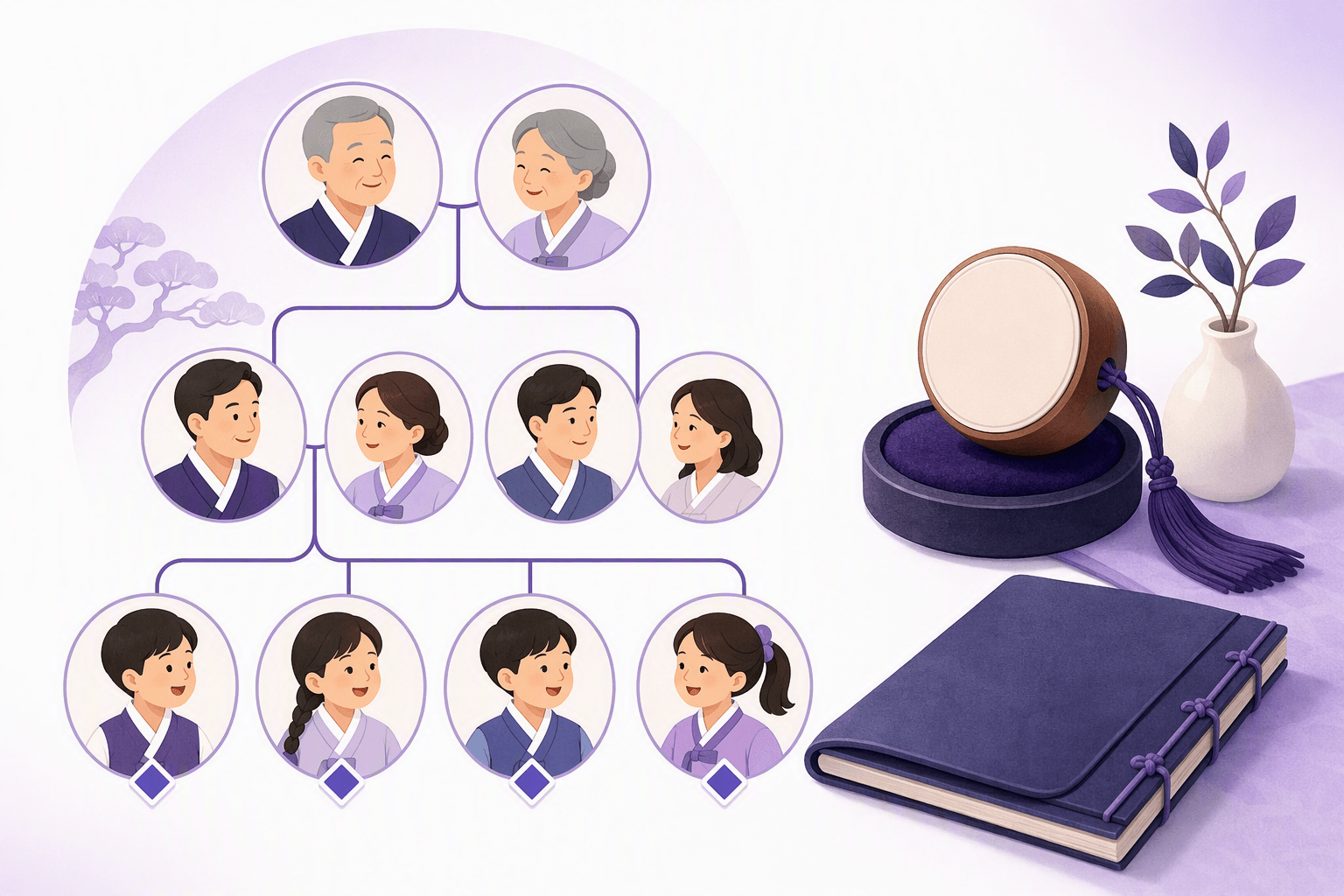
돌림자: The Generational Name Tradition
One of the most distinctive Korean naming traditions is 돌림자 (dollimja), the practice of sharing one syllable across all siblings or cousins of the same generation within a clan. For example, if the generational character is 민 (min), brothers might be named 민수 (Minsu), 민호 (Minho), and 민재 (Minjae).
This tradition is fading among younger Korean parents who prefer unique, modern names, but it remains deeply ingrained in Korean family culture. It allows Koreans to identify generational relationships within a family at a glance, a feature that reinforces the Confucian emphasis on family hierarchy and lineage.
🌍 Why the Age Question Follows the Name Question
In virtually every Korean first meeting, asking someone's name is immediately followed by asking their age. This is not curiosity; it is a grammatical necessity. Without knowing relative ages, neither speaker knows whether to use 존댓말 (formal/polite speech) or 반말 (casual speech). The National Institute of Korean Language (국립국어원) documents seven distinct speech levels in Korean, each triggered by the social relationship between speakers. The name-then-age sequence is the mechanism that establishes which level both speakers will use for the duration of the relationship.
Common Mistakes to Avoid
| Mistake | Why It Is Wrong | What to Do Instead |
|---|---|---|
| Using 이름 with an elder | 이름 is not honorific; it can feel disrespectful | Use 성함 for anyone older or of higher status |
| Giving your name without surname | Koreans expect full names in introductions | Say both surname and given name: 김수진 not just 수진 |
| Skipping the age question | Creates awkward uncertainty about speech levels | Ask 몇 년생이에요? naturally after name exchange |
| Using 너 (neo) with strangers | 너 is a casual "you" that implies closeness | Avoid second-person pronouns; just ask 이름이 뭐예요? |
| Calling someone by given name only | Only close friends or family use given names alone | Use full name or surname + 씨 (ssi): 수진 씨 |
Practice With Real Korean Content
Reading about name-asking phrases is a strong foundation, but hearing them in authentic Korean conversations is what makes them natural. Korean dramas are an outstanding resource: Crash Landing on You for the contrast between North and South Korean introduction styles, Itaewon Class for casual peer introductions, and Misaeng for formal business introductions where 성함 and 명함 (business cards) dominate.
Wordy lets you watch Korean movies and shows with interactive subtitles, tapping on any phrase to see its meaning, speech level, and cultural context in real time. Instead of memorizing name-asking phrases from a list, you absorb them from real conversations with natural intonation and body language.
For more Korean content, explore our blog for guides including the best movies to learn Korean. You can also visit our Korean learning page to start practicing today.
Frequently Asked Questions
What is the most common way to ask someone's name in Korean?
What is the difference between 이름 and 성함 in Korean?
Why do Koreans state their surname first?
Is it normal to ask someone's age right after their name in Korea?
How do I respond when someone asks my name in Korean?
Sources & References
- National Institute of Korean Language (국립국어원), Standard Korean Language Dictionary
- Academy of Korean Studies (한국학중앙연구원), Encyclopedia of Korean Culture
- Ethnologue: Languages of the World, Korean language entry (2024)
- Brown, P. & Levinson, S. (1987). 'Politeness: Some Universals in Language Usage.' Cambridge University Press.
Start learning with Wordy
Watch real movie clips and build your vocabulary as you go. Free to download.


