Quick Answer
The standard way to say 'nice to meet you' in Korean is '만나서 반갑습니다' (Mannaseo bangapseumnida), which literally means 'having met you, I am glad.' Korean has three main speech levels for this phrase: formal 만나서 반갑습니다, polite 만나서 반가워요 (Mannaseo bangawoyo), and casual 만나서 반가워 (Mannaseo bangawo). Choosing the right one depends entirely on the listener's age and social status.
The Short Answer
The standard way to say "nice to meet you" in Korean is 만나서 반갑습니다 (Mannaseo bangapseumnida). It literally means "having met you, I am glad" and works in formal introductions, business meetings, and any first encounter where you want to show respect.
Korean is spoken by over 80 million people worldwide, according to Ethnologue's 2024 data. What makes Korean introductions unique is that saying "nice to meet you" is only the beginning. A proper Korean introduction includes your name, your age or birth year, and often your school or workplace. This information is not small talk. It determines the speech level both people will use for the rest of the relationship. Whether you're looking up "nice to meet you in korean" for travel, study, or conversation, this guide covers everything you need.
"In Korean society, the very first exchange between strangers is a negotiation of social hierarchy. The introduction ritual does not merely share identities; it establishes the grammatical framework of the entire relationship."
(Ho-Min Sohn, The Korean Language, Cambridge University Press, 1999)
This guide covers 15+ ways to say "nice to meet you" in Korean across all three major speech levels, plus the cultural rituals surrounding introductions, from the age question to the business card exchange.

Quick Reference: Korean "Nice to Meet You" Phrases
| English | Korean | Pronunciation | Formality |
|---|---|---|---|
| Nice to meet you (formal) | 만나서 반갑습니다 | Man-na-seo ban-gap-seum-ni-da | formal |
| Nice to meet you (polite) | 만나서 반가워요 | Man-na-seo ban-ga-wo-yo | polite |
| Nice to meet you (casual) | 만나서 반가워 | Man-na-seo ban-ga-wo | casual |
| Pleased to meet you (formal) | 반갑습니다 | Ban-gap-seum-ni-da | formal |
| Pleased to meet you (polite) | 반가워요 | Ban-ga-wo-yo | polite |
| First time meeting you (formal) | 처음 뵙겠습니다 | Cheo-eum boep-get-seum-ni-da | very formal |
| Please take care of me | 잘 부탁드립니다 | Jal bu-tak-deu-rim-ni-da | formal |
| Please take care of me (polite) | 잘 부탁해요 | Jal bu-tak-hae-yo | polite |
| I've heard a lot about you | 말씀 많이 들었습니다 | Mal-sseum ma-ni deu-reot-seum-ni-da | formal |
| How old are you? (polite) | 몇 살이에요? | Myeot sa-ri-e-yo | polite |
| What year were you born? | 몇 년생이에요? | Myeot nyeon-saeng-i-e-yo | polite |
| What is your age? (respectful) | 연세가 어떻게 되세요? | Yeon-se-ga eo-tteo-ke doe-se-yo | very formal |
| I am [name] (formal) | 저는 ___입니다 | Jeo-neun ___-im-ni-da | formal |
| I am [name] (polite) | 저는 ___이에요/예요 | Jeo-neun ___-i-e-yo/ye-yo | polite |
| I am [name] (casual) | 나는 ___야/이야 | Na-neun ___-ya/i-ya | casual |
Understanding Speech Levels for Introductions
Before learning individual phrases, you need to understand why Korean has multiple versions of the same expression. Korean grammar encodes the speaker's relationship to the listener directly into verb endings. According to the National Institute of Korean Language (국립국어원), three speech levels dominate modern usage.
| Level | Korean Term | Ending Pattern | When to Use |
|---|---|---|---|
| Formal (격식체) | 격식체 (gyeokshikche) | -ㅂ니다 / -습니다 | Business, ceremonies, first meetings with elders |
| Polite (존댓말) | 존댓말 (jondaenmal) | -아요 / -어요 | Default for strangers, acquaintances, daily life |
| Casual (반말) | 반말 (banmal) | -아 / -어 | Close friends same age or younger only |
Brown and Levinson's landmark study Politeness: Some Universals in Language Usage (1987) identifies Korean as one of the world's most grammatically elaborate politeness systems. Where English speakers choose between "Nice to meet you" and "How do you do," Korean speakers navigate an entire matrix of verb endings, pronouns, and vocabulary shifts.
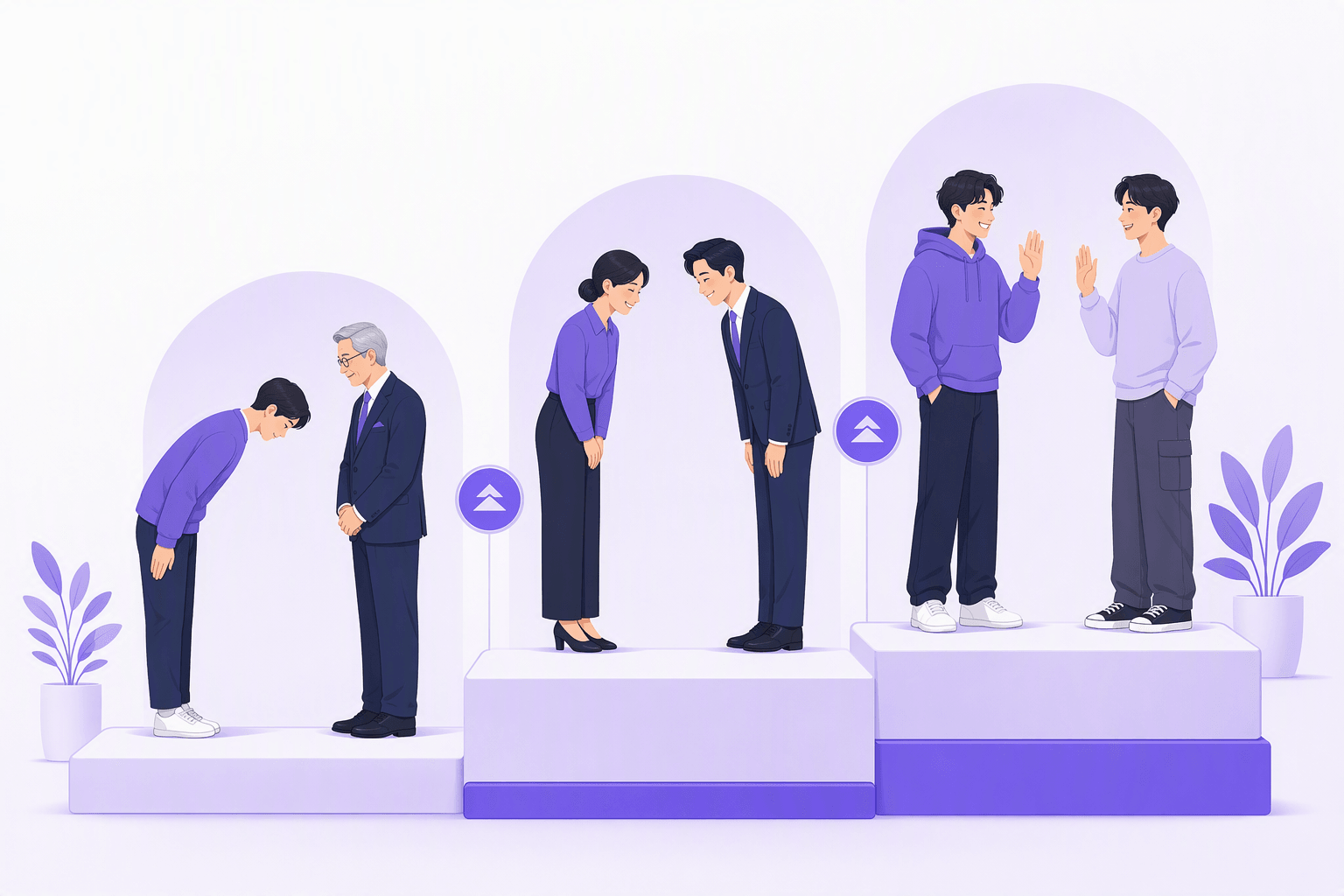
⚠️ The Age Question Is NOT Rude
One of the biggest cultural surprises for Westerners in Korea: asking someone's age within minutes of meeting them is completely normal and expected. Koreans ask "몇 살이에요?" (How old are you?) or "몇 년생이에요?" (What year were you born?) early in any new relationship. This is not nosiness; it is a practical necessity. Without knowing relative ages, neither person knows which speech level to use, and the conversation cannot proceed naturally.
Formal Introductions (격식체)
These phrases are essential for business meetings, interviews, meeting elders, and any situation where you want to make a strong, respectful first impression.
만나서 반갑습니다
/Man-na-seo ban-gap-seum-ni-da/
Literal meaning: Having met you, I am glad
“안녕하십니까, 만나서 반갑습니다. 저는 김민수입니다.”
Hello, nice to meet you. I am Kim Minsu.
The standard formal 'nice to meet you.' Used in business, with elders, at formal events, and in any first meeting where respect is paramount. Always accompanied by a bow of about 30 degrees.
This is the phrase you will use most in formal Korean introductions. Break it down: 만나서 (mannaseo) means "having met" and 반갑습니다 (bangapseumnida) means "I am glad." Together, they express that the act of meeting the person brings you happiness. The -습니다 ending places it firmly in the formal register.
In business settings, this phrase is typically part of a longer introduction sequence: bow, state your company and title, give your name, then say 만나서 반갑습니다. The King Sejong Institute's curriculum identifies this sequence as one of the foundational social skills for Korean learners.
처음 뵙겠습니다
/Cheo-eum boep-get-seum-ni-da/
Literal meaning: I will be seeing you for the first time
“처음 뵙겠습니다. 삼성전자 마케팅팀 박지영입니다.”
I am meeting you for the first time. I am Park Jiyoung from Samsung Electronics' marketing team.
The most formal first-meeting expression. 뵙다 (boepda) is the humble form of 보다 (boda, 'to see'), elevating the listener while lowering the speaker. Reserved for business and highly formal contexts.
This phrase takes formality one step further. The verb 뵙다 (boepda) is the humble form of 보다 (boda, meaning "to see"), and by using it, the speaker lowers themselves while elevating the listener. This level of linguistic humility is reserved for meeting a boss's boss, clients at formal dinners, or public figures. In everyday social life, 만나서 반갑습니다 is sufficient.
반갑습니다
/Ban-gap-seum-ni-da/
Literal meaning: I am glad/pleased
“아, 반갑습니다. 이야기 많이 들었습니다.”
Ah, pleased to meet you. I have heard a lot about you.
The shortened formal version that drops 만나서 but retains full formal register. Often used as a response when someone else says 만나서 반갑습니다 first.
This is the shortened version of the full phrase. It drops the 만나서 (having met) and keeps just the "I am glad" portion. You will often hear it as a response: one person says 만나서 반갑습니다, and the other replies with just 반갑습니다 or 저도 반갑습니다 (I am also pleased).
Polite Introductions (존댓말)
The polite level is your default for most first meetings outside of formal business contexts. Social gatherings, meeting friends of friends, casual workplaces, and everyday encounters all call for this level.
만나서 반가워요
/Man-na-seo ban-ga-wo-yo/
Literal meaning: Having met you, I am glad
“안녕하세요! 만나서 반가워요. 저는 이수진이에요.”
Hello! Nice to meet you. I'm Lee Sujin.
The polite-level 'nice to meet you.' Warm and respectful without being stiff. Ideal for social gatherings, meeting a friend's friend, casual workplaces, and most everyday first encounters.
This is the Goldilocks version, polite enough to show respect and warm enough to feel approachable. The -워요 ending (from the polite conjugation of 반갑다) gives it a softer, friendlier tone than the formal -습니다. If you only learn one "nice to meet you" phrase for daily life, this is the one.
반가워요
/Ban-ga-wo-yo/
Literal meaning: I am glad/pleased
“어, 반가워요! 많이 들었어요.”
Oh, pleased to meet you! I've heard a lot about you.
The shortened polite form. Used as a natural response when someone introduces themselves to you, or as a standalone greeting when the context of 'meeting' is already clear.
Just as 반갑습니다 is the short form of the formal phrase, 반가워요 is the short form of 만나서 반가워요. It works perfectly as a response or when the meeting context is obvious, for example when a mutual friend has just introduced you.

💡 Self-Introduction Formula
Korean introductions follow a predictable pattern. In polite speech: 안녕하세요 + 만나서 반가워요 + 저는 [name]이에요/예요. In formal speech: 안녕하십니까 + 만나서 반갑습니다 + 저는 [name]입니다. Having this formula memorized means you will never freeze during a first meeting.
Casual Introductions (반말)
Use these only with people who are clearly your age or younger, and only in informal settings. Using casual speech with someone older, even by a single year, is a serious social misstep in Korean culture.
만나서 반가워
/Man-na-seo ban-ga-wo/
Literal meaning: Having met you, I'm glad
“안녕! 만나서 반가워. 나는 준호야.”
Hey! Nice to meet you. I'm Junho.
The casual version used between peers of the same age. Common among university students meeting classmates born in the same year, or when a mutual friend has already established that casual speech is appropriate.
In Korean university culture, students born in the same year (동갑, donggap) typically switch to casual speech quickly after confirming their ages. 만나서 반가워 is the natural "nice to meet you" in that context. The pronoun also shifts: 저 (jeo, humble "I") in formal/polite speech becomes 나 (na, plain "I") in casual speech.
반가워
/Ban-ga-wo/
Literal meaning: Glad/Pleased
“오, 반가워! 많이 들었어.”
Oh, nice to meet you! I've heard a lot.
The most stripped-down casual form. Often heard among young people at social events, parties, or when introduced through mutual friends who have already established a casual tone.
The shortest possible "nice to meet you." You will hear this among young Koreans at social events and parties where the atmosphere is relaxed and age differences are minimal.
Essential Follow-Up Phrases
Korean introductions do not end at "nice to meet you." These follow-up phrases complete the introduction ritual and are just as important as the initial greeting.
잘 부탁드립니다
/Jal bu-tak-deu-rim-ni-da/
Literal meaning: I humbly ask for your good favor
“앞으로 잘 부탁드립니다.”
I look forward to your continued support.
Said after introductions to express 'please take care of me' or 'I look forward to working with you.' Has no direct English equivalent. Functionally identical to the Japanese よろしくお願いします (Yoroshiku onegaishimasu). Essential in workplace and group introductions.
This phrase has no clean English translation. It is a request for goodwill, cooperation, and mutual support, wrapped into a humble, formulaic expression. Koreans say it when joining a new team, starting a class, meeting a business partner, or beginning any collaborative relationship. The polite version, 잘 부탁해요 (jal butak haeyo), works in less formal but still respectful contexts.
The cultural parallel to Japanese よろしくお願いします is not a coincidence. Both Korean and Japanese cultures share Confucian roots that emphasize social harmony and mutual obligation. According to Brown and Levinson's politeness theory, both languages have developed elaborate "negative politeness" strategies, phrases that acknowledge the imposition of a new relationship while requesting the listener's grace.
말씀 많이 들었습니다
/Mal-sseum ma-ni deu-reot-seum-ni-da/
Literal meaning: I have heard your words a lot
“말씀 많이 들었습니다. 드디어 뵙게 되어 영광입니다.”
I've heard a lot about you. It's an honor to finally meet you.
A flattering phrase used when meeting someone whose reputation precedes them. 말씀 (malsseum) is the honorific form of 말 (mal, 'words/speech'), elevating the other person's reputation. Common in business and networking contexts.
This phrase adds warmth and flattery to a formal introduction. By using 말씀 (malsseum), the honorific form of 말 (mal, "words"), you signal that what you have heard about the person carries weight and importance. It is especially effective in business networking.
The Korean Introduction Ritual
A proper Korean introduction follows a specific sequence that goes far beyond exchanging names. Understanding this ritual will set you apart from other language learners.
The Full Introduction Sequence
In formal settings, introductions follow this order:
- Bow (30 degrees for standard respect, deeper for someone significantly senior)
- Greeting: 안녕하십니까 or 안녕하세요
- Organization and title (in business): company name + department + title
- Name: 저는 [name]입니다
- Nice to meet you: 만나서 반갑습니다
- Request for goodwill: 잘 부탁드립니다
- Business card exchange (if applicable)
In casual settings, it simplifies to: greeting + name + 만나서 반가워요.
The Age Conversation
| Situation | How to Ask | Korean | Pronunciation |
|---|---|---|---|
| To a peer or younger person | How old are you? | 몇 살이에요? | Myeot sa-ri-e-yo? |
| To a peer (birth year) | What year were you born? | 몇 년생이에요? | Myeot nyeon-saeng-i-e-yo? |
| To an elder (very respectful) | What is your age? | 연세가 어떻게 되세요? | Yeon-se-ga eo-tteo-ke doe-se-yo? |
Among younger Koreans, especially university students, asking 몇 년생이에요? (What year were you born?) is the most common approach. Birth year determines everything: someone born even one year earlier is your 선배 (seonbae, senior), and you owe them polite speech. Someone born the same year is your 동갑 (donggap, same-age peer), and casual speech is an option.
🌍 Why Age Determines Everything
Korea's age-based social system traces directly to Confucian philosophy, which has shaped Korean culture for over 600 years. The principle of 장유유서 (jangyu yuseo), meaning "there is an order between elders and juniors," is one of the five fundamental Confucian relationships. This is not merely tradition; it is embedded in the grammar itself. The National Institute of Korean Language (국립국어원) documents seven distinct speech levels, each encoding a different degree of social distance and respect.
Business Card and Handshake Etiquette
Physical gestures during introductions carry as much meaning as the words themselves.
Business Card Exchange (명함 교환)
Korean business card etiquette blends Korean and Japanese traditions. Follow these rules:
| Do | Don't |
|---|---|
| Present and receive with both hands | Use one hand (especially the left) |
| Read the card carefully before putting it away | Immediately pocket the card without looking |
| Place cards on the table during meetings | Write on someone's card in front of them |
| Offer your card to the most senior person first | Hand cards out randomly |
The Two-Handed Handshake
When shaking hands with someone older or of higher status, use the "supported handshake": extend your right hand while your left hand lightly touches or supports your right forearm. This gesture, unique to Korean culture, physically demonstrates deference. The younger or lower-ranking person should also bow slightly deeper during the handshake.
🌍 Eye Contact During Introductions
Unlike Western cultures where steady eye contact signals confidence and honesty, Korean etiquette calls for brief eye contact followed by a slight lowering of the gaze, especially when greeting elders or superiors. Sustained direct eye contact with someone of higher status can be interpreted as a challenge rather than confidence. With peers, normal eye contact is fine.
How to Respond to Korean Introductions
Responses to "Nice to Meet You"
| They Say | You Say | Notes |
|---|---|---|
| 만나서 반갑습니다 | 저도 반갑습니다 (Jeodo bangapseumnida) | "I am also pleased," mirror the formality |
| 만나서 반가워요 | 저도 반가워요 (Jeodo bangawoyo) | "Me too," polite mirror |
| 만나서 반가워 | 나도 반가워 (Nado bangawo) | "Me too," casual mirror |
| 처음 뵙겠습니다 | 저도 처음 뵙겠습니다 (Jeodo cheoeum boepgetseumnida) | Mirror the high formality |
Responses to Follow-Up Phrases
| They Say | You Say |
|---|---|
| 잘 부탁드립니다 | 저도 잘 부탁드립니다 (Jeodo jal butak deurimnida) |
| 말씀 많이 들었습니다 | 별말씀을요 (Byeolmalsseumeuryo), "Not at all / You're too kind" |
💡 The Mirror Strategy
The simplest and safest response to any Korean introduction phrase is to add 저도 (jeodo, "me too") and echo the same phrase back. This automatically matches the speech level and formality of the other person. 저도 반갑습니다, 저도 반가워요, 나도 반가워, all correct, all natural.
Common Mistakes to Avoid
Korean learners frequently make these introduction errors. Being aware of them will save you from awkward moments.
| Mistake | Why It's Wrong | What to Do Instead |
|---|---|---|
| Using 반말 with someone older | Deeply disrespectful, even if unintentional | Default to 존댓말 until you know their age |
| Skipping the bow | Feels incomplete and slightly rude to Koreans | Always bow, even slightly, when meeting someone new |
| One-handed business card exchange | Signals carelessness or disrespect | Always use both hands |
| Avoiding the age question | Creates conversational awkwardness | Ask naturally; it is expected and welcome |
| Using 나 (na) instead of 저 (jeo) | 나 is casual "I"; 저 is humble "I" | Use 저 with anyone you are not close to |
Practice With Real Korean Content
Reading about introduction phrases is a strong start, but hearing them in natural Korean conversation is what makes them automatic. Korean dramas are an outstanding resource for this: Misaeng for workplace introduction etiquette, Sky Castle for formal speech among high-status families, and Reply 1988 for casual introductions among neighborhood friends of different ages.
Wordy lets you watch Korean movies and shows with interactive subtitles, tapping on any phrase to see its meaning, speech level, and cultural context in real time. Instead of memorizing introduction sequences from a list, you absorb them from authentic conversations with natural intonation and body language.
For more Korean content, explore our blog for guides including the best movies to learn Korean. You can also visit our Korean learning page to start practicing today.
Frequently Asked Questions
What is the most common way to say 'nice to meet you' in Korean?
What does 반갑습니다 literally mean?
Is it rude to ask someone's age in Korean?
What is 잘 부탁드립니다 and when do I use it?
How should I physically greet someone I'm meeting for the first time in Korea?
Sources & References
- National Institute of Korean Language (국립국어원), Standard Korean Language Dictionary
- King Sejong Institute Foundation, Korean Language Education Standards (2024)
- Ethnologue: Languages of the World, Korean language entry (2024)
- Brown, P. & Levinson, S. (1987). 'Politeness: Some Universals in Language Usage.' Cambridge University Press.
- Sohn, H.-M. (1999). 'The Korean Language.' Cambridge University Press.
Start learning with Wordy
Watch real movie clips and build your vocabulary as you go. Free to download.


