Quick Answer
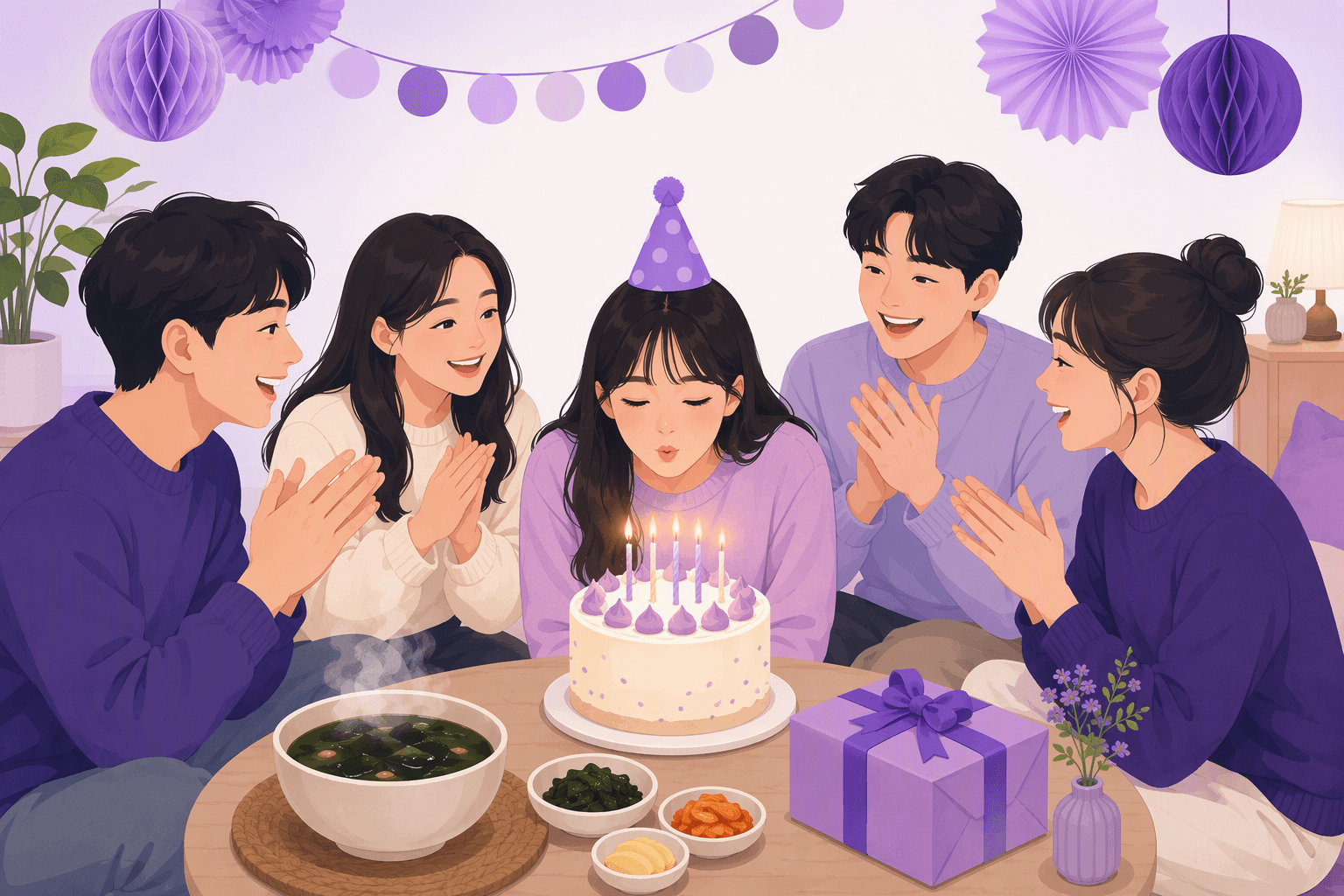
The most common way to say happy birthday in Korean is '생일 축하합니다' (Saengil chukahamnida, seng-eel choo-kah-hahm-nee-dah), the polite-formal form meaning 'I congratulate your birthday.' Among friends, '생일 축하해' (Saengil chukahae) is the casual form. Korean birthday culture features unique traditions like seaweed soup (미역국), age-counting customs, and the beloved Korean birthday song sung to the familiar melody.
The Short Answer
The most common way to say happy birthday in Korean is 생일 축하합니다 (Saengil chukahamnida, seng-eel choo-kah-hahm-nee-dah). This polite-formal expression works in virtually every situation. Among close friends, 생일 축하해 (Saengil chukahae) is the casual equivalent. In text messages, the ultra-short 생축 (Saengchuk) dominates.
Korean is spoken by over 80 million people worldwide, primarily in South Korea and North Korea, with significant diaspora communities across the globe, according to Ethnologue's 2024 data. Korean birthday culture is distinctive in ways that surprise outsiders: the birthday person eats 미역국 (miyeokguk = seaweed soup) to honor their mother, the traditional age-counting system made everyone 1-2 years "older" than their international age, and the speech level you choose for your birthday wish matters as much as the wish itself.
"In Korean, the way you express even simple congratulations is a grammatical map of your relationship to the listener. The speech level encodes age, status, intimacy, and social context, all in a single verb ending."
(Ho-Min Sohn, The Korean Language, Cambridge University Press, 1999)
This guide covers 16 essential Korean birthday expressions organized by category: standard wishes across speech levels, the birthday song, formal and written phrases, casual and slang expressions, and birthday-related cultural language. Each includes Hangul, romanization, pronunciation, and cultural context.
Quick Reference: Korean Birthday Phrases at a Glance
| English | Korean | Pronunciation | Formality |
|---|---|---|---|
| Happy birthday (polite-formal) | 생일 축하합니다 | Seng-eel choo-kah-hahm-nee-dah | formal |
| Happy birthday (polite) | 생일 축하해요 | Seng-eel choo-kah-heh-yo | polite |
| Happy birthday (casual) | 생일 축하해 | Seng-eel choo-kah-heh | casual |
| Happy birthday (text slang) | 생축 | Seng-chook | slang |
| Happy birthday (song) | 생일 축하합니다 (song lyrics) | Seng-eel choo-kah-hahm-nee-dah | polite |
| Happy birthday to you (English loanword) | 해피 벌스데이 | Heh-pee beol-seu-deh-ee | casual |
| Congratulations (formal) | 축하드립니다 | Choo-kah-deu-reem-nee-dah | very formal |
| May you be healthy for a long time | 건강하게 오래오래 사세요 | Geon-gang-ha-geh oh-reh-oh-reh sah-seh-yo | polite |
| I hope all your wishes come true | 소원이 다 이루어지길 바랍니다 | So-won-ee dah ee-roo-uh-jee-geel bah-rahm-nee-dah | formal |
| Have a happy day | 행복한 하루 보내세요 | Heng-bo-kan ha-roo bo-neh-seh-yo | polite |
| Happy belated birthday | 늦었지만 생일 축하해요 | Neu-jeot-jee-mahn seng-eel choo-kah-heh-yo | polite |
| Let's celebrate! | 축하하자! | Choo-kah-ha-jah | casual |
| Cheers! | 건배! | Geon-beh | casual |
| Congratulations on your first birthday | 돌 축하해요 | Dol choo-kah-heh-yo | polite |
| Happy 60th birthday | 환갑을 축하드립니다 | Hwan-gab-eul choo-kah-deu-reem-nee-dah | very formal |
| Did you eat seaweed soup? | 미역국 먹었어? | Mee-yeok-gook meog-eoss-eo | casual |
Standard Birthday Wishes by Speech Level
Korean's speech level system (존댓말 jondaenmal for polite, 반말 banmal for casual) determines which form of "happy birthday" you should use. Getting this right is essential, as using the wrong level can cause genuine offense.
생일 축하합니다 (Saengil Chukahamnida)
/seng-eel choo-kah-hahm-nee-dah/
Literal meaning: Birthday congratulations (formal-polite)
“생일 축하합니다, 김 선생님! 건강하시길 바랍니다.”
Happy birthday, Teacher Kim! I hope you stay healthy.
The standard polite-formal birthday greeting. The '-합니다' ending (hapnida style) is the most respectful everyday speech level. Safe for virtually everyone: elders, bosses, teachers, acquaintances, and strangers.
This is the form used in the Korean birthday song and the safest choice for almost any situation. The word 축하 (chuka) means "celebration" or "congratulations," and 합니다 (hamnida) is the formal-polite verb ending. According to the National Institute of Korean Language, this is the standard form taught in Korean language education worldwide.
생일 축하해요 (Saengil Chukahaeyo)
/seng-eel choo-kah-heh-yo/
Literal meaning: Birthday congratulations (polite)
“생일 축하해요! 오늘 뭐 할 거예요?”
Happy birthday! What are you doing today?
The polite but less stiff form using the '-해요' ending (haeyo style). Appropriate for coworkers of similar status, acquaintances you're friendly with, and in most everyday polite situations. Warmer than the formal '-합니다' form.
The 해요 (haeyo) ending is the polite speech level that most Korean learners use as their default. It is respectful without the stiffness of 합니다. In practice, many Koreans use this form for birthday wishes with coworkers, casual acquaintances, and people they want to be friendly with while maintaining politeness.
생일 축하해 (Saengil Chukahae)
/seng-eel choo-kah-heh/
Literal meaning: Birthday congratulations (casual)
“야, 생일 축하해! 오늘 저녁에 내가 쏠게!”
Hey, happy birthday! Tonight drinks are on me!
The casual form (반말 banmal) used with close friends, siblings, and people younger than you. The '-해' ending drops all politeness markers. Only use this with people you would address in banmal; using it with an elder or stranger is disrespectful.
반말 (banmal = casual speech) drops the politeness suffixes entirely. This is the form you use with close friends your age or younger, siblings, and people you have an established casual relationship with. In Korean friend groups, using the polite form would actually feel cold and distant, while 축하해 signals closeness and warmth.
⚠️ Speech Level Matters
Using 반말 (casual speech) with someone older than you or someone you do not know well is one of the most common social mistakes foreigners make in Korea. When in doubt, always use the polite form 축하해요 or the formal 축하합니다. Koreans will let you know when it is okay to switch to casual speech, often by saying "말 놓으세요" (Mal noeusaeyo, meaning "please speak casually").
생축 (Saengchuk)
/seng-chook/
Literal meaning: Birthday congrats (abbreviated slang)
“ㅋㅋ 생축! 선물 기대해~”
Haha happy bday! Look forward to a gift~
Ultra-short text abbreviation combining the first syllable of 생일 (saengil) and 축하 (chuka). Dominant in KakaoTalk messages and social media among younger Koreans. Only appropriate with very close friends. Similar to texting 'HBD' in English.
Korean text culture loves abbreviations, and 생축 is one of the most common. It is the Korean equivalent of "HBD" in English: quick, casual, and exclusively for close friends over text. You will see it constantly on Korean social media platforms and in KakaoTalk (Korea's dominant messaging app) birthday messages. Other text abbreviations include ㅊㅋ (chuka shorthand using only consonants) and 생일ㅊㅋ.
The Korean Birthday Song
생일 축하합니다 (Birthday Song)
/seng-eel choo-kah-hahm-nee-dah/
Literal meaning: Birthday congratulations (song lyrics)
“생일 축하합니다, 생일 축하합니다, 사랑하는 민수, 생일 축하합니다!”
Happy birthday to you, happy birthday to you, beloved Minsu, happy birthday to you!
Sung to the same melody as the English 'Happy Birthday to You.' The Korean version uses '사랑하는' (saranghaneun = beloved) before the person's name, adding warmth. This is the standard birthday song across South Korea.
The Korean birthday song follows the universally familiar melody with Korean lyrics:
생일 축하합니다, 생일 축하합니다, 사랑하는 [name], 생일 축하합니다!
The word 사랑하는 (saranghaneun = beloved/dear) before the birthday person's name adds a distinctly Korean touch of warmth. According to the King Sejong Institute Foundation, this Korean version has been standard since the 1960s and is taught in Korean language programs worldwide.
💡 After the Song
After singing, Koreans typically cheer and clap. The birthday person blows out the candles on the cake, makes a wish, and then uses a knife to cut the first slice. At many Korean birthday celebrations, especially for younger people, someone might playfully push the birthday person's face into the cake, though this trend has become controversial.
해피 벌스데이 (Haepi Beolseudei)
/heh-pee beol-seu-deh-ee/
Literal meaning: Happy birthday (English loanword in Korean)
“해피 벌스데이! 케이크 사왔어!”
Happy birthday! I bought a cake!
The English phrase borrowed into Korean, written in Hangul. Common on birthday cakes, party decorations, social media posts, and in casual spoken Korean among younger generations influenced by English media.
Like many English loanwords in Korean, 해피 벌스데이 has been thoroughly adopted. You will see it on birthday cakes (Korean bakeries often write birthday messages in both Korean and this Hangul-ized English), party banners, and Instagram posts. It carries a modern, trendy feel and is especially popular among K-pop fans and younger Koreans.
Formal and Written Birthday Wishes
For business contexts, elders, and formal correspondence. Korean formal language requires careful attention to honorifics. Explore more about Korean speech levels on our Korean learning page.
축하드립니다 (Chukadeurimnida)
/choo-kah-deu-reem-nee-dah/
Literal meaning: I humbly offer congratulations
“생신 축하드립니다. 늘 건강하시고 행복하시길 바랍니다.”
Congratulations on your birthday. I wish you always health and happiness.
Uses the humble verb form '드리다' (deurida = to humbly give/offer), elevating the recipient. Note the use of '생신' (saengsin) instead of '생일' (saengil): '생신' is the honorific form of 'birthday' used for elders and superiors.
The shift from 축하합니다 to 축하드립니다 uses the humble verb 드리다 (deurida), which lowers the speaker and elevates the recipient. Combined with 생신 (saengsin, the honorific word for birthday, replacing the neutral 생일), this creates the most respectful birthday greeting possible. Use it for grandparents, company executives, professors, and other figures of authority.
소원이 다 이루어지길 바랍니다 (Sowoni Da Iruueojigil Baramnida)
/so-won-ee dah ee-roo-uh-jee-geel bah-rahm-nee-dah/
Literal meaning: I hope all your wishes come true
“생일 축하합니다. 소원이 다 이루어지길 바랍니다.”
Happy birthday. I hope all your wishes come true.
A heartfelt formal wish often included in birthday cards, formal messages, and speeches. The formal verb ending '바랍니다' (baramnida = I hope/wish) gives it a respectful, earnest tone.
This phrase is the Korean equivalent of "May all your dreams come true." The formal 바랍니다 ending makes it suitable for written cards, formal speeches, and messages to people you respect. It is one of the most commonly written birthday wishes in Korean greeting cards.
건강하게 오래오래 사세요 (Geonganghage Oraeorае Saseyo)
/geon-gang-ha-geh oh-reh-oh-reh sah-seh-yo/
Literal meaning: Please live healthily for a long long time
“할머니, 생신 축하드려요. 건강하게 오래오래 사세요.”
Grandmother, happy birthday. Please stay healthy and live a long life.
A deeply respectful wish for health and longevity, especially meaningful when said to parents and grandparents. The repetition of '오래' (orae = long) emphasizes the depth of the wish. Health and longevity are the most valued birthday wishes in Korean culture.
Health and longevity are the supreme values in Korean birthday wishes, especially for elders. The doubled 오래오래 (for a long, long time) is a characteristically Korean intensification through repetition. This phrase carries genuine emotional weight and is the kind of thing that can bring a Korean grandparent to tears.
Casual Birthday Expressions
Among friends, Korean birthday culture is warm, playful, and often involves the birthday person treating friends to a meal.
행복한 하루 보내세요 (Haengbokan Haru Bonaeseyo)
/heng-bo-kan ha-roo bo-neh-seh-yo/
Literal meaning: Please spend/have a happy day
“생일 축하해요! 행복한 하루 보내세요!”
Happy birthday! Have a wonderful day!
A warm, forward-looking wish that works at any politeness level. Change '보내세요' to '보내' for casual speech with friends. Very common in KakaoTalk messages and social media birthday posts.
This is a versatile add-on to any birthday greeting. In casual form (행복한 하루 보내, haengbokan haru bonae) it works perfectly in text messages to friends. It is the kind of warm, simple wish that Koreans add after the main birthday greeting to extend the message naturally.
축하하자! (Chukahaja!)
/choo-kah-ha-jah/
Literal meaning: Let's celebrate!
“오늘 네 생일이니까 축하하자! 치맥 가자!”
Since it's your birthday today, let's celebrate! Let's go for chicken and beer!
The casual 'let's' form used among friends. Often followed by a celebration suggestion. Korean birthday celebrations among friends typically involve 치맥 (chimaek = fried chicken + beer), 고기 (gogi = meat/BBQ), or 노래방 (noraebang = karaoke).
Korean friend-group birthday celebrations almost always revolve around food. The classic combination is 치맥 (chimaek = fried chicken + beer), Korean BBQ, or a visit to a 노래방 (noraebang = singing room/karaoke). The birthday person may treat their friends, or friends may pool money to treat the birthday person. Customs vary by friend group.
늦었지만 생일 축하해요 (Neujeotjiman Saengil Chukahaeyo)
/neu-jeot-jee-mahn seng-eel choo-kah-heh-yo/
Literal meaning: I'm late, but birthday congratulations
“늦었지만 생일 축하해요! 바빠서 연락 못 했어요.”
Happy belated birthday! I was busy and couldn't reach out.
The standard belated birthday greeting. '늦었지만' (neujeotjiman = I'm late, but) is a natural way to acknowledge the delay. Being late is forgiven, especially with a sincere apology.
Unlike German culture where being late is far preferable to being early, Korean culture simply values punctuality. A belated wish with a brief explanation (바빠서 = because I was busy) is perfectly acceptable and forgiven without issue.
Birthday Culture and Traditions
미역국 먹었어? (Miyeokguk Meogeosseo?)
/mee-yeok-gook meog-eoss-eo/
Literal meaning: Did you eat seaweed soup?
“생일이지? 미역국 먹었어? 엄마가 끓여줬어?”
It's your birthday, right? Did you eat seaweed soup? Did your mom make it for you?
Asking if someone ate miyeokguk (미역국) on their birthday is a distinctly Korean way of acknowledging someone's birthday. The question carries cultural weight: miyeokguk on birthdays honors your mother, who ate it after giving birth for its nutritional benefits.
미역국 (miyeokguk = seaweed soup) is inseparable from Korean birthday culture. New mothers traditionally eat this nutrient-rich soup after giving birth, as the iodine and minerals in seaweed aid postpartum recovery and support breastfeeding. Eating it on your birthday is an act of remembrance and gratitude toward your mother. According to the National Institute of Korean Language, this tradition has been documented for centuries and remains virtually universal among Koreans.
🌍 Birthday Seaweed Soup
Even Koreans living abroad make a point of eating 미역국 on their birthday. If you cannot make it yourself, Korean restaurants in major cities will often prepare it for a customer who mentions it is their birthday. For Koreans studying or working far from home, receiving a photo of homemade miyeokguk from their mother on their birthday is a deeply emotional moment.
건배! (Geonbae!)
/geon-beh/
Literal meaning: Dry cup (empty your glass)
“생일 축하해! 건배!”
Happy birthday! Cheers!
The Korean toast, used when raising glasses at a birthday dinner. Like the Chinese '干杯' (ganbei) from which it derives, it literally means 'dry cup,' meaning drain your glass. When toasting with someone older, hold your glass lower and turn slightly away when drinking.
Korean drinking culture has specific etiquette: when drinking with someone older, pour their drink with both hands, receive your drink with both hands, and turn your head slightly away when you drink. At a birthday 건배, the eldest person or the toastmaster initiates, and everyone follows with enthusiastic 건배!
Milestone Birthday Celebrations
돌 축하해요 (Dol Chukahaeyo)
/dol choo-kah-heh-yo/
Literal meaning: First birthday congratulations
“아기 돌 축하해요! 돌잡이에서 뭘 잡았어요?”
Congratulations on the baby's first birthday! What did the baby grab at the doljabi?
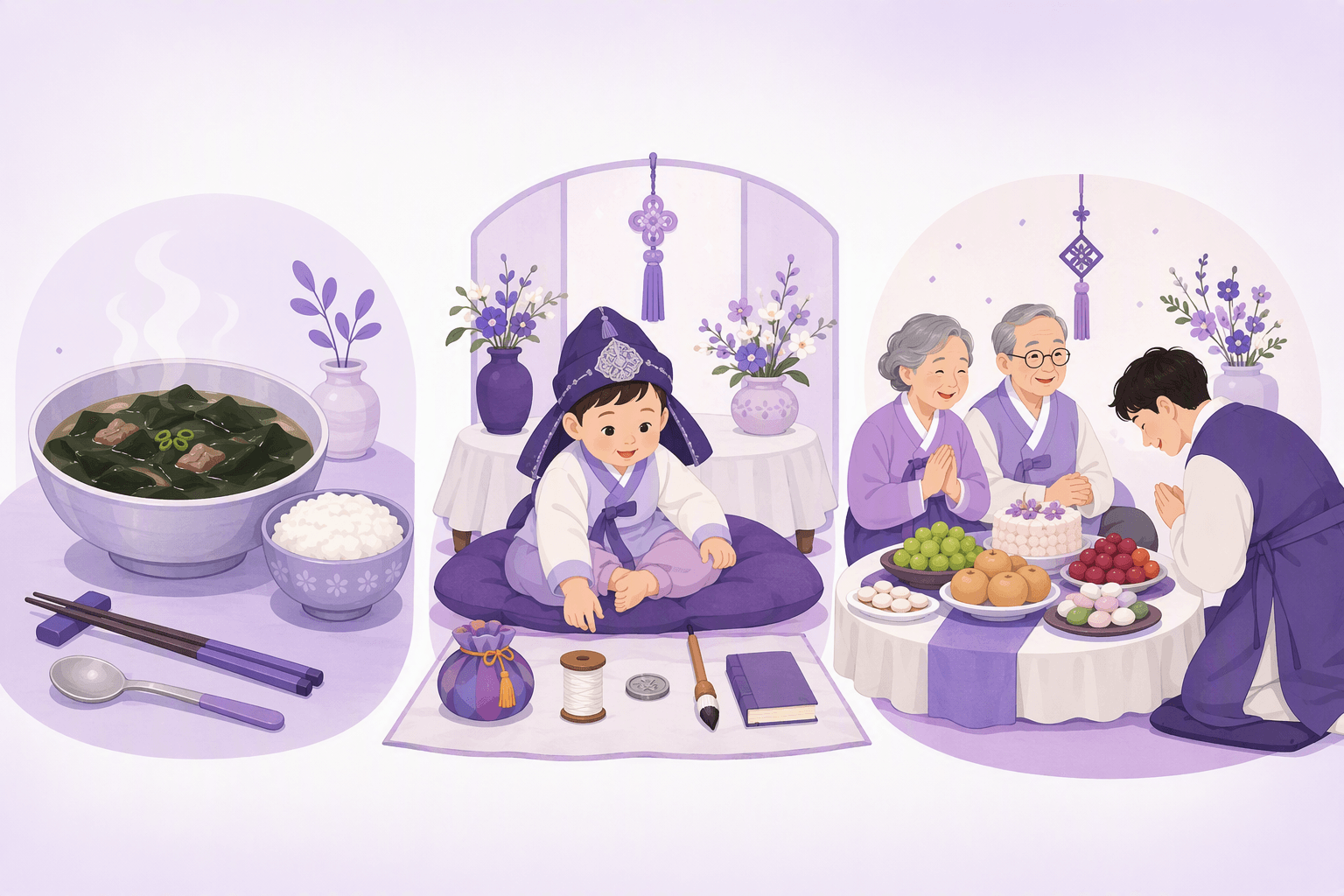
The 돌 (Dol), a baby's first birthday, is the most elaborate birthday celebration in Korean culture. It features the 돌잡이 (Doljabi) ceremony where objects are placed before the baby, and whichever one the baby grabs is believed to predict their future path.
The 돌잡이 (Doljabi) ceremony is uniquely Korean. Objects such as thread (long life), money (wealth), a book (scholarship), a microphone (entertainment career), and a stethoscope (medical career) are placed before the baby. Whichever the baby grabs first is believed to foretell their future. In modern Korea, the 돌 celebration is an elaborate event with professional photography, rented venues, and themed decorations.
환갑을 축하드립니다 (Hwangabeul Chukadeurimnida)
/hwan-gab-eul choo-kah-deu-reem-nee-dah/
Literal meaning: I humbly congratulate your 60th birthday
“아버지, 환갑을 축하드립니다. 항상 건강하세요.”
Father, congratulations on your 60th birthday. Please always be healthy.
The 환갑 (Hwangap, 60th birthday) marks the completion of one full cycle of the Chinese zodiac. Traditionally the most significant adult birthday in Korean culture, celebrated with a grand family banquet. The 칠순 (Chilsun, 70th) has become equally important as life expectancy has increased.
The 환갑 celebration marks the completion of one 60-year cycle in the traditional East Asian calendar system. Historically, reaching 60 was considered a remarkable achievement and was celebrated with a lavish family banquet (잔치, janchi). As Yeon and Brown note in Korean: A Comprehensive Grammar, the 칠순 (70th) and 팔순 (80th) celebrations have gained prominence as Korean life expectancy has risen to among the highest in the world.
How to Respond to Korean Birthday Wishes
| They Say | You Say | Translation |
|---|---|---|
| 생일 축하합니다! | 감사합니다! (Gamsahamnida!) | Thank you! (formal) |
| 생일 축하해요! | 고마워요! (Gomawoyo!) | Thank you! (polite) |
| 생일 축하해! | 고마워! (Gomawo!) | Thanks! (casual) |
| 생축! | ㅋㅋ 고마워! (kk gomawo!) | Haha thanks! |
| 건배! | 건배! (Geonbae!) | Cheers! |
💡 Who Pays in Korea?
Unlike in Italy where the birthday person always pays, Korean birthday customs vary. Close friends often treat the birthday person to a meal, while in other friend groups, the birthday person may host. In workplace settings, the team or boss usually treats the birthday person. The safest approach: offer to treat, but graciously accept if friends insist on paying.
Practice With Real Korean Content
Reading about birthday phrases is a solid foundation, but hearing native speakers use them naturally is what builds real fluency. Korean dramas (K-dramas) and variety shows are packed with birthday scenes, from the tearful surprise parties in romantic dramas to the hilarious birthday pranks on shows like Running Man and Knowing Bros.
Wordy lets you watch Korean movies and shows with interactive subtitles. Tap any phrase to see its meaning, pronunciation, and cultural context in real time. Instead of memorizing phrases from a list, you absorb them from authentic conversations with natural intonation and emotion.
For more Korean content, explore our blog for language guides including the best movies to learn Korean. You can also visit our Korean learning page to start practicing with real content today.
Frequently Asked Questions
What is the most common way to say happy birthday in Korean?
What is 생축 (Saengchuk)?
Why do Koreans eat seaweed soup on their birthday?
What do Koreans sing for happy birthday?
What is the Korean age system and how does it affect birthdays?
What birthday milestones are important in Korean culture?
Sources & References
- National Institute of Korean Language (국립국어원), Standard Korean Language Dictionary
- King Sejong Institute Foundation, Korean Language Education Guidelines (2024)
- Ethnologue: Languages of the World, Korean language entry (2024)
- Yeon, J. & Brown, L. (2011). 'Korean: A Comprehensive Grammar.' Routledge.
- Sohn, H.-M. (1999). 'The Korean Language.' Cambridge University Press.
Start learning with Wordy
Watch real movie clips and build your vocabulary as you go. Free to download.


