Quick Answer
The standard way to say good morning in Italian is 'Buongiorno' (bwohn-JOHR-noh), which literally means 'good day.' It covers both 'good morning' and 'good afternoon' until the switch to 'Buonasera' in the late afternoon. Italians also use 'Buondì' as a cheerful alternative and casual expressions like 'Ben svegliato!' (well awoken!) with family and close friends.
The Short Answer
The most common way to say good morning in Italian is Buongiorno (bwohn-JOHR-noh). It literally means "good day" and covers the entire morning through early afternoon. Unlike English, Italian does not have separate phrases for "good morning" and "good afternoon." Buongiorno handles both until it gives way to Buonasera (good evening) later in the day.
Italian is spoken by approximately 85 million people worldwide and is an official language in Italy, Switzerland, San Marino, and Vatican City. According to Ethnologue's 2024 data, it ranks among the top 25 most spoken languages globally. Morning greetings in Italian go far beyond a single phrase. They are woven into daily rituals like the sacred morning coffee at the bar, the walk through the piazza, and the opening of shops along the corso.
"The Italian morning greeting is not just words; it is a social contract. By saying Buongiorno, you acknowledge the other person's presence and affirm that you share the same community, even for a moment."
(Tullio De Mauro, Storia linguistica dell'Italia unita, Laterza, 2014)
This guide covers 16 morning greetings and related expressions, organized by formality and situation. Each includes pronunciation, an example sentence, and cultural context so you sound natural from your first cornetto to your last morning caffè.
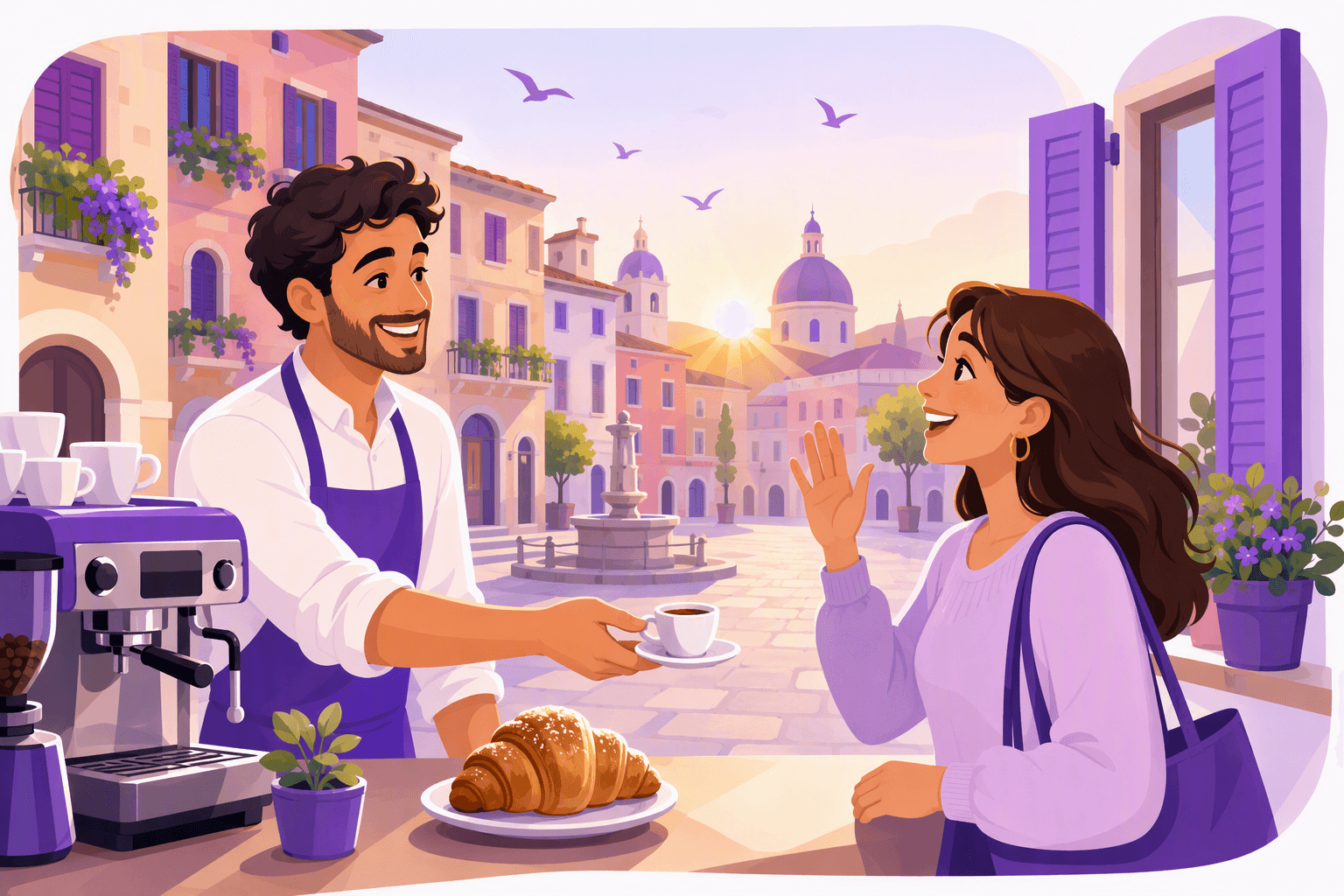
Quick Reference: Italian Morning Greetings at a Glance
| English | Italian | Pronunciation | Formality |
|---|---|---|---|
| Good morning / Good day | Buongiorno | bwohn-JOHR-noh | polite |
| Good morning (two words) | Buon giorno | bwohn JOHR-noh | polite |
| Good day! (cheerful) | Buondì | bwohn-DEE | casual |
| Well awoken! (to a man) | Ben svegliato! | behn sveh-LYAH-toh | casual |
| Well awoken! (to a woman) | Ben svegliata! | behn sveh-LYAH-tah | casual |
| How are you this morning? | Come stai stamattina? | KOH-meh STAH-ee stah-maht-TEE-nah | casual |
| Did you sleep well? | Hai dormito bene? | AH-ee dohr-MEE-toh BEH-neh | casual |
| Good morning everyone | Buongiorno a tutti | bwohn-JOHR-noh ah TOOT-tee | polite |
| How's it going this morning? | Come va stamattina? | KOH-meh VAH stah-maht-TEE-nah | casual |
| Have a good day | Buona giornata | BWOH-nah johr-NAH-tah | polite |
| Wake up! | Sveglia! | SVEH-lyah | casual |
| Good morning, sunshine | Buongiorno, raggio di sole | bwohn-JOHR-noh RAHJ-joh dee SOH-leh | casual |
| Rise and shine! | Alzati e brilla! | AHL-tsah-tee eh BREEL-lah | casual |
| Already awake? | Già sveglio/a? | jah SVEH-lyoh/lyah | casual |
| Good morning (formal) | Le porgo il mio buongiorno | leh POHR-goh eel MEE-oh bwohn-JOHR-noh | very formal |
| Good morning, how are you? (formal) | Buongiorno, come sta? | bwohn-JOHR-noh KOH-meh STAH | formal |
Standard Morning Greetings
These are the greetings you will hear most often across Italy, from the Alps to Sicily. The Accademia della Crusca, Italy's oldest linguistic authority (founded 1583), recognizes all of these as standard modern Italian.
Buongiorno
/bwohn-JOHR-noh/
Literal meaning: Good day
“Buongiorno, signora. Un caffè, per favore.”
Good morning, ma'am. A coffee, please.
The universal Italian morning greeting. Works in every setting from a casual bar visit to a business meeting. Covers 'good morning' and 'good afternoon' until the switch to 'Buonasera.'
Buongiorno is the cornerstone of Italian morning life. You say it when entering a shop, greeting your doorman, meeting a colleague, or ordering your espresso at the bar. It is never wrong in any daytime situation, which makes it the safest greeting for visitors to Italy.
The word is a compound of buono (good) and giorno (day). Unlike English, which splits the day into "morning" and "afternoon," Italian treats the entire daylight period before evening as one unit: giorno. This means Buongiorno pulls double duty.
🌍 When Does Buongiorno Become Buonasera?
The switch from Buongiorno to Buonasera is one of Italy's great unresolved debates. In Milan and Turin, the transition can happen as early as 3 PM. In Rome, around 4-5 PM. In Naples and Sicily, many people say Buongiorno until 5-6 PM or even later. The safest strategy: listen to what locals are saying and match them.
Buon giorno
/bwohn JOHR-noh/
Literal meaning: Good day (two words)
“Buon giorno, professore. Ha ricevuto la mia email?”
Good morning, professor. Did you receive my email?
The two-word variant of Buongiorno. Both forms are correct, but the single-word 'Buongiorno' is far more common in modern Italian. You may see 'Buon giorno' in formal letters or older texts.
Both Buongiorno and Buon giorno are grammatically correct. According to the Treccani dictionary, the one-word form has become the dominant standard in contemporary Italian. The two-word form appears occasionally in formal correspondence, literary writing, or when someone wants to add a slightly old-fashioned elegance to their greeting.
In practice, most Italians write and say the single-word version. If you are learning Italian, default to Buongiorno and you will always be correct.
Buondì
/bwohn-DEE/
Literal meaning: Good day (short form)
“Buondì! Che bella giornata oggi, no?”
Good morning! What a beautiful day today, right?
A cheerful, slightly informal alternative to Buongiorno. Common in everyday speech among friends, family, and relaxed workplaces. Also a well-known Italian breakfast snack brand name.
Buondì is the shorter, perkier cousin of Buongiorno. The dì comes from the Latin dies (day), making this a perfectly legitimate Italian word, not slang. It carries an upbeat, friendly energy that makes it ideal for greeting coworkers you are on good terms with, friends, and family.
Fun fact: Buondì is also the name of a famous Italian breakfast snack, a soft brioche cake made by Motta, sold in every Italian supermarket since 1953. The brand chose the name precisely because it evokes the warmth of an Italian morning.
Buona giornata
/BWOH-nah johr-NAH-tah/
Literal meaning: Good day (as a wish)
“Grazie, buona giornata! A domani.”
Thanks, have a good day! See you tomorrow.
This is a farewell, not a greeting. Use it when parting ways in the morning or afternoon. Think of it as the Italian 'Have a nice day.' The response is usually 'Anche a te!' (You too!) or 'Grazie, altrettanto!' (Thanks, likewise!).
This is an essential distinction that trips up many learners. Buongiorno is a greeting (you say it when arriving or meeting someone). Buona giornata is a wish (you say it when leaving or saying goodbye during the day). The difference is subtle but important.
You will hear shopkeepers say Buona giornata! as you leave their store, baristas say it after handing you your coffee, and colleagues say it at the end of a morning meeting. The standard replies are Grazie, anche a te! (Thanks, you too!) or Altrettanto! (Likewise!).
Casual and Family Morning Greetings
These expressions are for the kitchen table, the family group chat, and close friends. They carry the warmth and intimacy of Italian domestic life.
Ben svegliato!
/behn sveh-LYAH-toh/
Literal meaning: Well awoken! (to a man)
“Ben svegliato, dormiglione! La colazione è pronta.”
Well awoken, sleepyhead! Breakfast is ready.
A warm, affectionate morning greeting used within families and between close friends. Changes form by gender: 'Ben svegliato' for a man, 'Ben svegliata' for a woman. Often said to someone who has just woken up or arrived late.
Ben svegliato! (or Ben svegliata! for a woman) is one of those uniquely Italian expressions that captures the culture's warmth. It is the greeting you give someone who has just stumbled into the kitchen, eyes half-closed, still reaching for their coffee. It literally means "well awoken," as if waking up is an accomplishment worth celebrating.
The playful tone makes it perfect for teasing a late riser. Pair it with dormiglione (male sleepyhead) or dormigliona (female sleepyhead) for the full Italian family morning experience.
Ben svegliata!
/behn sveh-LYAH-tah/
Literal meaning: Well awoken! (to a woman)
“Ben svegliata, amore! Caffè?”
Well awoken, love! Coffee?
The feminine form of 'Ben svegliato.' Used by partners, parents, and close friends when greeting a woman who has just woken up. Sweet and domestic.
Italian's gendered endings mean morning greetings come in pairs. Ben svegliata is the feminine form, and you will hear it between partners, from parents to daughters, and among close female friends. The addition of amore (love) or tesoro (treasure) makes it especially tender.
Come stai stamattina?
/KOH-meh STAH-ee stah-maht-TEE-nah/
Literal meaning: How are you this morning?
“Ciao, come stai stamattina? Ti vedo un po' stanco.”
Hi, how are you this morning? You look a bit tired.
The morning-specific version of 'Come stai?' Adds the word 'stamattina' (this morning) to make the question feel more present and personal. Use the informal 'tu' form with friends and family.
Adding stamattina (this morning) to the standard Come stai? grounds the question in the present moment. It signals that you are not just going through the motions. You are genuinely asking about how the person's morning is going. Italians, especially in the south, often give real answers rather than an automatic Bene, grazie.
Hai dormito bene?
/AH-ee dohr-MEE-toh BEH-neh/
Literal meaning: Did you sleep well?
“Buongiorno, hai dormito bene? Ti ho sentito alzarti stanotte.”
Good morning, did you sleep well? I heard you get up last night.
A caring morning question used between family members, partners, and hosts greeting overnight guests. Shows genuine concern for the other person's rest.
This question is common in Italian households and perfectly natural to ask overnight guests. Italians take sleep seriously, and a bad night's rest is legitimate news, and asking about it shows care. The typical positive response is Sì, benissimo, grazie! (Yes, great, thanks!) or Come un sasso (Like a rock).
Come va stamattina?
/KOH-meh VAH stah-maht-TEE-nah/
Literal meaning: How's it going this morning?
“Ehi, come va stamattina? Pronto per la riunione?”
Hey, how's it going this morning? Ready for the meeting?
A slightly less personal alternative to 'Come stai stamattina?' The verb 'andare' (to go) makes this about things in general rather than the person specifically. Works well with acquaintances.
Come va? has a useful trick: because the verb andare (to go) is conjugated in the third person, you avoid choosing between tu and Lei. This makes Come va stamattina? a comfortable option for the office, where formality levels can be ambiguous.
Energetic Wake-Up Expressions
For those mornings when someone needs a push, or when you want to inject energy into the start of the day.
Sveglia!
/SVEH-lyah/
Literal meaning: Alarm! / Wake up!
“Sveglia, ragazzi! Sono già le otto!”
Wake up, guys! It's already eight o'clock!
A direct, energetic command to wake up. Used by parents, drill sergeants, group leaders, and anyone trying to get people moving in the morning. Also the Italian word for 'alarm clock.'
Sveglia! is both the word for alarm clock and a command to wake up. Italian parents use it with the same exasperated energy as the English "Rise and shine!", except with less shine and more urgency. You will also hear it in a figurative sense: when someone seems distracted or slow, Sveglia! means "Wake up! Pay attention!"
Buongiorno, raggio di sole
/bwohn-JOHR-noh RAHJ-joh dee SOH-leh/
Literal meaning: Good morning, ray of sunshine
“Buongiorno, raggio di sole! Come hai dormito?”
Good morning, sunshine! How did you sleep?
An affectionate morning greeting for partners, children, or anyone you adore. Characteristically Italian in its poetic warmth. Common in families and romantic relationships.
Italians have a gift for poetic everyday language, and this expression is a perfect example. Raggio di sole (ray of sunshine) turns a simple good morning into something lovely. Parents say it to children, partners say it to each other, and grandparents say it to everyone. It captures the Italian tendency to weave affection into the smallest daily moments.
Già sveglio/a?
/jah SVEH-lyoh/lyah/
Literal meaning: Already awake?
“Già sveglia? Sono solo le sei! Che è successo?”
Already awake? It's only six! What happened?
Said with mild surprise when someone is up earlier than expected. Can be playful or genuinely curious. Use 'sveglio' for a man and 'sveglia' for a woman.
This is the Italian morning greeting that expresses surprise. When your teenager appears in the kitchen before noon on a Saturday, Già sveglio? is the instinctive response. It works for anyone who is up earlier than usual and can be delivered with amusement, admiration, or mild suspicion.
Formal Morning Greetings
For professional settings, encounters with strangers, and situations where bella figura (making a good impression) matters most. If you want to deepen your understanding of Italian formality, visit our Italian learning page.
Buongiorno a tutti
/bwohn-JOHR-noh ah TOOT-tee/
Literal meaning: Good morning to everyone
“Buongiorno a tutti. Iniziamo la riunione?”
Good morning, everyone. Shall we start the meeting?
Used to greet a group: an office, a classroom, a meeting room, or a crowded shop. Polite and inclusive. 'Tutti' (everyone) makes it warm without being overly casual.
When you walk into a room full of people (a meeting, a classroom, a waiting room) Buongiorno a tutti is the natural greeting. It is polite, inclusive, and avoids the awkwardness of greeting each person individually. Teachers use it to begin class, managers use it to open meetings, and shopkeepers use it when multiple customers are present.
Buongiorno, come sta?
/bwohn-JOHR-noh KOH-meh STAH/
Literal meaning: Good morning, how are you? (formal)
“Buongiorno, dottoressa. Come sta? Spero bene.”
Good morning, doctor. How are you? I hope well.
The formal morning greeting-plus-inquiry. Uses the 'Lei' form of address. Essential for professional settings, elders, and anyone you would address by title.
Combining Buongiorno with Come sta? (the formal "how are you?") creates the complete formal morning greeting. Use it with your doctor, your professor, your landlord, or a new business contact. The Lei pronoun form shows respect without being stiff.
Le porgo il mio buongiorno
/leh POHR-goh eel MEE-oh bwohn-JOHR-noh/
Literal meaning: I offer you my good morning
“Egregio direttore, Le porgo il mio buongiorno e i miei più cordiali saluti.”
Dear director, I offer you my good morning and my warmest regards.
An extremely formal, almost ceremonial greeting found in official correspondence, institutional contexts, and very traditional settings. Rarely heard in everyday speech but useful to recognize.
This ultra-formal expression belongs to the world of official letters, institutional greetings, and old-school Italian courtesy. You are unlikely to use it in daily life, but you may encounter it in formal emails, public addresses, or when dealing with Italian bureaucracy. Recognizing it will save you confusion.
Responding to Morning Greetings
Knowing how to respond is just as important as initiating the greeting. Here are the most common morning exchanges.
| They Say | You Say | Notes |
|---|---|---|
| Buongiorno | Buongiorno | Echo the greeting back |
| Buongiorno, come sta? | Bene, grazie. E Lei? | Formal: use "Lei" |
| Buongiorno, come stai? | Bene, grazie. E tu? | Informal: use "tu" |
| Come va stamattina? | Bene! / Non c'è male | "Good!" / "Not bad" |
| Hai dormito bene? | Sì, benissimo! Grazie | "Yes, great! Thanks" |
| Ben svegliato/a! | Buongiorno! / Grazie! | Simple response works |
| Buona giornata! | Grazie, altrettanto! | "Thanks, likewise!" |
💡 The Espresso Response Rule
In a busy Italian morning, brevity is welcome. When a barista says Buongiorno, a simple Buongiorno back is perfect. There is no need for elaborate responses. Italians appreciate efficiency in morning routines, especially before the first coffee.
Italian Morning Culture: The Bar Ritual
No guide to Italian morning greetings is complete without understanding the bar, the Italian café that is the true stage for morning greetings. According to the Accademia della Crusca, the social function of the Italian bar has been central to community life since the 19th century.
🌍 The Sacred Morning Bar Visit
Every morning, millions of Italians perform the same ritual: walk to their local bar, say Buongiorno to the barista (who likely knows them by name), order a caffè (espresso) or cappuccino with a cornetto (croissant), drink it standing at the counter in under five minutes, say Buona giornata, and leave. This entire exchange costs between 1.50 and 3.50 euros and is considered non-negotiable by most Italians. Skipping the morning bar visit is like skipping breakfast itself.
⚠️ The Cappuccino Rule
Italians drink cappuccino only in the morning, typically before 11 AM. Ordering one after lunch or dinner is a well-known cultural faux pas. The reasoning is digestive: Italians believe the heavy milk interferes with digestion after a meal. After 11 AM, switch to caffè (espresso), caffè macchiato (espresso with a dash of milk), or caffè lungo (long coffee). You will not be refused a late cappuccino, but you will be silently judged.

The morning bar is also where regional greetings come alive. In Naples, you might hear Buongiorno, dottò! (a Neapolitan abbreviation of dottore, used generously for any respected man). In Rome, the greeting might be a breezy 'Giorno!, the shortened form that drops the Buon. In Milan, the exchange tends to be crisper and more efficient, reflecting the northern pace of life.
Regional Morning Variations
Italy's 20 regions produce remarkable linguistic diversity. As Tullio De Mauro documented, standard Italian only became the majority's everyday language in the second half of the 20th century. Before that, regional dialects dominated. Those dialects still color morning greetings today.
Northern Italy (Milan, Turin, Venice): Mornings tend to be efficient. A quick Buongiorno or even the clipped 'Giorno is standard. The switch to Buonasera comes early, sometimes by 3 PM. The pace is faster, the greetings shorter.
Central Italy (Rome, Florence, Bologna): Rome's 'Giorno is almost as common as the full Buongiorno. Florentines may add the characteristic Tuscan aspiration to their consonants. Bologna's morning greetings often blend into food discussions, because the city takes both greetings and breakfast very seriously.
Southern Italy (Naples, Bari, Palermo): Morning greetings are warmer, longer, and more effusive. Buongiorno may be followed by elaborate inquiries about family, health, and sleep quality. In Naples, dialect forms like Bonngiorno blend with standard Italian. The switch to Buonasera happens later, and mornings feel like they last longer in general.
For a deeper look at Italian regional differences, including colorful local expressions, check out our blog for more language and culture guides.
Practice With Real Italian Content
Reading about morning greetings gives you knowledge, but hearing them spoken by native speakers makes them instinctive. Italian cinema and television are filled with morning scenes, from the chaotic family breakfasts in modern comedies to the elegant Buongiorno, dottore exchanges in period dramas.
Wordy lets you watch Italian movies and shows with interactive subtitles. Tap any greeting to see its meaning, pronunciation, and cultural context in real time. Instead of memorizing phrases from a list, you absorb them from authentic conversations with natural intonation and regional accents.
For film recommendations, explore the best movies to learn Italian. Classic Italian cinema from directors like Fellini and Sorrentino showcases the full spectrum of Italian greetings, from formal exchanges in drawing rooms to the boisterous morning scenes at a Neapolitan bar.
Frequently Asked Questions
What is the most common way to say good morning in Italian?
When does 'Buongiorno' switch to 'Buonasera'?
Is 'Buongiorno' one word or two?
What is the cappuccino rule in Italy?
What is the difference between 'Buongiorno' and 'Buondì'?
How do Italians greet each other at a morning café?
Sources & References
- Accademia della Crusca, Italy's foremost authority on the Italian language, founded 1583
- Treccani, Vocabolario della lingua italiana, online edition (2025)
- Ethnologue: Languages of the World, Italian language entry (2024)
- De Mauro, T. (2014). 'Storia linguistica dell'Italia unita.' Laterza.
Start learning with Wordy
Watch real movie clips and build your vocabulary as you go. Free to download.


