Quick Answer
French does not have a direct translation for 'good morning.' The standard greeting is 'Bonjour' (bohn-ZHOOR), which means 'good day' and covers both morning and afternoon. In Québec, you may hear 'Bon matin' (a calque from English) but it is considered non-standard in Metropolitan French. Native speakers also use morning-specific expressions like 'Bien dormi ?' (sleep well?), 'Bonne matinée' (have a good morning), and 'Ça va ce matin ?' (how's it going this morning?).
The Short Answer
French does not have a dedicated phrase for "good morning." The standard greeting is Bonjour (bohn-ZHOOR), which literally translates to "good day" and covers the entire period from sunrise to roughly 6 PM. Unlike English, Spanish (Buenos días), or German (Guten Morgen), French collapses morning and afternoon greetings into a single word.
This surprises many learners, but it reflects a fundamental difference in how French structures time-based greetings. The language divides the day into two blocks: jour (day) and soir (evening). There is no separate matin (morning) greeting in standard French, only in Québec, where Bon matin has taken hold as a calque from English. Whether you're looking up "good morning in french" for travel, study, or conversation, this guide covers everything you need.
"The French language does not traditionally use 'bon matin' as a greeting. The correct form is 'bonjour,' which applies to the entire first part of the day."
(Académie française, Dire, ne pas dire)
That said, French speakers have plenty of morning-specific expressions that go beyond Bonjour. This guide covers 16 greetings and phrases you will hear during French mornings, from the café counter to the family breakfast table to the office corridor.
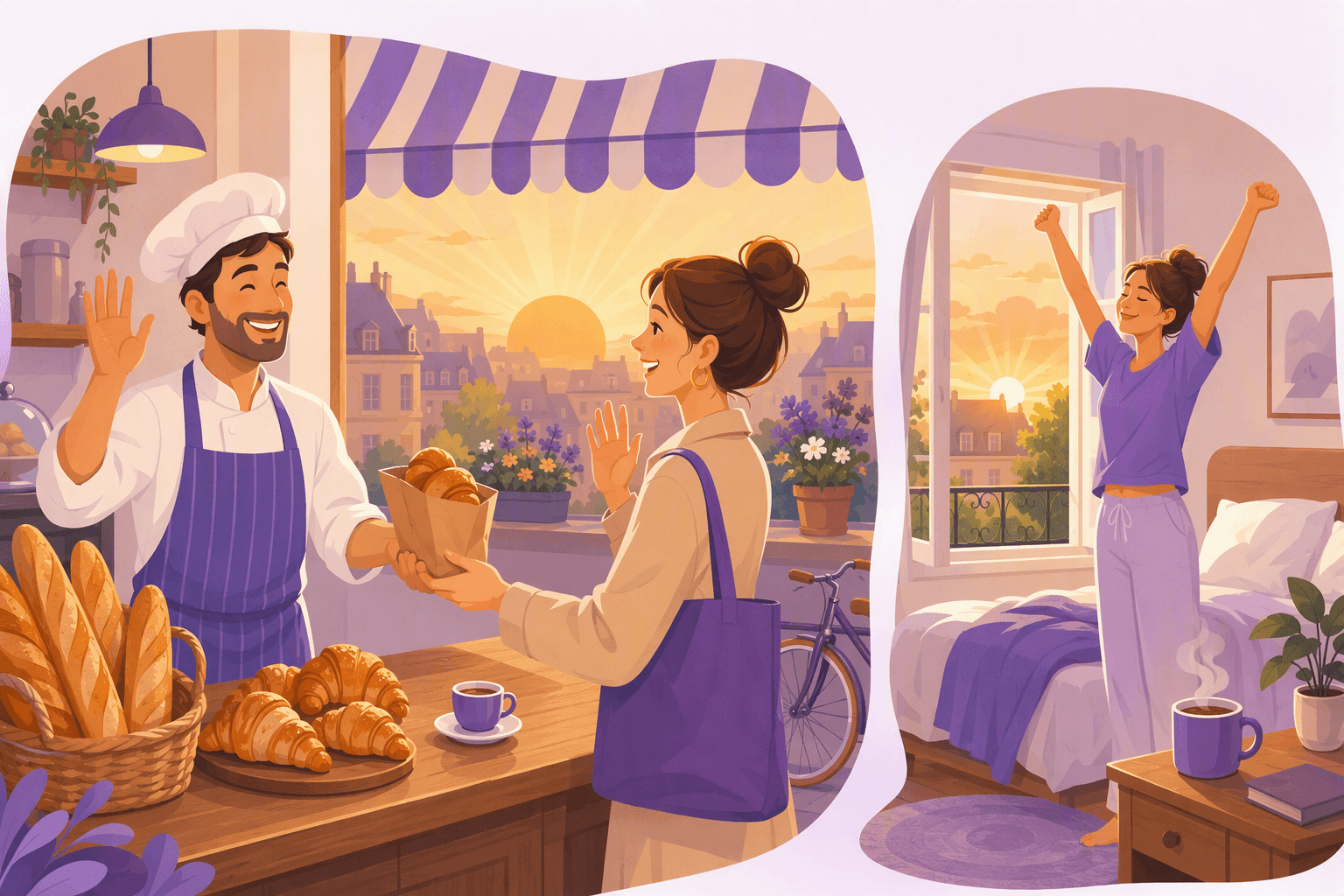
Quick Reference: French Morning Greetings at a Glance
| English | French | Pronunciation | Formality |
|---|---|---|---|
| Good morning / Good day | Bonjour | bohn-ZHOOR | polite |
| Good morning (Québec) | Bon matin | bohn mah-TAN | casual |
| Have a good morning | Bonne matinée | bun mah-tee-NAY | polite |
| How are you this morning? (formal) | Comment allez-vous ce matin ? | koh-MAHN tah-lay VOO suh mah-TAN | formal |
| Sleep well? | Bien dormi ? | byeh̃ dor-MEE | casual |
| Hi (casual) | Salut | sah-LEW | casual |
| Did you sleep well? | Tu as bien dormi ? | tew ah byeh̃ dor-MEE | casual |
| Good morning everyone | Bonjour à tous | bohn-ZHOOR ah TOO | polite |
| How's it going this morning? | Ça va ce matin ? | sah VAH suh mah-TAN | casual |
| Have a good day | Bonne journée | bun zhoor-NAY | polite |
| Did you have a good night? | Vous avez passé une bonne nuit ? | voo zah-vay pah-SAY ewn bun NWEE | formal |
| Rise and shine! | Debout, là-dedans ! | duh-BOO lah duh-DAHN | casual |
| Good morning sweetheart | Bonjour mon cœur | bohn-ZHOOR mohn KUR | casual |
| Already awake? | Déjà réveillé(e) ? | day-ZHAH ray-vay-YAY | casual |
| Coffee? | Un café ? | uhn kah-FAY | casual |
| Have a good day (formal) | Je vous souhaite une bonne journée | zhuh voo swet ewn bun zhoor-NAY | formal |
Why French Has No "Good Morning"
Before diving into each expression, it helps to understand why this gap exists. The answer lies in how French divides the day.
English splits greetings across three periods: morning, afternoon, and evening. French uses only two: jour (day, covering morning through late afternoon) and soir (evening, from roughly 6 PM onward). This gives French speakers Bonjour and Bonsoir, and nothing in between.
The word matin (morning) absolutely exists in French. You can say ce matin (this morning), demain matin (tomorrow morning), or tous les matins (every morning). But it was never grammaticalized into a greeting the way jour and soir were. According to the Académie française, Bonjour has served as the all-purpose daytime greeting since the Middle Ages.
🌍 The Québec Exception
Québécois French is the one major exception. Bon matin is widely used in Québec as a direct translation of "good morning," especially on radio, television, and in casual conversation. The Office québécois de la langue française acknowledges its use while noting it is not part of standard international French. If you are visiting Montréal, you will hear it constantly. In Paris, it would sound odd.
The Standard Morning Greeting
Bonjour
/bohn-ZHOOR/
Literal meaning: Good day
“Bonjour ! Un croissant et un café crème, s'il vous plaît.”
Good morning! A croissant and a café crème, please.
The default morning greeting in all French-speaking countries. Works from the moment you wake up until approximately 6 PM. Mandatory when entering a shop, café, or starting any interaction.
Bonjour is the single most important word for any French learner. It is your good morning, your good afternoon, and your social entry ticket. In France, walking into a boulangerie at 7 AM without saying Bonjour is a genuine social error, and the baker may serve you with noticeably less warmth.
The pronunciation places stress on the second syllable: bohn-ZHOOR. The "j" sounds like the "zh" in "pleasure," and the nasal "on" is produced by letting the air pass through your nose (say "ohn" without fully closing the "n").
According to the Organisation internationale de la Francophonie, French is spoken by approximately 321 million people across 29 countries. In every single one of them, Bonjour is the correct morning greeting.
The Québec Exception
Bon matin
/bohn mah-TAN/
Literal meaning: Good morning
“Bon matin, tout le monde ! Bien dormi ?”
Good morning, everyone! Sleep well?
Used in Québec as a direct equivalent of 'good morning.' Borrowed from English. Not used in Metropolitan France, Belgium, or Francophone Africa. Radio hosts, TV presenters, and everyday Québécois speakers use it freely.
Bon matin is the only true "good morning" in any variety of French. It entered Québécois French through English influence. Québec's proximity to English-speaking Canada and the United States made this calque almost inevitable.
You will hear Bon matin on Québécois morning radio shows, at breakfast restaurants in Montréal, and in casual greetings among friends and colleagues. The Office québécois de la langue française notes its widespread use while acknowledging that prescriptive grammarians often recommend Bonjour instead.
💡 When to Use Bon Matin
Use Bon matin only in Québec or with Québécois speakers. In France, Belgium, Switzerland, or Francophone Africa, it will sound like a direct (and awkward) translation from English. Stick with Bonjour in those contexts.
Morning-Specific Expressions
These phrases do not replace Bonjour; they follow it. A typical French morning interaction starts with Bonjour and then flows into one of these expressions.
Bien dormi ?
/byeh̃ dor-MEE/
Literal meaning: Well slept?
“Bonjour, chérie. Bien dormi ?”
Good morning, darling. Sleep well?
The most common morning follow-up among family members, partners, and close friends. Short, warm, and natural. The expected response is 'Oui, très bien' (yes, very well) or 'Pas trop' (not really).
This is the phrase you will hear most often at the French breakfast table. It is a contracted form (the full sentence would be Tu as bien dormi ?), but the shortened Bien dormi ? is far more natural in casual speech.
The response is typically Oui, très bien, merci (yes, very well, thanks) or, if the night was rough, Pas très bien (not very well) or Bof, pas trop (meh, not really).
Tu as bien dormi ?
/tew ah byeh̃ dor-MEE/
Literal meaning: You have well slept?
“Salut, tu as bien dormi ? Tu as l'air fatigué.”
Hey, did you sleep well? You look tired.
The full version of 'Bien dormi ?' Uses the informal 'tu.' More personal and slightly more concerned than the shortened form; often used when someone looks tired or had a difficult night.
The complete version of Bien dormi ? carries a slightly more personal, attentive tone. You might use this when you can tell someone did not sleep well; it signals genuine concern rather than a reflexive morning check-in.
Ça va ce matin ?
/sah VAH suh mah-TAN/
Literal meaning: It goes this morning?
“Bonjour, Marc. Ça va ce matin ? Prêt pour la réunion ?”
Good morning, Marc. How's it going this morning? Ready for the meeting?
Adds a morning-specific dimension to the universal 'Ça va ?' Often heard in workplaces and among friends. Implies awareness that mornings can be rough.
Adding ce matin (this morning) to the universal Ça va ? gives it a morning-specific flavor. It acknowledges that mornings are their own beast. Perhaps the person had a late night, a bad commute, or simply has not had their coffee yet.
Vous avez passé une bonne nuit ?
/voo zah-vay pah-SAY ewn bun NWEE/
Literal meaning: You have spent a good night?
“Bonjour, madame. Vous avez passé une bonne nuit ?”
Good morning, ma'am. Did you have a good night?
The formal (vous) way to ask about someone's night. Common in hotels, bed-and-breakfasts, and when greeting elderly family members. More refined than 'Bien dormi ?'
This is the polished, vous-level way to inquire about someone's night. Hotel staff use it with guests, attentive hosts use it with visitors, and grandchildren use it with grandparents. It reflects the care that French culture places on formality and consideration.
Workplace Morning Greetings
French workplace culture treats the morning greeting as a non-negotiable social ritual. Arriving at the office without greeting your colleagues is considered rude, and in some environments, genuinely damaging.
Bonjour à tous
/bohn-ZHOOR ah TOO/
Literal meaning: Good day to all
“Bonjour à tous ! On commence la réunion ?”
Good morning, everyone! Shall we start the meeting?
The standard group greeting in meetings, offices, and classrooms. 'À tous' makes it inclusive. For a mixed or all-female group, some speakers use 'Bonjour à toutes' or 'Bonjour à tous et à toutes.'
When you walk into a meeting room or an open-plan office, Bonjour à tous addresses everyone at once. In French workplaces, particularly in traditional companies, many employees still do a tour de bureau, walking around to say Bonjour individually to each colleague with a handshake or la bise. In larger or more modern offices, a collective Bonjour à tous suffices.
Comment allez-vous ce matin ?
/koh-MAHN tah-lay VOO suh mah-TAN/
Literal meaning: How go you this morning?
“Bonjour, Monsieur Dupont. Comment allez-vous ce matin ?”
Good morning, Mr. Dupont. How are you this morning?
The formal way to check in on someone's morning. Uses 'vous.' Appropriate with superiors, clients, and colleagues you do not know well. Always preceded by 'Bonjour.'
Adding ce matin to the standard formal greeting Comment allez-vous ? shows attentiveness. It tells the listener you are not just reciting a formula; you are genuinely acknowledging the specific moment of the day. The standard response is Très bien, merci. Et vous ? (Very well, thank you. And you?).
🌍 The Morning Tour in French Offices
In many French workplaces, employees are expected to greet each colleague individually when arriving in the morning. This tour de bureau can involve handshakes, la bise (cheek kisses), or at minimum a Bonjour and eye contact. Skipping it (walking straight to your desk without acknowledging anyone) is noticed and quietly judged.
Je vous souhaite une bonne journée
/zhuh voo swet ewn bun zhoor-NAY/
Literal meaning: I wish you a good day
“Merci pour votre aide. Je vous souhaite une bonne journée.”
Thank you for your help. I wish you a good day.
A formal parting wish, often heard after morning meetings or interactions with clients. More elaborate than the simple 'Bonne journée.' Signals professionalism and courtesy.
This is the expanded, formal version of Bonne journée. You will hear it in professional emails, after business meetings, and from customer service representatives. It carries extra weight and politeness, the kind of phrase that makes the listener feel valued.
Casual & Family Morning Expressions
These are the greetings that happen at the kitchen table, between roommates, and among close friends meeting for breakfast.
Salut
/sah-LEW/
Literal meaning: Health / Safety (archaic)
“Salut ! T'es déjà debout ? Il est que sept heures !”
Hey! You're already up? It's only seven!
The casual all-purpose greeting works just as well in the morning as at any other time. Among friends and family, a morning 'Salut' is completely natural and often replaces 'Bonjour.'
Among friends and family, Salut is a perfectly natural morning greeting. While Bonjour is obligatory with strangers, service workers, and in professional settings, Salut is the default at home and among peers. A simple Salut over coffee is all you need.
Bonjour mon cœur
/bohn-ZHOOR mohn KUR/
Literal meaning: Good day my heart
“Bonjour mon cœur. Le café est prêt.”
Good morning, sweetheart. The coffee is ready.
A tender morning greeting between romantic partners or from parents to children. 'Mon cœur' (my heart) is one of the most common French terms of endearment. Other options include 'mon amour' (my love), 'ma chérie' / 'mon chéri' (my darling).
French mornings at home often begin with a term of endearment. Mon cœur (my heart), mon amour (my love), and chéri(e) (darling) are all natural additions to Bonjour. Between parents and young children, Bonjour mon petit cœur (good morning, little heart) is especially warm.
Debout, là-dedans !
/duh-BOO lah duh-DAHN/
Literal meaning: Up, in there!
“Allez, debout, là-dedans ! Le petit déjeuner est servi !”
Come on, rise and shine! Breakfast is served!
The French equivalent of 'rise and shine!' Used playfully by parents waking children or between roommates. Cheerful and energetic. 'Là-dedans' literally refers to 'in there' (the bed, the room).
This playful wake-up call is the French "rise and shine." Parents use it with children, roommates use it with each other, and it carries an affectionate, upbeat energy. The phrase literally means "up, in there!", pointing at the bed or room where the sleeper is still hiding.
Déjà réveillé(e) ?
/day-ZHAH ray-vay-YAY/
Literal meaning: Already awake?
“Oh, déjà réveillée ? Il est à peine six heures !”
Oh, already awake? It's barely six o'clock!
Expresses mild surprise at finding someone awake early. Common among family members and housemates. Gendered in writing: 'réveillé' (masculine), 'réveillée' (feminine). Pronounced identically.
This expression carries a note of pleasant surprise. It implies the person is awake earlier than expected. In French, the adjective agrees with the gender of the person: réveillé for masculine, réveillée for feminine, though the pronunciation is the same.
Morning Farewells
These phrases are said when leaving someone during the morning, not when arriving. Understanding the distinction prevents a common learner mistake.
Bonne matinée
/bun mah-tee-NAY/
Literal meaning: Good morning (as a wish)
“Merci, bonne matinée ! À ce midi !”
Thanks, have a good morning! See you at lunchtime!
A parting wish meaning 'have a good morning,' used when leaving someone during the morning hours. The farewell counterpart to 'Bonjour.' Less common than 'Bonne journée' but perfectly natural when parting before noon.
Bonne matinée is the morning-specific farewell that many French learners never learn. It means "have a good (rest of the) morning" and is used when parting from someone before noon. After noon, it shifts to Bonne après-midi (have a good afternoon) and then Bonne soirée (have a good evening).
Bonne journée
/bun zhoor-NAY/
Literal meaning: Good day (as a wish)
“Allez, bonne journée ! On se voit ce soir.”
Right, have a good day! See you tonight.
The most common daytime farewell in French. Said when parting in the morning or afternoon. You will hear it from every shopkeeper, colleague, and barista after a morning interaction. Response: 'Merci, vous aussi !' (Thanks, you too!).
You will hear Bonne journée more than almost any other phrase during a French morning. Every baker, every barista, every receptionist will send you off with it. The response is simple: Merci, vous aussi ! (Thanks, you too!).
The French Café Morning Ritual
Un café ?
/uhn kah-FAY/
Literal meaning: A coffee?
“Bonjour ! Un café ? Je viens d'en faire.”
Good morning! Coffee? I just made some.
In French homes and offices, offering coffee is a core part of the morning ritual. 'Un café ?' is as much a greeting as a question. At a café, 'un café' means an espresso by default; specify 'un café crème' or 'un café allongé' if you want something else.
Coffee and French mornings are inseparable. At home, Un café ? is both an offer and a greeting. At a café or boulangerie, ordering your morning coffee is a ritual with its own vocabulary. According to Ethnologue, France consumes approximately 5.4 kg of coffee per capita annually, and much of it flows through the morning routine.
🌍 The French Morning Coffee Order
At a French café, un café means a small espresso, not a large drip coffee. If you want something closer to American-style coffee, ask for un café allongé (a long coffee, with extra hot water). For coffee with milk, say un café crème (morning only; ordering milk-based coffee in the afternoon is unusual). A noisette is an espresso with just a dash of milk.
How to Respond to Morning Greetings
Here is how to handle the most common morning exchanges.
Morning Greeting Responses
| They Say | You Say | Notes |
|---|---|---|
| Bonjour ! | Bonjour ! | Always echo it back |
| Bon matin ! (Québec) | Bon matin ! / Bonjour ! | Either works in Québec |
| Bien dormi ? | Oui, très bien, merci | Or "Pas trop" if you slept poorly |
| Ça va ce matin ? | Ça va, et toi ? | Casual response |
| Comment allez-vous ce matin ? | Très bien, merci. Et vous ? | Formal response |
Farewell Responses
| They Say | You Say |
|---|---|
| Bonne matinée ! | Merci, vous aussi ! / Toi aussi ! |
| Bonne journée ! | Merci, à vous aussi ! |
| Je vous souhaite une bonne journée | Merci, c'est très aimable. Vous aussi. |
💡 The Morning Bonjour Formula
A typical French morning interaction follows this pattern: Bonjour (greeting) + request or conversation + Bonne journée or Bonne matinée (farewell). At a bakery, it sounds like this: "Bonjour ! Une baguette, s'il vous plaît." ... "Voilà, un euro dix." ... "Merci, bonne journée !" ... "Merci, vous aussi !" Never skip the opening Bonjour or the closing Bonne journée.
Morning Customs Across the French-Speaking World
Morning greetings in French vary not just in words but in physical customs. The Francophonie spans five continents, and morning rituals differ accordingly.
In Metropolitan France, the morning typically begins with la bise, cheek kisses between family, friends, and close colleagues. The number varies by region: two in Paris, three in Provence, four in parts of the Loire Valley. In the workplace, a handshake with Bonjour is standard for less familiar colleagues.
In Québec, mornings are somewhat less formal. A wave or nod with Bonjour or Bon matin is common. La bise is less frequent than in France, reflecting the influence of Anglo-Canadian customs.
In Francophone Africa, morning greetings are often more elaborate. In Sénégal, for example, a morning greeting exchange can last several minutes, with each person inquiring about the other's family, health, and night's rest. Rushing through a greeting is considered disrespectful.
🌍 The Importance of Morning Greetings in French Culture
In French culture, the morning greeting is not optional small talk. It is a social contract. Research from the Institut français confirms that French speakers consider the absence of Bonjour at the start of an interaction to be one of the most offensive social lapses possible. Whether you are in a Parisian office, a Montréal café, or a Dakar market, starting with Bonjour marks you as someone who understands and respects the culture.
Practice With Real French Content
Reading about morning greetings gives you the vocabulary, but hearing them in context is what makes them natural. French films are filled with morning scenes: breakfast conversations in Amélie, café orders in Paris, je t'aime, and workplace greetings in The Intouchables.
Wordy lets you watch French movies and shows with interactive subtitles. When a character says Bonjour at a café or Bien dormi ? over breakfast, you can tap the phrase to see its meaning, pronunciation, and cultural context in real time. Instead of memorizing phrases from a list, you absorb them from authentic conversations.
For more French content, explore our blog for language guides, or check out the best movies to learn French for curated film recommendations. You can also visit our French learning page to start practicing with real content today.
Frequently Asked Questions
How do you say 'good morning' in French?
Is 'Bon matin' correct French?
What is the difference between 'Bonjour' and 'Bonne matinée'?
How do French people greet each other first thing in the morning?
When does 'Bonjour' stop being appropriate?
Do French people say 'good morning' at cafés?
Sources & References
- Académie française, Dictionnaire de l'Académie française, 9th edition
- Organisation internationale de la Francophonie (OIF), La langue française dans le monde, 2022 report
- Ethnologue: Languages of the World, French language entry (2024)
- Office québécois de la langue française (OQLF), Banque de dépannage linguistique
Start learning with Wordy
Watch real movie clips and build your vocabulary as you go. Free to download.


