Quick Answer
The most common way to say congratulations in Korean is '축하합니다' (Chukahamnida, choo-kah-hahm-nee-dah), the polite-formal form. Among close friends, '축하해' (Chukahae) is the casual equivalent. The root word '축하' (chukha) means celebration or congratulation and pairs with different speech level endings depending on your relationship to the person.
The Short Answer
The most common way to say congratulations in Korean is 축하합니다 (Chukahamnida, choo-kah-hahm-nee-dah). This polite-formal expression works for weddings, graduations, promotions, and every other celebratory occasion. Among close friends, 축하해 (Chukahae) is the casual equivalent.
Korean is spoken by over 80 million people worldwide, according to Ethnologue's 2024 data. The word 축하 (chukha) is the core building block: it means "celebration" or "congratulation" and never changes. What changes is the verb ending attached to it, which signals your relationship to the person you are congratulating. This speech level system, documented extensively by the National Institute of Korean Language (NIKL), is what makes Korean congratulatory expressions simultaneously simple in concept and nuanced in practice.
"Politeness in Korean is not merely a matter of word choice but of grammatical architecture. The verb ending is a social signal, encoding the speaker's assessment of relative age, status, and intimacy in every single utterance."
(Brown & Levinson, Politeness: Some Universals in Language Usage, Cambridge University Press)
This guide covers 15+ Korean congratulatory expressions organized by speech level and occasion: formal, polite, casual, and situation-specific phrases for weddings, graduations, and career milestones. Each includes Hangul, romanization, pronunciation, and cultural context.

Quick Reference: Korean Congratulations at a Glance
| English | Korean | Pronunciation | Formality |
|---|---|---|---|
| Congratulations (formal) | 축하합니다 | Choo-kah-hahm-nee-dah | formal |
| Congratulations (humble-formal) | 축하드립니다 | Choo-kah-deu-reem-nee-dah | very formal |
| Congratulations (polite) | 축하해요 | Choo-kah-heh-yo | polite |
| Congratulations (casual) | 축하해 | Choo-kah-heh | casual |
| Congrats! (exclamation) | 축하! | Choo-kah | casual |
| Clap clap clap! (celebratory) | 짝짝짝! | Jjak-jjak-jjak | casual |
| Wedding congratulations | 결혼 축하합니다 | Gyeol-hon choo-kah-hahm-nee-dah | formal |
| Graduation congratulations | 졸업 축하합니다 | Jol-eop choo-kah-hahm-nee-dah | formal |
| Congratulations on passing | 합격 축하합니다 | Hap-gyeok choo-kah-hahm-nee-dah | formal |
| Congratulations on your promotion | 승진 축하합니다 | Seung-jin choo-kah-hahm-nee-dah | formal |
| Well done! (casual) | 잘했어! | Jal-hess-eo | casual |
| Let's celebrate! | 축하하자! | Choo-kah-ha-jah | casual |
| I'm so proud of you | 정말 자랑스러워 | Jeong-mal ja-rang-seu-reo-wo | casual |
| Congratulations on your first birthday | 돌 축하해요 | Dol choo-kah-heh-yo | polite |
| Happy 60th birthday | 환갑을 축하드립니다 | Hwan-gab-eul choo-kah-deu-reem-nee-dah | very formal |
Formal Congratulations
Korean formal speech (존댓말, jondaenmal) is essential when congratulating elders, superiors, or anyone in a public or professional setting. The Korean Language Society notes that choosing the correct formality level for congratulations is considered a direct reflection of your social awareness.
축하합니다
/choo-kah-hahm-nee-dah/
Literal meaning: Congratulations (formal-polite)
“축하합니다! 정말 대단하시네요.”
Congratulations! That's truly impressive.
The standard formal-polite congratulation using the '-합니다' (hapnida) speech level. Safe for virtually any situation: weddings, graduations, promotions, public speeches, and conversations with anyone you are not on casual terms with.
This is the default choice and the safest option. The structure is transparent: 축하 (chukha = congratulation) + 합니다 (hamnida = formal-polite verb ending meaning "do/give"). According to NIKL's Standard Korean Language Dictionary, 축하 derives from the Sino-Korean characters 祝 (to wish/pray) and 賀 (to congratulate), making its literal meaning "wishing congratulations." You will hear this form at award ceremonies, wedding speeches, graduation events, and in any setting where formality is expected.
축하드립니다
/choo-kah-deu-reem-nee-dah/
Literal meaning: I humbly offer congratulations
“사장님, 승진을 진심으로 축하드립니다.”
Director, I sincerely offer congratulations on your promotion.
Uses the humble verb '드리다' (deurida = to humbly give/offer), which actively lowers the speaker and elevates the recipient. Reserved for elders, superiors, professors, and highly formal occasions like company events or family celebrations for senior members.
The shift from 축하합니다 to 축하드립니다 is significant. The humble verb 드리다 (deurida) replaces the neutral 하다 (hada = to do), signaling that you are offering your congratulations upward, to someone of higher status. Use this with your boss, a professor, grandparents, or at formal ceremonies. In a corporate setting, congratulating your CEO on a company milestone with 축하합니다 is fine, but 축하드립니다 demonstrates sharper social awareness.
💡 진심으로 (Jinsimeuro). Add Sincerity
Adding 진심으로 (jinsimeuro = sincerely/from the heart) before any congratulatory phrase elevates its emotional weight. 진심으로 축하합니다 (I sincerely congratulate you) is warmer than plain 축하합니다 and is especially appropriate in written messages, speeches, and when the accomplishment is truly significant.
Polite Congratulations
The polite speech level (-해요, haeyo style) strikes a balance between respect and warmth. It is the default for most everyday Korean interactions.
축하해요
/choo-kah-heh-yo/
Literal meaning: Congratulations (polite)
“시험 합격했다고요? 축하해요!”
You passed the exam? Congratulations!
The polite but approachable form using the '-해요' (haeyo) ending. Appropriate for coworkers of similar age, acquaintances, and situations where you want to be respectful without sounding stiff. The most commonly used speech level in daily Korean conversation.
Most Korean language learners will use this form more than any other. The 해요 ending is polite enough for strangers and warm enough for friendly acquaintances. At a housewarming party, a colleague's promotion dinner, or hearing good news from a neighbor, 축하해요 hits exactly the right note.
Korean speech levels are not just about formality; they encode emotional distance. The Korean Language Society observes that 축하해요 occupies the social sweet spot where roughly 70% of everyday congratulatory interactions occur, making it the most practical form for Korean learners to master first.
Casual Congratulations
Casual speech (반말, banmal) is reserved for close friends, siblings, and people younger than you. Using it signals closeness and warmth, but using it with the wrong person signals disrespect.
축하해
/choo-kah-heh/
Literal meaning: Congratulations (casual)
“와, 진짜? 축하해! 한턱 쏴야지!”
Wow, really? Congrats! You gotta treat us!
The casual 반말 (banmal) form used exclusively with close friends, younger people, and those you have an established casual relationship with. Dropping the '-요' politeness marker signals intimacy. In Korean friend culture, congratulations are often immediately followed by '한턱 쏴' (hantuk sswa = treat us).
Among Korean friends, 축하해 is the natural, effortless form. It often comes paired with playful demands: 한턱 쏴! (Treat us!) is the classic follow-up when a friend shares good news. This reflects the Korean social custom where good fortune is expected to be shared, typically through buying a meal or drinks for friends.
K-pop has played a major role in globalizing this word. Fans worldwide recognize 축하해 from idol birthday messages, award show speeches, and social media posts. BTS, BLACKPINK, and other groups regularly use 축하해 when congratulating each other, exposing hundreds of millions of international fans to casual Korean congratulatory speech.
축하!
/choo-kah/
Literal meaning: Congrats! (abbreviated exclamation)
“축하! 드디어 해냈구나!”
Congrats! You finally did it!
The most abbreviated form: just the noun '축하' used as an exclamation. Common in text messages, social media comments, and rapid in-person reactions. Similar to just saying 'Congrats!' in English.
Stripped of all verb endings, 축하! is pure exclamation. It is the fastest way to express congratulations in a KakaoTalk message, an Instagram comment, or a rapid verbal reaction. You will see it constantly in Korean social media, often accompanied by celebratory emojis or 짝짝짝.
짝짝짝!
/jjak-jjak-jjak/
Literal meaning: Clap clap clap! (onomatopoeia)
“승진했어? 짝짝짝! 대박이다!”
You got promoted? Clap clap clap! That's amazing!
An onomatopoeia mimicking applause, used as a celebratory exclamation in text, speech, and on variety shows. Functions as both literal clapping encouragement and a written congratulatory expression. Extremely common on Korean TV, where variety show hosts use it to cue audience applause.
짝짝짝 is distinctly Korean. While many languages have onomatopoeia for clapping, Korean elevates it into a standalone celebratory expression. On variety shows like Running Man and Knowing Bros, hosts use it to cue audience reactions. In text messages, it functions as written applause, a way to clap for someone through a screen. The double consonant ㅉ (jj) gives it a sharp, percussive sound that mimics actual clapping.
🌍 Korean Text Congratulations Culture
Korean text congratulations are an art form. Common patterns include: 축하축하 (chukha chukha, doubling for emphasis), 축하해~~~ (adding tildes for warmth), ㅊㅋ (just the consonants, ultra-abbreviated), and 짝짝짝 paired with 축하. The brevity and creativity of Korean text congratulations reflect KakaoTalk's dominance as the communication platform where over 90% of Korean smartphone users are active.
Occasion-Specific Congratulations
Korean congratulatory expressions follow a consistent and logical pattern: [occasion noun] + 축하합니다/축하해요/축하해. Once you know the occasion word, you can construct the appropriate phrase at any speech level.
결혼 축하합니다
/gyeol-hon choo-kah-hahm-nee-dah/
Literal meaning: Marriage congratulations
“결혼 축하합니다! 두 분 정말 잘 어울려요.”
Congratulations on your wedding! You two are a perfect match.
The standard wedding congratulation. Korean weddings feature '축의금' (chukuigeum), monetary gifts in white envelopes given at the reception desk before the ceremony. The amount follows strict social conventions based on your relationship to the couple.
Korean weddings are where congratulatory culture reaches its most codified form. The 축의금 (chukuigeum) system (monetary gifts in white envelopes) is a defining feature. Guests register their names and hand over the envelope at the reception desk (접수대, jeopsu-dae) before the ceremony even begins. The amount is carefully calibrated: close friends typically give 50,000-100,000 KRW, coworkers 30,000-50,000 KRW, and close family members 100,000-300,000 KRW or more.
A critical rule: the amount must be an odd number. Giving 40,000 KRW or 60,000 KRW is avoided because even numbers are associated with funerals (부의금, buuigeum). The standard denominations are 30,000, 50,000, 70,000, and 100,000 KRW. Getting this wrong is a significant social misstep that Koreans will notice and remember.
졸업 축하합니다
/jol-eop choo-kah-hahm-nee-dah/
Literal meaning: Graduation congratulations
“졸업 축하합니다! 앞으로의 미래가 기대돼요.”
Congratulations on your graduation! I'm excited for your future.
Used for all graduation levels from elementary school through university. Korean graduation ceremonies are major family events. Graduates often receive large flower bouquets, stuffed animals, and sometimes 축의금-style monetary gifts. University graduation photos are a serious production with professional photographers.
Korean graduation culture is photogenic and elaborate. Graduates are met by friends and family carrying enormous flower bouquets (the bigger the bouquet, the more loved you appear). University graduation photos are treated with near-wedding-level seriousness, with professional photographers, multiple outfit changes, and campus landmark backdrops. The congratulatory phrase 졸업 축하합니다 will be heard dozens of times at any Korean graduation ceremony.
합격 축하합니다
/hap-gyeok choo-kah-hahm-nee-dah/
Literal meaning: Passing (an exam) congratulations
“합격 축하합니다! 그동안 정말 고생 많았어요.”
Congratulations on passing! You worked so hard all this time.
Used when someone passes an important exam. In Korea, the 수능 (Suneung, College Scholastic Ability Test) is the most significant exam in a student's life. Passing professional exams (bar exam, medical boards, civil service) is also a major congratulatory event. The phrase '고생 많았어요' (you worked hard) is almost always paired with this congratulation.
Few cultures place as much weight on exam results as Korea. The 수능 (Suneung, College Scholastic Ability Test) reshapes the entire country for a day each November. Flights are rerouted to reduce noise, businesses open late so students can commute easily, and police officers give late students motorcycle rides to testing centers. When results arrive, 합격 축하합니다 carries the weight of years of preparation and sacrifice. The companion phrase 고생 많았어요 (goesaeng manasseoyo = you worked so hard) is almost always added, acknowledging the effort behind the achievement.
⚠️ 승진 축하합니다, Promotions
For workplace promotions, 승진 축하합니다 (seungjin chukahamnida) is the standard phrase. In Korean corporate culture, promotions are announced formally and celebrated with team dinners (회식, hoesik). Using the formal level is safest here, even with colleagues you are friendly with, because the professional context demands it.
Milestone Celebrations in Korean Culture
Korean culture has uniquely significant milestone celebrations that go beyond typical birthday parties. Understanding these events gives you the cultural context to congratulate appropriately.
돌 (Dol). The First Birthday
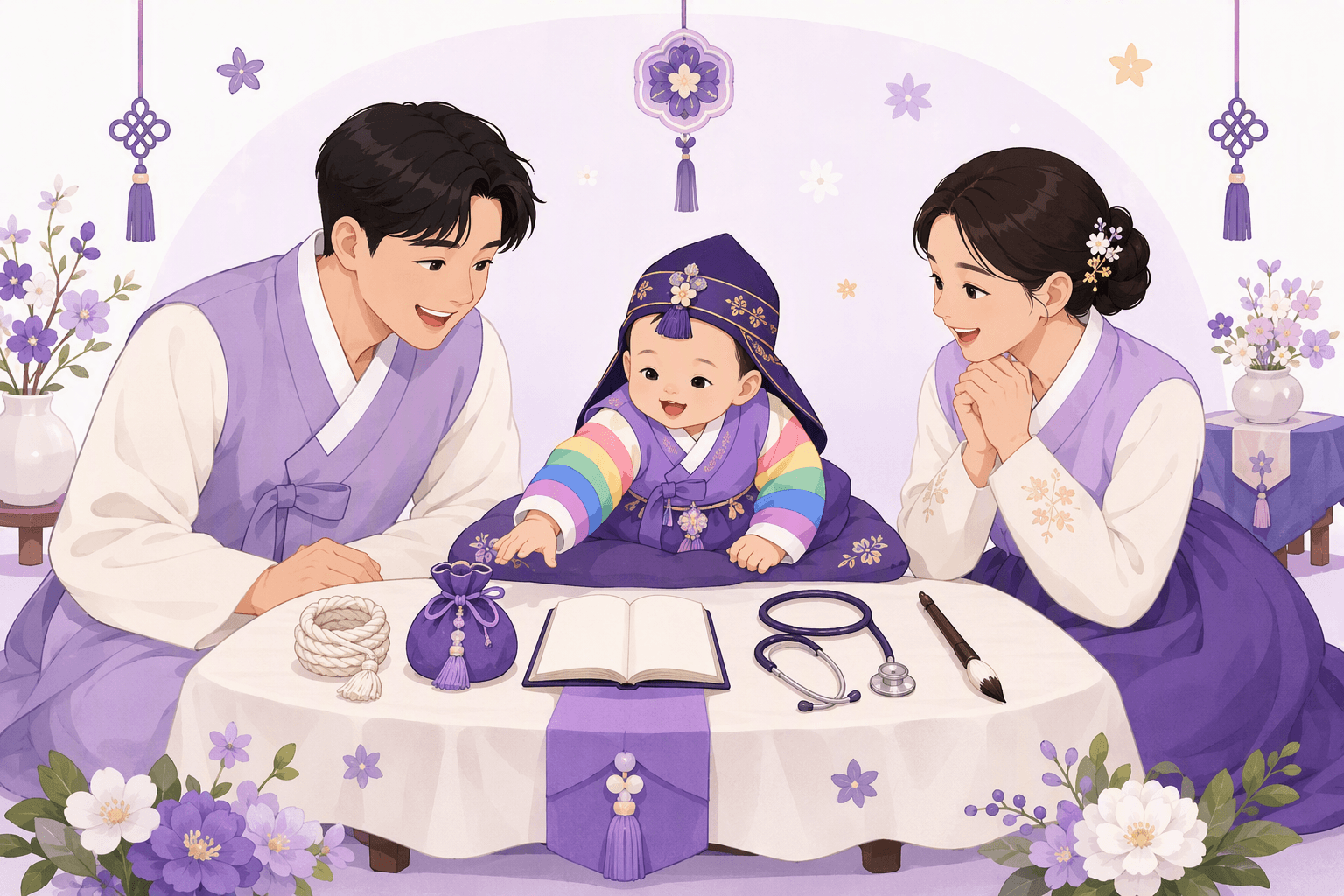
The 돌 (Dol) is arguably the most elaborate celebration in Korean family life. It marks a baby's first birthday and features the 돌잡이 (Doljabi) ceremony, where objects are arranged before the baby: thread (long life), money (wealth), a book (scholarship), a stethoscope (medical career). Whichever item the baby grabs is said to predict their future. The standard congratulation is 돌 축하해요 (Dol chukahaeyo), and guests bring monetary gifts in addition to baby presents.
환갑 (Hwangap). The 60th Birthday
The 환갑 (Hwangap) marks the completion of one full 60-year cycle of the traditional East Asian calendar. Historically, when few people reached 60, this was celebrated with an elaborate family banquet (잔치, janchi). The appropriate congratulation is 환갑을 축하드립니다 (Hwangabeul chukadeurimnida), using the humble formal level to honor the elder. As Korean life expectancy has risen to over 83 years, the 칠순 (Chilsun, 70th) and 팔순 (Palsun, 80th) have gained equal prominence.
How to Respond to Korean Congratulations
| They Say | You Say | Translation |
|---|---|---|
| 축하합니다! | 감사합니다! (Gamsahamnida!) | Thank you! (formal) |
| 축하해요! | 고마워요! (Gomawoyo!) | Thank you! (polite) |
| 축하해! | 고마워! (Gomawo!) | Thanks! (casual) |
| 짝짝짝! | ㅋㅋ 고마워! (kk gomawo!) | Haha thanks! |
| 잘했어! | 고마워, 너도 잘할 거야! (Gomawo, neodo jalhal geoya!) | Thanks, you'll do great too! |
A common cultural pattern in Korean responses is deflection through modesty. Rather than simply saying "thank you," many Koreans add phrases like 아직 멀었어요 (ajik meoreosseoyo = I still have a long way to go) or 운이 좋았어요 (uni joasseoyo = I was lucky). This reflects the Confucian value of humility that runs through Korean social interactions.
💡 한턱 쏴! (Hantuk Sswa!). The Treat Expectation
When you share good news with Korean friends, expect to hear 한턱 쏴! (Treat us!) or 한턱 내! (Hantuk nae! = You're buying!). This is a playful but genuine social expectation: good fortune should be shared, typically by buying a meal or round of drinks. Refusing outright would seem stingy. The standard response is 그래, 내가 쏠게! (Geurae, naega ssolge! = Alright, I'll treat!).
Practice With Real Korean Content
Reading about congratulatory phrases gives you the foundation, but hearing them spoken naturally by native Koreans is what builds genuine fluency. Korean dramas are packed with congratulatory scenes, from tearful university acceptance moments to elaborate wedding sequences to corporate promotion announcements.
Wordy lets you watch Korean movies and shows with interactive subtitles. Tap any phrase to see its meaning, pronunciation, and cultural context in real time. Instead of memorizing phrases from a list, you absorb them from authentic conversations with natural emotion and intonation.
For more Korean content, explore our blog for language guides including the best Korean dramas to learn Korean. You can also visit our Korean learning page to start practicing with real content today.
Frequently Asked Questions
What is the most common way to say congratulations in Korean?
What is the difference between 축하합니다 and 축하드립니다?
What is 축의금 (chukuigeum) and how much should I give?
What does 짝짝짝 (jjakjjakjjak) mean?
How do Koreans celebrate major life events differently from Western cultures?
Sources & References
- National Institute of Korean Language (국립국어원), Standard Korean Language Dictionary
- Korean Language Society (한글학회), Korean Speech Level Usage Guidelines
- Ethnologue: Languages of the World, Korean language entry (2024)
- Brown, P. & Levinson, S., Politeness: Some Universals in Language Usage (Cambridge University Press)
Start learning with Wordy
Watch real movie clips and build your vocabulary as you go. Free to download.


