Quick Answer
The 12 months in French are janvier, février, mars, avril, mai, juin, juillet, août, septembre, octobre, novembre, and décembre. Like days of the week, French months are never capitalized and are all masculine. Use 'en' before months (en janvier) and the format 'le + number + month' for dates (le 14 juillet).
The 12 months of the year in French are janvier, février, mars, avril, mai, juin, juillet, août, septembre, octobre, novembre, and décembre. They follow the same Latin calendar roots as English, but with distinctly French pronunciation, including nasal vowels, silent letters, and one famously debated word (août). Whether you're looking up "months in french" for travel, study, or conversation, this guide covers everything you need.
French is spoken by approximately 310 million people across 29 countries on five continents, according to Ethnologue's 2024 data and the OIF's global Francophonie report. Whether you are booking a hotel in Paris, scheduling meetings in Montreal, or reading a Belgian train timetable, the months are essential vocabulary that appears in nearly every written and spoken interaction.
"The names of the months, inherited virtually unchanged from Latin through Old French, represent one of the most stable lexical domains in the history of the French language."
(David Crystal, The Cambridge Encyclopedia of Language)
This guide covers all 12 months with pronunciation, Latin etymology, grammar rules, cultural events, and the pronunciation traps that catch most learners.

All 12 Months at a Glance
| English | French | Pronunciation | Note |
|---|---|---|---|
| January | janvier | zhahn-vee-AY | Nasal vowel in first syllable |
| February | février | fay-vree-AY | Accent aigu on first é |
| March | mars | mahrs | Final s is pronounced |
| April | avril | ah-VREEL | Final l is pronounced |
| May | mai | meh | One syllable |
| June | juin | zhwehn | Nasal vowel |
| July | juillet | zhwee-YEH | Silent final t |
| August | août | oot | Pronunciation debated |
| September | septembre | sehp-TAHM-bruh | Nasal vowel in second syllable |
| October | octobre | ok-TOH-bruh | |
| November | novembre | noh-VAHM-bruh | Nasal vowel in second syllable |
| December | décembre | day-SAHM-bruh | Accent aigu on first é |
Notice that the last four months (septembre through décembre) all share the -bre ending, pronounced as a soft "bruh." This pattern makes them easy to learn as a group.
Etymology: From Latin to Modern French
Every French month name traces directly back to Latin, passing through Old French with remarkably little change. Understanding these origins helps you remember the names and connects French to its sister Romance languages.
Janvier
From Latin Januarius, honoring Janus, the two-faced Roman god of doorways, beginnings, and transitions. Janus looked simultaneously backward at the old year and forward into the new one. The CNRTL traces the Old French form jenvier appearing as early as the 12th century before settling into modern janvier.
Février
From Latin Februarius, derived from februare (to purify). February was the month of ritual purification in the Roman calendar, when the Lupercalia festival cleansed the city before spring. The accent aigu on the first é is essential; without it, the word does not exist in French.
Mars
From Latin Martius, the month of Mars, the god of war. In the original Roman calendar, March was actually the first month of the year. The Roman agricultural season began with spring planting, making Mars the logical starting point. The final s in French mars is pronounced, unlike in most French words ending in s.
Avril
From Latin Aprilis, possibly related to aperire (to open), referring to the opening of flower buds in spring. The final l is always pronounced in avril, making it "ah-VREEL."
Mai
From Latin Maius, honoring Maia, the Roman goddess of growth and fertility. At one syllable (simply "meh"), mai is the shortest month name in French and one of the easiest to pronounce.
Juin
From Latin Junius, likely honoring Juno, the goddess of marriage and childbirth. The pronunciation "zhwehn" contains one of French's characteristic nasal vowels, where the -in sound resonates through the nose rather than the mouth.
Juillet
From Latin Julius, named after Julius Caesar in 44 BC. Before Caesar's reform, this month was called Quintilis (the fifth month in the original Roman calendar). The -illet ending in French is pronounced "ee-YEH" with a silent final t.
🌍 The Republican Calendar
During the French Revolution (1793-1805), the National Convention replaced the Gregorian calendar entirely. The Republican Calendar gave months poetic nature-based names: Vendémiaire (grape harvest), Brumaire (fog), Frimaire (frost), Nivôse (snow), Pluviôse (rain), Ventôse (wind), Germinal (germination), Floréal (flower), Prairial (meadow), Messidor (harvest), Thermidor (heat), and Fructidor (fruit). Napoleon abolished this calendar in 1806, but the names live on in French culture. Thermidor still describes a lobster dish, and Brumaire is famous from Napoleon's 18 Brumaire coup.
Août
From Latin Augustus, named after Emperor Augustus Caesar. The pronunciation of août is the single most debated pronunciation question in French. The Académie française accepts both "oot" (with the final t) and "oo" (without it). Northern French speakers generally pronounce the t; many southern speakers do not. The circumflex accent on the o (now optional under the 1990 spelling reform) marks a historical u that disappeared from the written form.
Septembre
From Latin September, meaning "seventh month" (septem = seven). This is a relic of the original Roman calendar, where March was the first month. September was indeed the seventh month until January and February were added to the beginning of the calendar around 713 BC.
Octobre
From Latin October ("eighth month," from octo = eight). Like septembre, it preserves the old Roman numbering that no longer matches our calendar.
Novembre
From Latin November ("ninth month," from novem = nine). The nasal vowel in the second syllable makes the pronunciation distinctly French: "noh-VAHM-bruh."
Décembre
From Latin December ("tenth month," from decem = ten). The last of the four "numbered" months, all of which are off by exactly two from their actual position, a permanent reminder that the Roman calendar once started in March.
Pronunciation Guide: Nasal Vowels and Silent Letters
French months contain several pronunciation features that trip up English speakers. Mastering these sounds early prevents bad habits.
Nasal Vowels
Three months feature prominent nasal vowels, a hallmark of French pronunciation where air passes through both the mouth and nose simultaneously:
| English | French | Pronunciation | Note |
|---|---|---|---|
| January | janvier | zhahn-vee-AY | The 'an' is nasal; do NOT pronounce the n |
| June | juin | zhwehn | The 'in' is nasal; lips rounded, air through nose |
| November | novembre | noh-VAHM-bruh | The 'em' is nasal, like 'on' in French 'bon' |
The key rule: when n or m follows a vowel and precedes a consonant (or ends the word), the vowel becomes nasal and the n/m itself is not pronounced as a separate consonant. So janvier is "zhah(n)-vee-AY" where the (n) nasalizes the a rather than being spoken distinctly.
Silent and Pronounced Final Consonants
French is famous for silent final consonants, but the months contain exceptions that must be memorized:
| Month | Final letter | Pronounced? | Note |
|---|---|---|---|
| mars | s | Yes | Unusual; most final s in French is silent |
| avril | l | Yes | Final l is usually pronounced in French |
| août | t | Debated | Both "oot" and "oo" are accepted |
| juillet | t | No | Silent, standard French pattern |
💡 The CaReFuL Rule
A common mnemonic for French final consonants: the letters C, R, F, and L (spelling "CaReFuL") are often pronounced at the end of a word. This explains why the l in avril and the r in janvier are audible, while the t in juillet follows the normal silent pattern.
Grammar: Using Months in Sentences
No Capitalization
The Académie française classifies months as common nouns (noms communs). They are never capitalized in French unless they begin a sentence. Writing Janvier with a capital letter in the middle of a sentence is a spelling error.
- Mon anniversaire est en mars. (My birthday is in March.)
- Mars est le mois du printemps. (March is the month of spring. Capitalized only because it starts the sentence.)
All Masculine
Every month is grammatically masculine. When you need an article, use le:
- le mois de janvier (the month of January)
- le beau mois de mai (the beautiful month of May)
Prepositions: "En" and "Au mois de"
To say "in [month]," French offers two constructions:
| English | French | Pronunciation | Note |
|---|---|---|---|
| in January | en janvier | ahn zhahn-vee-AY | Standard, most common |
| in the month of January | au mois de janvier | oh mwah duh zhahn-vee-AY | More formal/emphatic |
| since March | depuis mars | duh-PWEE mahrs | |
| until June | jusqu'en juin | zhoos-kahn zhwehn | |
| from May to September | de mai à septembre | duh meh ah sehp-TAHM-bruh |
Never use dans to say "in a month." The correct preposition is always en: en février, en octobre, en décembre.
Writing Dates
French dates follow the day-month-year order, the opposite of American English:
- le 14 juillet 2026 = July 14, 2026
- le 1er janvier = January 1st (the only date that uses an ordinal: premier)
- le 25 décembre = December 25th (cardinal number, not ordinal)
In numeric format, France uses dd/mm/yyyy: 14/07/2026. This is a common source of confusion for English speakers: 03/04/2026 means April 3rd in France, not March 4th.
⚠️ Date Format Differences in the Francophone World
While all Francophone countries use day-month-year order, the separators vary. France uses slashes (14/07/2026), while Canada officially uses the ISO format with hyphens (2026-07-14) in government and business contexts. Belgium and Switzerland follow the French slash convention. In Quebec, you may encounter both formats depending on whether the context is French or English Canadian.
Cultural Calendar: Key Events by Month
Understanding which months matter culturally helps you connect vocabulary to real French life. Here are the events that define the French year.
| English | French | Pronunciation | Note |
|---|---|---|---|
| January 1: New Year's Day | Le Jour de l'An | luh zhoor duh lahn | |
| February: Crêpe Day (Feb 2) | La Chandeleur | lah shahn-duh-LUHR | |
| May 1: Labor Day | La Fête du Travail | lah feht doo trah-VYE | Lily of the valley gifted |
| July 14: Bastille Day | La Fête nationale | lah feht nah-see-oh-NAHL | France's national day |
| August: Summer holidays | Les grandes vacances | leh grahnd vah-KAHNS | Much of France shuts down |
| September: Back to school | La rentrée | lah rahn-TRAY | Major cultural event |
| November 1: All Saints' Day | La Toussaint | lah too-SEHN | National holiday, cemeteries visited |
| December 25: Christmas | Noël | noh-EL |
Août and Les Grandes Vacances
August is the defining vacation month in France. The concept of les grandes vacances (the long holidays) runs from early July through August, but août is when the country truly empties. Entire businesses close for the month, and signs reading fermeture annuelle (annual closing) appear in shop windows across the country. Paris becomes noticeably quieter as Parisians flee to the coast or countryside.
Septembre and La Rentrée
La rentrée (literally "the re-entry") in September is far more than just back-to-school. It marks the restart of French political, cultural, and social life after the summer pause. New book releases, television seasons, business initiatives, and political agendas all launch during la rentrée. The expression la rentrée littéraire specifically refers to the September publishing season, when hundreds of new novels flood French bookstores simultaneously.
🌍 Mai and France's Many Holidays
May is famous among French workers as the month of ponts (bridges), long weekends created by public holidays falling near weekends. May 1st (Labor Day), May 8th (Victory in Europe Day), and Ascension Thursday can create chains of days off. The French art of faire le pont (making the bridge) means taking an extra day off between a holiday and the weekend to create a four-day break. In some years, May can feel like an entire month of mini-vacations.
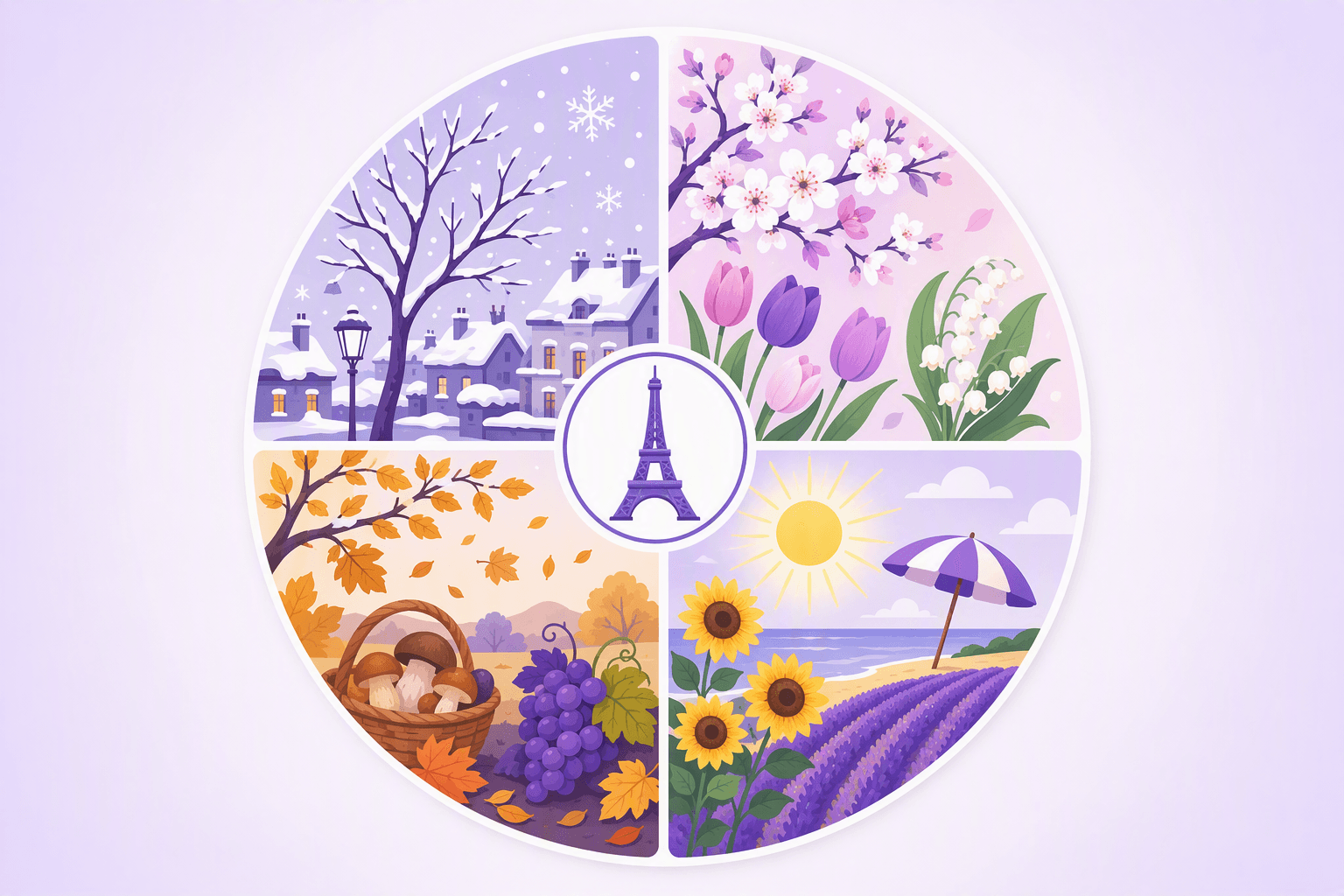
Seasonal Vocabulary
French divides the year into four seasons, each grammatically feminine except printemps (which is masculine). The preposition changes depending on the season.
| English | French | Pronunciation | Note |
|---|---|---|---|
| Spring | le printemps | luh prahn-TAHN | Masculine. Use 'au printemps' |
| Summer | l'été | lay-TAY | Masculine. Use 'en été' |
| Autumn/Fall | l'automne | loh-TUNN | Masculine. Use 'en automne' |
| Winter | l'hiver | lee-VEHR | Masculine. Use 'en hiver' |
The preposition rule: use au for printemps (because it starts with a consonant and takes the article le), and en for the other three seasons: en été, en automne, en hiver. This mirrors the month preposition, since en is the default for time expressions.
Practice With Real French Content
Months appear constantly in everyday French, from news broadcasts (les élections auront lieu en juin) to casual conversation (on part en vacances en août) to written invitations and schedules. Recognizing them by sound, not just in writing, is essential for real comprehension.
French films and series provide excellent practice for hearing months spoken naturally. Weather reports, birthday scenes, and holiday episodes are especially rich with calendar vocabulary. Check out our guide to the best movies for learning French for recommendations across different genres and difficulty levels.
Wordy lets you watch French content with interactive subtitles, so you can hear months and dates used in authentic dialogue and tap any word to see its meaning and pronunciation instantly. Explore our blog for more French learning guides, or visit our French learning page to start building your vocabulary today.
Frequently Asked Questions
What are the 12 months of the year in French?
Are French months masculine or feminine?
How do you say dates in French?
Why are French months not capitalized?
How do you pronounce 'août' (August) in French?
How do you say 'in January' in French?
Sources & References
- Académie française, Dictionnaire de l'Académie française, 9th edition
- Organisation internationale de la Francophonie (OIF), La langue française dans le monde, 2022
- Centre National de Ressources Textuelles et Lexicales (CNRTL), Etymological entries
- Ethnologue: Languages of the World, 27th edition (2024). French: 310 million speakers
- Crystal, D. The Cambridge Encyclopedia of Language (Cambridge University Press)
Start learning with Wordy
Watch real movie clips and build your vocabulary as you go. Free to download.


