Quick Answer
The French word for family is 'la famille' (lah fah-MEE). Core family members include mère (mother), père (father), frère (brother), sœur (sister), fils (son), and fille (daughter). In-laws use the 'beau-/belle-' prefix: belle-mère means both mother-in-law and stepmother. French also distinguishes between formal terms (père, mère) and affectionate ones (papa, maman, mamie, papi).
French family vocabulary is among the first things every learner needs. The word la famille (lah fah-MEE) sits at the heart of French life, and knowing how to talk about parents, siblings, children, and extended relatives unlocks everyday conversations from introductions to holiday dinners. Whether you're looking up "french family words" for travel, study, or conversation, this guide covers everything you need.
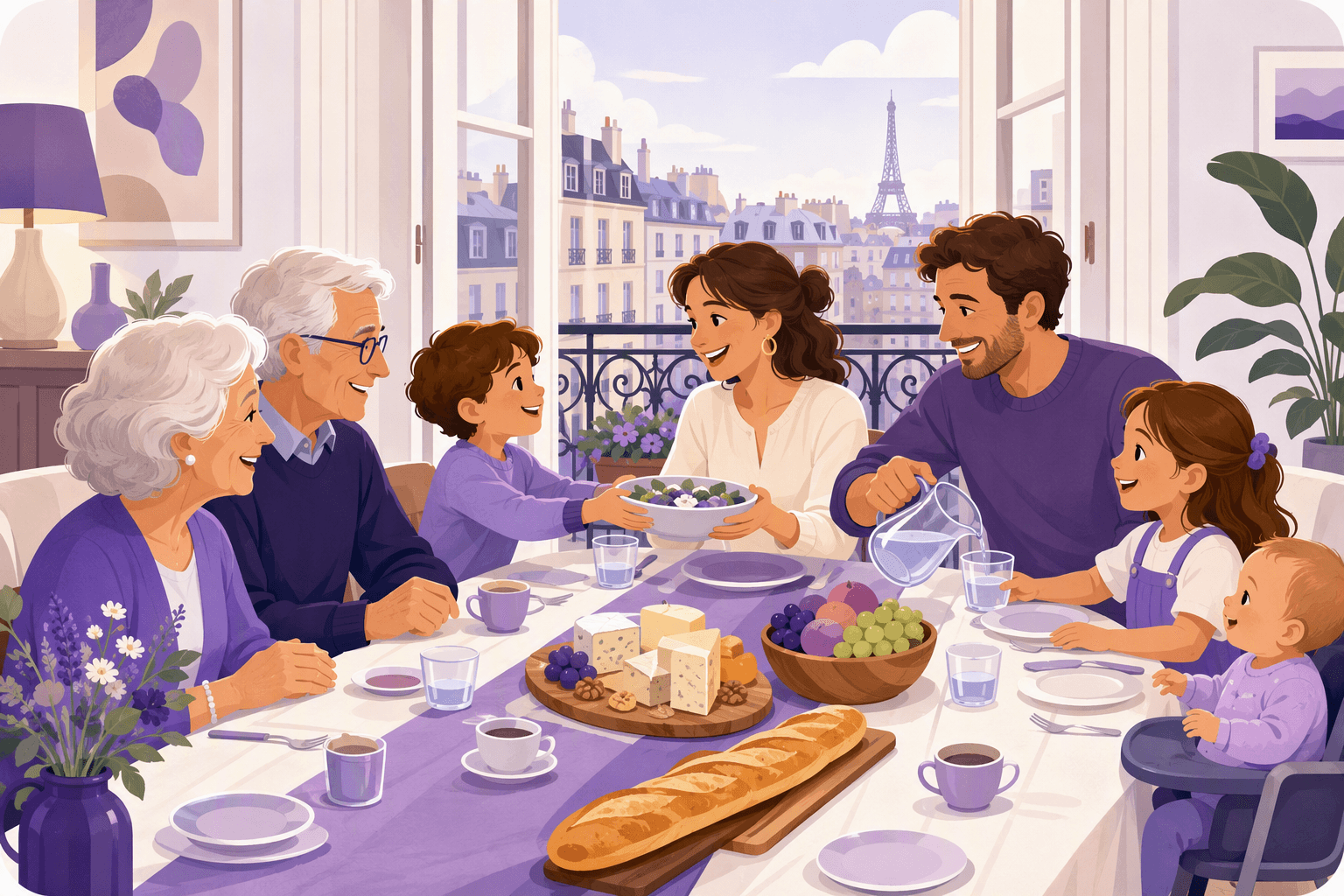
French is spoken by approximately 321 million people across 29 countries according to the Organisation internationale de la Francophonie's 2022 report. Across every francophone region, from Paris to Montreal to Dakar, family vocabulary remains remarkably consistent, making these words universally useful no matter where your French takes you.
"French kinship terminology follows the Eskimo system identified by Murdock, distinguishing lineal relatives (parents, children) from collateral ones (aunts, uncles, cousins) while using a single term for all cousins regardless of side."
(George P. Murdock, Social Structure, Free Press, 1949)
This guide covers immediate family, extended relatives, in-laws, affectionate terms, and the cultural context that makes French family vocabulary unique.
Complete Family Vocabulary Reference
Here is the essential French family vocabulary at a glance. Every term below is covered in detail in the sections that follow.
| English | French | Pronunciation |
|---|---|---|
| Family | La famille | lah fah-MEE |
| Mother | La mère | lah mehr |
| Father | Le père | luh pehr |
| Brother | Le frère | luh frehr |
| Sister | La sœur | lah suhr |
| Son | Le fils | luh feess |
| Daughter | La fille | lah fee |
| Grandfather | Le grand-père | luh grahn-PEHR |
| Grandmother | La grand-mère | lah grahn-MEHR |
| Uncle | L'oncle | LOHN-kluh |
| Aunt | La tante | lah tahnt |
| Cousin (m.) | Le cousin | luh koo-ZAN |
| Cousin (f.) | La cousine | lah koo-ZEEN |
| Nephew | Le neveu | luh nuh-VUH |
| Niece | La nièce | lah nee-ESS |
| Mother-in-law | La belle-mère | lah bell-MEHR |
| Father-in-law | Le beau-père | luh boh-PEHR |
| Brother-in-law | Le beau-frère | luh boh-FREHR |
| Sister-in-law | La belle-sœur | lah bell-SUHR |
| Mom | Maman | mah-MAH |
| Dad | Papa | pah-PAH |
| Grandma | Mamie | mah-MEE |
| Grandpa | Papi | pah-PEE |
| Godfather | Le parrain | luh pah-RAN |
| Godmother | La marraine | lah mah-REN |
Immediate Family: La Famille Proche
The immediate family, la famille proche (lah fah-MEE prohsh), covers parents, siblings, and children. These are the words you will use most frequently in daily French.
La mère
La mère (lah mehr) is the formal word for mother. It appears in official documents, formal writing, and when speaking about someone else's mother in a neutral context. In everyday speech, however, nearly all French speakers say maman instead. The word mère shares the same Latin root (mater) as English "mother," Spanish madre, and Italian madre.
💡 Mère vs. Maman
Using mère when speaking about your own mother can sound cold or distant in casual conversation. French speakers of all ages say maman in everyday life. There is no age limit where it becomes childish, unlike the English perception of "mommy." Ma mère (my mother) is appropriate when talking about her to others in a neutral or formal tone.
Le père
Le père (luh pehr) means father. Like mère, it serves as the formal term while papa dominates in daily speech. The word also appears in religious contexts: le Père Noël (Father Christmas/Santa Claus) and mon père as an address for a priest.
Le frère
Le frère (luh frehr) means brother. French distinguishes between le grand frère (older brother) and le petit frère (younger brother) using the adjectives grand (big) and petit (small) rather than separate words. Half-brothers are demi-frères (duh-mee FREHR).
La sœur
La sœur (lah suhr) means sister. The œ ligature is a distinctive feature of French orthography that produces a sound similar to the "u" in English "fur." As with brothers, French uses grande sœur and petite sœur for older and younger sisters respectively.
Le fils
Le fils (luh feess) means son. This word has an unusual pronunciation: the final -ls is pronounced, making it "feess" rather than the silent ending you might expect. This distinguishes it from le fil (thread), where the l is also pronounced but without the s sound.
La fille
La fille (lah fee) means both daughter and girl. Context makes the meaning clear: ma fille nearly always means "my daughter," while une fille in a general context means "a girl." For absolute clarity, some speakers use une jeune fille (a young woman/girl) to distinguish from une fille meaning daughter.
🌍 Les Enfants
The word les enfants (lay zahn-FAHN) means both "the children" and "the kids." French parents commonly address their children collectively as mes enfants (my children). The word covers both sons and daughters together, and in French grammar, the masculine plural enfants is used for mixed groups.
Extended Family: La Famille Élargie
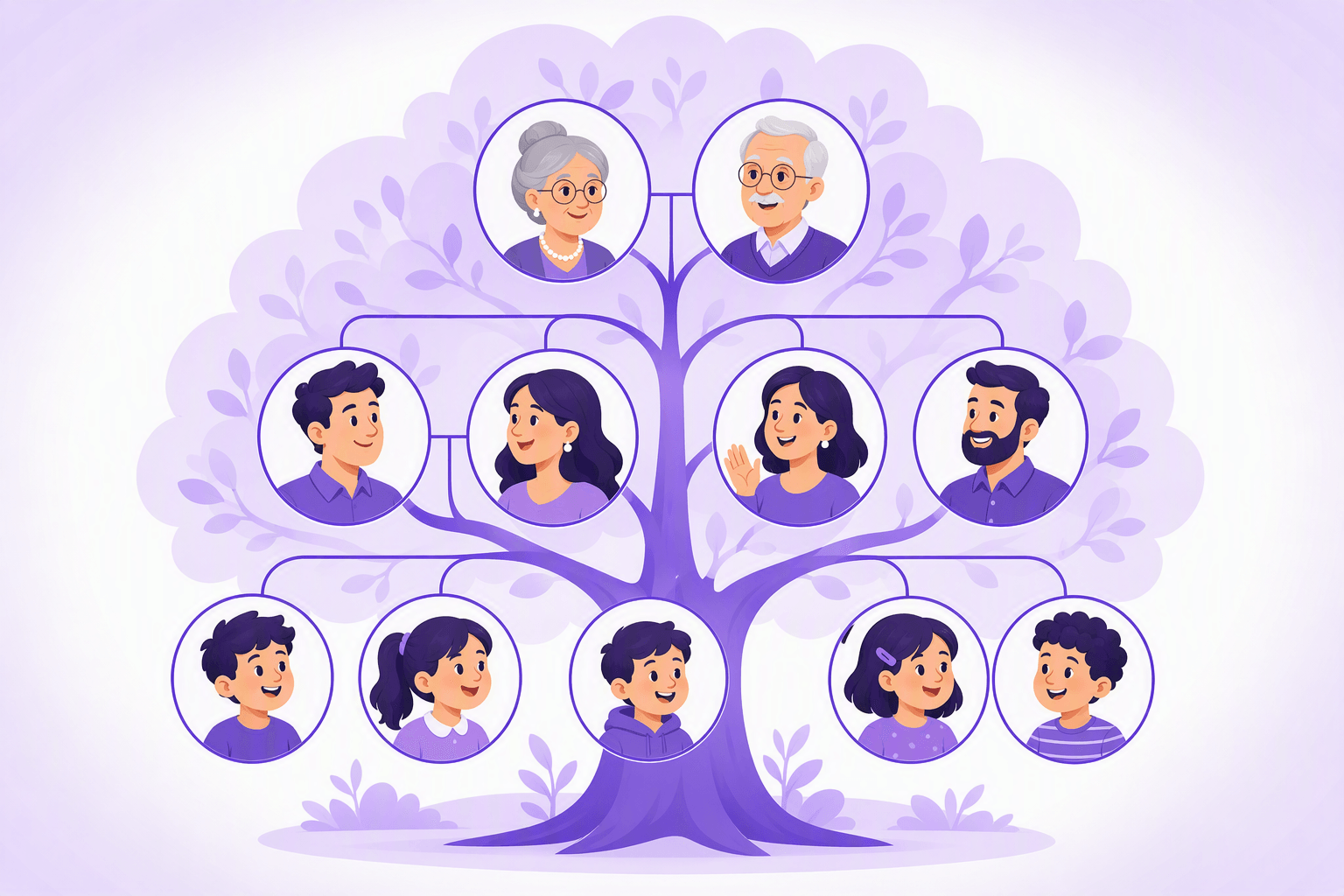
The extended family, la famille élargie (lah fah-MEE ay-lar-ZHEE), includes grandparents, aunts, uncles, cousins, nephews, and nieces.
Le grand-père
Le grand-père (luh grahn-PEHR) means grandfather. The grand- prefix literally means "big" or "great." For great-grandfather, French adds another layer: l'arrière-grand-père (lah-ree-EHR grahn-PEHR).
La grand-mère
La grand-mère (lah grahn-MEHR) means grandmother. Note that grand does not take a feminine -e ending here. It remains grand-mère, not grande-mère. This is a historical exception maintained by the Académie française, though grande-mère is increasingly accepted informally.
L'oncle
L'oncle (LOHN-kluh) means uncle. The article le contracts with the vowel to form l'oncle. In many French families, uncles are addressed by their first name without a title, though some families use tonton (tohn-TOHN) as an affectionate term, similar to "uncle" used informally in English.
La tante
La tante (lah tahnt) means aunt. The affectionate equivalent is tata (tah-TAH) or tatie (tah-TEE), used especially by young children. In francophone Africa, tante and tonton are also used as respectful forms of address for older non-relatives, reflecting the broader concept of community family.
Le cousin / La cousine
Le cousin (luh koo-ZAN) is the masculine form and la cousine (lah koo-ZEEN) is the feminine. Unlike English, French marks gender on cousin with different endings. French does not distinguish between first cousins and more distant ones with separate words. A cousin germain (koo-ZAN zhehr-MAN) specifically means "first cousin" when the distinction matters.
Le neveu
Le neveu (luh nuh-VUH) means nephew. The word traces back to Latin nepotem, which also gives English "nepotism," originally favoritism shown to nephews by popes and bishops.
La nièce
La nièce (lah nee-ESS) means niece. Note the accent grave on the è, creating an open "eh" sound.
In-Laws: La Belle-Famille
French in-law vocabulary uses one of the language's most elegant linguistic features: the beau-/belle- prefix system. La belle-famille (lah bell fah-MEE) refers to the in-laws collectively.
La belle-mère
La belle-mère (lah bell-MEHR) means mother-in-law. The belle- prefix literally translates as "beautiful," making belle-mère literally "beautiful mother." This charming etymology reflects the traditional courtesy extended to in-laws in French culture. Historically, addressing your mother-in-law as "beautiful mother" was a mark of respect and welcome.
🌍 Belle- for In-Laws AND Step-Relations
The beau-/belle- prefix serves double duty in French. Belle-mère means both mother-in-law and stepmother. Beau-père means both father-in-law and stepfather. Context determines the meaning. In modern France, where la famille recomposée (blended family) is increasingly common (according to INSEE, about 11% of French children live in blended families), this ambiguity occasionally requires clarification. Some speakers specify ma belle-mère par alliance (by marriage) versus ma belle-mère par remariage (by remarriage).
Le beau-père
Le beau-père (luh boh-PEHR) means father-in-law or stepfather. The masculine prefix beau- (handsome/beautiful) mirrors belle- for feminine relations. The pronunciation shortens beau to "boh" before the consonant.
Le beau-frère
Le beau-frère (luh boh-FREHR) means brother-in-law. This term covers both your spouse's brother and your sibling's spouse. French does not distinguish between these two relationships as some languages do.
La belle-sœur
La belle-sœur (lah bell-SUHR) means sister-in-law. Like beau-frère, it covers both your spouse's sister and your sibling's spouse.
"The French beau-/belle- prefix system for affinal kin is a distinctive Romance language feature. While Italian uses 'suocera' and Spanish uses 'suegra' for mother-in-law, French retains this poetic construction that dates to Old French courtesy conventions."
(Académie française, Dictionnaire, 9th edition)
Affectionate Family Terms
French has a rich set of informal, affectionate terms for family members. These are the words actually used in homes across the francophone world.
| English | French | Pronunciation | Note |
|---|---|---|---|
| Mom/Mum | Maman | mah-MAH | Universal, all ages |
| Dad | Papa | pah-PAH | Universal, all ages |
| Grandma | Mamie | mah-MEE | Most common informal |
| Grandpa | Papi | pah-PEE | Most common informal |
| Grandma (alt.) | Mémé | may-MAY | Older generation, some regions |
| Grandpa (alt.) | Pépé | pay-PAY | Older generation, some regions |
| Uncle (affectionate) | Tonton | tohn-TOHN | Used by children |
| Aunt (affectionate) | Tatie / Tata | tah-TEE / tah-TAH | Used by children |
Maman
Maman (mah-MAH) is the standard everyday word for mom. Unlike in English-speaking cultures where adults might feel self-conscious saying "mommy," French adults freely use maman throughout their entire lives. It is not considered childish. President Macron referring to his maman in interviews would raise no eyebrows.
Papa
Papa (pah-PAH) follows the same pattern and is universally used by children and adults alike. The stress falls on the second syllable. In extremely formal or literary contexts, père replaces papa, but this sounds deliberately elevated.
Mamie
Mamie (mah-MEE) is the most popular informal word for grandmother in contemporary France. The older variant mémé (may-MAY) is still used in some regions and by older generations, but mamie has become the dominant form. Some grandmothers choose their own preferred name: bonne-maman (good-mama), mamou, or creative variations.
Papi
Papi (pah-PEE) is the counterpart to mamie for grandfather. The older variant pépé (pay-PAY) carries a more rustic or old-fashioned feel. As with grandmothers, some grandfathers prefer bon-papa, papy (alternate spelling), or other personalized names.
Godparents: Le Parrain et La Marraine
The godparent tradition holds special significance in French culture, extending well beyond its religious origins.
Le parrain
Le parrain (luh pah-RAN) means godfather. In France, the parrain traditionally plays an active role in the child's life, attending school events, giving advice during adolescence, and serving as a trusted adult outside the immediate family. The word also carries cultural weight from the cinema: the French title of The Godfather is simply Le Parrain.
La marraine
La marraine (lah mah-REN) means godmother. The godchild is called le filleul (luh fee-YUHL) for a godson and la filleule (lah fee-YUHL) for a goddaughter. French law does not formally recognize godparents, but the social institution remains strong. Many secular French families still appoint parrain and marraine as honorary roles without religious ceremony.
🌍 Famille Recomposée
La famille recomposée (lah fah-MEE ruh-kohm-poh-ZAY), literally "recomposed family," is the French term for blended or step-families. France has one of Europe's highest rates of non-marital partnerships, thanks partly to the PACS (Pacte civil de solidarité), a civil union created in 1999. The PACS gives couples many of the legal protections of marriage without the formality, and it has shaped how French people think about family structure. About 200,000 PACS are registered annually in France alongside roughly 230,000 marriages.
Gender Rules for Family Vocabulary
Most French family terms come in masculine/feminine pairs. Masculine terms often end in a consonant or -in, while feminine counterparts add -e or change the ending entirely.
| English | French | Pronunciation | Note |
|---|---|---|---|
| Father / Mother | Père / Mère | pehr / mehr | Same ending pattern |
| Brother / Sister | Frère / Sœur | frehr / suhr | Different stems |
| Son / Daughter | Fils / Fille | feess / fee | Different stems |
| Nephew / Niece | Neveu / Nièce | nuh-VUH / nee-ESS | Related stems |
| Cousin (m./f.) | Cousin / Cousine | koo-ZAN / koo-ZEEN | Add -e for feminine |
| Godfather / Godmother | Parrain / Marraine | pah-RAN / mah-REN | Different prefix |
💡 Possessive Adjectives with Family
The standard pattern is mon père (my father), ma mère (my mother), mes parents (my parents). The plural mes works for both genders. Before feminine words starting with a vowel, use mon instead of ma for liaison purposes.
Talking About Your Family in French
These essential phrases for discussing family appear constantly in French conversation.
| English | French | Pronunciation |
|---|---|---|
| I have two brothers | J'ai deux frères | zhay duh FREHR |
| She is my sister | C'est ma sœur | say mah SUHR |
| Do you have children? | Vous avez des enfants ? | voo zah-VAY day zahn-FAHN |
| I am an only child | Je suis fils/fille unique | zhuh swee feess/fee ew-NEEK |
| We are a big family | Nous sommes une grande famille | noo sohm ewn grahnd fah-MEE |
When meeting someone new, asking Vous avez des frères et sœurs ? (Do you have brothers and sisters?) is a natural and welcome question. At social gatherings, discussing la famille signals genuine interest and warmth.
Practice with Real French Content
Family vocabulary appears everywhere in French media, from family dramas and comedies to news stories and everyday dialogue. Films like Intouchables, Le Fabuleux Destin d'Amélie Poulain, and La Famille Bélier are packed with family interactions and natural vocabulary use. Check out our guide to the best movies for learning French for more recommendations.
Wordy lets you practice family vocabulary in real context by watching French content with interactive subtitles. When a family term appears in dialogue, you can tap it to see the translation, hear the pronunciation, and build your vocabulary naturally. Explore our blog for more French learning guides, or visit our French learning page to start practicing today.
Frequently Asked Questions
What is the French word for family?
How do you say mother and father in French?
What does belle-mère mean in French?
What is the difference between fils and fille in French?
What is a parrain and marraine in French culture?
Sources & References
- Académie française, Dictionnaire de l'Académie française, 9th edition
- Organisation internationale de la Francophonie (OIF), La langue française dans le monde (2022)
- Ethnologue: Languages of the World, 27th edition (2024), French language entry
- Murdock, G.P., Social Structure (Free Press, 1949), kinship terminology systems
Start learning with Wordy
Watch real movie clips and build your vocabulary as you go. Free to download.


