Quick Answer
The days of the week in French are lundi (Monday), mardi (Tuesday), mercredi (Wednesday), jeudi (Thursday), vendredi (Friday), samedi (Saturday), and dimanche (Sunday). French days are not capitalized and the week starts on Monday.
The Short Answer
The seven days of the week in French are lundi, mardi, mercredi, jeudi, vendredi, samedi, and dimanche. They are never capitalized, they are all masculine, and the week starts on Monday across the entire Francophone world.
French is spoken by approximately 321 million people in 29 countries across five continents, according to the Organisation internationale de la Francophonie's 2022 report. From scheduling a meeting in Paris to planning a weekend in Montreal, the days of the week are among the first vocabulary any French learner needs.
"The French weekday names are a living fossil record of Gallo-Roman civilization, preserving the planetary deities of antiquity in the mouths of 21st-century speakers."
(Maurice Grevisse, Le Bon Usage)
This guide covers all seven days with pronunciation, etymology, grammar rules, and cultural context to help you use them correctly from day one.
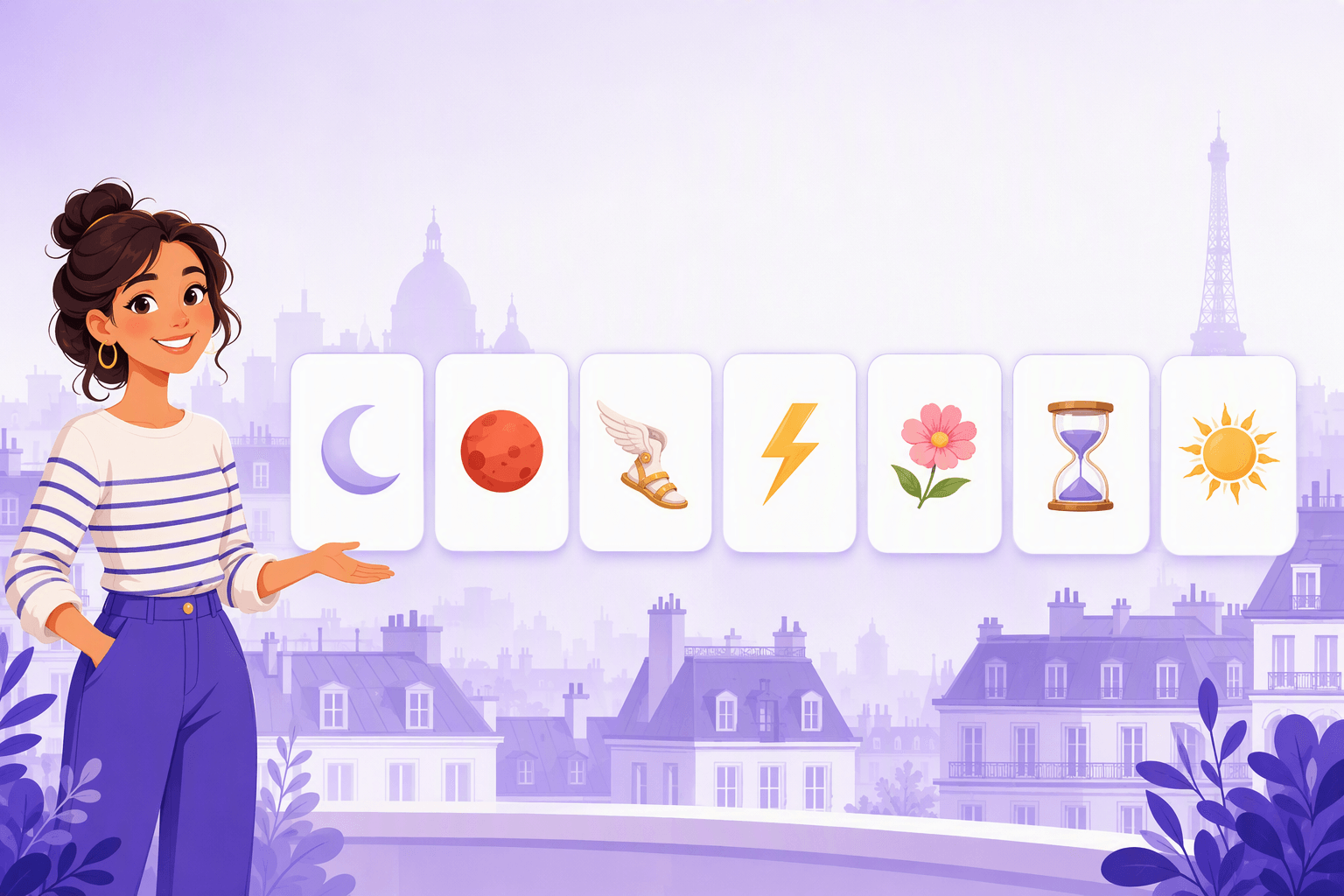
All 7 Days at a Glance
| English | French | Pronunciation | Note |
|---|---|---|---|
| Monday | lundi | luhn-DEE | From Lune (Moon) |
| Tuesday | mardi | mar-DEE | From Mars (god of war) |
| Wednesday | mercredi | mehr-kruh-DEE | From Mercure (Mercury) |
| Thursday | jeudi | zhuh-DEE | From Jupiter |
| Friday | vendredi | vahn-druh-DEE | From Vénus (Venus) |
| Saturday | samedi | sam-DEE | From Sabbath |
| Sunday | dimanche | dee-MAHNSH | From Dominicus (Lord) |
Notice the pattern: Monday through Saturday all end in -di (from Latin dies, meaning "day"), while dimanche breaks the pattern with its -che ending.
Planetary Origins: The Story Behind Each Day
Like Spanish, Italian, and Portuguese, French inherited its weekday names from the Roman planetary system. The first five days directly honor Roman gods, while Saturday and Sunday reflect religious influences that reshaped the calendar.
Lundi
Lundi comes from the Latin Lunae dies (day of the Moon). French preserves this connection clearly: lune still means "moon" in modern French, and lunaire means "lunar." English "Monday" follows the same logic through its Germanic equivalent, "Moon's day."
In French culture, lundi carries a reputation as the most dreaded day of the week. The expression avoir le blues du lundi (to have Monday blues) is widely used, mirroring the English "Monday blues."
Mardi
Mardi derives from Martis dies (day of Mars), the Roman god of war. The planet Mars is also called Mars in French, and the month of March (mars) shares the same root.
🌍 Mardi Gras: Fat Tuesday
The most famous French use of mardi worldwide is Mardi Gras (literally "Fat Tuesday"), the carnival celebration before the Christian season of Lent. While Mardi Gras is celebrated globally, its largest Francophone celebrations are in New Orleans (influenced by French colonial history), Quebec City, and Nice, France. The name refers to the tradition of eating rich, fatty foods before the fasting period begins.
Mercredi
Mercredi comes from Mercurii dies (day of Mercury), the fleet-footed messenger god of commerce and communication. The connection to Mercure (Mercury) is straightforward.
In the French education system, Wednesday has historically been a half-day or a day off for primary school students. This tradition dates back to the 19th century, when Wednesdays were reserved for religious instruction (catechism). Although reforms in 2013 attempted to add Wednesday morning classes, many French families still associate mercredi with children's extracurricular activities.
Jeudi
Jeudi descends from Jovis dies (day of Jupiter), the king of the Roman gods. Jupiter ruled the sky, thunder, and the heavens. In English, "Thursday" comes from Thor, the Norse thunder god, a direct mythological parallel.
The French "J" is pronounced as a soft "zh" sound (like the "s" in English "measure"), making jeudi sound like "zhuh-DEE."
Vendredi
Vendredi comes from Veneris dies (day of Venus), the goddess of love and beauty. English "Friday" derives from Frigg (or Freya), the Norse love goddess.
The novel Vendredi ou les Limbes du Pacifique (Friday, or The Other Island) by Michel Tournier is a celebrated French retelling of the Robinson Crusoe story, named after the day Crusoe's companion was found.
🌍 Vendredi 13: Lucky or Unlucky?
Unlike in English-speaking countries where Friday the 13th is considered unlucky, the French attitude is more divided. The French national lottery (Française des Jeux) actually runs special Vendredi 13 drawings with larger jackpots, because many French people consider the date lucky. However, the superstition about it being unlucky also exists, and the two beliefs coexist.
Samedi
Samedi breaks the planetary pattern. It derives from the Late Latin Sambati dies, which itself comes from the Hebrew Shabbat (שַׁבָּת), meaning "rest." English "Saturday" kept the Roman planetary name (Saturn's day), but French, like Spanish (sábado), preserved the religious term.
Dimanche
Dimanche comes from the Latin dies Dominicus (day of the Lord), a Christian renaming that replaced the pagan dies Solis (day of the Sun). English kept the pagan name as "Sunday," while French adopted the Christian one.
In France, dimanche has a protected legal status. Many stores are closed on Sundays, and the repos dominical (Sunday rest) is codified in French labor law. While exceptions have expanded in recent years, especially in tourist areas and large cities, the cultural association between dimanche and rest remains strong.
Grammar: How to Use Days in Sentences
French has specific rules for using days of the week that differ from English. These are essential for sounding natural.
No Capitalization
The Académie française classifies days of the week as common nouns. They are never capitalized unless they begin a sentence.
- J'ai un rendez-vous mardi. = I have an appointment on Tuesday.
- Mardi, j'ai un rendez-vous. = On Tuesday, I have an appointment. (capitalized because it starts the sentence)
Specific Day vs. Habitual Day
This is the most important distinction in French. The presence or absence of the article le completely changes the meaning.
| Construction | Meaning | Example |
|---|---|---|
| lundi (no article) | This coming Monday / last Monday | Je pars lundi. (I'm leaving on Monday.) |
| le lundi (with article) | Every Monday (habitual) | Je travaille le lundi. (I work on Mondays.) |
No preposition is needed in either case. English uses "on" before days, but French uses nothing (specific) or just le (habitual).
All Masculine
All seven days are masculine. When you need an article, it is always le (singular) or les (plural), never la or les with feminine agreement.
- le lundi = on Mondays
- les lundis = Mondays (as a noun, e.g., les lundis sont difficiles, Mondays are hard)
Plural Forms
All days can be made plural by adding -s: les lundis, les mardis, les mercredis, les jeudis, les vendredis, les samedis, les dimanches. However, the singular with le is far more common for expressing habitual actions.
💡 The Article Shortcut
If you can replace "on [day]" with "every [day]" in English and the sentence still makes sense, use le in French. If it only refers to one specific occurrence, drop the article entirely.
The Week Structure: Monday First
France and all Francophone countries place Monday at the start of the week. This is visible in every French calendar, planner, and scheduling app. The French word for "week" is semaine (feminine), and the standard workweek expression is du lundi au vendredi (from Monday to Friday).
The "weekend" in French is le week-end (borrowed from English, with a hyphen) or the more formal la fin de semaine. In Quebec, fin de semaine is strongly preferred over the anglicism week-end, reflecting Quebec's active language protection policies.

Useful Phrases With Days of the Week
| English | French | Pronunciation |
|---|---|---|
| What day is it today? | Quel jour sommes-nous ? | kel zhoor sum NOO |
| Today is Monday. | Aujourd'hui, c'est lundi. | oh-zhoor-DWEE seh luhn-DEE |
| See you on Friday. | À vendredi. | ah vahn-druh-DEE |
| I work Monday to Friday. | Je travaille du lundi au vendredi. | zhuh trah-VYE doo luhn-DEE oh vahn-druh-DEE |
| The weekend | Le week-end | luh wee-KEHND |
| Every Tuesday | Tous les mardis | too leh mar-DEE |
| Last Wednesday | Mercredi dernier | mehr-kruh-DEE dehr-nee-AY |
| Next Thursday | Jeudi prochain | zhuh-DEE pro-SHEHN |
Months of the Year: A Quick Companion Reference
Days and months go hand in hand. Here are the 12 months in French, also never capitalized and all masculine.
| English | French | Pronunciation |
|---|---|---|
| January | janvier | zhahn-vee-AY |
| February | février | fay-vree-AY |
| March | mars | mahrs |
| April | avril | ah-VREEL |
| May | mai | meh |
| June | juin | zhwehn |
| July | juillet | zhwee-YEH |
| August | août | oot |
| September | septembre | sehp-TAHM-bruh |
| October | octobre | ok-TOH-bruh |
| November | novembre | noh-VAHM-bruh |
| December | décembre | day-SAHM-bruh |
To express a date in French, use the format: le + number + month. For example, le 14 juillet (July 14th, Bastille Day). The first of the month uses the ordinal: le premier janvier (January 1st), but all other dates use cardinal numbers.
Cultural Notes: How Days Shape French Life
The French Workweek
France operates on a legally mandated 35-hour workweek, established in 2000. While many professionals work more than 35 hours, this law shapes the rhythm of French life. The expression métro, boulot, dodo (subway, work, sleep) captures the weekday routine, while weekends are fiercely protected for leisure, family, and food.
Mercredi and Children
As noted earlier, Wednesday holds a unique place in French family life. Even where Wednesday morning classes now exist, the afternoon remains free. This is when children attend sports clubs, music lessons, and centres de loisirs (leisure centers). If you visit a French park on a Wednesday afternoon, you will notice far more children than on other weekdays.
Dimanche: The Sacred Rest Day
French dimanche culture goes beyond religion. Markets (marchés), brunches, and family lunches define Sunday mornings. The legal restrictions on Sunday commerce, known as repos dominical, mean that many shops, especially outside Paris, remain closed. Supermarkets that do open on Sundays typically close by 1 PM.
💡 Francophone Differences
In Quebec, fin de semaine replaces week-end. In Belgium, you might hear septante for 70 and nonante for 90 in date-related conversations. In West Africa, market days often follow traditional weekly cycles that overlay the French calendar. The days themselves are the same, but how they feel culturally varies across the Francophone world.
Practice With Real French Content
Learning the days of the week from a list gives you the foundation, but hearing them woven into natural conversation is what builds fluency. French films and series are full of scheduling, planning, and day-of-the-week references.
Wordy lets you watch French movies and shows with interactive subtitles. Tap any word to see its meaning, pronunciation, and grammar in context. Rather than memorizing isolated vocabulary, you learn how native speakers actually use these words in real sentences.
For more French learning resources, check out our blog for guides on topics from greetings to the best movies for learning French. Visit our French learning page to start practicing today.
Frequently Asked Questions
What are the 7 days of the week in French?
Does the week start on Monday or Sunday in France?
How do you say 'on Monday' in French?
Why are French days of the week not capitalized?
Where do the French names for the days come from?
Are French days of the week masculine or feminine?
Sources & References
- Académie française, Dictionnaire de l'Académie française, 9th edition
- Organisation internationale de la Francophonie, La langue française dans le monde, 2022
- Ethnologue: Languages of the World, French language entry (2024)
- Grevisse, M. & Goosse, A. (2016). Le Bon Usage. De Boeck Supérieur, 16th edition.
- ISO 8601, International standard for date and time representations
Start learning with Wordy
Watch real movie clips and build your vocabulary as you go. Free to download.


