Quick Answer
The most essential colors in French are rouge (red), bleu (blue), jaune (yellow), vert (green), blanc (white), and noir (black). The key grammar rule: most color adjectives agree in gender and number with the noun they describe (un chat noir, une robe noire), but colors derived from nouns (like orange, marron, and bordeaux) are invariable and never change form.
French color vocabulary is far more than a list of words to memorize. Colors in French carry grammatical rules that trip up even intermediate learners: gender agreement, invariable exceptions, and shade modifiers that change how agreement works entirely. Mastering les couleurs means understanding these rules, not just the words themselves.
With approximately 321 million speakers worldwide according to the Organisation internationale de la Francophonie's 2024 report, French is the fifth most spoken language globally and an official language in 29 countries across five continents. Whether you are describing a painting at the Musée d'Orsay, shopping for clothes in Paris, or simply talking about the weather, color words appear constantly in everyday French.
"Color terminology in French reflects centuries of cultural exchange, from the Arabic-derived 'azur' to the Persian 'écarlate' to the Italian 'vermillon.' The French color lexicon is a miniature history of trade routes and artistic movements."
(David Crystal, The Cambridge Encyclopedia of Language, Cambridge University Press)
This guide covers 30+ French color words organized by category, with pronunciation, grammar agreement rules, shade modifiers, cultural idioms, and the unique distinctions that native speakers actually make. For interactive practice with real French content, visit our French learning page.
Quick Reference: Essential French Colors
These are the colors you will encounter most frequently in everyday French. Pay attention to the notes column: it marks which colors follow standard agreement rules and which are invariable.
| English | French | Pronunciation | Note |
|---|---|---|---|
| Red | Rouge | roozh | Regular: rouge/rouge/rouges |
| Blue | Bleu | bluh | Regular: bleu/bleue/bleus/bleues |
| Yellow | Jaune | zhohn | Regular: jaune/jaune/jaunes |
| Green | Vert | vehr | Regular: vert/verte/verts/vertes |
| Orange | Orange | oh-RAHNZH | Invariable (from noun) |
| Purple | Violet | vee-oh-LEH | Regular: violet/violette |
| White | Blanc | blahn | Irregular: blanc/blanche |
| Black | Noir | nwahr | Regular: noir/noire/noirs/noires |
| Gray | Gris | gree | Regular: gris/grise/gris/grises |
| Brown | Marron | mah-ROHN | Invariable (from noun) |
| Pink | Rose | rohz | Regular: rose/rose/roses |
| Beige | Beige | behzh | Regular: beige/beige/beiges |
💡 The Invariable Rule
Colors derived from nouns (orange the fruit, marron the chestnut, bordeaux the wine, turquoise the gemstone) never change form for gender or number. This is one of the most important grammar rules in French color vocabulary. When in doubt about whether a color is invariable, ask yourself: "Does this word also name a thing?" If yes, it probably does not change.
Primary Colors: Rouge, Bleu, Jaune
The three primary colors are among the first adjectives any French learner encounters. Each follows slightly different agreement patterns.
Rouge
Rouge is one of the simplest color adjectives in French. It has only one singular form for both masculine and feminine nouns, and adds -s for plural.
- un manteau rouge (a red coat, masculine)
- une robe rouge (a red dress, feminine)
- des fleurs rouges (red flowers, plural)
The word rouge appears throughout French culture. French speakers say le tapis rouge (the red carpet) and the famous Moulin Rouge literally means "Red Mill." In wine terminology, un rouge alone can mean "a red wine," and un verre de rouge, s'il vous plaît is perfectly natural at any French café.
Bleu
Bleu follows standard agreement rules with a feminine form bleue and plurals bleus / bleues. The added -e in the feminine is silent, so pronunciation stays the same.
- le ciel bleu (the blue sky, masculine)
- la mer bleue (the blue sea, feminine)
- les yeux bleus (blue eyes, masculine plural)
French uses bleu in culinary contexts that might surprise English speakers. A steak bleu is cooked even rarer than rare: barely seared, cool inside. Le bleu is also what the French call blue cheese, and un bleu in informal speech means a bruise. The famous expression un cordon bleu (blue ribbon) denotes a master chef, originating from the blue ribbon worn by knights of the Order of the Holy Spirit.
Jaune
Jaune has the same form for masculine and feminine singular, adding -s for plural. It is straightforward in agreement but carries an unexpected cultural meaning.
- un mur jaune (a yellow wall)
- une fleur jaune (a yellow flower)
- des feuilles jaunes (yellow leaves)
The expression rire jaune (to laugh yellow) means to force a fake laugh when you are actually upset or uncomfortable. It dates back to the 15th century and remains common in modern French. The gilet jaune (yellow vest) took on powerful political meaning during the 2018-2019 protest movement in France.
Secondary Colors: Vert, Orange, Violet
Vert
Vert is one of the colors that changes noticeably between masculine and feminine forms. The feminine verte adds a pronounced -t sound at the end.
- un feu vert (a green light, masculine, "vehr")
- une pomme verte (a green apple, feminine, "vehrt")
- des légumes verts (green vegetables, masculine plural)
The Académie française notes that vert has been used metaphorically since the 12th century to mean "vigorous" or "sharp." An older person described as encore vert (still green) is still energetic. A volée de bois vert (a volley of green wood) means a harsh verbal attack. And se mettre au vert (to put oneself in the green) means to escape to the countryside.
Orange
Orange is the most important invariable color to remember. Because it derives from the noun une orange (the fruit), it never changes form: no feminine, no plural agreement.
- un sac orange (an orange bag, masculine)
- une écharpe orange (an orange scarf, feminine)
- des chaussures orange (orange shoes, plural, no -s!)
This rule surprises many learners who expect oranges as a plural form. The Le Petit Robert dictionary explicitly marks orange as invariable when used as a color adjective. The only time oranges exists with an -s is when referring to multiple fruits: deux oranges (two oranges).
Violet
Violet follows regular agreement: masculine violet, feminine violette, with plurals violets and violettes. The feminine form adds a syllable to the pronunciation.
- un tissu violet (a purple fabric, "vee-oh-LEH")
- une fleur violette (a purple flower, "vee-oh-LEHT")
The word violette also serves as a noun meaning the violet flower, and it is a common French first name. La violette de Toulouse (the Toulouse violet) is a celebrated regional symbol and flavoring used in candies, liqueurs, and perfumes across southwest France.
Neutral Colors: Blanc, Noir, Gris, Brun, Marron
Blanc
Blanc has one of the most distinctive masculine-feminine shifts among color adjectives. The masculine blanc (blahn) becomes the feminine blanche (blahnsh), a completely different ending.
- du vin blanc (white wine, masculine)
- une page blanche (a blank/white page, feminine)
- des draps blancs (white sheets, masculine plural)
The phrase carte blanche (white card, meaning full freedom to act) has been borrowed directly into English. A nuit blanche (white night) is a sleepless night, and also the name of annual all-night arts festivals held in Paris and other French cities.
Noir
Noir follows standard agreement: noir / noire / noirs / noires. The feminine adds a silent -e.
- le chat noir (the black cat, masculine)
- la nuit noire (the dark night, feminine)
- les olives noires (black olives, feminine plural)
Film noir and roman noir (crime novel) are French artistic genres that have influenced global culture. The expression broyer du noir (to grind black) means to be depressed or to brood. Le marché noir (the black market) and l'humour noir (dark humor) function the same way as their English equivalents.
Gris
Gris follows regular agreement: gris / grise / gris / grises. Note that the masculine singular and plural are identical; only context and the article reveal the number.
- un temps gris (gray weather, masculine)
- une souris grise (a gray mouse, feminine)
- des cheveux gris (gray hair, masculine plural)
French weather discussions frequently feature gris. A ciel gris (gray sky) is the default description for overcast days, which dominate in northern France for much of the year. The expression faire grise mine (to make a gray face) means to look displeased or to give someone a cold reception.
Brun vs. Marron
This distinction is one of the most culturally specific aspects of French color vocabulary, and getting it right immediately marks you as an attentive learner.
Brun describes hair, skin, complexion, and occasionally beer. It agrees in gender and number: brun / brune / bruns / brunes.
- une femme brune (a brown-haired woman)
- les cheveux bruns (brown hair)
- une bière brune (a dark ale)
Marron describes objects, clothing, and everything that is not hair or skin. It is invariable and never changes form.
- des chaussures marron (brown shoes, no -s!)
- un sac marron (a brown bag)
- des yeux marron (brown eyes, the one exception where marron applies to the body)
A third term, châtain, applies specifically to light brown or chestnut-colored hair: des cheveux châtains. Using marron for hair sounds as strange to a French ear as saying someone has "chocolate-colored hair" would in English.
🌍 Brown Eyes: The Marron Exception
While brun is normally the color for body features, les yeux marron (brown eyes) is the standard expression, not les yeux bruns. This is one of the few body-related contexts where marron is preferred. Interestingly, marron remains invariable even here: des yeux marron (never marrons). The Le Petit Robert dictionary confirms this usage as standard.
Additional Colors: Rose, Bordeaux, Turquoise, Beige
Rose
Rose follows regular agreement despite deriving from the flower noun. It is one of the rare cases where a noun-derived color does agree: rose / rose / roses.
- un mur rose (a pink wall)
- une chemise rose (a pink shirt)
- des joues roses (pink cheeks)
The expression voir la vie en rose (to see life in pink) means to see the world optimistically. This phrase was immortalized by Édith Piaf's legendary 1946 song "La Vie en rose," which remains one of the most recognizable French songs worldwide.
Bordeaux
Bordeaux (bor-DOH) describes a deep wine-red or burgundy color. As a city name and wine term, it is invariable.
- une veste bordeaux (a burgundy jacket)
- des rideaux bordeaux (burgundy curtains)
Turquoise
Turquoise (toor-KWAHZ) is invariable, derived from the gemstone that originally reached Europe through Turkey (the word literally means "Turkish").
- une mer turquoise (a turquoise sea)
- des yeux turquoise (turquoise eyes)
Grammar: Gender Agreement Rules
Color adjective agreement is one of the grammar topics that separates intermediate learners from advanced ones. Here is the complete system.
Regular colors agree in gender and number with the noun:
| Masculine sg. | Feminine sg. | Masculine pl. | Feminine pl. |
|---|---|---|---|
| bleu | bleue | bleus | bleues |
| noir | noire | noirs | noires |
| vert | verte | verts | vertes |
| gris | grise | gris | grises |
| violet | violette | violets | violettes |
| brun | brune | bruns | brunes |
Special case, blanc: blanc / blanche / blancs / blanches. The feminine form is irregular.
Same-form colors (masculine = feminine): rouge, jaune, rose, beige. These only add -s for plural.
Invariable colors (never change): orange, marron, bordeaux, turquoise, crème, corail, saumon, kaki.
⚠️ Compound Colors Are Always Invariable
When a color is modified by another word, the entire expression becomes invariable, with no agreement at all. This applies to shade modifiers (bleu clair, vert foncé), compound colors (bleu-vert, gris-bleu), and noun modifiers (rouge cerise, vert pomme). Example: des yeux bleu clair (not bleus clairs), des robes bleu-vert (not bleues-vertes).
Shades and Modifiers: Clair, Foncé, Vif, Pâle
French uses a set of modifiers placed after the color word to describe shades. Once you learn these four words, you can describe virtually any shade in French.
| English | French | Pronunciation | Note |
|---|---|---|---|
| Light | Clair | klehr | bleu clair = light blue |
| Dark | Foncé | fohn-SEH | vert foncé = dark green |
| Vivid / Bright | Vif | veef | rouge vif = bright red |
| Pale | Pâle | pahl | rose pâle = pale pink |
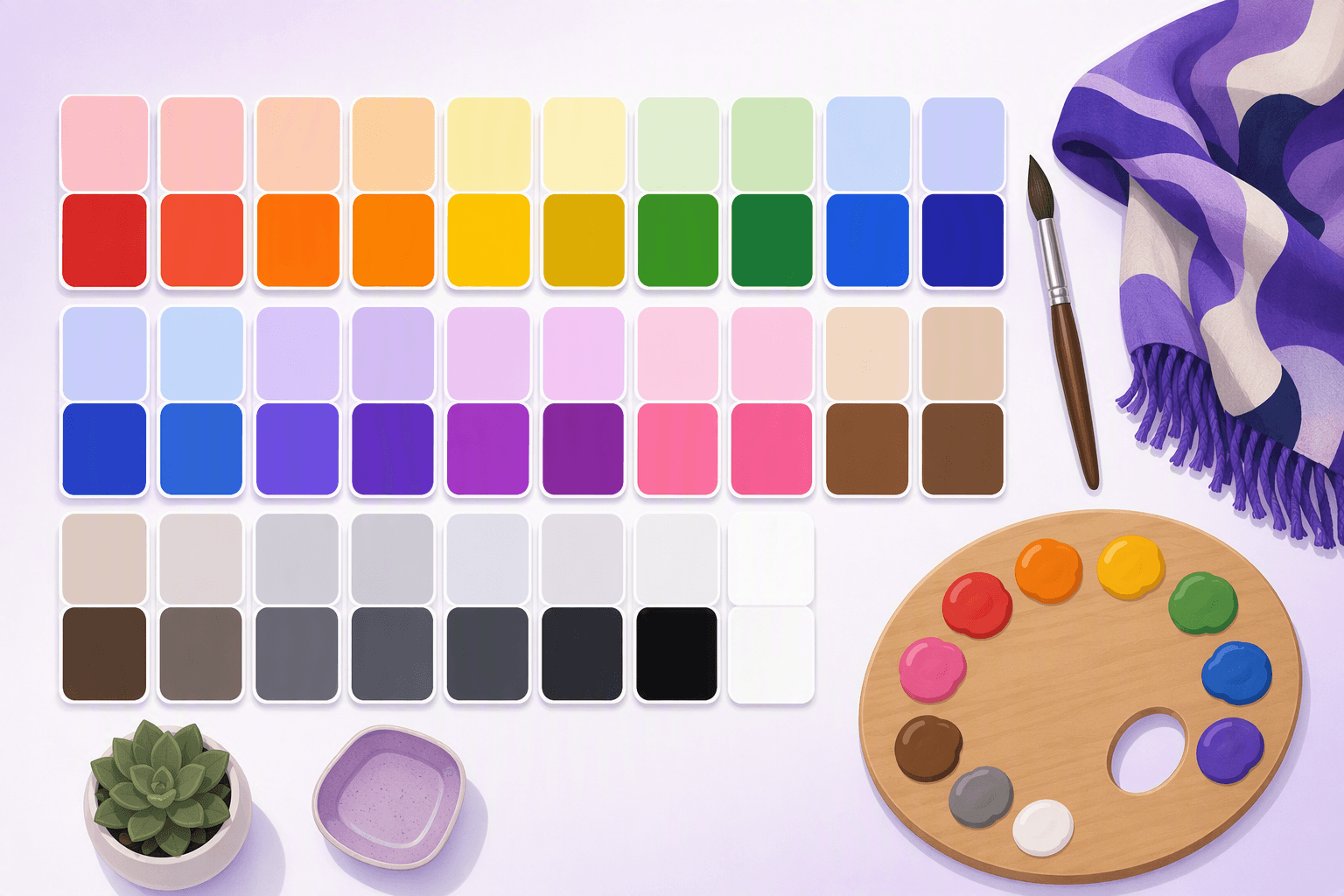
The critical grammar rule: when a color is followed by a modifier, the entire expression becomes invariable. You say une robe bleu foncé (a dark blue dress), not bleue foncée. This applies even when the base color would normally agree. The Académie française confirms this rule in its 9th edition dictionary.
Additional shade vocabulary French speakers use frequently:
- bleu marine (navy blue, invariable, from la marine)
- bleu ciel (sky blue, invariable)
- vert pomme (apple green, invariable)
- rouge cerise (cherry red, invariable)
- blanc cassé (broken white / off-white, invariable)
- gris perle (pearl gray, invariable)
Color Idioms: Expressions French Speakers Actually Use
French is exceptionally rich in color-based idioms. These expressions appear constantly in conversation and in French films and TV shows. Understanding them is essential for comprehension beyond textbook French.
Red (Rouge):
- Voir rouge (to see red): to become furious, to lose your temper
- Être dans le rouge (to be in the red): to be in financial trouble or overdrawn
- Le fil rouge (the red thread): a recurring theme or common thread running through something
Green (Vert):
- Être vert de jalousie (to be green with jealousy): identical meaning to the English idiom
- Se mettre au vert (to put oneself in the green): to escape to the countryside for rest
- Donner le feu vert (to give the green light): to authorize, same as English
Blue (Bleu):
- Avoir une peur bleue (to have a blue fear): to be absolutely terrified
- Un cordon bleu (a blue ribbon): a master chef or exceptional cook
- Un bleu (a blue one): a bruise, or slang for a complete beginner
Yellow (Jaune):
- Rire jaune (to laugh yellow): to force a fake, uncomfortable laugh
- Le maillot jaune (the yellow jersey): the leader's jersey in the Tour de France
Black (Noir):
- Broyer du noir (to grind black): to be depressed, to dwell on dark thoughts
- Un roman noir (a black novel): a crime or noir novel
- Travail au noir (work in black): undeclared or off-the-books work
White (Blanc):
- Carte blanche (white card): full freedom to act as one chooses
- Une nuit blanche (a white night): a sleepless night
- Être blanc comme un linge (to be white as a sheet): to be very pale from shock or fear
"Color idioms in French reveal deep cultural associations that rarely align with English equivalents. While both languages share 'seeing red' for anger, French uniquely associates blue with fear and yellow with forced laughter, connections rooted in medieval humoral theory."
(Académie française, Dictionnaire, 9th edition)
Colors in French Culture: Art, Flags, and Cuisine
The Impressionists and Color
France's relationship with color is inseparable from its art history. The Impressionist movement, born in 1860s Paris, revolutionized how Western civilization talks about and perceives color. Claude Monet, Pierre-Auguste Renoir, and Camille Pissarro built an entire artistic philosophy around the observation that colors shift with light, that a haystack is not simply jaune but a spectrum of jaune pâle, orange doré, rose vif, and violet foncé depending on the hour.
This legacy lives on in everyday French. The language has an unusually rich vocabulary for color nuance, and French speakers tend to be more precise about shades than English speakers. Where English might say "light blue," a French speaker is more likely to specify bleu ciel (sky blue), bleu lavande (lavender blue), or bleu glacier (glacier blue).
Le Tricolore: The French Flag
The drapeau tricolore (three-colored flag), bleu, blanc, rouge, is one of the most recognized flags in the world. The three colors represent liberty (blue), equality (white), and fraternity (red), and they were adopted during the French Revolution of 1789. French children learn to recite bleu, blanc, rouge as a fixed phrase, always in that order.
Colors in French Cuisine
Color words permeate French culinary vocabulary:
- Un steak bleu: cooked extremely rare (barely seared)
- Le fromage bleu: blue cheese
- Un cordon bleu: a breaded, stuffed cutlet (and a master chef)
- La sauce blanche: white sauce (béchamel)
- Les haricots verts: green beans (literally "green beans")
- Le vin rosé: rosé wine (literally "pink wine")
Regional Variations: France, Quebec, and Africa
Color vocabulary is largely consistent across the French-speaking world, but some regional preferences exist.
In Quebec, speakers sometimes use English-influenced color terms in informal contexts: checker le light vert instead of vérifier le feu vert. However, formal Québécois French maintains standard color vocabulary. The Office québécois de la langue française actively promotes standard French color terminology.
In West and Central Africa, where French is spoken by over 140 million people according to the OIF, color descriptions may draw on local language metaphors. In some regions, the brun/marron distinction is less rigid, and speakers may use brun more broadly for objects. Color symbolism can also differ: while white represents purity in France, it is associated with mourning in some West African French-speaking cultures.
In Belgium, color vocabulary follows standard French conventions, though Belgian French preserves some archaic color terms that have fallen out of use in France, such as blet (overripe brown) used more frequently in spoken language.
Practice Colors With Real French Content
Memorizing color tables is a solid foundation, but encountering les couleurs in authentic French speech is what makes them stick. French films, series, and documentaries use color vocabulary constantly, from fashion commentary to food descriptions to emotional expressions.
Wordy lets you watch French content with interactive subtitles. When a color word appears in dialogue, you can tap it to see its gender, agreement form, and meaning in context. Instead of studying bleu, bleue, and bleus from a table alone, you absorb them naturally as native speakers use them.
Explore our blog for more French guides, or check out the best movies to learn French for viewing recommendations that bring vocabulary to life in authentic conversation.
Frequently Asked Questions
What are the basic colors in French?
Why doesn't 'orange' change for gender in French?
What is the difference between brun and marron in French?
How do you say light blue or dark green in French?
What are some French color idioms?
Do French color adjectives go before or after the noun?
Sources & References
- Académie française, Dictionnaire de l'Académie française, 9th edition
- Organisation internationale de la Francophonie (OIF), La langue française dans le monde, 2024
- Le Petit Robert, Dictionnaire alphabétique et analogique de la langue française
- Ethnologue: Languages of the World, 27th edition (2024)
- Crystal, D., The Cambridge Encyclopedia of Language (Cambridge University Press)
Start learning with Wordy
Watch real movie clips and build your vocabulary as you go. Free to download.


