Quick Answer
The most important French body parts to learn first are 'la tête' (head), 'le bras' (arm), 'la jambe' (leg), and 'le cœur' (heart). Every body part noun in French has grammatical gender, masculine (le) or feminine (la), and many appear in everyday idioms that native speakers use constantly.
Why Learn Body Parts in French?
Knowing body parts in French is essential for medical situations, understanding everyday idioms, and navigating life in any of the 29 countries where French is an official language. According to the Organisation internationale de la Francophonie's 2024 report, approximately 321 million people speak French worldwide, making it the fifth most spoken language globally.
Like all French nouns, body parts carry grammatical gender, masculine (le) or feminine (la). There is no reliable rule for predicting gender; it must be memorized with each word. French also features some of the language's most irregular plurals in body vocabulary, including the famous l'œil (eye) becoming les yeux (eyes). Whether you're looking up "french body parts" for travel, study, or conversation, this guide covers everything you need.
"The vocabulary of the human body is among the oldest and most stable layers of any language. In French, body-part terms have served as the foundation for metaphorical expression since the earliest Old French texts of the ninth century."
(Maurice Grevisse & André Goosse, Le Bon Usage, De Boeck Supérieur, 2016)
This guide covers 35+ body parts organized by region, with pronunciation, gender, medical phrases, and the idioms French speakers use every day. For interactive practice, visit our French learning page.
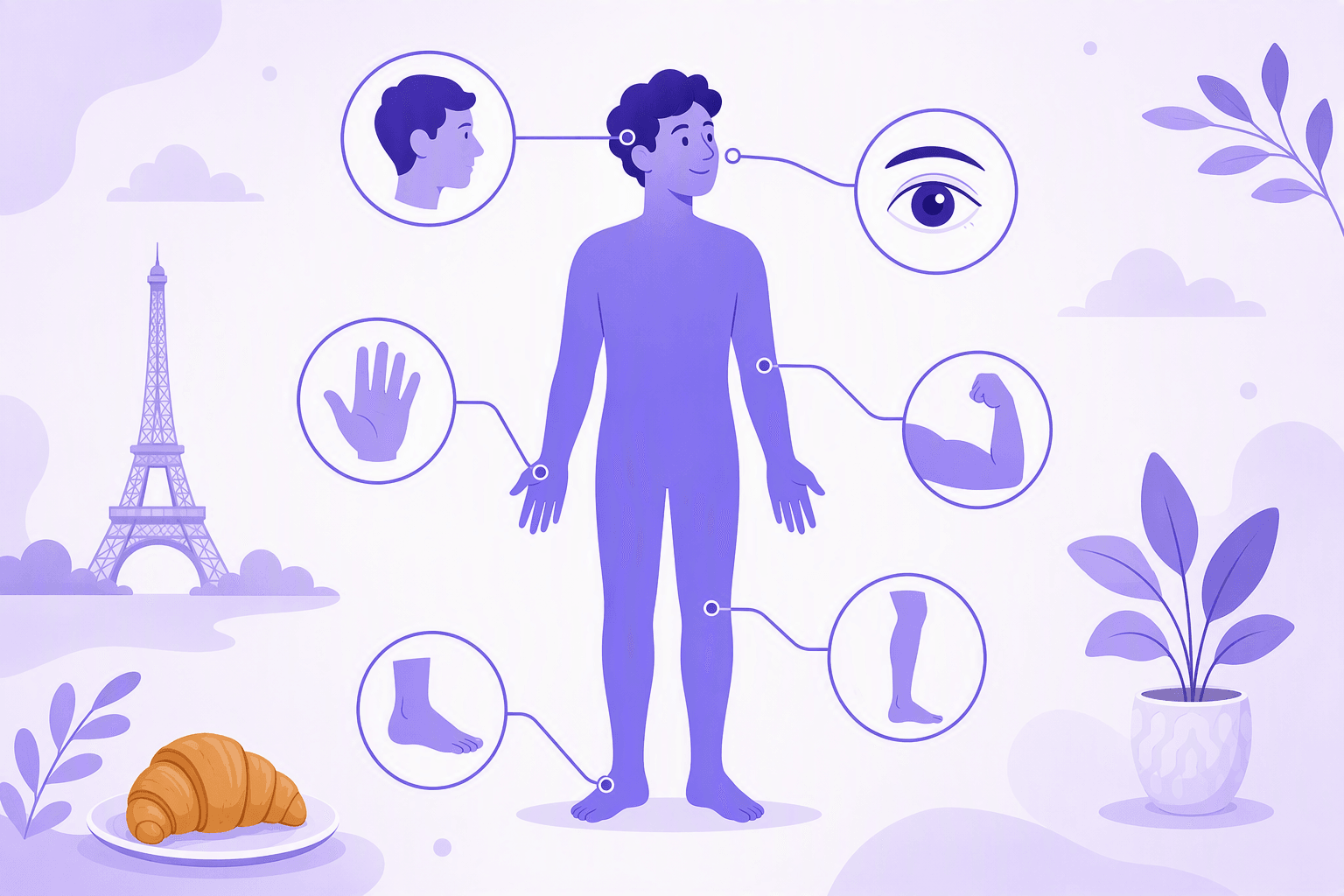
Head and Face
The head and face account for the densest cluster of body vocabulary in French. Pay special attention to l'œil / les yeux, one of the most irregular noun forms in the entire language.
| English | French | Pronunciation | Note |
|---|---|---|---|
| Head | la tête (f) | lah teht | Also means 'mind, top' |
| Face | le visage (m) | luh vee-ZAHZH | Also 'la figure' (informal) |
| Eye | l'œil (m) | luh-yuh | Plural: les yeux (irregular!) |
| Ear | l'oreille (f) | loh-RAY | Plural: les oreilles |
| Nose | le nez (m) | luh neh | Silent 'z' in singular |
| Mouth | la bouche (f) | lah boosh | Used in many idioms |
| Tongue | la langue (f) | lah lahngg | Also means 'language' |
| Tooth | la dent (f) | lah dahn | Plural: les dents |
| Lip | la lèvre (f) | lah LEH-vruh | Plural: les lèvres |
| Chin | le menton (m) | luh mahn-TOHN | |
| Forehead | le front (m) | luh frohn | Silent 't' |
| Cheek | la joue (f) | lah zhoo | Related to 'la bise' (cheek kiss) |
| Eyebrow | le sourcil (m) | luh soor-SEE | Silent 'l' |
| Hair | les cheveux (m pl) | leh shuh-VUH | Always plural; a single hair = un cheveu |
💡 L'œil → Les yeux: French's Most Famous Irregular Plural
The shift from l'œil (one eye) to les yeux (eyes) is one of the most dramatic plural changes in French. It descends from the Latin oculus (singular) and oculi (plural), which evolved along separate phonetic paths over centuries. There is no pattern to apply here; simply memorize both forms. You will encounter les yeux far more frequently than l'œil in everyday speech.
Key Medical Phrases for Head and Face
When communicating with a doctor or pharmacist in a French-speaking country, these constructions are essential:
- J'ai mal à la tête (zhay mahl ah lah teht): "I have a headache"
- J'ai mal aux yeux (zhay mahl oh zyuh): "My eyes hurt"
- J'ai mal aux dents (zhay mahl oh dahn): "I have a toothache"
- Mon nez saigne (mohn neh sehn-yuh): "My nose is bleeding"
The core construction is avoir mal à (to have pain at) + definite article + body part. Note the contractions: à + le = au, à + les = aux. So "my back hurts" is J'ai mal au dos (not à le dos).
Upper Body and Torso
Torso vocabulary appears frequently in medical consultations and physical descriptions. Several of these words have unexpected genders that must be memorized.
| English | French | Pronunciation | Note |
|---|---|---|---|
| Neck | le cou (m) | luh koo | Short word, often confused with 'le coup' (blow) |
| Shoulder | l'épaule (f) | leh-POHL | Plural: les épaules |
| Chest | la poitrine (f) | lah pwah-TREEN | Also 'le torse' for male chest |
| Back | le dos (m) | luh doh | Silent 's' |
| Stomach | l'estomac (m) | lehs-toh-MAH | Silent 'c'; belly = le ventre |
| Waist | la taille (f) | lah tah-yuh | Also means 'size' |
| Hip | la hanche (f) | lah ahnsh | Silent 'h' |
| Rib | la côte (f) | lah koht | Also means 'coast' and 'hill' |
🌍 Le Ventre vs. L'estomac
While l'estomac is the anatomical stomach, French speakers overwhelmingly use le ventre (belly/abdomen) in everyday speech. J'ai mal au ventre is far more common than J'ai mal à l'estomac. The word ventre covers a broader area and is used for any abdominal discomfort, pregnancy references, and informal body descriptions.
Medical Phrases for the Upper Body
- J'ai mal au dos (zhay mahl oh doh): "My back hurts"
- J'ai mal au ventre (zhay mahl oh vahn-truh): "My stomach hurts"
- J'ai mal à la poitrine (zhay mahl ah lah pwah-TREEN): "My chest hurts" (seek immediate help)
- J'ai des nausées (zhay deh noh-ZEH): "I feel nauseous"
Arms and Hands
Arm and hand vocabulary is essential for everyday French. The word la main (hand) appears in an extraordinary number of idioms and fixed expressions.
| English | French | Pronunciation | Note |
|---|---|---|---|
| Arm | le bras (m) | luh brah | Silent 's' |
| Elbow | le coude (m) | luh kood | Idiom: se serrer les coudes |
| Wrist | le poignet (m) | luh pwah-NYEH | Also means 'cuff' (of shirt) |
| Hand | la main (f) | lah mehn | Appears in dozens of idioms |
| Finger | le doigt (m) | luh dwah | Silent 'gt' |
| Thumb | le pouce (m) | luh poos | Also means 'inch' (old measure) |
| Nail | l'ongle (m) | lohn-gluh | Masculine! |
💡 Silent Consonants in Body Parts
French body vocabulary is full of silent final consonants: le bras (silent 's'), le doigt (silent 'gt'), le dos (silent 's'), le nez (silent 'z'), le front (silent 't'). These letters reappear in liaison when followed by a vowel: les bras ouverts (leh brah-zoo-VEHR). Mastering these silent endings is essential for correct pronunciation.
Body Part Idioms: Arms and Hands
French is extraordinarily rich in hand and arm idioms. Here are the most common:
- Avoir le bras long (to have the long arm): to have connections, to be well-connected
- Se serrer les coudes (to squeeze elbows together): to stick together, to support each other
- Avoir le cœur sur la main (to have the heart on the hand): to be generous
- Mettre la main à la pâte (to put the hand in the dough): to pitch in, to get involved
- En un tour de main (in a turn of the hand): in an instant
- Haut la main (hand up high): easily, hands down
Lower Body and Legs
Lower body vocabulary is critical for sports, medical descriptions, and understanding the many French idioms built around feet and legs.
| English | French | Pronunciation | Note |
|---|---|---|---|
| Leg | la jambe (f) | lah zhahmb | |
| Thigh | la cuisse (f) | lah kwees | |
| Knee | le genou (m) | luh zhuh-NOO | Plural: les genoux (add -x) |
| Shin | le tibia (m) | luh tee-bee-AH | Named after the bone |
| Calf | le mollet (m) | luh moh-LEH | |
| Ankle | la cheville (f) | lah shuh-VEE-yuh | Also means 'peg, pin' |
| Foot | le pied (m) | luh pyeh | Plural: les pieds |
| Toe | l'orteil (m) | lor-TAY | Or 'le doigt de pied' |
| Heel | le talon (m) | luh tah-LOHN | Talon d'Achille = Achilles' heel |
Lower Body Idioms
- Casser les pieds à quelqu'un (to break someone's feet): to annoy someone
- Avoir bon pied, bon œil (to have good foot, good eye): to be in good shape
- Mettre les pieds dans le plat (to put feet in the dish): to put your foot in your mouth
- Être sur pied (to be on foot): to be up and about, to be operational
- Faire du genou (to do the knee): to play footsie under the table
💡 Genoux: One of the -oux Plurals
Le genou becomes les genoux in the plural, with an -x ending instead of -s. It belongs to the famous group of seven French nouns ending in -ou that take -x in the plural: bijou, caillou, chou, genou, hibou, joujou, and pou. All other -ou nouns simply add -s.
Internal Organs
Internal organ vocabulary is particularly important for medical communication. The Organisation internationale de la Francophonie notes that French serves as the primary medical language in 29 countries across four continents.
| English | French | Pronunciation | Note |
|---|---|---|---|
| Heart | le cœur (m) | luh kuhr | Also 'darling' (mon cœur) |
| Brain | le cerveau (m) | luh sehr-VOH | |
| Lung | le poumon (m) | luh poo-MOHN | Plural: les poumons |
| Liver | le foie (m) | luh fwah | Foie gras = fatty liver |
| Kidney | le rein (m) | luh rehn | Plural: les reins (also means 'lower back') |
| Bone | l'os (m) | lohs (sg) / leh-zoh (pl) | Pronunciation changes in plural! |
| Blood | le sang (m) | luh sahn | Silent 'g' |
| Skin | la peau (f) | lah poh | |
| Muscle | le muscle (m) | luh moos-kluh |
🌍 Les Reins: Back Pain or Kidney Pain?
In everyday French, les reins (the kidneys) is commonly used to mean "the lower back." When someone says J'ai mal aux reins, they usually mean lower back pain, not a kidney problem. In medical contexts, les reins specifically refers to the kidneys. This dual meaning can cause confusion, so doctors may ask mal aux reins ou au dos? to clarify.
Essential Medical Phrases With Organs
- J'ai mal au cœur (zhay mahl oh kuhr): "I feel sick to my stomach" (NOT "my heart hurts," this is a common trap!)
- Mon cœur bat très vite (mohn kuhr bah treh veet): "My heart is beating very fast"
- J'ai mal aux reins (zhay mahl oh rehn): "My lower back hurts"
- Je me suis cassé un os (zhuh muh swee kah-SEH uhn ohs): "I broke a bone"
⚠️ J'ai mal au cœur Does NOT Mean 'My Heart Hurts'
This is one of the most important false friends in French medical vocabulary. J'ai mal au cœur means "I feel nauseous / I feel sick," NOT "my heart hurts." If you actually have chest or heart pain, say J'ai une douleur à la poitrine or J'ai mal à la poitrine. Getting this wrong could delay critical medical care.
The Avoir Mal Construction: Expressing Pain in French
The core pattern for describing pain in French uses avoir mal à (to have pain at):
| English | French | Literal Translation |
|---|---|---|
| My head hurts | J'ai mal à la tête | I have pain at the head |
| My eyes hurt | J'ai mal aux yeux | I have pain at the eyes |
| Does your stomach hurt? | Tu as mal au ventre ? | You have pain at the belly? |
| His legs hurt | Il a mal aux jambes | He has pain at the legs |

Remember the contractions: à + le = au, à + les = aux. The body part keeps its definite article, not a possessive adjective. This pattern applies universally across all body parts.
Body Part Idioms Native Speakers Actually Use
French is celebrated for its body-part idioms. The Académie française's dictionary contains hundreds of fixed expressions built around tête, cœur, main, and other body words. Here are the most frequently used in conversation and in French films and TV:
- Coûter les yeux de la tête (to cost the eyes from the head): to be outrageously expensive
- Avoir la tête dans les nuages (to have the head in the clouds): to be a daydreamer
- Donner sa langue au chat (to give one's tongue to the cat): to give up guessing
- Avoir l'estomac dans les talons (to have the stomach in the heels): to be starving
- Faire la sourde oreille (to do the deaf ear): to turn a deaf ear
- Garder la tête froide (to keep the head cold): to keep a cool head
"French idiomatic expressions built on body-part metaphors reveal a systematic mapping of physical experience onto abstract thought that has remained remarkably stable since the Middle Ages."
(Académie française, Dictionnaire, 9th edition)
Practice Body Parts With Real French Content
Building vocabulary from organized tables is an excellent start, but encountering these words in authentic French conversation is what drives long-term retention. French cinema and television provide natural, repeated exposure to body vocabulary, from medical dramas to comedies to thrillers.
Wordy lets you watch French content with interactive subtitles. Tap on any body-part word to see its gender, pronunciation, and meaning in real time. Instead of memorizing from lists alone, you absorb la tête, le cœur, and les yeux naturally, the way native speakers encounter them.
Explore our blog for more French guides, or visit the best movies to learn French for viewing recommendations that bring this vocabulary to life.
Frequently Asked Questions
What are the most common body parts in French?
How do you say 'my head hurts' in French?
Why does French use 'les' instead of 'my' with body parts?
What is the plural of 'l'œil' in French?
What are some French idioms that use body parts?
How do you describe symptoms to a French doctor?
Sources & References
- Académie française, Dictionnaire de l'Académie française, 9th edition
- Organisation internationale de la Francophonie, La langue française dans le monde, 2024
- Ethnologue: Languages of the World, French language entry (2024)
- Grevisse, M. & Goosse, A. (2016). Le Bon Usage, 16th edition. De Boeck Supérieur.
- World Health Organization, Multilingual Health Phrase Guide (2023)
Start learning with Wordy
Watch real movie clips and build your vocabulary as you go. Free to download.


